
Alabama to receive more than $137,000 in credit reporting settlement
Alabama will receive more than $137,000 in a multistate settlement over a dispute about credit reporting errors. State Attorney General Luther Strange said in a statement Wednesday that Alabama will receive $137,018 in a settlement with national credit reporting agencies Equifax Information Services LLC, Experian Information Solutions Inc., and TransUnion LLC. The settlement requires the agencies to move more quickly to fix disputed information on credit reports, wait longer before adding items and more carefully scrutinize certain data they’re furnished with by collection agencies and others. Officials say the settlement calls for the agencies to pay 31 participating states $6 million for costs associated with an investigation into consumer complaints about credit reporting errors. Strange says the settlement will mean better service for consumers in Alabama and elsewhere. Republished with permission of The Associated Press.
Group rallies against state abortion bills

A crowd of about 100 people rallied outside the Alabama Statehouse on Wednesday to protest legislation they say would close abortion clinics or attempt to outright ban most abortions. Planned Parenthood Southeast organized the rally as lawmakers consider three abortion bills, including one that would ban abortions once a fetal heartbeat is detected, which can happen as early as six weeks into a pregnancy “We want them to step out of the exam room. Let the women of the great state of Alabama make the decisions for themselves as to how they are going to take care of themselves,” said Dr. Didi Saint-Louis, the medical director at Planned Parenthood Southeast. Nikema Williams, vice president of public policy for Planned Parenthood Southeast, said the bill would ban abortion as early as six weeks into pregnancy, often before a woman might know she’s pregnant. The fetal heartbeat law would be a direct conflict to the U.S. Supreme Court decision that legalized abortion. A federal judge ruled a similar North Dakota law unconstitutional and Saint-Louis predicted a similar result in Alabama. “Try as they may, they do not have the right to dismantle Roe v. Wade,” Saint-Louis said of lawmakers. The bill’s sponsor, Republican Rep. Terri Collins of Decatur, has said she thinks another court might rule differently. Collins has said she thinks it is “common sense” to define the start of life with a heartbeat because death is defined by the absence of a heartbeat. Lawmakers are also considering a bill that would prohibit an abortion clinic from being located within 2,000 feet of a public school. The bill is aimed at a Huntsville clinic across the street from a school. However, Williams said, the bill could close all but one of the state’s five abortion clinics because the definition of “school” could include universities. The bills have cleared a House committee but have not had a vote on the House floor. Republished with permission of The Associated Press.
10’s a crowd? GOP prepares for double digits on debate stage
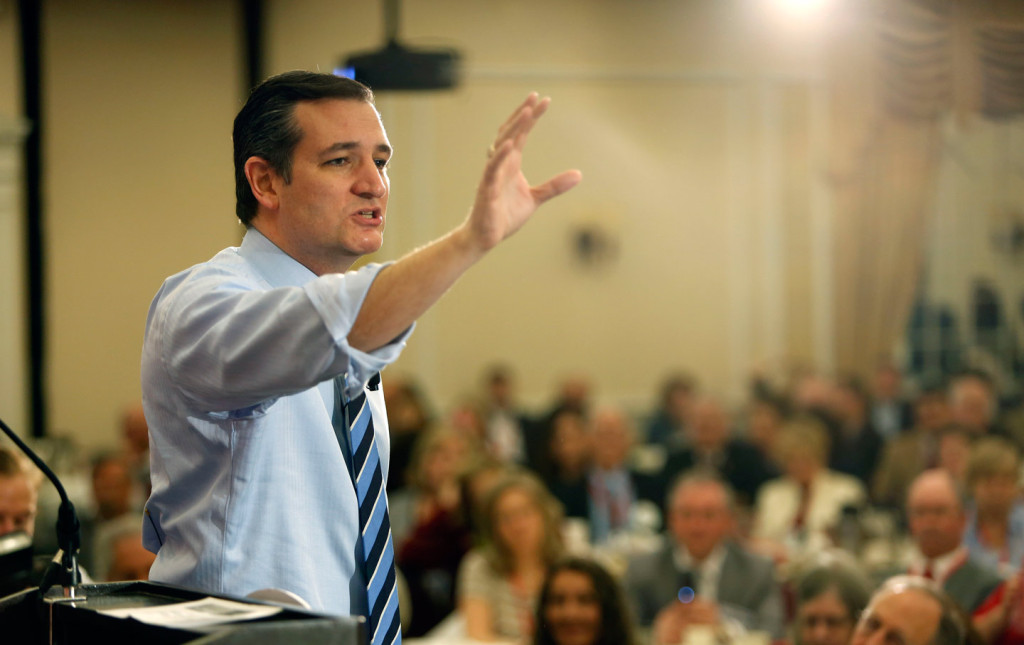
The first Republican presidential debate will feature no fewer than 10 candidates. That’s according to guidelines released Wednesday by debate hosts Fox News and Facebook, which offer the first clues as to how the GOP will handle its largest presidential class in recent memory. Party officials have been working privately in recent weeks to prevent its first debate in August from becoming a nationally televised circus, while lesser-known candidates have been lobbying for access. Only announced candidates will be allowed to participate, according to the new guidelines. Participation will be limited to those who “place in the top 10 of an average of the five most recent national polls, as recognized by Fox News.” More than 10 candidates would be allowed on the debate stage in the event of a tie. At least 15 high-profile contenders are expected to compete for a spot, a group likely to include eight current or former governors, four senators, two accomplished business executives and a renowned neurosurgeon. There will be winners and losers under the new system. The winners could include the likes of Donald Trump, a businessman and reality television star who has already launched a presidential exploratory committee. While some party officials were reluctant to grant him a spot on stage should he run, he has placed within the top 10 in most recent polls. The losers could include statewide office holders who have struggled to gain national traction. Those on the bubble include former Texas Gov. Rick Perry, Louisiana Gov. Bobby Jindal, 2012 presidential candidate Rick Santorum, Ohio Gov. John Kasich, and former technology executive Carly Fiorina, the only woman in the Republican field. Their roads to the White House would be even steeper without the opportunity to stand out in a nationally televised debate. “I’ll look forward to making the cut and making my case to GOP voters on Aug. 6,” Fiorina wrote on Twitter. Several candidates have lobbied Republican officials in recent weeks to consider creative options, including debate “heats” featuring seven or eight candidates at a time on consecutive nights. CNN, which plans to hold a GOP debate in September, said Wednesday it will divide its event into two parts: one featuring the 10 highest-polling candidates, the other including “candidates who meet the minimum threshold of 1 percent in public polling but are ranked outside the top 10.” Republican National Committee Chairman Reince Priebus said, “We support and respect the decision CNN has made.” For its August debate, Fox News also promised to provide “additional coverage and air time … to those candidates who do not place in the top 10,” according to Michael Clemente, the network’s executive vice president of news editorial. There will be 12 GOP presidential debates between August and March, with the first scheduled for Aug. 6 in Cleveland. The moderators for the first meeting include Fox anchors Bret Baier, Megyn Kelly and Chris Wallace. Republished with permission of The Associated Press.
Gulf oil leak records cannot be kept secret, U.S. judge says

A federal magistrate judge has rejected a company’s bid to preserve the confidentiality of numerous emails and reports about its failed efforts to halt a Gulf of Mexico oil leak 10 years ago. The documents could be evidence in a lawsuit that environmental groups filed against Taylor Energy Co., which owned a platform that toppled during Hurricane Ivan in 2004. An Associated Press investigation recently revealed evidence that the leak at the site of the toppled platform is worse than Taylor or government regulators had publicly reported. U.S. Magistrate Judge Karen Wells Roby rejected arguments Wednesday by Taylor lawyers who said the documents contain valuable trade secrets. Taylor can ask to a district judge to review Wells Roby’s ruling. The AP has filed a public records request for some of the same confidential records. Republished with permission of The Associated Press.
Obama: Climate change will harm national security

President Barack Obama is framing the challenges of climate change as a matter of national security that threatens to aggravate poverty and political instability around the globe and jeopardize the readiness of U.S. forces. “Make no mistake, it will impact how our military defends our country,” the president says in excerpts of a commencement address prepared for delivery Wednesday at the U.S. Coast Guard Academy in New London, Conn. “And so we need to act and we need to act now.” The president in recent months has pressed for action on climate change as a matter of health, as a matter of environmental protection and as a matter of international obligation. He’s even couched it as a family matter, linking it to the worry he felt when one his daughters had an asthma attack as a preschooler. His speech to the cadets, by contrast, is focused on what the Obama administration says are immediate risks to national security, including contributing to more natural disasters that result in humanitarian crises and potential new flows of refugees. Further, the president sees climate change aggravating poverty and social tensions that can fuel instability and foster terrorist activity and other violence. Obama said the cadets would be part of the first generation of officers to begin their service in a world where it is increasingly clear that “climate change will shape how every one of our services plan, operate, train, equip and protect their infrastructure.” His prepared remarks said climate change “is not just a problem for countries on the coast or for certain regions of the world. Climate change impacts every country on the planet.” As for the impact in the U.S., Obama pointed to streets in Miami and Charleston, S.C., that flood at high tide and to military bases across the country already feeling negative effects. “Around Norfolk, high tides and storms increasingly flood parts of our Navy base and an air base,” Obama said of military facilities in Virginia. “In Alaska, thawing permafrost is damaging military facilities. Out West, deeper droughts and longer wildfires could threaten training areas our troops depend on.” With the Republican-led Congress indifferent to Obama’s entreaties, the president has been doing what he can to combat climate change through executive orders to cut greenhouse gas emissions and through the powers of persuasion. But his climate change agenda has drawn strong political opposition and a number of legal challenges. Many of the GOP presidential candidates for 2016 have said that taking unilateral steps to address climate change could hurt the U.S. economy. Obama’s appearance at the Coast Guard Academy was to be his second and last commencement address of the season after speaking earlier this month at a community college in South Dakota. The president traditionally delivers a commencement address every year to one of the service academies. Later Wednesday, he was visiting Stamford, Conn., for a Democratic fundraiser at a private home, with about 30 supporters contributing up to $33,400 each. Republished with permission of The Associated Press.
Alabama House panel debates cap on title loan interest rates
Alabama title loan companies could see a 36 percent cap on the interest rates they’re allowed to charge consumers under legislation under consideration in the House. The House financial services committee heard public arguments Wednesday about tightening regulations of subprime loans that use cars and other assets as collateral. House Bill 400 requires title lending companies to be licensed by the state and adhere to state-level restrictions on the charges, interest, and fees associated with title loans. The Federal Deposit Insurance Corporation estimates that 1.1 million households used auto title loans in 2013. Alabama lenders are allowed to charge 25 percent per month for an auto title loan, translating to as much as 300 percent on a yearly basis. “We’re talking about an industry that doubles its money three times on an annual basis,” bill sponsor Rep. Rod Scott said. “We know that’s not appropriate. From the consumer’s perspective, that’s usury.” Scott said he brought the bill because of concern over what he describs as unfair practices and predatory lending to Alabama’s poorest households. The result, he said, is that people have to ask family, churches or nonprofit groups for help to pay off the loans. “You can’t borrow your way out of debt, especially when the interest rates are so onerous,” Scott said. Osjha Domenicone, head of government affairs for title loan company Select Management Resources, said her company has had only two complaints in five years. “Other states that have passed price restrictions like the ones in this bill have seen an increase in complaints because their citizens are left with nothing but unregulated, unaccountable online lenders,” she said. “I assure you, a 36 percent cap does eliminate the industry and this access to credit … I have a difficult time understanding why my customers and employees should suffer over two complaints in five years.” Stephen Stetson from Alabama ARISE argued that in the 25 states without a title loan presence, consumers can still access credit through traditional banking. Several members expressed concern over imposing regulation at the state level, when the federal Consumer Financial Protection Bureau is expected to take action on payday and title lending this year. “Anything we do is just going to get overturned at the federal level,” Rep. Mike Hill said. The panel declined to vote on House Bill 400 Wednesday. Stetson said that with just seven days left in the regular session, that decision would mean another year of predatory lending for Alabama consumers. “We’re looking at a long off-season where more people are going to get their cars repossessed or get trapped in more loans,” Stetson said. “It’s a shame that 67 bill co-sponsors – which is enough (votes) to get it passed on the House floor – wasn’t enough to get this bill through committee.”
Mike Rogers: CMP could sell vintage firearms
As many of you across east Alabama may have seen or heard in the news: The National Defense Authorization Act recently passed the U.S. House of Representatives with my strong support. This critical piece of legislation outlines how Congress will support our nation’s military. I was relieved to see that Congress increased the overall authorized funding for our nation’s military. Several key provisions important to east Alabama made it into the bill. The first was a commitment to help protect jobs at important military facilities like the Anniston Army Depot, one of the Army’s most productive and efficient facilities. Folks across east Alabama may remember a few years ago when the depot had to furlough some workers because of the Pentagon’s poor budget management. The new provision would protect facilities like the depot that operate under the Working Capital Fund from being forced to furlough workers in order to meet arbitrary budget demands from the Pentagon. Another was my amendment to allow the Army to transfer its surplus vintage firearms to the Civilian Marksmanship Program (CMP) which has its southern headquarters in Anniston and will soon have the CMP park open in June in Talladega County. If you’re a gun owner like I am, you may be familiar with the M1911A1. This iconic pistol used to serve as the standard U.S. armed forces sidearm, until it was replaced by the Berretta 9mm pistol. Although a few thousand of these pistols have been sold to foreign countries for a small fee, the remainder are in storage. That costs the taxpayer about $200,000 a year. As a strong supporter of Second Amendment rights, I believe this bill is a common-sense approach to not only save the taxpayer money, but to allow gun collectors to add this vintage pistol to their collection. It is my hope that both provisions will stay in the bill as the process moves forward in the Senate. I also hope the administration will ultimately support them. Providing for our national defense is a top priority to keep our country safe and our defenses strong. Mike Rogers represents Alabama’s 3rd Congressional District. He’s in his eighth term. You can sign up for his e-Newsletter at www.mikerogers.house.gov.
Alabama members call for longer-term transportation planning after trust fund vote
The U.S. House has passed H.R. 2353 — a bill approving temporary funding for the nation’s federal transportation trust fund for two months beyond an impending statutory cutoff — with the support of U.S. Reps. Bradley Byrne and, somewhat more surprisingly, Terri Sewell. But that didn’t stop either from expressing displeasure at the short-term nature of the bill passed Tuesday, a result of ongoing gridlock over myriad issues in the House. Byrne and Sewell, who respectively represent Alabama’s 1st and 7th Congressional Districts, each issued statements Tuesday evening saying a more predictable and comprehensive approach is required for maximum public good. “It is sometimes hard in Washington for Republicans and Democrats to find common ground, but both sides agree we need a long-term, reliable funding stream for the Highway Trust Fund,” Byrne said in his news release. “While I voted for today’s short term extension, I will not continue to support kicking the can down the road and putting off difficult decisions. Funding our nation’s highway system is a fundamental responsibility of Congress, and it is time we get serious about finding a solution. I intend to be a constructive participant in that process.” Sewell — breaking with most of her caucus, which opposed the measure — echoed those statements after her “yea” vote Tuesday afternoon. “The Highway Trust Fund Extension is nothing more than a Band-Aid. It’s disappointing that Congress is no closer to drafting a long-term solution to invest in our nation’s roads, bridges, and rails than we were this time last year,” Sewell said in her written statement. “Our nation’s investment in infrastructure is woefully inadequate to the detriment of our constituents.” “In Alabama, deteriorating roads cost motorists approximately $1.2 billion a year. Across our country, an estimated one in three fatal traffic accidents is caused by roads that are in poor or mediocre condition, and the American Society of Civil Engineers estimates that one out of every nine bridges in the U.S. is structurally deficient.” Sewell ended, however, on a hopeful note. “By building the infrastructure of tomorrow, we would also create thousands of good-paying jobs that help more hard-working Americans earn a living.”
