
Federal judge Mark Fuller resigns amidst domestic violence allegations

According to various news reports, an Alabama federal court judge accused of domestic violence has delivered his resignation to President Barack Obama. AL.com is reporting that attorneys for U.S. District Court Judge Mark Fuller have confirmed the judge’s resignation effective August 1st. Last summer, Judge Fuller was arrested for alleged battery of his wife, Kerri Fuller. Several members of Congress have urged a thorough investigation of the case, including U.S. Congresswoman Terri Sewell who has called for the federal judge’s impeachment. In a written statement following Judge Fuller’s announcement, the Congresswoman had this to say: “News of Judge Fuller’s impending resignation is a welcome outcome to a very painful breach of the public trust. His resignation will be the culmination of a drawn out process that was woefully unnecessary. The public trust was violated the moment his wife phoned the police. “Justice was not served. We sent the wrong message to victims of domestic violence by allowing a federal judge to collect a paycheck — without managing a caseload — and ultimately having his record expunged. “Fuller failed to uphold our most fundamental values. Perhaps the only consolation is that he has chosen to spare his family and our nation of the expense of a drawn out impeachment process.”
House speaker warns against chasing “phantom” funds in state budget
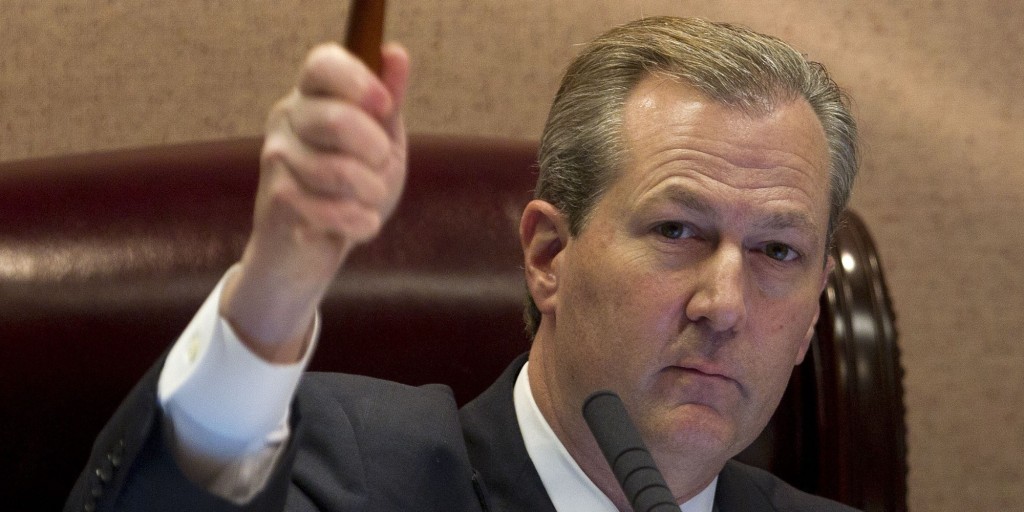
In recent weeks, proposals to tackle state budget reform have floated through the Statehouse as lawmakers explore options to correct Alabama’s fiscal woes. The argument, according to Sen. Gerald Dial who wrote the most recent reform bill, is that the state has enough money to pay its expenses if only lawmakers weren’t bound by earmark provisions and the walled-off nature of the education and general fund budgets. Dial explained the situation just before the Senate finance and taxation committee voted on Senate Bill 502. “I’ve heard it said that one of the problems we’ve got in this state is that we’ve got earmarking,” Dial said. “We’ve got almost $3 billion in Heritage Trust Fund. Just think what we could do [with that money]. Without earmarks, there’s enough funding in this state to fund government for more than five or 10 years.” That’s an issue House Speaker Mike Hubbard seems willing to explore. This week, Hubbard announced a new Commission on Earmarking and Budget Reform to study the state budget process, including earmarking, appropriations, spending oversight, and the fact that Alabama is one of only three states with two separate budgets. That commission’s findings won’t be available to lawmakers until the 2016 legislative session. Meanwhile, Hubbard is raising concerns about pursuing “phantom” money when considering proposals to unify the state budget. In a recent radio interview, Hubbard explained his position on efforts to pull the reported $300 million to $400 million surplus in education funding to ease pressure on the general fund. Unifying the budget “doesn’t create more money in the immediate term,” Hubbard said. “And the only way that is going to fix anything is if we were spending too much money on education. I don’t think we’re spending too much money on education. We have put some measures in place […] — the Rolling Reserve Act — that forced this Legislature and future Legislatures to have the discipline to not spend every amount of money that we think we’re going to have.” In a presentation to lawmakers in March, the Legislative Fiscal Office projected a $287 million surplus in the Education Trust Fund and a $290 million shortfall in the General Fund. Some have questioned whether the practice of claiming tax revenue for the Education Trust Fund – then creating a barrier between the education and General Fund – is the root cause of the state’s current budget shortfall. Senate Bill 502 would create a single state budget and remove earmarks within the budget so that lawmakers and agencies could prioritize expenses. Several lawmakers, including Sens. Cam Ward and Rodger Smitherman, have raised concerns that a unified budget would allow Medicaid and corrections expenses — currently walled-off in the Alabama General Fund — to eat through funding for public schools. According to Hubbard, those concerns are valid because the surplus isn’t there. “That’s just money we created that we’re not going to appropriate,” he said. “If you take that and move it over, that violates the principle that we were saying: that we’re not going to be like the Democrats and spend more money than we have. “That so-called surplus? It’s phantom money,” Hubbard said. “This is money that is projected that we will have. It’s not sitting in a bank somewhere, this is money we think is going to come in between now and the end of the next fiscal year.” As lawmakers prepare for a possible Special Session, Hubbard cautioned against relying on an education surplus for long-term budget planning. “There’s some in our House who think we ought to do that — particularly the new guys who just came in. […] Anything above the cap, we said we would spend on nonrecurring capital expenses or one-time expenses because we don’t know whether it’s going to be there the next year or not. To get the General Fund dependent on that money is doing nothing to solve the long-term problem.”
John McMillan: Global trade vital to Alabama ag, industry

As Agriculture & Industries Commissioner, I work closely with the Alabama farming and business communities to grow the economy and create prosperity for our state. This provides firsthand knowledge that one of the most important factors in generating this kind of growth and prosperity is international trade. That’s why Congress needs to take a bold step and pass Trade Promotion Authority (TPA). TPA has been in the national news quite a bit lately, and garnered a fair share of controversy. But much of what one reads or hears about TPA is misleading or misinformed. Heated rhetoric aside, TPA is nothing more than an agreement between Congress and a U.S. president as to how they will work together to negotiate, consider, and vote on international trade agreements. TPA allows both branches of the federal government to participate in trade development and set up an expedited process for trade deals. TPA does not take power away from Congress and give it to President Barack Obama. Presidents can negotiate trade deals any time they want — with or without TPA, they still need Congressional approval of any trade deal they negotiate. In fact, TPA provides for more oversight of and transparency from the administration, and gives Congress a voice in the entirety of the process, instead of just a vote at the end. TPA also makes sure the public has its say by requiring any agreement to be published for public review 60 days before it can be finalized. Why is TPA necessary? Because Congress is Congress, and no matter how beneficial a trade agreement would be for the nation, there will always be one or two legislators who have a political axe to grind who will hold up the process. TPA makes sure the narrow interests of the very few don’t trump the broad interests of the very many. In doing so, it lets our potential trade partners know they can rely on the terms of the agreements they negotiate with a president and that they will not be changed or unduly delayed by a highly politicized Congress. That’s why it is so important to get TPA back on the books for our state. Alabama is a major exporter, and our farms and businesses count on new global markets to grow their businesses and create jobs. Without TPA, we cannot finalize the kinds of deals that open up these markets. TPA is not some abstract federal legislative issue — it has a direct impact on Alabama’s economy and the 90,000 jobs supported by Alabama exports. Recently, U.S. Trade Representative Michael Froman described Alabama as an “exporting powerhouse,” and said that Alabama “exports are supporting well-paying jobs.” These are not understatements: In 2014, Alabama exported $19.5 billion in goods. In 2013, almost 4,000 companies exported from the state, more than 80 percent of which were small- and medium-sized companies. It’s no surprise, then, that a recent poll found that an overwhelming majority of Alabamians support free trade. Last week the U.S. Senate voted in favor of TPA with a strong, bipartisan majority. I strongly urge Reps. Robert Aderholt, Gary Palmer and Terri Sewell — as well as the rest of Alabama’s congressional delegation — to support TPA as it moves through the U.S. House of Representatives. John McMillan is the Commissioner of Agriculture & Industries for the state of Alabama. You may contact him at john.mcmillan@agi.alabama.gov.
Martha Roby: Next generation of military leaders

One of my favorite parts of serving in Congress is the honor and responsibility I have to nominate young men and women for an appointment to our nation’s military academies. Each year, my office conducts a rigorous process by which applicants are reviewed and interviewed by an independent panel of service academy alumni. Our service academies are some of the most prestigious institutions in the world. Appointments are highly sought after and require high academic, character and leadership standards. Those appointed must commit to serve in the military for a minimum of five years upon graduation. Once the panel has made its selections, I have the privilege of calling the students to personally inform them of their nomination to a U.S. military academy. It is an honor to be the first to thank these courageous students for their willingness to serve their country and to wish them the best on this exciting endeavor. Below are students who were nominated through my office and have received appointments to U.S. military academies for 2015. I join their families, teachers and friends in congratulating them on such a momentous accomplishment. Matthew Dunlap, Enterprise: U.S. Air Force Academy. Son of William J. Dunlap, student at the U.S. Air Force Academy Preparatory School. Alvaro Nicholas Flores, Ozark: West Point. Son of Alvaro and Kimberly Flores, student at Carroll High School Hunter Rowan Godwin, Dothan: West Point. Son of Joseph and Patricia Godwin, student at Providence Christian School. Jesse Cornelius Anthony Haggerty, IV, Eufaula: U.S. Air Force Academy. Son of Jesse and Angela Haggerty, student at the Lakeside School. Baxter J. Hodge, Montgomery: West Point. Son of Ray and Deana Hodge, student at Eastwood Christian School. Shawn N. Paris, Jr., Fort Rucker: U.S. Naval Academy. Son of Shawn and Jennifer Paris, student at Carroll High School. Leo Alfred Petters, Montgomery: U.S. Naval Academy. Son of Brian and Vicki Petters, student at Montgomery Catholic Preparatory School. Pearce Anthony Phinney, Prattville: U.S. Naval Academy. Son of Col. Todd and Sharon Phinney, student at Prattville Christian Academy. Jesse Ariel Ramire, Daleville: West Point. Son of Berny and Peta Ramirez, student at the Alabama School of Math and Science in Mobile. Again, I want to congratulate these students on this special achievement. If you or a someone you know is interested in knowing more about seeking a nomination to a military academy, please visit my website at https://roby.house.gov/serving-you/military-academy-nominations. Martha Roby represents Alabama’s 2nd Congressional District. She is in her third term.
Gov. Robert Bentley makes 9 appointments this week
This is the first of a regular column on Alabama Today listing Gov. Robert Bentley’s recent appointments and most current list of vacancies for boards and commissions. Before we get into the most recent appointments I wanted to start by introducing the appointments process and staff. The current staff includes Lyndsey Stewart as the director of appointments and Will Edwards as the assistant director of appointments and scheduling. According to her LinkedIn profile, Stewart, a 2004 graduate of the University of Alabama, joined the governor’s office in September 2013 as his director of appointments. Prior to that she worked for two years as governmental affairs coordinator at Maynard, Cooper & Gale P.C. and has more than five years professional experience before then. According to the list of vacancies, “The Appointments Office supports the Governor in meeting his major obligation to appoint qualified, representative and appropriate people to positions on regulatory and licensing boards and commissions, university trustees, advisory boards and task forces. We are continually looking for qualified candidates to serve on 450+ boards and commissions that oversee a large variety of industries and make decisions that affect the day-to-day lives of Alabamians.” The office’s statement goes on to say, “We are always glad to hear from you, and appreciate your input on the appointments process. Interested candidates may submit their resume/bio to appointments@governor.alabama.gov.” According to the governor’s office, this past week these appointments have been made: Alabama Historical Commission State Historic Preservation Officer (acting): Lisa Jones 911 Board CMRS 1: C. Wayne Hutchens VoIP Services 1: Robert Smith Jasper Civil Service Board Member: Roger D. Wilson State Textbook Committee: Science 6thCongressional District: Jo Chambers Mental Health Board of Trustees Congressional District 1: Wade B. Perry Jr. Congressional District 2: The Honorable Jim Perdue Congressional District 7: Reverend David L. Bennett Sr. Motorsports Hall of Fame State At-Large: Duane Stephens
Alabama Power launches Alabama NewsCenter

Alabama Power has launched a new website Alabama NewsCenter. The site will provide original news content from across the state with sections for business, community, innovation and weather. According to the Alabama Messenger, the site launched on Wednesday and will be led by veteran reporter Mike Tomberlin. Tomberlin is quoted by the Messenger as saying, “Alabama NewsCenter will provide Alabama Power customers and the media with topical information about the state’s economic development efforts, business news, and stories about the people, places and events that make Alabama a great place to live, work and play.” According to Tomberlin’s Linkedin page, he was with The Birmingham News for 17 years. He was also a member of the Alabama Natgional Guard and blogged his experiences about Afganistan in a blog titled Yellowhammering Afghanistan (though I warn you if you click the link you may get lost in his great posts). The new site helps Alabama residents cut through the static of catch-all content that many news outlets and blogs post. It helps put useful content at readers’ fingertips, a mission we at Alabama Today can relate to. We hope to see our content linked to soon. (Hint, hint Mike) From the site’s “about us” page: Alabama NewsCenter is a credible, direct source of the news and information that matter most to Alabama Power customers. Alabama NewsCenter also tells the stories of the people and businesses powering our state, striving to make Alabama a wonderful place to live and work. In keeping with Alabama Power’s century of work in economic development, Alabama NewsCenter aims to promote the good news of this state through original and shared content. This site will spotlight businesses who have found success in Alabama, economic developers who work daily to grow jobs in this state, companies and entrepreneurs doing innovative things, communities that make our quality of life so much better and people doing things both great and small that make all the difference. The stories are intended to be shared by traditional media, blogs and social media outlets or enjoyed on this site to help promote the state – its businesses, its innovation, its people and its communities. We hope this is one of the sites you return to frequently to stay informed and inspired about the state we call home. We will be following the progress and growth of this page, and from one new site to another wish them the best of luck.
Education funding, school choice biggest wins this session, say lawmakers

According to House and Senate leaders, education reform and school choice were the brightest spots of the 2015 legislative session. In separate radio interviews on Friday, Senate President Pro Tem Del Marsh and House Speaker Mike Hubbard both said that investing in classrooms, expanding school choice, and supporting workforce readiness for community college students were among the biggest accomplishments by lawmakers this year. The $6 billion state education budget includes a $13 million increase for textbooks and more than $10 million for the Alabama’s nationally acclaimed Pre-K program. “I think this year’s education budget is the largest it’s ever been,” Marsh said. Marsh and Hubbard also pointed to the bill to authorize Alabama’s first charter schools as an accomplishment this session, calling it a step forward for students and parents. The new law creates public schools with the ability to develop curriculum and select teachers bound by contracts instead of regulations set by the state. Before this session, Alabama was one of only eight states without charter schools, according to the Alabama Coalition for Public Charter Schools. “We passed the charter school bill, which I think is a huge step forward for the state of Alabama,” Hubbard said. “And the budget that we passed for education puts more money in the classrooms.” Speaker Hubbard added that the biggest accomplishments weren’t only in the K-12 classrooms, adding that the state’s first commission to oversee Alabama’s 25 community and technical colleges could make a difference to future workforce prospects. “The change of governance for the two-year school system I think is a huge game changer for the state long term,” Hubbard said. “I think we’re putting more of a focus in the community colleges on workforce development and getting them out from underneath the K-12 school board — they have enough to worry about themselves. Getting a board that is business oriented that will support the chancellor and the mission of the two-year system in terms of creating the skills that we need in the state of Alabama.”
Alabama legislative week in review: May 26-28
The 26th legislative day ended with reports from House and Senate lawmakers that an August Special Session is likely in order to finish discussions on overcoming the states short-term and long-term budget shortfalls. Agenda items before lawmakers in August could include Senate President Pro Tem Del Marsh’s lottery and gaming proposal, various measures to increase state revenue, and a controversial proposal from Sen. Gerald Dial to eliminate earmarks and unify the education and general fund budgets. At a public hearing on Wednesday, agency chiefs outlined a list of horrible outcomes — from prison closures to shortages in mental health services — should the austere general fund budget come to fruition. Despite those concerns, lawmakers gave the budget proposal a favorable report by a vote of 13-0, moving the stripped-down budget closer to reality. Here is a quick week in review going through all of the major headlines from this week’s legislative agenda: Alabama lawmakers offered a final unanimous vote on a bill that would allow physicians to prescribe terminally ill patients promising, but unapproved medical treatments. House Bill 463, known as the Right to Try Act, allows doctors caring for people with terminal illnesses to prescribe medications that the Food and Drug Administration has deemed promising, but not yet ready for mass consumption. Thursday’s vote makes Alabama one of at least 12 states that have passed right to try legislation this year. • • • The Alabama House passed a bill to establish integrated care networks to allow more Medicaid recipients to stay in their homes instead of nursing homes. • • • The House also voted 68-26 to expand the Alabama Accountability Act and tighten restrictions on scholarships and the groups that distribute them.’ • • • Gov. Robert Bentley appointed the state’s first commission to oversee Alabama’s 25 community and technical colleges. Lawmakers say the eight-member commission will help schools to focus on developing more specialized training programs and preparing entry-level employees to meet growing workforce demands. • • • The House Judiciary committee offered a favorable report on House Bill 657, to ban employment discrimination on the basis of “immutable” characteristics that do not effect job performance. Bill sponsor Rep. Mike Ball said that the measure would protect differences in gender expression, gender identity and sexual orientation. The following day, lawmakers blocked House Bill 615, Rep. Chris England’s proposal to establish civil rights protections against any discrimination based on sexual orientation, gender identity, or familiar status.
Hillary Clinton to unveil platform in June campaign kickoff rally

Hillary Rodham Clinton will end weeks of smaller campaign events with a splashy rally designed to start her run for the White House that aides expect to cost over $1 billion, senior Clinton advisers said Thursday. The June 13 event — at a location still being kept quiet — aims to detail Clinton’s vision for the country in a higher-profile manner than the roundtables she’s held in early voting states since announcing her candidacy for the Democratic presidential nomination last month. She’ll be joined by former President Bill Clinton and their daughter, Chelsea, who have so far stayed away from the campaign trail, going so far as to travel to Africa in the weeks after Clinton’s entry into the race. Clinton’s speech will be followed by the release of a series of detailed policy proposals throughout the summer and fall, the officials said. While many of her would-be Republican challengers are focused on foreign policy, Clinton’s message will center on economic issues that directly affect families still struggling to recover from the Great Recession. The officials who described the plans Thursday did so on condition of anonymity, in order to brief reporters on campaign strategy. Even as Clinton makes reforming the campaign finance system a major tenet of her bid, her team expects to raise more than $1 billion between both her campaign and Priorities USA Action, a super PAC backing her candidacy. That’s about the same amount of money President Barack Obama raised for his re-election campaign in 2012. Like Obama, officials say they are first focused on raising about $100 million to spend in the Democratic primaries. In recent weeks, Clinton has ramped up her fundraising, adding a series of donor events to her schedule and announcing she would court donors for Priorities. Officials said they increased early fundraising because of concerns about the amount of money expected to be raised by her Republican rivals. While Clinton is the clear front-runner for the Democratic nomination, her campaign insists its focus is solely on the primary contest. Despite that focus, campaign officials are eying opportunities to expand the electorate beyond the coalition of young people, women, African-Americans and Hispanics that helped Obama twice win the White House. Officials raised the prospect of Clinton being able to compete in some traditionally Republican states where demographics are beginning to look more favorable for Democrats. While the campaign did not specify which states they were looking at, Democrats outside the campaign have mentioned Arizona and Georgia as possible options. Republished with permission of The Associated Press.
