
Tim Melson: Improving Alabama healthcare starts with funding Alabama Medicaid

I am deeply concerned about the future of healthcare in this state as a result of the ripple effects of proposed cuts to Alabama Medicaid. If we want to improve and grow as a state and have job opportunities for our citizens, we cannot afford to let this happen. Healthcare is a multi-billion dollar business in this state, employing hundreds of thousands of Alabamians. And I am among the many that believe Medicaid helps secure the foundation of our state healthcare ecosystem. While Governor Bentley’s original 2016 budget included a 20% increase for Medicaid funding, the one passed in the regular session and vetoed by the governor cut Medicaid funding by roughly 5%. During the special session cuts of anywhere from 5% to 25% were proposed, and even after a special legislative session we still do not have a General Fund budget. Worse, the actual cuts would be much greater, considering that for every dollar in state funding that is cut we lose roughly $3 in federal matching funds. A $156 million cut then really means $600 million less injected into our healthcare system. So why does this potential loss matter? Because many of Alabama’s rural hospitals, pediatrician offices, and other healthcare professionals are already teetering on the edge of closure. In 1980, 85% of hospitals in rural counties delivered babies (over half of all deliveries are paid for by Medicaid). Now only 17 rural counties have a hospital with delivery services or an OB/GYN. Because over 1 million people are covered by Alabama Medicaid right now, and more than half of those are children. That represents nearly 21% of the state’s population. It is a cross-section of our state’s population that affects rural, suburban, and urban. Because Children’s Hospital in Birmingham, one of the finest medical facilities of its kind in the country, recently issued a statement revealing that over 60% of its patients are covered by Alabama Medicaid. If you cut funding for those children, what is the likelihood that the hospital can continue to serve non-Medicaid patients? Pretty slim. Because at the other end of the age spectrum, Medicaid also forms the backbone of the nursing home system in this state. If funding is lost there, everyone in a nursing home, not just Medicaid patients, will be harmed. Two out of every three residents are there because of the coverage from Alabama Medicaid. In other words, cutting Medicaid means cuts to every medical practice and every healthcare facility. That means a lack of access to quality care for all citizens, not just those covered by Medicaid. This is all compounded by the fact that the agency is in the middle of a massive structural reform that will save taxpayers hundreds of millions of dollars…assuming funding is granted by the legislature. With these changes, care will be based on outcomes. That means funding crucial preventative and maintenance services that will cut costs by reducing the need for emergency services. Medicaid is at a turning point in Alabama. We can choose to reform and improve the system or continue harsh cuts that will perpetuate the degradation of healthcare across the state. So I call on my fellow Alabamians to talk to their state representatives and state senators. Urge them to find a solution that does not include dismantling our healthcare system. Cutting Medicaid means cutting healthcare. For everybody. Tim Melson represents District Six in the Alabama Senate, which is comprised of all or parts of Madison, Limestone, and Lauderdale counties. He is a retired anesthesiologist and deeply involved in community service.
Martha Roby: We will never forget

It is hard to believe 14 years have passed since the September 11, 2001 terrorist attacks on our country. None of us will ever forget where we were that day 14 years ago and how it affected us. The world changed before our very eyes, and, in many ways, it won’t ever be the same. I know you join me in remembering the nearly 3,000 victims who lost their lives at the World Trade Center in New York, the Pentagon in Arlington, Virginia, and on Flight 93 in Shanksville, Pennsylvania. We honor the heroes who emerged that day and in the months and years to come: the first responders who ran into flaming buildings and the soldiers who volunteered to serve in the aftermath, many of whom laid down their own lives. May we always solemnly reflect on how much has been sacrificed on our behalf. I believe it is also very important to share our memories of 9-11 with young people who were not alive or were too young to remember. Much like the memories of Pearl Harbor were passed along to us, we owe it to the next generation to explain what happened and how it reshaped our world. This reflection and sharing with young people can help us all reaffirm our steadfast belief in the American ideals of freedom, liberty and justice that make this country what President Abraham Lincoln called the “last best hope of Earth.” This week also marked the third anniversary of the September 11, 2012 terrorist attack on a U.S. diplomatic compound in Benghazi, Libya, that killed four Americans, including our U.S. Ambassador. We remember those victims who unnecessarily lose their lives and say a prayer for their families on what I’m sure is a very difficult time for them. As you know, I serve on the House Select Committee on Benghazi, which is charged with investigating what happened leading up to, during and in the wake of the attack. What began as far-from-clear explanations from the Obama Administration as to what exactly happened that day and why, has now turned into a remarkable stonewalling effort from the State Department on disclosing Benghazi-related communications to the Select Committee. Despite these roadblocks, I remain committed to a thorough and fact-based investigation on behalf of the victims, their families and the American people who deserve the truth about what happened on a very dark day for our country. The Select Committee will be interviewing some high-ranking officials in the coming weeks, including former Secretary of State Hillary Clinton and her top aides at the time. I will keep you posted on our progress. Martha Roby represents Alabama’s 2nd Congressional District. She is currently serving her third term.
Rick Perry first to exit 2016 Republican presidential race
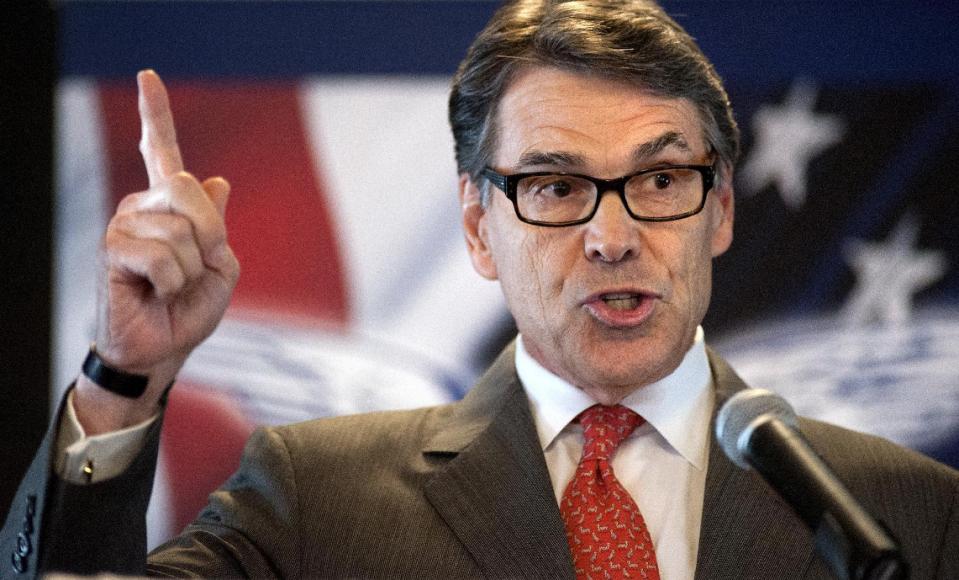
Former Texas Gov. Rick Perry ended his second bid for the Republican presidential nomination on Friday, becoming the first major candidate of the 2016 campaign to give up on the White House. The longest-serving governor in Texas history told a group of conservative activists in St. Louis that “some things have become clear” and he was suspending his campaign. “We have a tremendous field of candidates — probably the greatest group of men and women,” Perry said. “I step aside knowing our party is in good hands, as long as we listen to the grassroots, listen to that cause of conservatism. If we do that, then our party will be in good hands.” Dallas businessman and longtime Perry donor Roy Bailey said Friday that the former governor called him Thursday night and broke the news that he was planning to leave the race. “He was very matter of fact, he was confident in his decision,” Bailey said. “He hated it, because he’s such a competitive person, that that’s what it came down to. He’ll take a breather and jump back into life out of politics.” Former Arkansas Gov. Mike Huckabee, who took the stage at the Eagle Forum conference in St. Louis immediately after Perry announced his exit, called on the crowd to pray for Perry’s future success. “The only thing harder than to get into a race for something like president, is to make the decision to get out of the race,” said Huckabee, the runner-up for the GOP nomination in 2008. “And I hope that all of you will recognize that it was a very difficult decision. I’ve been there before.” Four years after his first bid for the White House ended after disappointing finishes in the Iowa caucuses and New Hampshire primary, Perry this time couldn’t even make it to the second debate night of the 2016 race. After failing to poll well enough to qualify for the featured primetime debate last month, Perry was again relegated to a pre-debate forum for the back of the pack at next week’s debate at the Reagan Library outside Los Angeles. He delivered a stronger performance at that first event than he did four years ago, when he couldn’t remember the third federal agency he’d promised to close if elected and muttered, “Oops” — a moment that doomed his bid in 2012. But few noticed in a 2016 GOP campaign dominated by billionaire Donald Trump, who stole away Perry’s Iowa campaign chairman after Perry was forced to suspend paying members of his staff as his campaign fundraising dried up. “It’d be easy just to keep going, be easy to go do the debate next week, be easy to keep going to Iowa and South Carolina and other states and everything and taking your money and dragging it out,” Bailey said. But, Bailey said, “he could see it was pretty obvious to him he wasn’t going to be the next presidential nominee from the Republican Party.” A group of super PACs, largely funded by three big Perry backers, had briefly kept Perry afloat by raising $17 million, hiring their own Iowa staff and producing television and digital ads and mailers. His decision Friday came as a surprise to those groups, which are barred from communicating directly with the campaign. A pro-Perry super PAC emailed its supporters Friday morning saying it was back on television in Iowa to promote his candidacy. A Twitter message from the group sent later in the morning further emphasized, “In It For the Long Haul.” “The decisions of a candidate to get into to, or out of, a campaign of this magnitude are intensely personal, family decisions,” said Ray Sullivan, the co-chair of one of the pro-Perry super PACs. “The campaign’s cash position matters, your poll numbers matter, but those things are surmountable if the candidate and his family are willing to stick it out even against seemingly long odds.” Republished with permission of the Associated Press.
Alabama delegation votes along party lines against Iran nuclear deal
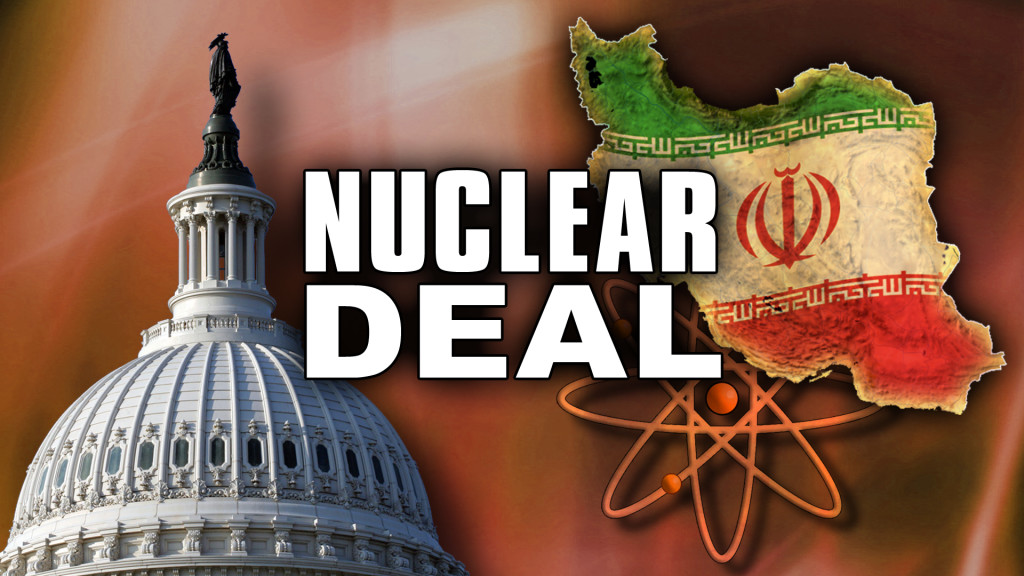
Members of Alabama’s congressional delegation split along party lines Friday when the House took its vote on the nuclear deal with Iran. Support for the controversial White-House backed agreement failed in the House 269-162. But the vote was largely symbolic as a way to record Republican opposition to the deal, as Senate Democrats Thursday blocked a final vote to reject the deal giving President Barack Obama‘s administration a hard-to-come-by diplomatic victory. The landmark agreement announced in July between Iran and six other countries — the United States, Germany, France, the United Kingdom, Russia and China — aims to prevent Iran from a nuclear weapons program in exchange for sanctions relief that have isolated the country and stymied its economy. Here’s what the Alabama delegation had to say of their votes: U.S. Rep. Bradley Byrne (AL-01): voted NO This will likely be the most important vote I will take during my time in Congress, and I could not support the nuclear agreement, which will put the American people at greater risk. This deal does not do nearly enough to prevent Iran from gaining access to a nuclear weapon. In turn, the deal will empower Iran by giving them access to billions of dollars in sanctions reliefs and allowing them to acquire Intercontinental Ballistic Missiles. As a member of the House Armed Services Committee, my constituents can rest assured that I will continue to do all I can to bring this deal to a halt and hold the Obama administration accountable. U.S. Rep. Martha Roby (AL-02): voted NO Not only will we have paved the way for Iran to obtain a nuclear weapon and potentially initiated a nuclear arms race in the Middle East, but we will have strengthened the hand of this adversarial state while weakening our own. One silver lining is, because this is an executive agreement and not a treaty, it is subject for review in the next administration. Let’s pray our next president doesn’t adhere to a foreign policy doctrine of “leading from behind. U.S. Rep. Mike Rogers (AL-03): voted NO I remain adamantly opposed to the nuclear deal with Iran. Iran has proven time and time again they cannot be trusted and have done nothing but fund terror across the Middle East against those like our closest ally Israel. U.S. Rep. Robert Aderholt (AL-04): voted NO The deal the Administration has made with Iran seems to be more about securing a legacy for the President than about making sure Iran never obtains a nuclear weapon. This deal simply adds time to the clock, but does nothing to change Iran’s endgame. Before negotiations began, the President said that no deal was better than a bad deal. In light of everything that is wrong with the Iran Nuclear Deal, it is hard for me to imagine what the President would have considered a bad deal. U.S. Rep. Gary Palmer (AL-06): voted NO The Corker-Cardin law is clear. It requires that the President to transmit to Congress ‘the agreement … including all related materials and annexes’ before any sanctions can be waived. The President has failed to transmit the ‘side agreements’ concerning the exact terms of the nuclear inspections. I joined 93 of my colleagues in a letter to the President concerning this issue last month. Unfortunately, these materials have still not been transmitted to Congress. The President needs to comply with the law and give Congress access to all of the documents that are part of this deal with Iran.” The Corker-Cardin bill was passed and signed into law in May. Key elements of the Iran deal’s inspections program, which is executed by the International Atomic Energy Agency (IAEA), are part of ‘side agreements’ between the IAEA and Iran, have not been transmitted to Congress, a violation of the Corker-Cardin law. Reports indicate that these agreements allow inspections of the Parchin military site, a key location for Iran’s nuclear program, to be based on information and samples provided by the Iranian regime, not independent investigators. U.S. Rep. Terri Sewell (AL-07): voted YES After several months of thorough deliberation, classified briefings with nuclear experts and military officials, and extensive conversations with numerous constituent groups and diplomats from our allied nations and partners, I have decided to support the Joint Comprehensive Plan of Action (JCPOA). I did not come to this decision lightly, nor am I under any illusions that this agreement is not without its problems. However, I believe this agreement is the best multilaterally negotiated agreement we will get, and thus represents the most viable diplomatic option moving forward. To be clear, my decision to support the JCPOA is not based on a belief in Iran’s intentions but rather in the power of the international community to collectively enforce a nuclear-free Iran. As a Member of the House Permanent Select Committee on Intelligence, I have a unique understanding of our intelligence capabilities and of our capacity to monitor Iran’s compliance with the JCPOA. Moreover, all of the options available to the United States—including the use of military force—will remain available throughout the life of the deal and beyond. Ultimately, I believe the JCPOA provides us with a diplomatic path forward and helps us further counter Iran’s destabilizing activities in the region.
Presidential TV ad roundup: Sept. 11 edition

Here’s a roundup of all the Presidential TV ads from this past week: Jeb Bush Title: The Real Donald Trump Published: 1 September 2015 Tone: Critical, but honest Title: My passion for education reform Published: 1 September 2015 Tone: Encouraging Title: What growing at 4% means Published: 6 September 2015 Tone: Hopeful Title: I’m delivered Published: 8 September 2015 Tone: Enthusiastic Chris Christie Title: Law enforcer Published: 24 August 2015 Tone: Serious Title: Every life Published: 2 September 2015 Tone: Compassionate Title: Every life Published: 2 September 2015 Tone: Compassionate Marco Rubio Title: The journey continues Published: 9 September 2015 Tone:Optimistic and passionate Scott Walker Title: Day one Published: 31 August 2015 Tone: Disdainful Hillary Clinton Title: Hillary’s fight against Citizen’s United Published: 8 September 2015 Tone: Condemnatory
Pat Dye: Lottery alone won’t fill state budget gaps

Former Auburn head football coach Pat Dye, now President of the Alabama Jobs Foundation, issued a statement Thursday that despite his strong support for a state lottery, that alone is not enough to heal Alabama’s ongoing budget woes. “We need real long-term solutions for our budget crisis, not short term fixes, cuts to essential state services and hundreds of millions in new taxes that the people of Alabama cannot afford,” said Dye on Thursday. “The real solution is right before our eyes and yet the Alabama Legislature refuses to see: a vote on gaming and a lottery. It is wrong to raises taxes before we give the people of Alabama the right to vote on gaming and a lottery.” The solution Dye refers to is Sen. Del Marsh‘s gaming plan, which is more thoroughgoing than lottery-only proposals now circulating in the Legislature. Marsh’s plan would not only reverse Alabama’s position as one of just a few states in that nation with no state lottery, it would eliminate current anti-gambling prohibitions to create a handful of state-sanctioned casinos around the state. Dye went so far as to say that without more expansive provisions, the AJF – a coalition of leading state industrial and business interests – would withhold its support for a referendum to enact a lottery. “A lottery and gaming will create $400 million in new revenue, $1.2 billion in economic impact, and create more than 11,000 new jobs, a job total equal to the Alabama auto industry. Job creation is the key to Alabama’s economic future. The Alabama Jobs Foundation will not support a lottery referendum because a lottery alone will not create the jobs or economic impact we need to fix our long term budget problems,” said Dye. Dye had previously called for a vote on a referendum on a more expansive gaming program, citing a poll which indicated high levels of support among Alabama voters.
