
Analysis: GOP is party desperately in search of a leader
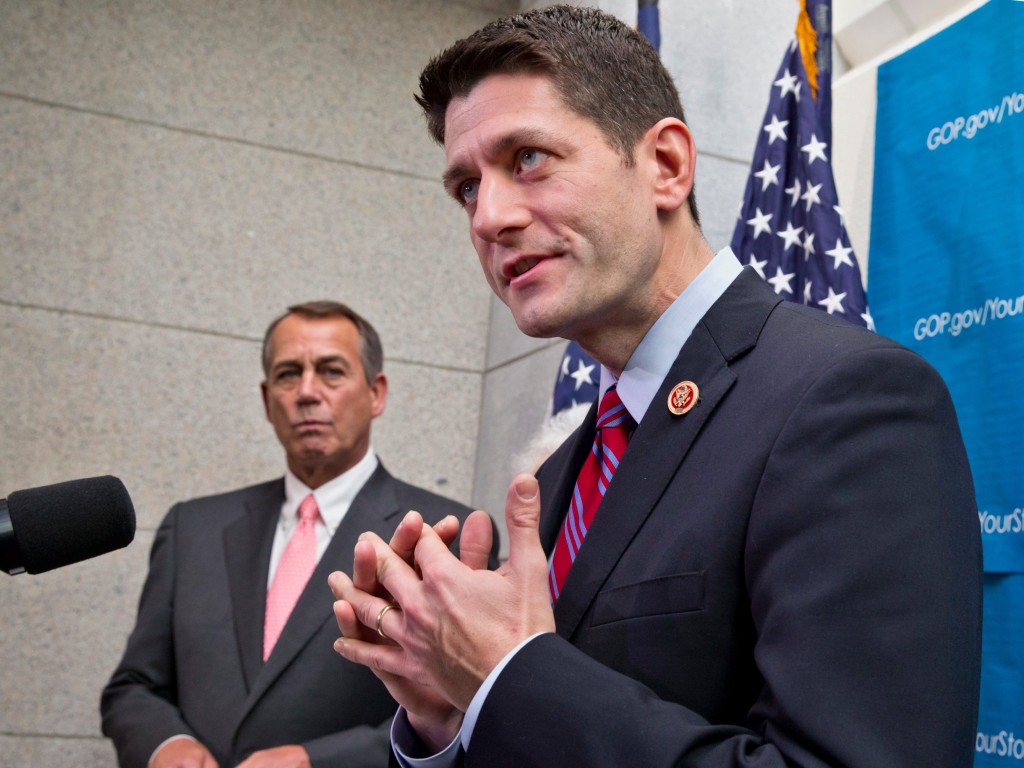
The GOP is a party in chaos, desperately in search of a leader. In the unruly U.S. House, Republicans enjoy a near-historic majority, yet deep divisions between ultra-conservatives and more traditional GOP lawmakers have left them at a loss over who should be in charge. In the Republican presidential primary, experienced governors and senators – long the party’s national leaders-in-waiting – are overshadowed by outsiders like Donald Trump who only seem to get stronger as they challenge the GOP establishment. Trump even claimed he helped push California Rep. Kevin McCarthy out of the race for House speaker this week, a shocking pullback by a lawmaker seen as the heir apparent. “They’re giving me a lot of credit for that, because I said you really need somebody very, very tough,” said Trump, the brash billionaire who has led GOP primary polls throughout the summer and fall. McCarthy was felled by the same factors that led current Speaker John Boehner to announce his resignation: a rebellion among members sent to Washington by voters who believe the party has compromised far too often with President Barack Obama and congressional Democrats. The challenge now facing Republicans is not only looking for leaders to unite the party’s warring factions, but determining whether finding them is even possible. For all the talk about ideology, the split among Republicans is often more about tactics. Boehner and McCarthy are both staunchly conservative lawmakers, but members elected in the tea party-era openly question whether they can be trusted to hold the line in budget negotiations and on other matters. In the House, some Republicans are begging Wisconsin Rep. Paul Ryan to step into the void. Ryan is no more conservative than Boehner – like the outgoing speaker, he has called for immigration reform – but he’s widely respected in the party and seen as one of its intellectual leaders. “It would be hard for people to confront Paul Ryan and say he’s not a good Republican or he’s not loyal,” Rep. Peter King, R-N.Y., said. “He has the stature nobody else has right now.” Yet it’s telling that Ryan, a budget expert and the GOP’s vice presidential pick in 2012, has so far said he doesn’t want the job. He’s left the clear impression that ascending to speaker in the current political environment would be more detrimental than helpful to his political future, which includes White House ambitions. Indeed, the next speaker will face a quick test to corral lawmakers who equate compromise with surrender. Congress must lift the nation’s debt limit by early November in order to avoid a default and faces a Dec. 11 deadline to pass a budget and keep the government open. A protracted fight over either issue would spill into the GOP presidential primary, forcing candidates to pick sides between the House’s small but vocal “hell no” caucus and leaders who warn the party would take the blame for a default or a federal shutdown. The risk for the party establishment is that those fights could harden support for presidential candidates running as political outsiders, namely Trump as well as retired neurosurgeon Ben Carson and former technology executive Carly Fiorina. Predictions that Trump, and now Carson and Fiorina, would fade in polls have so far proved unfounded, yet few Republican strategists believe any of the three could win the general election. If former Florida Gov. Jeb Bush, Sen. Marco Rubio or another experienced politician does become the GOP nominee, it’s unclear whether the hardliners would fall in line or simply abandon the party on Election Day by not showing up or backing a third-party contender. For Republicans aghast at the turmoil roiling their party, there’s this to cling to: The GOP’s electoral prospects beyond the White House remain strong. They’re sure to keep control of the House thanks to heavily gerrymandered districts, they have a legitimate shot at holding the Senate, and their prospects are good in several governors’ races. And while Democrats have demographic advantages in the presidential race, given their strength with Hispanics, blacks and younger Americans, voters may simply prefer a change rather than giving the party a third straight term in the White House. At least a few Republicans also appear to be clinging to the hope that the current chaos marks the low point for the party, not the start of a deeper descent. “It’s a rocky, difficult period,” said Rep. Tom Cole of Oklahoma, a Boehner ally. “But it’s probably a cathartic moment as well.” Republished with permission of the Associated Press.
A round-up of Sunday editorials from Alabama’s leading newspapers

A round-up of Sunday editorials from Alabama’s leading newspapers: The Anniston Star – Saying ‘no’ to more executions Everywhere they turn, Alabama officials are being told no. No, U.S. District Court Judge Keith Watkins said Thursday, the state can’t kill five death-row inmates with large doses of midazolam, a sedative. No, Watkins said earlier this week, the state can’t kill a death-row inmate by hanging because it isn’t set up logistically to do so. For the same reason, Watkins also said the state can’t kill a death-row inmate by firing squad. No to that, too. So here Alabama sits, desperately wanting to set execution dates for a handful of death-row inmates, and it can’t do it. It’s blocked at every turn. The nation’s slow move away from eye-for-an-eye justice has, for the moment, at least, backed the state against a wall. Our wish is that this court-caused slowdown would cause Alabama officials — and Alabamians themselves — to re-evaluate their love-affair with state-sponsored killings. On this, though, we’re realists and expect nothing but full-steam-ahead stances from Attorney General Luther Strange, Gov. Robert Bentley and the Republican-controlled Legislature. But we can wish nonetheless. Alabama’s in this mess because the three-drug cocktail it had previously used to kill its condemned is no longer an option. Two of the three drugs aren’t available. Five death-row inmates are fighting the state’s new three-drug recipe in court, citing the chance for an “unconstitutional level of pain,” which is why the state “offered” to kill them with just one drug, midazolam. Two other inmates asked about being shot to death or hanged. The Birmingham News – Deontay Wilder’s next fight: Duke Williams? Deontay Wilder is looking for someone to fight. Duke Williams is available and angry. Let’s do this. The 6’7 Wilder is an active WBC heavyweight champion. The man just loves to fight, and he’s really good at it. 35-0 with 34 KO’s. Why wouldn’t the Tuscaloosa native want to take on Auburn’s most prolific fighter? Why wouldn’t the Tuscaloosa native want to take on Auburn’s most prolific fighter? Williams, a talented 6’2 wide receiver, was removed from Auburn after he punched 4 people at a local bar, according to witnesses. Apparently there was some alcohol involved. So he messed up and is looking for a new gig. Why not take a shot at the champ? It’s time to move the T-Town/Auburn thing into the boxing ring, y’all. Are you ready to GRRRRRumble? The Decatur Daily – Racism claims wrong, this time At first glance, the Sept. 30 announcement the Alabama Law Enforcement Agency would close 31 driver’s license offices appeared to be the latest of many exhibits demonstrating the state’s determined effort to suppress the black vote. A year after requiring all voters to present photo identification at the polls — a move that had disproportionately burdened black voters — the state made it harder to get the most common form of photo ID. Indeed, the closures meant state driver’s license offices no longer exist in any county in which 75 percent or more of registered voters are black. It’s a narrative that spread fast and wide. Alabama media jumped on it, then the national media. Would-be presidents highlighted it, and the Rev. Jesse Jackson adjusted his travel plans to include Alabama. The facts do not support the narrative, however. Anyone with the fortitude to follow the three torturous sessions of the Legislature this year sees the problem with ascribing racial animus as the motivating force behind the closures. ALEA Secretary Spencer Collier and Gov. Robert Bentley are in an all-out feud with the Legislature, which failed to adequately address the state’s desperate need for more revenue. Whether or not the closure of the offices was financially necessary, it clearly was intended as a slap at lawmakers. Indeed, the budget included language seeking to prevent Bentley from carrying out the threat to close driver’s license offices, language that was consistent with the legislative dream-world in which budget cuts have no consequences. While the choice of offices to be closed was tone deaf to Alabama’s history of racial relations, it was neither arbitrary nor malicious. The satellite offices closed were those with low traffic. Dothan Eagle – Top-notch nursing programs complement health care Dothan has long enjoyed a reputation as a regional hub for health care, anchored by Flowers Hospital and Southeast Alabama Medical Center. With highly competent specialty programs at both facilities, area patients have access to top-notch care without the need to travel to larger medical facilities, in most cases. And if that need should arise, facilities for those specialties are within easy driving range. In recent years, Dothan has become home of a medical school, which has just held a white coat ceremony for its third class of doctors. But doctors and hospitals are only part of what makes excellent health care. Without nurses and professionals in associated health fields, the delivery of health care would likely screech to a halt. That shouldn’t be a problem in the Wiregrass. Wallace Community College has been turning out nurses with varying training levels for years, as does Troy University in Troy. Graduates of these schools’ nursing and associated health care programs create a strong pool of training candidates to fill the needs of the region’s broad array of health care services. Recently, a trade publication called Nurse Journal ranked nursing programs across the nation, and found that programs at Wallace Community College and Troy University rank in the top 100 for schools in the eastern region. Of more than 1,100 schools in the region, Wallace was ranked at 90, while Troy ranked 36. Our community is fortunate to have nursing programs available for interested students who can receive their training close to home, and then have a strong chance of finding jobs right here in the Wiregrass. And the Nursing Journal rankings should be of great comfort to residents who may someday be under the care of local graduates, because they’ll likely be among the best trained professionals in
