
Frustrated Republicans contemplate changes to debate setup
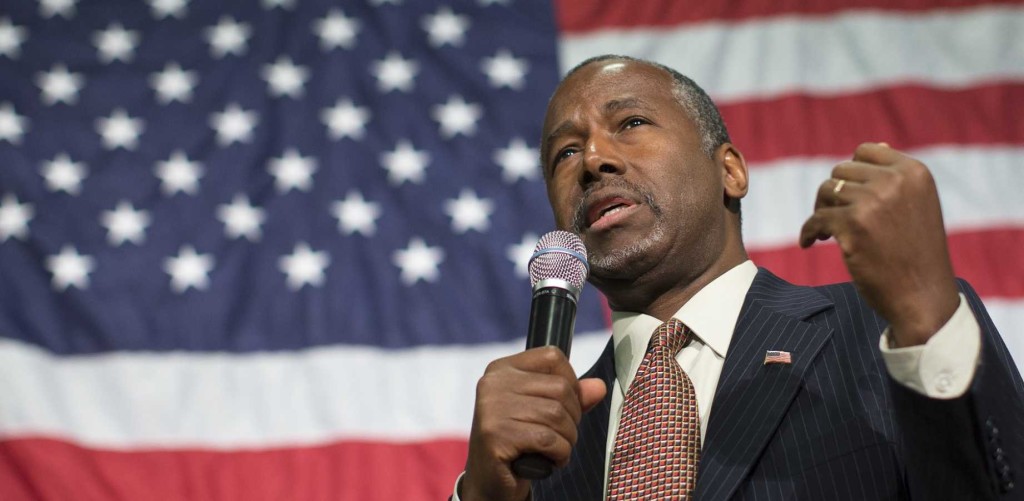
Republican candidates frustrated by their party’s presidential debates are contemplating changes to those remaining on the nomination calendar, even beyond the GOP chairman’s decision to suspend a partnership with NBC News and its properties on a debate set for February. The complaints prompted a private meeting Sunday night in Washington, organized by Ben Carson‘s campaign, with representatives from more than a dozen campaigns expected to attend. Yet it seemed unlikely that the campaigns would reach a consensus, given their competing needs, and even Carson’s campaign expected the meeting to achieve “absolutely nothing.” The most recent debate, moderated by CNBC in Boulder, Colorado, on Wednesday night, drew the harshest criticism. Afterward, some candidates complained that the questions were not substantive enough; others wanted more air time or the chance to deliver opening and closing statements. “We need to mature in the way that we do these debates if they’re going to be useful to the American people,” retired neurosurgeon Carson told ABC’s “This Week.” The push-back comes despite a high-profile effort by the Republican National Committee to improve the debate process going into the 2016 election season. The party said the 2012 debate schedule promoted too much fighting among candidates, so for 2016, the RNC dramatically reduced the number of debates for this election and played a leading role in coordinating network hosts and even moderators, in some cases. Three debates remain before the first nomination contest, the Iowa caucuses on Feb. 1; the next one is scheduled for Nov. 10 in Las Vegas. The RNC has sanctioned five debates after the caucuses. While organizers of the meeting were not including the RNC, the party has been in regular communication with campaigns about their concerns. “This is the first step in the process of understanding what the candidates want, and then we need to have a more specific conversation about NBC,” RNC chief strategist Sean Spicer said Sunday when asked about the meeting. “We need to start a process. Tonight’s the first step.” It seemed unlikely that the campaigns would reach a consensus, given their competing needs. Second-tier contenders such as South Carolina Sen. Lindsey Graham want to be featured alongside their higher-profile rivals. Some candidates, including Carson, are pressing for a greater focus on substance, more notice of the guidelines and perhaps fewer future debates. “Everybody thinks there are too many,” Carson spokesman Doug Watts said Sunday, adding that he had low expectations for the meeting. “Realistically, we expect absolutely nothing to come out of it.” Some candidates are trying to use the debate discord to their advantage — none more than Texas Sen. Ted Cruz. Campaigning in Iowa this weekend, he slammed the CNBC debate moderators for asking questions in a way that he said “illustrate why the American people don’t trust the media.” He was cheered after calling for future debates to be moderated by conservatives such as radio host Rush Limbaugh. Watts said every Republican campaign had agreed to attend except for New Jersey Gov. Chris Christie‘s. Republican attorney Ben Ginsberg, the general counsel for Mitt Romney’s last presidential campaign, was to moderate the meeting. Republished with permission of The Associated Press.
On MTP, Jeb Bush says Marco Rubio has “given up” on his day job
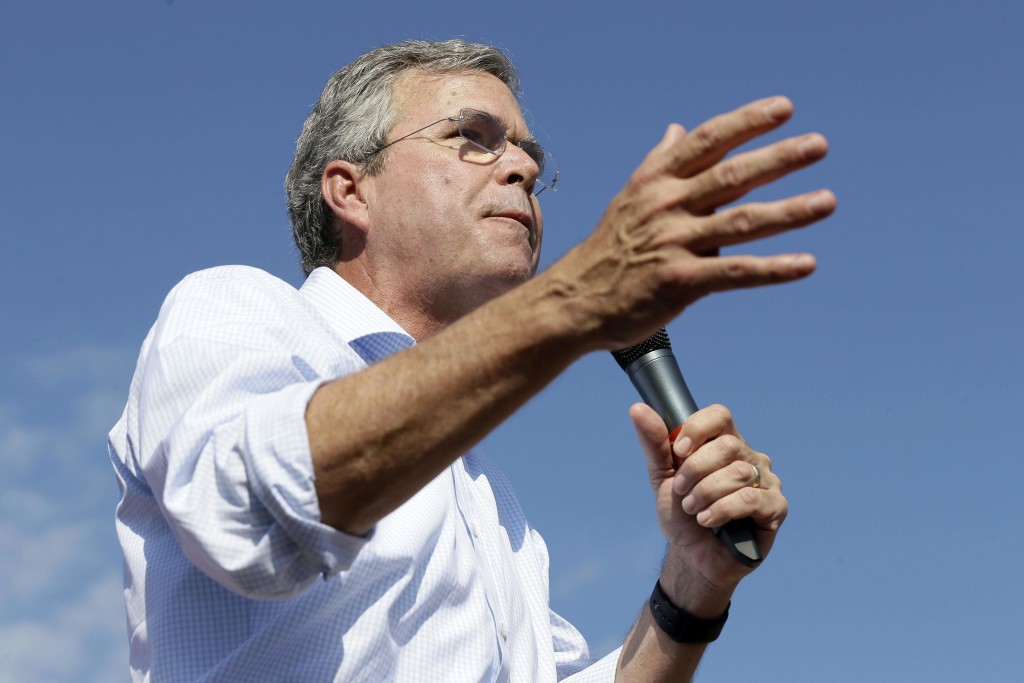
Although he’s been hammered by the punditry class for getting schooled by Marco Rubio for daring to bring up his poor voting record in the U.S. Senate at last week’s GOP presidential debate, Jeb Bush said today that he has no regrets about doing so. “I got to be governor of a state and accomplish big things,” Bush told Meet The Press’s (MTP) Chuck Todd in an interview taped on Saturday in Miami and aired on Sunday morning. “And in this era of gridlock, it’s really hard to break through, and I think he’s given up. And I think that’s the wrong thing to do. This is about public service, about solving problems. If you look at the three people on the stage from the United States Senate, all three of them have a combined two bills that became law that they’ve sponsored. If you look at Hillary Clinton, in ten years, three bills she sponsored that became law. This is the gridlock that I’m running to try to break up. I can change the culture in Washington.” Bush insisted that he hadn’t seen the 112-page memo from his presidential campaign detailing why Rubio is a “risky bet” for the Republican Party before it leaked. “I didn’t see it,” he said. “Well, I read about it when it was leaked for sure. I didn’t know about the PowerPoint.” Bush told Todd that while he knows he needs to get better at debates after being considered to done poorly at last Wednesday night’s affair in Boulder, he hasn’t watched a tape of it, and doesn’t intend to. Bush answered a question by CNBC’s Carl Quintanilla about whether there should be an investigation of daily fantasy sports products DraftKings and FanDuel, but Chris Christie seemed to be impugning both men afterwards in expressing revulsion at such a question asked at a debate. Bush seemed to concede that he should have answered it differently. “My focus in the debate, I will change the whole conversation,” he told Todd. “So if someone asks me about Fantasy Football next time, which was kind of bizarre if you think about it, I’ll talk about the people I’ve met that are really worried that they have declining income.” Bush will appear in Tampa, Orlando and Jacksonville on Monday. He said that his speech in Tampa will be about how Republicans need to be hopeful and optimistic and have an aspirational message, which doesn’t seem like something he hasn’t been saying on the stump for sometime. Bush said he maintain a belief he’s had for decades – that there should be no litmus tests for Supreme Court Justice appointees, which is usually said in reference to the abortion issue. Interestingly, he said he’s having an internal debate about his feelings on the death penalty. “I’m conflicted,” he confessed to Todd.”I am. It was the law of the land when I was governor, and I faithfully dealt with it. To be honest with you, it is not a deterrent anymore because it’s seldom used. It clogs up the courts, it costs a ton of money. And– CHUCK TODD: Are you one of those that look at the fiscal part of it and say, “You know what? Maybe it makes more fiscal sense to not do it”? JEB BUSH: Here’s the one thing, and it’s hard for me, as a human being, to sign the death warrant, to be honest with you. I’m informed by my faith in many things, and this is one of them. So I have to admit that I’m conflicted about this. But here’s the deal, when you meet people, this happens in rare cases where the death penalty’s given out and you meet family members that have lost a loved one and it’s still in their heart. It’s etched in their soul. And this is the way that they get closure, I get more comfortable with it, to be honest with you. But we should reform it. If it’s to be used as a deterrent, it has to be reformed. It can’t take 25 years. That does no one any good. Neither the victims nor the state is solving this problem with that kind of tangled judicial process. CHUCK TODD: So you’re still in favor of it, but? JEB BUSH: Yeah, but I’m just saying, look, this is life, Chuck. It’s not all either/or. Sometimes you can see both sides. And I believe life is truly a gift from God, and innocent life particularly should be protected at all cost, for sure. But people that commit these crimes, there should be– justice can’t be denied. And it shouldn’t be delayed. And maybe there’s a better way to do this where victims feel as though they’re being served, because that should be front and center, the first obligation of the state.
Jeb Bush vs. Marco Rubio rivalry intensifies as Iowa caucuses draw closer
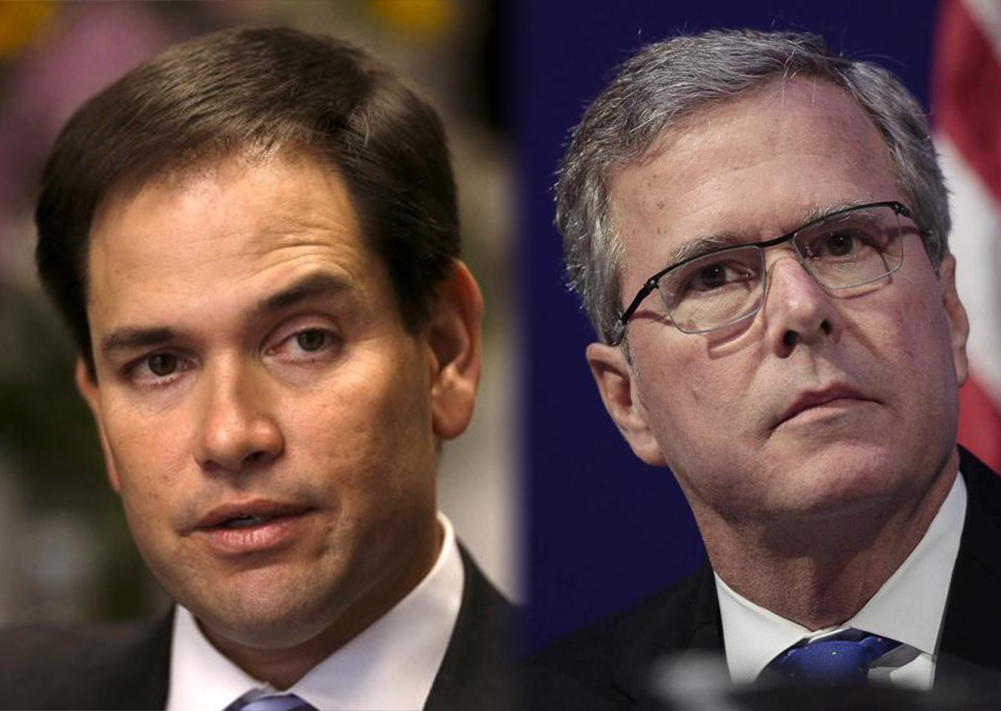
Neither Jeb Bush nor Marco Rubio emphasized the need to do well in Iowa in the early months of the 2016 presidential campaign. But that’s changed as their rivalry intensifies and pressure mounts to emerge from the Feb. 1 caucuses as the favorite among mainstream conservatives. Neither has visited Iowa as often as more socially conservative candidates such as Texas Sen. Ted Cruz, and both lack the star power of rivals billionaire Donald Trump and newcomer Ben Carson. But the key, unveiled by Bush in a donor conference and reinforced after Wednesday’s debate, is how they fare against each other, and Iowa is the first test. “They’re competing for the same segment of Iowa Republicans,” said former state party chairman Matt Strawn, who said that vote still “absolutely is up for grabs.” As a result, they are adding resources in the state and spending more time courting voters. Bush and Rubio were among 10 presidential candidates to appear at the Iowa Republican Party’s Growth and Opportunity forum, a tailgate-themed festival at the Iowa State Fairgrounds in Des Moines, and the last multicandidate event before the caucuses. Bush, a former Florida governor, was seen as a potential front-runner based on his early fundraising success. But he has failed to catch fire since this summer. Meanwhile, the younger Rubio has called for a new generation of leaders but has struggled to grab the national limelight. But at the Des Moines forum on Saturday, Rubio tried to capitalize on a strong showing at Wednesday night’s national debate and an increasing curiosity about him. Rubio told more than 1,000 Iowa GOP faithful that the nation is on the wrong path and assured them there “is a road that will allow us to be the freest and will allow us to leave our children better off,” he said. “To do that we must turn the page, and allow new leaders and new principles.” The jab at Bush, the 62-year-old son and brother of former presidents, is more subtle than Bush’s now outright battle with Rubio for missing Senate votes while campaigning for the White House, a criticism Bush raised during Wednesday’s debate. On Saturday, Bush again mentioned Rubio’s Senate attendance, with an Iowa twist: “If you’re elected to serve, you should do what Chuck Grassley does: You should show up to vote,” Bush said, referring to Iowa’s senior senator. To date, the better-funded Bush has invested more and earlier in a political organization, with at least 10 staffers in the state, as well as having as a senior national adviser David Kochel, a veteran Iowa GOP operative. Rubio, who has had a leaner operation, has 30 people working across the first four nominating states — Iowa, New Hampshire, South Carolina and Nevada. “I think Bush has an organizational advantage,” Iowa Republican Chairman Jeff Kaufmann said. “But I think Rubio has a momentum advantage. Also, I think he has an advantage coming out of the debate.” Now Rubio’s fundraising is also rising. Billionaire investor Paul Singer on Friday announced his support for Rubio in a letter to his extensive network of Republican fundraisers, encouraging them to follow his lead. Bush’s team views Rubio as his most dangerous competitor for voters and donors who want to see a traditional nominee. Wednesday night’s attack from Bush backfired. During a post-debate conference call, Bush’s team told supporters the debate did not go well and tried to reassure skittish donors the turnaround loomed ahead. After his speech, Rubio was mobbed by supporters and journalists. He shook hands, signed books and posed for photos for an hour, joking easily with the crowd. “Just make sure you’re here in February,” he said to a woman who told him she spends time in Florida. Bush’s stand decorated by hay bales offered cotton candy. But even Bush supporters acknowledge that he needs to improve his game. “I think he’s taken some hits because of poor debate performances,” said Don Pugsley, 68, of Des Moines. He also said Bush has given strong performances before smaller audiences in Iowa. Bush acknowledged amid pictures and autograph requests in a crush of supporters and reporters that he needs to improve debating. “I have enough humility to know that I’ve got to get better,” he told reporters. “I’m going to get better. I have enough self-awareness to know that.” Republished with permission of The Associated Press.
A round-up of Sunday editorials from Alabama’s leading newspapers

A round-up of Sunday editorials from Alabama’s leading newspapers: The Anniston Star – In some Alabama counties, you only get one day a month The Alabama Law Enforcement Agency’s repair of the damage done to the state driver’s license offices begins next week. It’s not much of a fix, by the way. For a moment, set aside the justified criticism that ALEA’s closing of 31 locations in mostly rural and low-income areas creates ripe soil for voter-ID concerns. Instead, consider the day-to-day details of the ALEA’s plan. Thirty counties will soon see their driver’s license offices reopen. Most will open one day a month. (Two offices, in Alexander City and Brewton, will be open more frequently.) Better check the schedule. Miss your day and you either have to wait a month, drive to an open office further from your home, or drive without a valid license. The office schedules listed Friday on the ALEA website show none of the closed offices will be open on Mondays. Six locations, including Centre’s, will be open next Tuesday — the first Tuesday of the month. That’s the only November day available at that Cherokee County location to re-up a license. If Alabamians there can’t get off work, or if they’re sick, or if something comes up, well, too bad. Gotta wait until the first Tuesday in December, or drive to another county, provided its office is open when you go. The Birmingham News – In 2016 presidential race, low-information voters and the politics of perception My wife is a remarkably talented political observer in spite of the fact she’s not actually that interested in the minutia of public policy. Most of our political conversations occur as we’re getting ready for bed. This week, I asked who she liked most of all the candidates. “I like Carly Fiorina,” she said. “Why?” I responded. “She looks and acts presidential. She has calm, thoughtful answers, and she’s not into trading insults.” “Does it matter that she’s a woman?” I asked. “No, that probably makes it harder for her. She’s going to have men second-guessing her all the time. But she seems to take it in stride,” said my wife. “I really liked when Donald Trump attacked her, and she turned it into an opportunity.” We didn’t get to policy. We didn’t dive into the specific details of recent debates either. To be clear, she’s more than capable of understanding nuanced policy issues; they’re simply secondary to the traits she’s looking to see in America’s President. The Decatur Daily – The Gadsden Times on payday loans The numbers are astonishing. In the first 10 weeks, payday lenders had to record their transactions on a statewide database, Alabamians took out 462,209 payday loans. Based on those numbers, Alabamians are on course to take out just over 2.4 million payday loans on an annual basis. An industry representative tried to defend payday loans, saying there’s little alternative for the 300,000 or so people who use the service in Alabama. Max Wood, who owns Check Spot stores in a couple of cities, said the database, which is designed to keep people from amassing more than $500 in payday loans at one time, caused many Alabama payday lenders to shut down already. Wood said more than 200 licensed payday lenders have gone out of business in the last year alone. He said other states that enacted databases have seen the number of lenders shrink by 50 percent. While it’s obvious Wood thinks the closures are a bad thing, others disagree. Shay Farley, legal director for Alabama Appleseed, said the state is “above the curve” in payday loan use. Her organization lobbied for stricter regulation of the industry, saying the loans create a debt trap when borrowers have to roll over the loans because they can’t repay the original amount borrowed. Payday lenders charge up to $17.50 per $100 for 10- to 14-day loans. A borrowing limit was in place before the database was authorized, but lenders could simply say they didn’t know borrowers had more than $500 in loans and there was no way to check. Dothan Eagle – Ebb and flow Many residents give little thought to the workings of municipal government unless something goes wrong or there’s some talk of a tax increase. They may find the minutiae of day-to-day governance boring. For the most part, they’re right. That doesn’t mean it isn’t important. A great deal of work goes into arcane procedures and ordinances meant to help keep the electricity on, the water flowing and the wastewater systems in operation. That may seem like something of little concern to residents. But when there’s a problem – faucets run dry, lights and air-conditioning don’t work or sewer systems back up – those things we take for granted become tremendous inconveniences. Residents with a little time on their hands today at 10 a.m. should consider attending an informational meeting in the Board Room on the second floor of the Dothan Civic Center. Members of the Dothan Planning and Development department will present a proposed ordinance on the management of fats, oils and grease to the Dothan City Commission. The proposed ordinance was developed in response to the EPA’s Administrative Order on Consent with the City of Dothan concerning its sewer system, and should help to control the introduction of fats, oils and grease into the wastewater collection system. Fats, oil and grease, or FOG in environmental parlance, can wreak havoc on a wastewater system, and most cities, particularly those with large populations, have gone to great length to minimize the amount of these substances that go down the drain. The Enterprise Ledger – It’s time to change course of this ship ESPN’s popularity took a nosedive when it honored Caitlyn (or is it Bruce?) Jenner with the Arthur Ashe Courage Award, but apparently Glamour Magazine’s executives don’t care about public relations either as it has now named the guy (or is he a gal?) as its Woman of the Year. Several public
