
Jeb Bush gets louder, more colorful in campaign revamp
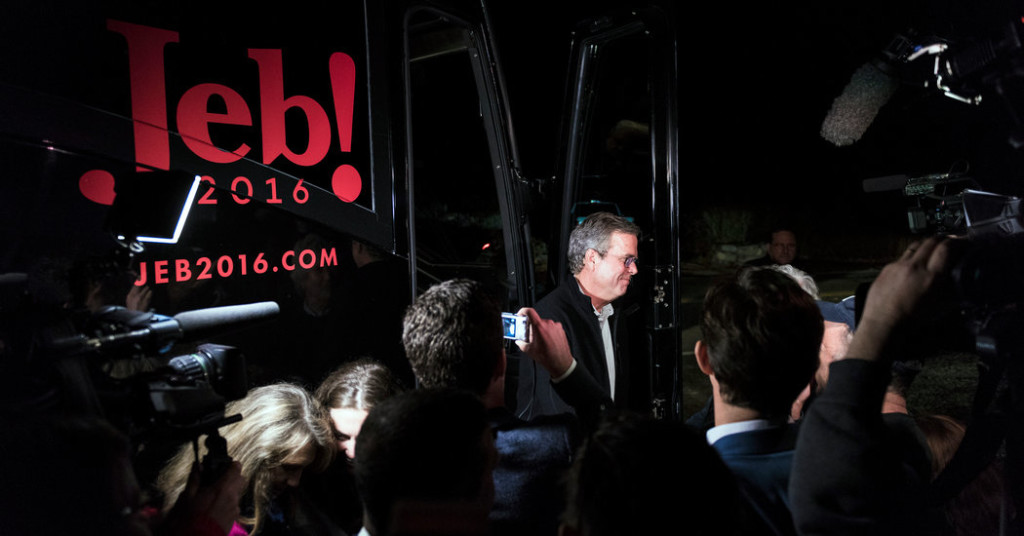
Republican Jeb Bush‘s campaign revival tour is getting louder and more colorful as he charges across early voting states with a can-do slogan, a tour bus and critiques of rivals who have become threats to his claim as the GOP mainstream favorite. “We’re Americans, dammit!” he shouted Wednesday at a pharmacy in Hollis, N.H., as he complained that the U.S. was not leading in key foreign policy disputes. He saved special words for Donald Trump, the former reality show star who remains a leader in the unpredictable GOP nomination fight. “A president can’t say ‘You’re fired,’ and go to commercial break,” Bush told more than 100 people at a senior center in Raymond, New Hampshire, Tuesday night. “A president has to roll up their damn sleeves and get to work.” A night earlier, his voice showed signs of strain as he railed against what he called anemic economic growth. “That means more people stuck in poverty. That means one in five children on food stamps,” Bush said, raising his voice during an event Tuesday in Rye, N.H. “That’s the new normal. I hope you agree with this: we need to reject that out of hand. And we can do it.” The volume and feeling reflect the urgency of Bush’s drive to push his campaign into a winning position ahead of the first votes of the GOP nomination fight in Feb. Once seen as the probable favorite, Bush’s viability has never really thrived in the face of unexpectedly strong support from outsiders Trump and retired neurosurgeon Ben Carson, who are leading the pack. Also a thorn for Bush: Marco Rubio, his onetime protege, who has approached the dynamics as an opportunity to win over the GOP establishment turned off by Trump and Carson. Bush took a more restrained tone on Rubio, with whom he’d clashed in last week’s debate. “He hasn’t changed the culture in Washington,” Bush told reporters aboard his campaign bus. He refused to answer questions on Rubio’s personal spending habits, which had had come up during last week’s debate. “It’s not my job to worry about that,” Bush said. Priority No. 1 for Bush, acknowledged even by him, is injecting some life into his campaign. That has meant a new motto – “Jeb Can Fix It -a heavier travel schedule to early voting states and more attention-grabbing performances. After New Hampshire this week, he’ll tour South Carolina. Traveling in a blue tour bus with the slogan plastered on its side, Bush stopped Wednesday at a Manchester area school in the morning, the pharmacy in Hollis later and was headlining a law enforcement and drug abuse roundtable in Goffstown in the early afternoon. He was headed north to the lake country for two events later in the day. Bush plans to wrap up the three-day visit Thursday. During a Republican debate in Colorado last week, Bush criticized Rubio for missing Senate action as he campaigns for president. Bush joked that the Senate’s schedule was hardly demanding by suggesting it was akin to “a French workweek.” Traveling with reporters in New Hampshire on Tuesday, Bush joked that comparing the French to Congress was really unfair to the French. “I really did a disservice to the French,” he said, according to multiple press reports. Republished with permission of the Associated Press.
Alabama, Florida lawmakers urge Congress to act on ailing Apalachicola river basin

U.S. Sens. Jeff Sessions and Richard Shelby joined with Florida counterparts Marco Rubio and Bill Nelson urged a Senate budget panel to take on what they called “ongoing mismanagement” of the Apalachicola-Chattahoochee-Flint (ACF) and Alabama-Coosa-Tallapoosa (ACT) River Basins on the part of the U.S. Army Corps of Engineers on Wednesday. The senators asked the Senate Appropriations Subcommittee on Energy and Water Development to include language related to the ACF in the Fiscal Year 2016-2017 budget in a letter addressed to the committee. The document already includes language regarding the ACT. “In light of the Corps’ September 30, 2015, release of the Draft Environmental Impact Statement” related to the basement, the senators wrote, “Congressional action is needed given the current proposal would continue to severely restrict water flows for downstream users. “The ACF’s water supply is the lifeblood for many Alabama and Florida communities, and supports multiple industrial and domestic uses. For example, both Florida and Alabama rely on the ACF for navigation and the production of hydroelectric power that supplies efficient, low-cost energy for many throughout the region. In addition, Alabama and Florida depend on the ACF for irrigation and agricultural purposes, flood control, and water quality. Without a reliable and consistent freshwater flow from the ACF, entire communities and their respective economies are left to the decisions and priorities of those upstream,” they wrote. They lawmakers said the river accounts for $200 million in economic impact annually on the region, and directly employs some 85 percent of the local workforce there. Recent ecological and water management mishaps have caused severe damage to basin, and to the surrounding economy. “Because of each state’s vital need to ensure that the ACT and ACF River Basins are properly managed with each of their interests appropriately considered, we urge the Subcommittee to include language in any omnibus appropriations vehicle that ensures that management of both of these critical basins are not left to the whims of an unaccountable federal bureaucracy, but instead is properly determined and agreed upon by each state’s governor,” the bipartisan group of senators concluded. See the full text of the letter here, courtesy of Rubio’s congressional office.
Rep. Steve Clouse disputes Lance LeFleur allegations with facts
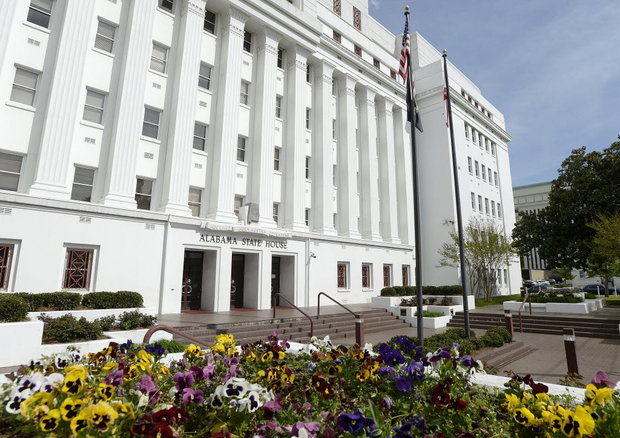
Tuesday night, Alabama Today got a call from state Rep. Steve Clouse in response to our post “Ethics questions abound, who will investigate.” In that post we highlighted a letter purportedly written by Alabama Department of Emergency Management (ADEM) Director Lance LeFleur that accused Clouse of potential ethics violations for pursuing language in the budget bill to exempt the Underground Storage Tank Trust Fund (UST) from transfers to the general fund. Clearly perplexed by the resurrection of allegations that he had a personal conflict made by LeFleur called to set the record straight. He confirmed that LeFleur brought his allegations about his alleged conflict in the language to to Sen. Arthur Orr during the budget process and that Orr spoke to him about them directly at that time. According to Clouse he told Orr that his family got out of the Amoco oil business 27 years ago. More recently Clouse and his father were brokers for ethanol and transformer oil but that business was shut down several years ago. A car business Clouse owned closed over a year ago. He says he is now a full-time legislator (though admittedly he was babysitting his toddler granddaughter yesterday, which is a job in itself). Clouse pointed out that the broker business was not impacted by the UST Trust Fund. He stated that he didn’t own any tanks, equipment and work was done over the phone. It was important Clouse noted to point out when the budget left the house there were zero transfers from the ADEM budget insisting that the senate was responsible for the $1.2 million funds transfers. Insisting the language he added wasn’t even necessary he said he did so to ensure a piece of mind to those paying into the fund and to save ADEM a potential lawsuit if they attempted to use UST Trust Fund monies in any way other than their designated use. Clouse told Alabama Today that LeFlaur said he’s “okay with his budget being zero as long as there were not transfers.” When asked about the fee increases now being requested due to the fact ADEM was zeroed out with LeFlaur’s blessing he noted that legislators “knew there was a possibility of raises.” He was unaware of the previous across the board fee increases which included 19 percent in 2011 and 50 percent in 2013 and did not know that a 20 percent fee increase on top of the other two was currently being proposed. He did not want to speak directly to them because he was not fully informed on all of the specifics but we will follow up with him as he has time to research the matter more. In addition to the call by Clouse, Alabama Today received numerous calls and messages on his behalf. One from a influential lobbyist and friend said, “I’m 100 percent sure he wouldn’t do anything like that for personal gain.” Another caller stated that Clouse, “is one of the nicest guys in Montgomery, salt of the earth. These attacks are baseless.” Speaker Mike Hubbard‘s office told Alabama Today, “Speaker Hubbard has every confidence in Chairman Clouse.” Clouse told Alabama Today that he is planning on meeting with LeFleur this Thursday, November 5th. We will report back and continue to cover this story as more develops. The next installment will be more about the fee increases and budget of ADEM.
Mike Rogers: Honoring America’s veterans

Each year on Nov. 11, we honor those brave men and women who have served our country in uniform and those who have paid the ultimate sacrifice for the freedoms we enjoy today. As many of you across East Alabama may know, I have a Veterans Advisory Council that includes veterans from each of the 13 counties that make up the 3rd District. These council meetings allow me the opportunity to hear directly what is on the minds of our veterans and take their concerns back to Washington. This year our meeting is scheduled during the week of Veterans Day and will include a very special guest, Mr. Bennie Adkins of Opelika. Mr. Adkins was awarded the Medal of Honor in September 2014 for his acts of bravery on the battlefield in Vietnam. Mr. Adkins, like all of our veterans, is a true American hero and we look forward to having him at our meeting. During the past couple of years, scandals have occurred within our VA healthcare system, including the Central Alabama Veterans Healthcare System (CAVHS) in Montgomery. I think we all can agree our Veterans deserve the best care we can offer them. It is the least we can do to thank them for their selfless service. One of the changes implemented was the Veterans Choice Program that allows veterans to get health care from non-VA doctors. Unfortunately some of our veterans still haven’t been able to get the help they need. That is why I’ve joined U.S. Rep. Byrne in cosponsoring H.R. 1096, which would make the choice program work better by changing the criteria to closest medical service instead of medical facility. While this is just one fix to one issue it is an example of what we as a Congress have to continue to do to make sure we keep the the Department of Veterans Affairs accountable and responsive to the needs of our veterans. In addition, my office always stands ready to assist any veteran from the 3rd District when it comes to dealing with the VA. Not just on Veterans Day, but every day, I encourage all of us across East Alabama to remember the men and women in uniform that have lost their lives and to keep those still serving and their families in our thoughts and prayers. God Bless America. Mike Rogers represents Alabama’s 3rd Congressional District. He is in his third term.
Luther Strange joins national fight against illegal debt collections
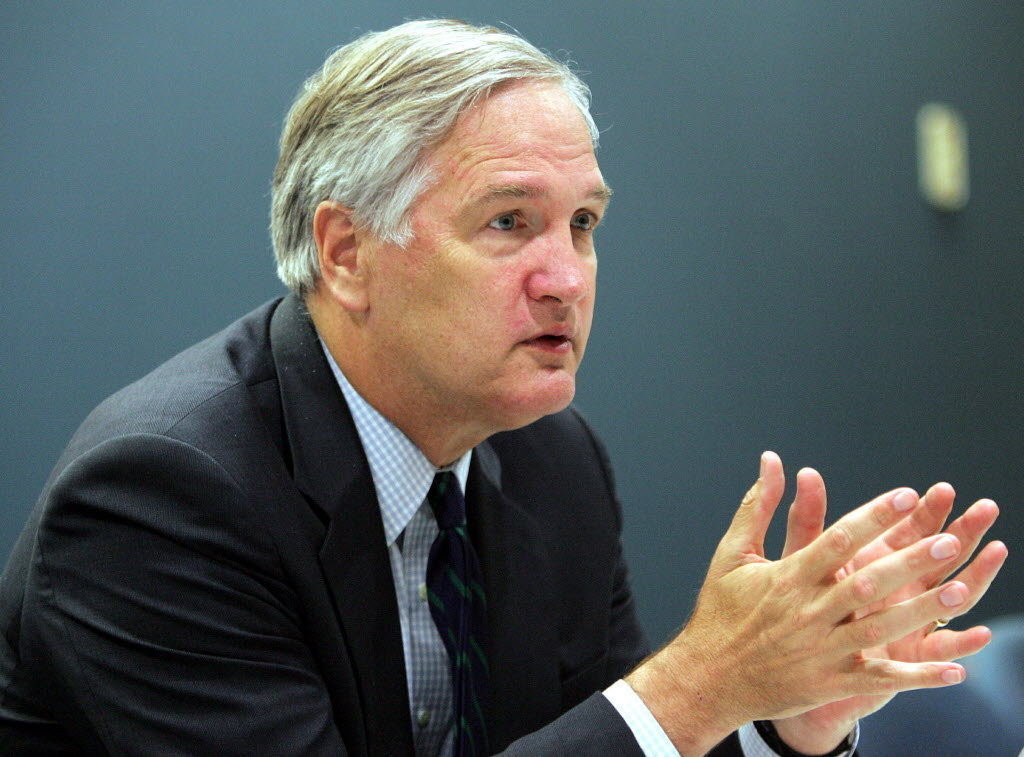
Alabama Attorney General Luther Strange said Wednesday he’ll join a coalition of consumer and government groups in weeding out fraudulent and deceptive practices in the nation’s burgeoning debt-collection industry. Strange will team up with the Federal Trade Commission as part of their new “Operation Collection Protection” initiative, which aims to root out bad actors in debt litigation, sales, and swapping. “Consumers deserve for debt collections to be handled in an appropriate and legal manner,” said Strange, the state’s highest-ranking prosecutor. “My office is committed to assist consumers who are suffering from mistreatment in debt collections, and to ensure more fair practices.” A news release trumpeted Strange’s efforts to lead the state’s participation in a recent settlement with Chase Bank USA which has so far turned over about $65,000 to 85 Alabama consumers as part of an estimated $50 million settlement after Chase admitted fault in its credit card collection practices. The case was spurred in part by Operation Collection Protection, which said Wednesday it will pursue 110 new actions against coercive or fraudulent collectors. Strange also urged Alabamians to call his office’s Consumer Protection Section if they suspect they are being subjected to illegal debt collection practices, or to visit the division’s website at ago.alabama.gov. Operation Collection Protection initiated approximately 118 actions, according to Strange’s statement, some of which have resulted in debt collectors being barred or suspended. The endeavor has secured more than $180 million in monetary relief and $300 million in judgments and brought criminal charges against some 15 defendants. Strange, a Republican, was first elected in 2010 and subsequently re-elected last November.
Who’s Alabama’s wealthiest member of Congress?
U.S. Sen. Richard Shelby is Alabama’s wealthiest member of Congress, with a net worth of $4.18 million, according to Roll Call‘s annual “Wealth of Congress” report, ranking Shelby 72nd in all of Congress. Not too far behind is U.S. Sen. Jeff Sessions coming in 85th. Every year since 1990 reporters from the beltway rag Roll Call scour each member’s financial disclosure forms to create their “Wealth of Congress Index,” which ranks members by wealth. This year’s rankings were derived from forms covering the 2014 calendar year. According to Roll Call, “The disclosure forms are imperfect at best — members are required to report values in broad ranges of minimums, starting at $1 to $1,000 and ending with any asset or liability worth $50 million or more. Our equation for calculating the minimum net worth of each member remains unchanged: Total minimum reported value of assets minus total minimum reported value of liabilities equals total minimum net worth.” The Yellowhammer State’s delegation has a total net worth of at least $10.26 million, averaging $1.14 million per member, with a median of $570,000. In contrast, the median household net worth in the United States stood at $68,828 in 2011, with 69 percent of households holding some form of debt, according to the most recent U.S. Census statistics. Here’s a look at how the Alabama delegation ranks and their net worth: #72 U.S. Sen. Richard Shelby Net worth: $4.18 M How he got there: Collects interest from his Tuscaloosa Title Co., which he founded and has remained chairman of since 1974. He also outright owns the commercial property that houses the company as well as his Tuscaloosa home and Washington townhouse. #85 U.S. Sen. Jeff Sessions Net worth: $3.21 million How he got there: Owns 16 pieces of land, dozens of mutual funds, several municipal bonds and money in bank accounts. #85 U.S. Rep. Robert Aderholt Net worth: $1.01 million How he got there: Real estate. #222 U.S. Rep. Bradley Byrne Net worth: $0.73 million How he got there: Mutual funds. #250 U.S. Rep. Mike Rogers Net worth: $0.57 million How he got there: A 20 percent stake in Capitol Development LLC, through which he owns 200 acres of land in Anniston. #265 U.S. Rep. Gary Palmer Net worth: $0.48 million How he got there: An IRA and has a 20 percent stake in Canaan LLC, through which he owns 105 acres of land in Vernon #350 U.S. Rep. Martha Roby Net worth: $0.13 million How she got there: A 25 percent stake in Hancey Mill Road Farm, LLC. #395 U.S. Rep. Mo Brooks Net worth: $0.03 million How he got there: Bonds as well as a mix of stocks, including Duke Energy, Charles Schwab and Digirad in a tax-deferred account. #442 U.S. Rep. Terri Sewell Net worth: $ – 0.08 million How she got there: Personal loans and credit card debt. Click here for the full list of Roll Call’s Wealth of Congress Index.
“Over-income” Alabamians abusing public housing, audit finds
A recent internal audit by the U.S. Department of Housing and Urban Development founds that tens out thousands of Americans are “over-income” by public housing standards, yet continue to live in subsidized dwellings anyway. The report found 25,226 families who earned more than the $30,200 maximum for eligibility in Section 8 housing, named after a federal law governing publicly subsidized neighborhoods. A recent inquiry by an Alabama reporter found dozens of cases in Mobile County alone, including one man who makes some $110,000 a year, but continues to enjoy $550-a-month rent courtesy of taxpayers. “Why would you even want to live like this?” a public housing resident recently said to Mobile’s WPMI. “If I was making that much money, I wouldn’t even want to stay here.” The HUD audit found multiple people with assets of more than a million dollars living under federal housing authorities, including one New York family who reported earning $497,911 one year. Alabama U.S. Rep. Bradley Byrne said he was dismayed by the news, but not surprised by reports of fraud and abuse by some beneficiaries. “I wish I could say I was shocked, but I’m not,” said Byrne, a Fairhope Republican who has represented Alabama’s 1st Congressional District since 2013. “This is just another reason why we need to look at a total rethink and reform of all those programs because we are wasting taxpayer dollars, and we don’t have ’em to waste,” said Byrne. “We want to get people in it if they really need it, and then find the means to get out as quickly as we can so they can get a job and support themselves.” The audit contained a recommendation that the department “direct housing authorities to establish policies to reduce the number of overincome families in public housing,” a step that could save American taxpayers an estimated $104.4 million the report said would be better used assisting eligible low-income families in need of housing assistance. HUD responded to a media inquiry on the audit, saying “there are positive social benefits to having families with varying income levels residing in the same property.”
Mike Huckabee to make campaign stop in Alabama Thursday
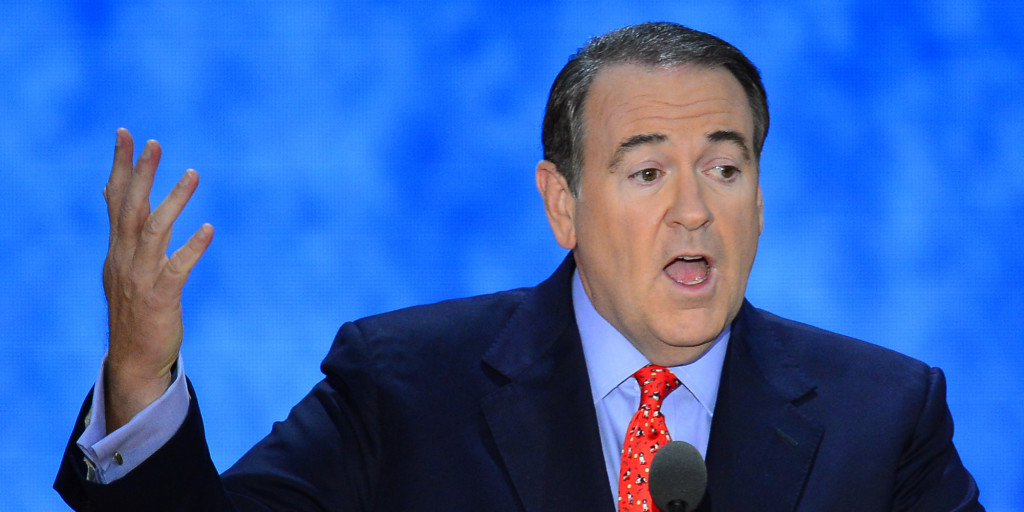
Republican presidential hopeful Mike Huckabee is visiting Alabama. Alabama Secretary of State John Merrill announced that the former Arkansas governor will stop at the Alabama Republican Party headquarters in Birmingham on Thursday. Huckabee will present his petition and filing fee to Republican Chairwoman Terry Lathan to appear on the Alabama ballot. At least eight presidential candidates have visited Alabama ahead of next year’s March 1 southeastern regional primary. Southern states have banded together in the so-called “SEC Primary” to try to draw more interest from presidential contenders. Ohio Gov. John Kasich held a rally in Mobile Tuesday evening. Republished with permission of the Associated Press.
Daniel Sutter: The U.S. hurricane drought
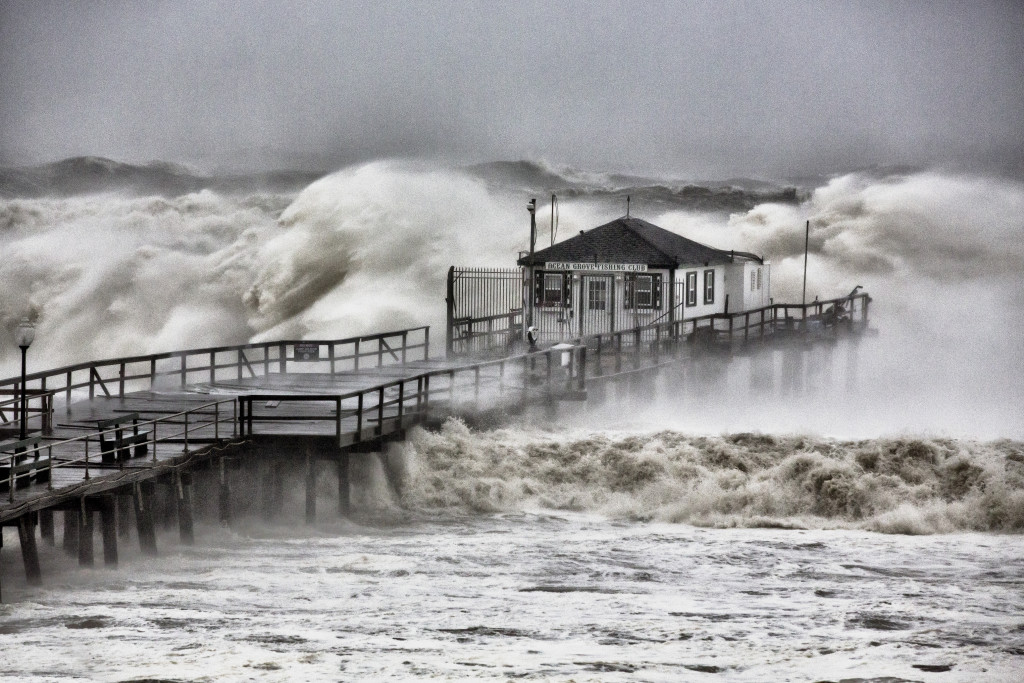
Last weekend marked ten years since Hurricane Wilma struck Florida as a Category 3 storm on the Saffir-Simpson hurricane intensity scale. Wilma was the last major hurricane (categories 3, 4 and 5) to strike the U.S. Ten years is the longest span between major hurricane landfalls since 1851, exceeding the longest prior drought (1860-1869) by over a year. The hurricane future appeared very different ten years ago. Global warming was allegedly making hurricanes more frequent and devastating, and hurricanes were going to get worse. The busy 2004 and 2005 seasons certainly made hurricanes seem more frequent. The 2005 Atlantic season featured 28 named storms (we ran through our alphabet and had to use Greek letters as names) and 15 hurricanes, both records. Katrina devastated New Orleans and the Mississippi coast that year. Seven major and thirteen total hurricanes struck the U.S. in 2004-05. Hurricanes also seemed more devastating than ever. Katrina caused $100 billion in damage (adjusted for inflation) and the highest U.S. death toll since 1928. At the end of 2005, 6 of the 8 costliest hurricanes on record had occurred in the previous two years. This part of the tale, however, was misleading. Economists know to adjust historical dollar figures for inflation. But adjusting for inflation does not make damage from past and present hurricanes fully comparable. Increases in population and wealth mean that hurricanes have a lot more property to destroy now. Damage normalizations assuming that damage will increase proportionally with population and wealth per person provide more accurate comparisons. Normalizations provide an educated guess about the damage we could expect if past hurricanes occurred today. Normalization dramatically increases the damage measured in past hurricanes. Consider the “Great Miami Hurricane” of 1926. Miami Beach has grown from a population of 644 in 1920 to 90,000 today, and is home to some very expensive real estate. Normalized damage from the Great Miami Hurricane exceeds $200 billion, or more than double Katrina’s total. Once normalized, hurricane damage has not been increasing over time. Increases in population and property at risk, what researchers call societal vulnerability, explain rising damages. Societal vulnerability has increased significantly. The population of Atlantic and Gulf coast counties, for example, has increased from under 6 million in 1900 to almost 38 million in 2010. The value of insured property at risk from hurricanes now exceeds $10 trillion. Societal vulnerability is not necessarily bad. The U.S. population has more than quadrupled since 1900, and people must live somewhere. Areas safe from hurricanes can face tornado, earthquake, or tsunami risk. Furthermore, Americans value living and vacationing near the ocean, while many industries must locate near the coast. We can now afford what previously would have been catastrophic losses. Coastal development is worthwhile as long as the value created exceeds the potential hurricane damage. The extra costs will be reflected in prices of rental or vacation properties, or goods like gasoline or chemicals. Several government policies, however, subsidize hurricane losses and thus encourage development when the value created does not exceed the extra costs. The two most prominent policies are state homeowners insurance regulation and the National Flood Insurance Program. Both of these policies push some of the costs of insurance against hurricanes on to other Americans. Does the U.S. hurricane drought prove that global warming is not occurring? Not necessarily. This past decade has witnessed some active Atlantic hurricane seasons, and Mexico has been hit be two Category 5 hurricanes, including Patricia this past weekend. The drought might just be luck. And yet the hurricane drought, combined with the more than decade-long warming pause in satellite-measured temperature records, like the one maintained at the University of Alabama-Huntsville, should make us rethink global warming policy. The Clean Power Plan, for instance, will cost us hundreds of billions of dollars, and yield few benefits if warming is not as bad as climate models forecast. On the other hand, the U.S. will be hit by major hurricanes in the future regardless of whether the climate warms. Eliminating inefficient government policies will reduce the cost of hurricanes, and the damage avoided will escalate if global warming strengthens future hurricanes. Daniel Sutter is the Charles G. Koch Professor of Economics with the Manuel H. Johnson Center for Political Economy at Troy University and host of Econversations on TrojanVision.
Donald Trump says ads are coming to early-voting states
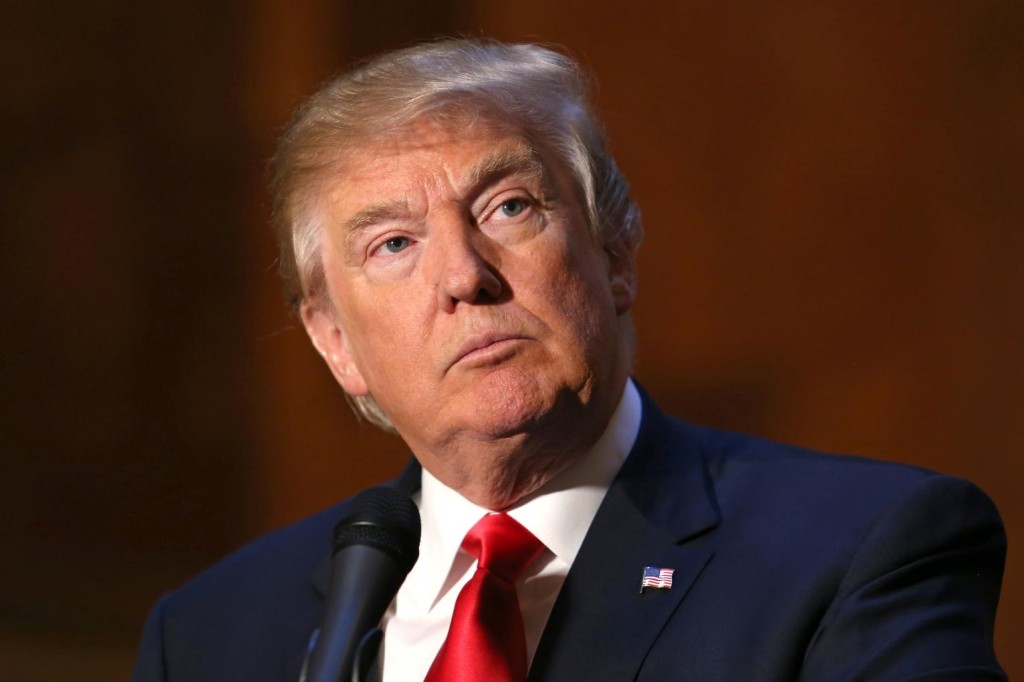
Republican presidential candidate Donald Trump says he’s finally planning to put some money on the line as several of his rivals receive new attention and support. The billionaire businessman, who has so far relied on the news media to promote his unorthodox campaign, said in an interview Tuesday night on Fox News that his campaign will begin paid advertising soon in the first states to vote in the GOP nomination race. “We’re going to start some ads, I think, over the next two days,” he said in the interview with Fox’s Sean Hannity. “Certainly in Iowa, we’re going to start ads, and in New Hampshire and, I think, in South Carolina, too. So, we’re going to start advertising a little bit.” Trump’s campaign did not immediately respond to a request for more details about the timing or how much Trump planned to spend. His campaign had not reserved any television advertising time as of Tuesday, according to Kantar Media’s CMAG advertising tracker. Trump said in early October that he had ads in the works, but in the weeks since has said he didn’t think they were necessary given how much attention he’s already given and the potential for Trump overload. Despite Trump’s boasting that he self-funds his campaign, the vast majority of the cash he has spent so far has come from donor contributions. Still, he has spent far less than many of his rivals — thanks, he’s said, to the fact that he hasn’t had to spend millions on paid ads. “I was going to have spent $25 million by this time. I’ve spent nothing. I feel guilty because I’ve spent nothing ’cause, we haven’t needed it,” he said Tuesday. “But we’re going to start spending a little bit of money over the next three or four weeks.” Trump dominated opinion surveys throughout the summer, but several of his rivals have been garnering new attention from voters and donors this fall. To those who may be thinking about going after him with negative ads, he added a warning. “Look, anybody that hits me, we’re going to hit them 10 times harder,” he said. “We’re going to just dollar-for-dollar, we’re going to go after them. We have more money than anybody else by a factor of about 1,000.” Republished with permission of the Associated Press.
