
Richard Shelby slams Barack Obama over “misguided and dangerous” executive order
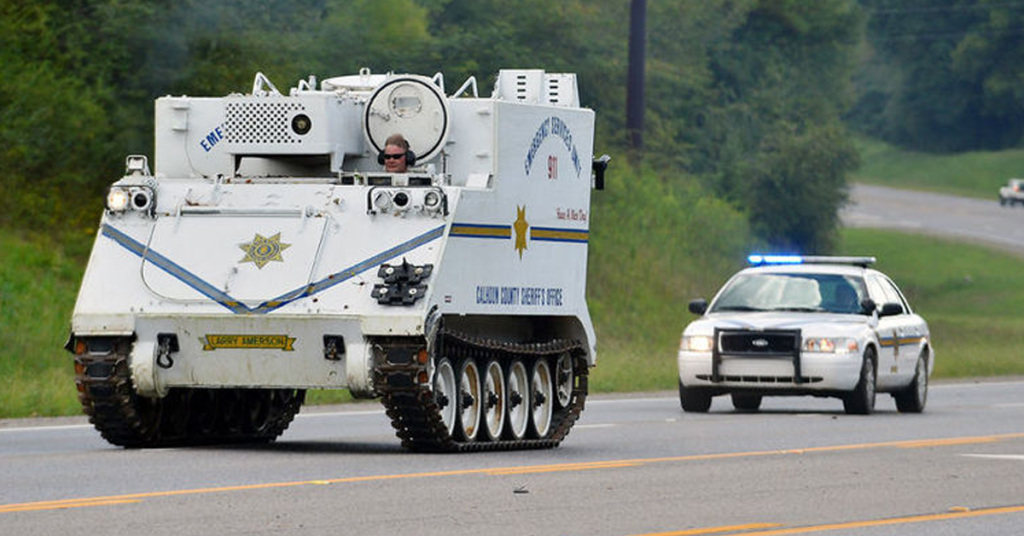
U.S. Senator Richard Shelby Tuesday called on President Barack Obama to reverse an executive order he claims is “misguided and dangerous” and has resulted in two unarmed, tracked armored vehicles being taken from the Calhoun County Sheriff’s Office last week. For over 20 years, under the federal government’s 10-33 program, the Department of Defense has distributed surplus military equipment and vehicles to local law enforcement across the county, including the Calhoun County sheriff’s department. Last Wednesday, the federal government forced Calhoun County sheriff Larry Amerson to return two 10-33 vehicles. According to a statement from the sheriff’s office, the vehicles were first obtained from the federal government after a mentally ill person shot three Anniston police officers in 2001 and other officers had no protection to remove the injured from the area. “Time and time again, President Obama abuses the authority of his office by making unilateral decisions through executive fiat,” explained Shelby. “From his attempts to grant executive amnesty to illegal immigrants and his plans to allow Syrian refugees to resettle in the United States, to his decision to take away vehicles from local law enforcement in Calhoun County, it is clear that this president is more interested in scoring political points than ensuring the safety of our citizens.” “We live in an increasingly dangerous and uncertain world, and we cannot allow President Obama to prioritize protecting those trying to do us harm over those trying to protect us. I will continue to fight against this flawed, irresponsible executive action that expands Washington’s influence in our communities and weakens local law enforcement’s ability to protect us.” Obama made the change to the long-standing policy and issued the executive order following civil unrest in Ferguson, MO after the shooting of teenager Michael Brown when local police deployed a number of military-style vehicles to defend against civilian protesters on the city streets. “We’ve seen how militarized gear can sometimes give people the feeling like there’s an occupying force,” President Obama explained. “As opposed to a force that’s part of the community that’s protecting them and serving them.” Obama believe that type of equipment “can alienate and intimidate residents and make them feel scared.”
Joe Morton: Alabama children’s education path clearly is before us

The Business Education Alliance of Alabama unites business and education with dual goals of providing the best education opportunities and skills training available for Alabama’s students and encouraging growth for teachers. The BEA helps provide tools that prepare students for the competitive 21st Century workforce. We at the BEA are pro-business and pro-education because both communities have a shared goal of propelling Alabama into a position of national and international leadership in economic development and education excellence. Recently the TimesDaily and the Decatur Daily encouraged the Alabama Education Association to right its ship, as it likely will. All Alabama education organizations with a goal of uplifting children and supporting professional teachers are invited to work with the BEA towards creating an education system that does not keep children hostage to the past. The BEA works to unite, not divide, business and education so that students and parents are better served and our economy is improved. We are committed to providing accurate and unbiased information to leaders in both the public and private sectors to better determine and implement the best public policies for our state. For example, our August 2015 report, “Teachers Matter: Rethinking How Public Education Recruits, Rewards, and Retains Great Educators,” is a blueprint for reaching the next level. Within the last several years, the forward-looking Alabama Legislature has passed important and effective new education tools that will help Alabama’s students see a brighter future that will uplift them, their families, and the businesses which employ them. One vision was to allow parents to take charge of their children’s educations and create a pathway for students to escape the limited education opportunities within their zip code. Change began in 2013 with passage of the important Alabama Accountability Act. With this law, Alabama joined 12 other states on a new path toward education modernization and excellence. The law provides the opportunity for low-income students to apply for tax credit scholarships that are funded by individual or corporate taxpayers and administered by scholarship-granting organizations. Virtually all of the scholarships in 2014 went to children who qualified for free or reduced-price lunches. In 2015, the Legislature followed up with a public charter school law that local school systems may use to create innovative options and best serve students whose needs are currently unmet. The law allows local school boards to develop public charter schools to help all students. And legislators have made wise investments in high quality pre-Kindergarten, Dual Enrollment, Advanced Placement, Distance Learning, and Career Tech, which prepare students for success on the front end and ensure pathways to college and careers on the back end. These are examples of Alabama’s wishes enacted through our elected officials who see an Alabama moving toward a quality 90 percent high school graduation rate, skilled training for those who do not want to attend traditional college, and education funding free of systemic and crippling proration. Alabama must continue to recruit the jobs of tomorrow that will hire skilled and educated students. To do that, Alabama must concentrate on all students meeting high standards and at a minimum graduating from high school career- and or college-ready. With skilled and educated graduates, Alabama employers can be guaranteed the trained and effective workforce they need in order to remain here, for Alabama’s economy to grow, and for the Education Trust Fund to prosper. Former Alabama State Superintendent of Education Joe Morton, Ph.D., is chairman and president of the Business Education Alliance of Alabama.
Daniel Sutter: Bad economics produces poor policy
Do you care about the mileage your car gets? Some economists, and the bureaucrats at the Department of Energy (DoE), don’t think so, and use this belief as a basis to restrict the products available on the market. Research examining different energy-related decisions, like the purchase of high mileage cars and energy saving appliances, and insulating and weatherizing homes, provides support for this belief. But the research is largely bad economics, and based on confusion. Engineers and economists use the term energy efficiency very differently. Engineers consider an appliance or machine energy efficient if it uses less energy to perform a task. Economists say we use energy efficiently when we minimize the cost of energy use plus the cost of saving energy. As an economist I think that our definition is more relevant, but let’s consider why. Would you want to buy a car that gets 60 miles per gallon but cost $200,000, or cost only $20,000 but could go only 30 miles per hour? Would you want to buy a clothes dryer that used little electricity but required 2 days to dry a load of clothes? I suspect not. The engineering focus on energy use to the exclusion of other considerations makes for economic nonsense. Many studies purport to find evidence that Americans consumers and businesses fail to buy more expensive products that use less energy and engineers believe would “pay for themselves” in cost savings. This result has become known as the “energy efficiency paradox.” But it is bad economics. Good economics attempts to understand decisions as consumers or businesses do; there are many reasons why people may not to purchase the product using the least amount of energy. This thinking is affecting our lives. The DoE has been aggressively tightening energy efficiency standards authorized by the Energy Policy and Conservation Act of 1975. The DoE in 2015 was in the process of revising 35 standards for residential and commercial products. Each standard limits Americans’ freedom of choice by only allowing products meeting DOE’s definition of efficiency on the market. Global warming policy also exploits the energy efficiency paradox as a cheap way to meet a large part of the greenhouse gas emissions reductions needed to meet the Clean Power Plan’s targets. The cost of meeting the Clean Power Plan’s emissions reductions will greatly exceed estimates if the energy efficiency paradox is not valid. Economist Walter Williams, who will be visiting Troy and the Johnson Center next spring, has often noted that while a thief will take your money and be off, a politician takes your money and then insists on telling you that you are better off as a result. Similarly, the DoE’s cost-benefit analyses claim that we are better off being prevented from buying the refrigerators, air conditioners, and dryers we would otherwise. Do Americans in fact ignore energy costs? When I was growing up, I helped my Dad insulate our house to save on winter heating costs. Millions of Americans bought fuel efficient cars imported from Japan in response to the Energy Crisis of the 1970s. Record oil prices over the past decade led many people to buy hybrids, while people are driving more in response to this year’s lower prices. The evidence confirms what we know from our own actions. The used car market allows us to see if Americans value energy savings, since higher gas prices should reduce the price of cars which get poor gas mileage. Studies have consistently found that used car prices move as expected. Economists Ted Gayer and Kip Viscusi recently concluded that research on energy efficiency “does not provide strong, credible evidence of persistent consumer irrationality.” The United States was founded on the principle that government exists to serve citizens, which I hope we still believe in. If so, it is illegitimate for politicians and bureaucrats to impose their choices on us simply because they can. Many policy makers now feel free to override Americans’ decisions about energy due to charges of irrationality based on weak evidence and bad economics. Bad economics often leads to poor government policy, and we suffer the consequences. Daniel Sutter is the Charles G. Koch Professor of Economics with the Manuel H. Johnson Center for Political Economy at Troy University and host of Econversations on TrojanVision.
