
Time is running out for Donald Trump’s rivals to stop him

Donald Trump‘s rivals are running out of time to stop him after his dominant performance in South Carolina. A close look at the election calendar suggests that if the New York billionaire’s rivals don’t slow him by mid-March, their only chance to deny him the Republican presidential nomination may be a nasty and public fight at the party’s convention this summer. “When you look at it right now, it looks like there’s this juggernaut,” said Rich Beeson, a senior aide to one of Trump’s main rivals, Florida Sen. Marco Rubio. The reason is delegates and how they’re awarded. Winning states generates headlines, but the nomination is earned by collecting a majority of the delegates awarded in primaries and caucuses. Next up: Nevada’s caucuses on Tuesday. This year, most contests award delegates proportionally, based on each candidate’s share of the vote. Beeson and strategists for other campaigns argue that could make it hard for Trump to build a big lead because even the second- and third-place finisher can win delegates. If one candidate can run up a significant lead, as Trump has begun to, then proportional contests also make it difficult for rivals to catch up. South Carolina is the perfect example of this problem for Rubio and Texas Sen. Ted Cruz. The state isn’t winner-take-all when it comes to delegates, but Trump’s strength in all parts of South Carolina allowed him to haul in all 50 delegates awarded in Saturday’s primary. Trump now has 67 delegates. Cruz and Rubio took home none from South Carolina, leaving them with a total of 11 and 10, respectively. Trump is well on his way, and he knows it. “Folks, let’s go, let’s have a big win in Nevada, let’s have a big win in the SEC,” Trump said in his South Carolina victory speech, referring to the states with universities in the Southeastern Conference that will vote next month. “Let’s put this thing away.” Only a small fraction of the delegates to be won in the GOP primary season, which began Feb. 1 in Iowa and ends June 7 in California and a handful of other states, have been awarded to date. But some of Trump’s opponents acknowledge he could build an insurmountable lead by mid-March if current trends continue. “There are going to be a lot of circumstances where we can declare some victories and at least get this thing to March 15,” Beeson said. “Once we get to March 15, if the die has not been cast by then, it’s a different game.” Why March 15? That’s the first day on which the GOP’s rules allow states to hold a winner-take-all contest. Florida will award 99 delegates that day, while Ohio will give out 66. The Missouri primary is that day, too. Like South Carolina, Missouri awards a pot of delegates to the statewide winner, as well as three delegates each to the winner of each congressional district. That makes it possible for one candidate to win all of Missouri’s 52 delegates, or at least a large majority. Put simply, it’s a day in which a candidate running second to Trump could catch up. Or fall even further behind. Altogether, there are 14 such contests on the GOP primary calendar, offering a total of 752 delegates. That’s not enough delegates to claim the nomination; it takes 1,237. But if one candidate wins most of those states, he could build a lead too big to overcome. In the modern political era, a candidate usually wins enough delegates to emerge as the presumptive nominee several weeks — or even months — before the end of primary voting. That happens when the candidate claims so many delegates it’s all but impossible for anyone else to catch up. But the nomination isn’t formalized until the party’s presidential nominating convention, scheduled for July this year. The last time the Republican nomination wasn’t decided before the convention was 1976. Yet some of Trump’s rivals are already talking about the possibility of a “contested” convention as they envision a series of second- or third-place finishes in the upcoming GOP primaries. Rubio’s campaign manager, Terry Sullivan, recently told The Associated Press, “I would be surprised if it’s not May or the convention” when the party settles on its nominee. At the convention, a lead in the race for delegates guarantees nothing if the candidate doesn’t have an outright majority, said Ben Ginsberg, a leading Republican election attorney. Under most state party rules, delegates are only required to vote for their candidate on the first ballot at the convention. “If no one comes into the convention with a majority of delegates, then all bets are off,” Ginsberg said. “You’re dealing with a potentially unruly and independent group of people.” Republished with permission of the Associated Press.
Marco Rubio, Ted Cruz jostle to claim ‘alternative-to-Donald Trump’ vote
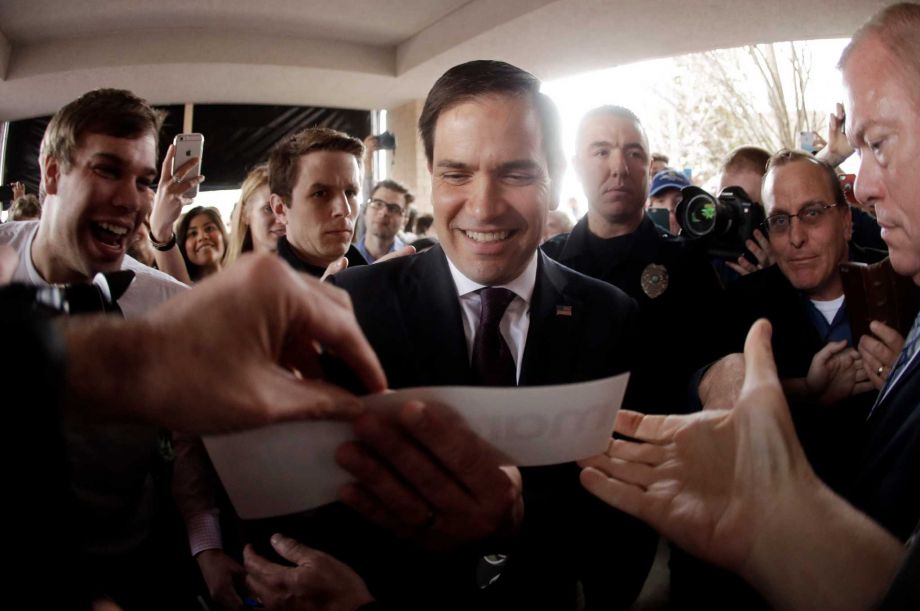
Republicans Marco Rubio and Ted Cruz battled to emerge as the true anti-Trump on Sunday as the billionaire businessman took an ever-so-brief break from his trademark braggadocio to say his drive for the GOP nomination isn’t unstoppable — yet. Fresh off a commanding victory in South Carolina, Donald Trump declined to say the nomination was his to lose. But he quickly went on to declare, “I’m really on my way.” Soon enough, in a television interview, he was toting up electoral math all the way through Election Day and concluding, “I’m going to win.” The candidates’ diverging flight plans demonstrated how the campaign spreads out and speeds up now. Nevada’s GOP caucuses are Tuesday, and then a dozen states vote in the March 1 Super Tuesday bonanza. Trump was in Georgia exulting over his latest victory, Cruz headed for Nevada, and Rubio embarked on a Tennessee-Arkansas-Nevada trifecta. On the Democratic side, Hillary Clinton savored her weekend win in the Nevada caucuses as Bernie Sanders acknowledged that while his insurgent campaign has made strides, “at the end of the day … you need delegates.” He looked past Tuesday’s Democratic primary in South Carolina to list Colorado, Minnesota, Massachusetts and Oklahoma as places where he has a “good shot” to do well. Rubio and Cruz used the Sunday morning news shows to spin rosy-road-forward scenarios after complete but unofficial returns in South Carolina put Trump way up top, with Rubio squeaking past Cruz for second. But with roughly 70 percent of Republicans in national polls declining to back Trump, Cruz and Rubio tried to cast themselves as the one candidate around whom what Rubio calls the “alternative-to-Donald-Trump vote” can coalesce. Rubio also took an aggressive run at Trump, faulting him for a lack of specifics on policy. “If you’re running for president of the United States, you can’t just tell people you’re going to make America great again,” he said on CBS’ “Face the Nation.” At a later rally in Franklin, Tennessee, a Nashville suburb, Rubio took note of the smaller GOP field after Jeb Bush‘s departure from the race, and celebrated his biggest crowd of the campaign, estimated at more than 3,000 people. Rubio avoided criticizing his GOP rivals, instead highlighting his efforts to help middle-class families. Cruz, for his part, stressed his conservative bona fides and said he was the lone “strong conservative in this race who can win. We see conservatives continuing to unite behind our campaign,” he told NBC’s “Meet the Press.” With Bush gone from the race, Rubio was hoping to pick off past donors to the Bush campaign and looking to benefit as well from a cessation in the millions of dollars in negative ads run by the Bush campaign and its allies. Rubio also suggested it was only a matter of time before John Kasich and Ben Carson folded as well. He hinted it would be better to get that winnowing over with, saying, “the sooner we can coalesce, the better we’re going to be as a party in general.” Not so fast, Kasich countered. “We’re getting big crowds everywhere we go,” the Ohio governor insisted, listing Vermont, Massachusetts and Virginia as places he can shine. Cruz tried to brush right past his apparent third-place finish in South Carolina and instead hark back to his victory over Trump in leadoff Iowa. “It is becoming clearer and clearer that we are the one campaign who can beat Donald Trump,” Cruz told reporters before a campaign stop in rural Nevada. The Texas senator said his path to victory calls for a strong showing on Super Tuesday, and that Texas was “clearly the crown jewel” of that day. Rubio, a Florida senator, highlighted the big delegate take available in the five-state round of voting on March 15, which includes his home state. He noted that round offers victors a “winner-take-all” share of delegates rather a proportional share. Cruz scoffed at Rubio’s strategy, saying: “They’re trying to wait until March 15 to win a state.” Trump suddenly had nice things to say about Bush, the candidate he had hammered so relentlessly when they were rivals. As for Rubio, Trump told “Fox News Sunday” that “I start off liking everybody. Then, all of a sudden, they become mortal enemies.” At a rowdy Atlanta rally, Trump crowed over his big South Carolina win, saying “we’re just doing one after another.” Spitting out the superlatives, he called his sweep of all 50 delegates there “amazing,” ”beautiful,” ”conclusive” and “very, very decisive.” Clinton was happy with her Nevada win but acknowledged she has work to do in persuading voters that she has their best interests at heart. “I think there’s an underlying question that maybe is really in the back of people’s minds and that is, you know, is she in it for us or is she in it for herself?” Clinton said on CNN. “I think that is a question that people are trying to sort through.” Working to increase his support among black voters, Sanders visited a Baptist church luncheon following services in West Columbia, South Carolina, and talked up the country’s economic recovery under President Barack Obama. Republished with permission of the Associated Press.
Marco Rubio brings optimistic conservative message to Sunday shows
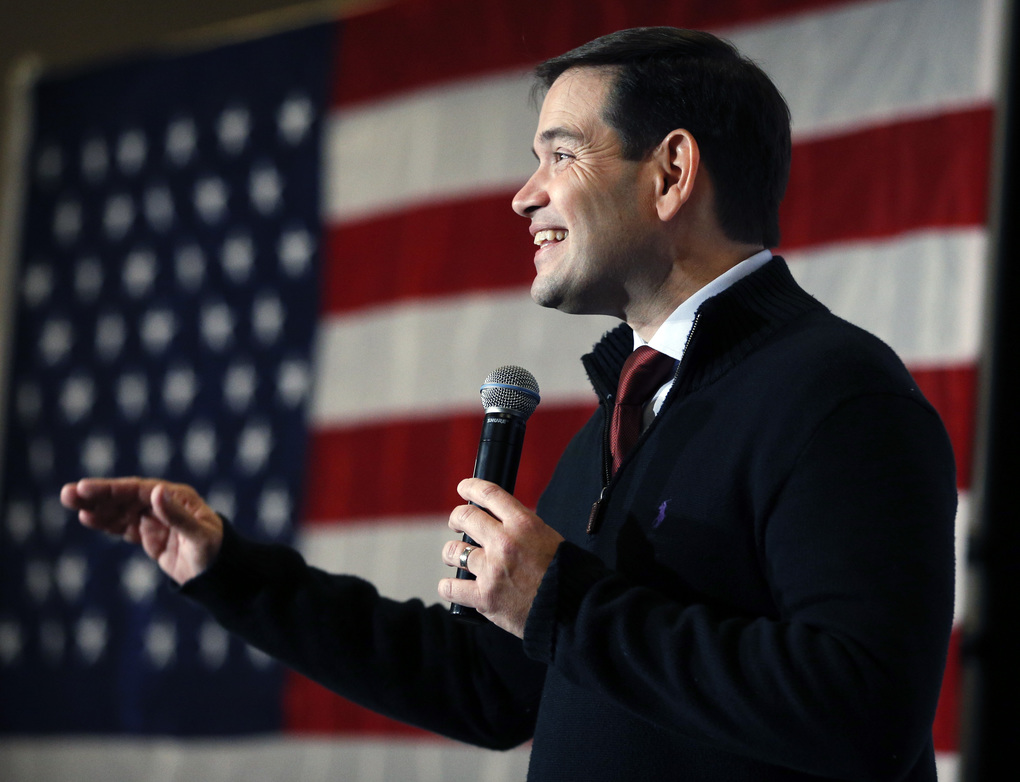
On all four broadcast network Sunday shows, Marco Rubio attempted to position himself as the “optimistic conservative” in a three-man race for the GOP nomination. On Meet the Press, Rubio was asked why he should “feel good” about coming in a “distant second” in South Carolina. Rubio’s answer boiled down to being the logical alternative to Trump. “Seventy percent of Republicans want someone other than Donald Trump as the nominee” and “more and more, that ‘alternative to Trump’ vote is coming to us.” Rubio asserted that Trump will find it increasingly hard to “crowd people out” with “outrageous statements” as the field narrows, leaving an opening for his campaign which is “very realistic about the challenges” ahead, yet “very optimistic about the future.” Rubio was asked about his previous immigration position, one that synced up neatly with that of the President, as a relatively devastating attack ad that had Rubio and Obama talking points paralleling each other indicated. “People don’t care about it,” Rubio said, “it doesn’t matter.” Rubio pivoted to his proposed course of action now: the “only way forward is by doing it in pieces,” and that first piece is “securing the border.” Rubio then discussed his national strategy going forward, headed into Super Tuesday, stopping short of guaranteeing an outright win anywhere, while insisting his was a “national campaign.” “All of these states award delegates differently,” and the Winner Takes All states are “where we need to win.” On Fox News Sunday, Rubio likewise was on message, saying that the narrowing field will allow “the remaining 70 percent [of non-Trump support] to coalesce” as the field shrinks to three “full-scale national campaigns.” Rubio pushed the narrative of Reaganesque optimism when asked to compare his effort to Trump’s, saying his presentation was “very optimistic about the future” with “real answers to real problems,” as opposed to Trump’s constant messaging about “how bad things are.” “I look forward to having a policy debate,” Rubio said, “if we can make it” one. Rubio also addressed Ted Cruz, who is “very weak on national security,” and whose campaign “tenor” has “voters increasingly troubled.” When asked if Cruz had the integrity or character to be President, Rubio noted that “from his campaign it’s missing,” citing robocalls in South Carolina that charged that Rubio was cutting his campaign short and would end it altogether if he didn’t win South Carolina. Rubio also messaged against the attendance-record criticisms that have simmered around his stints in the Florida House and the Senate. In the House, he said being majority whip necessarily hampered his ability to make some committees, such as the special committee on 9/11 related issues. And in the Senate, scheduling likewise was a burden. Often, he said, “three committees are meeting at the same time,” making it hard to “be at every hearing” when another committee “could be having votes. ABC’s This Week offered some variations on the theme. Rubio addressed Trump’s recent retweet that Rubio and Cruz may face eligibility issues related to being native born, by pointing out the media coverage of every time “Trump says something edgy and outrageous,” a tactic that’s “not working with the narrowing field.” Regarding why he hasn’t gone on the offense against Trump, Rubio kept it positive, saying the “election’s about who is most capable of leading” the party, before casting doubt on Trump’s ability to lead on day one. “Putin’s not going to [provide] a six-month honeymoon period,” Rubio said, adding that the “world’s not going to wait” for Trump to get his bearings. Rubio also was asked if Mitt Romney was poised to endorse him, a meme floated by the Huffington Post. Romney, Rubio said, is “not scheduled to endorse me,” which is a nice turn of phrase, and that added that “if he were, we wouldn’t announce it on the Huffington Post.” Rubio brought his message to Face the Nation, reiterating his contention that 70 percent of the GOP electorate is up for grabs in a three-man race, and that, unlike Trump, he’s “very realistic about our challenges” yet “optimistic about our future.” “You can’t just tell people you’re going to Make America Great Again. You’ve got to explain how you’re going to do it, policy-wise.” Rubio also described Trump’s views of Putin as “troubling,” saying that the frontrunner “doesn’t understand who Putin is, or what he’s trying to do.” Rubio has policy questions about “everything” related to Trump policy positions, ranging from Obamacare to Supreme Court philosophy. “The Democrats, if we nominate somebody who’s nebulous about these things, they will eat our lunch.” The narrowing of the field, Rubio said, was on schedule with his campaign’s initial read of the race, before the “Winner Take All states.”
A roundup of Sunday editorials from Alabama’s leading newspapers

A roundup of Sunday editorials from Alabama’s leading newspapers: Anniston Star – Nelle Harper Lee, 1926-2016 “You never really understand a person until you consider things from his point of view … until you climb into his skin and walk around in it.” — “Before I can live with other folks, I’ve got to live with myself. The one thing that doesn’t abide by majority rule is a person’s conscience.” — “Real courage is when you know you’re licked before you begin, but you begin anyway and see it through no matter what.” — “Sometimes the Bible in the hand of one man is worse than the whisky bottle in the hand of (another) … There are just some kind of men who — who’re so busy worrying about the next world they’ve never learned to live in this one.” — “I think there’s one kind of folks. Folks.” Birmingham News – I can’t believe I’m actually sticking up for Donald Trump It’s not often I can side with Donald Trump. Frankly, most of his conduct disgusts me and his proposal to deport 12 million illegal immigrants would be absurdly impossible to execute. It’s equally unusual for me to criticize Pope Francis. As a life-long Catholic, I believe he is one of the best and most effective popes God has ever blessed us with since Jesus Himself walked this earth. Yet, in a classic “man bites dog” scenario, the Holy Father apparently hasn’t thought through his comment this week about Trump’s proposed wall to keep illegal immigrants from crossing our southern border. After visiting the U.S.-Mexican border, Pope Francis said this about Trump: “A person who thinks only about building walls, wherever they may be, and not of building bridges, is not Christian. This is not the gospel.” Decatur Daily – GOP misguided on Scalia replacement The Issue The prevailing GOP position on the replacement of U.S. Supreme Court Justice Antonin Scalia is a reminder that opposition to President Barack Obama is blind, not reasoned. It also suggests GOP politicians are so obsessed with short-term political goals that they are making unwise strategic decisions. In 2009, fresh off the new president’s overwhelming victory, Rush Limbaugh famously proclaimed, “I hope Obama fails.” His comment set the tone for the seven years that have followed. A Republican Party that once prided itself on having well-reasoned theories for effective governance has in the last seven years devolved into a party that only consistently stands for one thing: opposing Obama. This strategy of blind opposition has not been effective in strengthening the Republican Party. Obama won again in 2012. A party once known for the inspirational rhetoric and grand ideas of Ronald Reagan and even Abraham Lincoln, GOP politicians increasingly are recognized by the public as obstructionists. By defining itself as “the party of no,” the GOP has cobbled together a constituency that has little in common but for opposition to a single president. Dothan Eagle – Location information enhances police response A standoff between federal law enforcement officials and Apple CEO Tim Cook emerged this week after the feds asked the tech giant to develop software that would essentially create a bypass to the iPhone’s touted privacy features. Left with a locked iPhone belonging to one of the gunmen in December’s San Bernardino terrorist shootings, the government asked the company to help breach a function that would erase all data from the device following a number of unsuccessful attempts to log in. Cook and Apple have taken the stance that to create such software would be detrimental to the privacy and security of millions of American iPhone users, and millions more worldwide. As technological advances emerge, there will likely be more clashes between privacy advocates and law enforcement. However, police have also benefitted from new technology in other ways that will vastly improve service to the public. Enterprise Ledger – It’s February, but SEC jabs still connecting The jabs never cease. A recent phone conversation with a “friend” went as follows: “Hey Luke. What’s up?” “Just trying to make it home through these 162 national championship banners Alabama is now claiming.” “Oh really, well come down for a few days and we’ll talk about it, or we can talk about Auburn football over a cup of coffee.” My cousin is an avid LSU fan, growing up smack dab in the middle of Duck Dynasty territory. Each fall I get under his skin with another remark about an LSU fall out. And by each year, I mean every year since most of us could pronounce “underachievement.” But I digress. TimesDaily – Ambitious sentencing reform was needed The Issue In Alabama, we’re torn between the desire to be tough on crime and the reluctance to pay the price for an adequate corrections system. Sentencing reform legislation that took effect recently was an implicit recognition the state can’t afford the penalties it wants to impose. On Jan. 30, major sentencing reform legislation took effect in the state. It was one of the most ambitious laws passed by the state Legislature in recent years, and its passage may have owed much to its complexity. The public did not understand the law well enough to oppose it. The law’s net effect, and its goal, was to ease the penalties on nonviolent crimes. Sen. Cam Ward, R-Alabaster, shepherded the legislation through the Statehouse, and he’s taking a beating now that district attorneys and the public understand what it does. While the Legislature may need to tweak the law, Ward should not be painted as a villain. What he accomplished was long overdue. Gadsden Times – Socialism sounds good, but isn’t sustainable A lot has been written about socialism with the emergence of Sen. Bernie Sanders, D-Vt., as a serious candidate for president. Socialism has a nice ring to it and many people think it simply means taking care of all the needs of the population by the federal government. But socialism by definition is the theory or system of ownership of the means of
