
Richard Shelby welcomes Tuscaloosa WWII, Korean War veterans during Honor Flight to D.C.
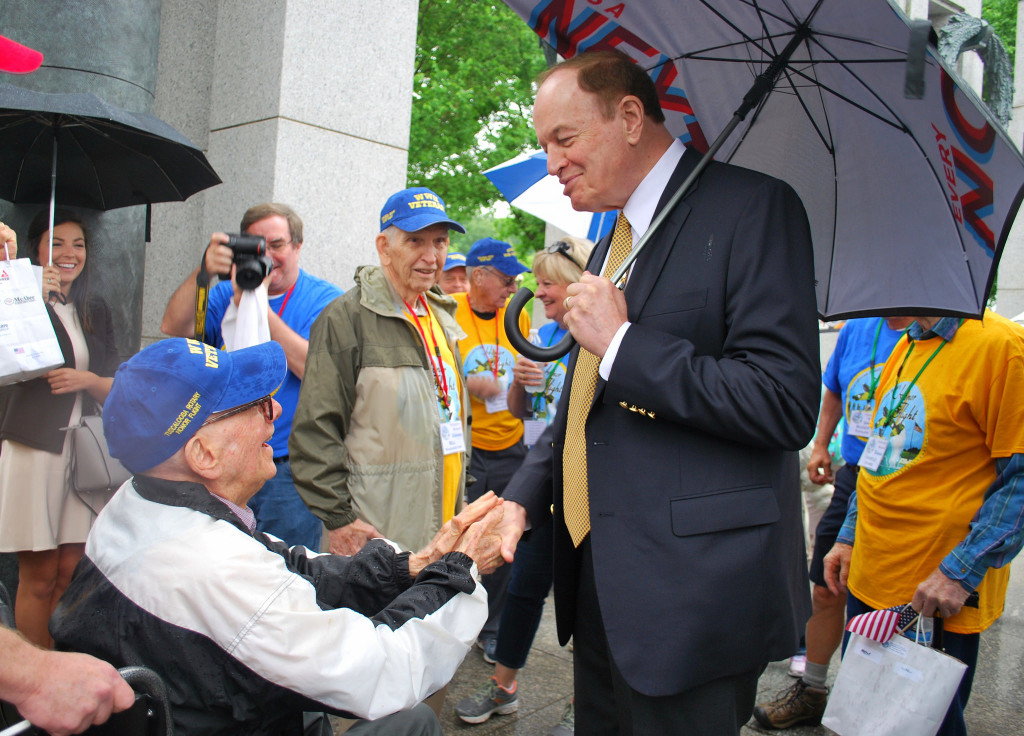
With Memorial Day right around the corner, Republican U.S. Sen. Richard Shelby took time out of his D.C. schedule to welcome Tuscaloosa World War II and Korean War veterans to the nation’s capital on Wednesday. The veterans are visiting Washington, D.C. as part of their Honor Flight, a program that helps veterans from across the country visit D.C., to see the memorials built in their honor. Flights are funded by donations from organizations and individuals. This particular trip was funded by the Tuscaloosa Rotary Club. “The Honor Flight program provides our military heroes with the opportunity to view the memorials dedicated to their service and sacrifice, and I was grateful to play a small role in paying tribute to them today,” said Shelby after meeting the veterans. “My visit with these veterans served as a reminder that we owe our men and women in uniform, both past and present, a great debt of gratitude for the freedoms we enjoy every day as Americans. We must never forget their patriotism, bravery, and selfless dedication to our great nation.” The veterans met and were photographed with Shelby at the World War II Memorial on the National Mall. Click to see more photos.
Robert Bentley signs Jason Flatt suicide prevention act into law

Alabama Gov. Robert Bentley on Tuesday signed a bill into law that requires educators and others to have training on youth suicide awareness and prevention annually, teaching them how to engage students on the issue. Sponsored by Tuscaloosa-Republican Sen. Gerald Allen, SB11 also known as the Jason Flatt Act, was named after a 16-year-old who killed himself in 1997. Flatt’s father, Clark Flatt, created the Tennessee-based nonprofit, the Jason Foundation, to raise awareness of youth suicide after his son’s death. Saban began working with the organization while he was the head coach at LSU. The act’s passage also fulfills one of the goals of the 2016 “Right for Alabama” legislative agenda Senate Republicans laid out in January of this year to expand suicide prevention training. The following paragraph was included in the agenda: Expand Suicide Awareness Prevention Education Training Suicide affects youths of every ethnic, economic, and social background. Equipping K-12 teachers with the tools and training to speak with students about suicide prevention will reduce the stigma associated with suicide and the illnesses and emotions that lead to it. Bentley’s signature make Alabama the 18th state to pass the Jason Flatt Act since 2007. The law also passed in the following states: Alaska, Arkansas, California, Georgia, Illinois, Louisiana, Mississippi, Montana, North Dakota, Ohio, South Carolina, South Dakota, Tennessee, Texas, Utah, West Virginia, Wyoming, and Alabama.
Alabama’s 2016 Congressional Art Competition winners announced

Each spring, high school students from across the state submit their artwork to the annual Congressional Art Competition for a chance to represent their congressional district in the U.S. Capitol with their artistic talents. Sponsored by the Congressional Institute to recognize and encourage artistic talent in each congressional district, more than 650,000 high school students have participated in the competition since it began in 1982. Winners are recognized both in their district and at an annual awards ceremony in Washington, D.C. The winning works are displayed for one year at the U.S. Capitol. Here are the winners from across the Yellowhammer State this year: Alabama’s 1st Congressional District Winner: Leah Brown Piece: “Full Capacity” High School: St. Paul’s Episcopal School “The Congressional Art Competition gives us an opportunity to put the impressive artistic talents of students in Southwest Alabama on full display,” said Rep. Bradley Byrne (AL-01). “I am especially proud of Leah Brown, this year’s winner, and I look forward to seeing her artwork on display in the U.S. Capitol. “I am constantly amazed by the high-quality of artwork produced by students in our area high schools. This year was no different, and I applaud each student, as well as the teachers, for their participation and commitment to the arts.” Click “1” below to see Alabama’s 2nd District winner
DHS freed nearly 20,000 convicted criminal immigrants in 2015

The U.S. repeatedly tried to deport Jean-Jacques, an immigrant living in the U.S. illegally, but his native Haiti wouldn’t take him back after he served more than a decade in a state prison for attempted murder and committed multiple parole violations. Each time Jacques was arrested on a parole violation, he would serve a sentence in state prison and then be released to immigration custody. At least three times, Haiti refused to take him back, so Immigration and Customs Enforcement officials in early 2015 did the same thing they do thousands of times a year – they released a violent criminal immigrant from jail. Six months later, Jacques killed Casey Chadwick, a young Norwich, Connecticut, woman. He was convicted of murder last April and faces sentencing this summer. Jacques is a textbook example of the kind of immigrant living in the U.S. illegally that the Obama administration says should be returned to his home country. But that’s easier said than done. Jacques’ release and that of more than 19,700 convicted criminal immigrants during the 2015 budget year reveal yet another complication in the country’s complicated immigration system. ICE has released tens of thousands of convicted criminals. Combined, those people have been convicted of hundreds of thousands of crimes, including murder and sexual assault. Jacques’ case and those of others like him show how difficult it would be to carry out proposals by some politicians, including presumptive Republican presidential nominee Donald Trump, which immigration officials simply find and deport the estimated 11 million immigrants living in the country illegally. ICE Director Sarah Saldana told Congress recently that agents routinely have little choice but to release immigrants. Saldana said the agency is bound by a complex set of immigration laws and rules that govern which immigrants have to be detained and which ones can be set free while they wait for an immigration judge to rule on their case. Add to the mix a yearslong immigration court backlog of nearly half a million cases and some criminal immigrants could be free in the United States for years before being ordered out of the country. “What is unacceptable is even one (release). Why did you release even one person?” Rep. Jason Chaffetz, R-Utah, asked Saldana. Saldana also told lawmakers that an effort to develop a system to alert local authorities about a newly released criminal immigrant is underway. But lawmakers and others say it’s not enough. “They got caught committing a crime. They were convicted of the crime and instead of following the law and deporting them; you released them … and they commit more crimes,” Chaffetz said. “That is so wholly unacceptable.” Chester Fairlie, the Chadwick family’s lawyer, said criminal immigrants like Jacques need to stay in jail. And the government could pressure other governments to take back their citizens, he said, by cutting aid packages or reducing the number of visas available for their citizens to come to the United States. “It seems to me that our State Department should have enough leverage to say to them, you cannot arbitrarily refuse to take these people back,” Fairlie said. The House Judiciary Committee approved a bill in March 2015 that would allow the U.S. to continue to detain some criminal immigrants even if their home country won’t take them back. It hasn’t progressed beyond the committee. But Chaffetz said the administration already can pressure foreign governments to take their citizens back by curbing visas. He said Homeland Security officials need to ask the State Department to impose those visa sanctions. “By U.S. law, these countries must accept deportations or we won’t give any more visas,” Chaffetz said. “All I’m asking is that the administration enforces current law.” The State Department said Wednesday it has been asked to curb visas in the past, and a meeting is planned between State and DHS officials. It is expected that DHS officials will make a new request for some visa sanctions, but it’s unclear which countries may be targeted. The government has briefly stopped issuing some temporary work visas for immigrants from certain countries that have refused the return of their citizens, including Guyana in 2001. Such efforts can be a sort of signal to other nations considering blocking the return of some criminal immigrants. “You can do it in a targeted way and stop issuing certain categories of visas,” said Igor Timofeyev, a former director of immigration policy and a special adviser for refugee and asylum affairs at DHS during President George W. Bush‘s administration. But the effort can be fraught with political and diplomatic complications, Timofeyev said. In the case of China, for instance, a complicated political and economic relationship means that being able to send home criminal immigrants is not the only consideration for an administration. Nevertheless, Chaffetz and other Republican lawmakers have repeatedly pressed DHS officials to kick-start efforts to penalize countries whose governments have refused to cooperate with deportation efforts. “They shouldn’t be getting federal aid,” Chaffetz said during the hearing on the issue. “And we shouldn’t be giving them visas so that more people from those countries can come to the United States.” Republished with permission of the Associated Press.
