
Mike Hubbard trial day 12: Defense rests case, closing arguments begin
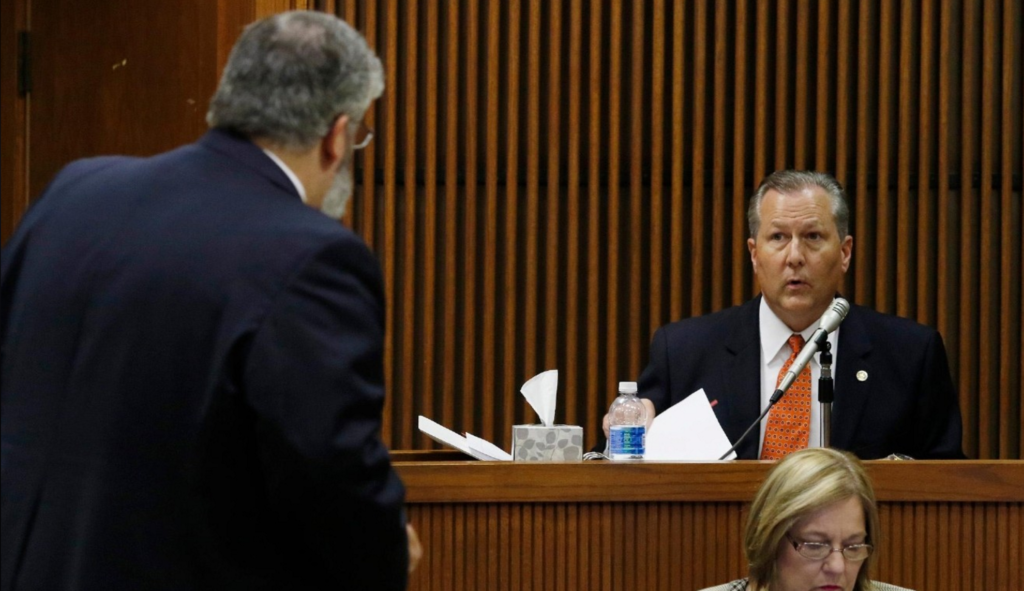
After nearly three weeks of testimony from witnesses including high-profile names such as Gov. Robert Bentley, former Gov. Bob Riley, Senate President Pro Tem Del Marsh, the defense rested its case against Alabama House Speaker Mike Hubbard Thursday morning after calling but one witness — Hubbard himself. Hubbard spent little more than an hour Thursday morning testifying, hoping to prove his innocence. Early Thursday, prosecutor Matt Hart brought up an email Hubbard sent to Michael Mitchell, a Publix representative, asking to set up a meeting about Capitol Cups – a company Hubbard had a consulting contract with that paid $10,000 a month. In the email, Hart told the courtroom that Hubbard called Capital Cups a constituent and even signed the email with his Alabama House Speaker title. The defense argued this was an automatically generated email signature. Hart prodded Hubbard, asking if he mentioned in the email to Mitchell that he was working as a consultant for Capital Cups. “No sir. Didn’t think it was relevant,” Hubbard replied. Hubbard went on to testify that Mitchell was a friend who sadly died a few years ago of an aneurysm. Hart quickly pointed out that Mitchell must not have been that good of a friend, as he just spoke with him a few days ago. “Well I must have him confused with someone else,” Hubbard explained to the courtroom. That was the last thing he was asked on the stand. Closing arguments got underway in Hubbard’s trial shortly before 3 p.m. with the Deputy Attorney General Mike Duffy presenting for the prosecution and finishing in roughly an hour and a half. Duffy’s main argument was Hubbard’s actions clearly violated the Alabama Ethics Law, saying that Hubbard “knew where the line was, and he crossed it.” “The cornerstone of the ethics law is that public officials should not be able to make money off their offices,” said Duffy. Hubbard “diminished the integrity of our government … because he wanted to make some money,” Duffy continued arguing that while chair of the Alabama Republican Party Hubbard intentionally directed business to his companies Craftmaster Printers and the Auburn Network. “What matters is he asked for something he’s not allowed to ask for, and he took things he’s not allowed to take,” Duffy said before he asked the jury to told Hubbard accountable. “I’m going to ask you to find this defendant accountable and find him guilty,” he said. Next attorney Lance Bell began the closing arguments for the defense, where he made it roughly 45 minutes of the allotted two hours. He will wrap-up Friday morning. Hubbard was indicted in October 2013 on 23 felony ethics charges of using his political office for personal gain. If convicted, he faces a maximum penalty of two to 20 years incarceration and fines of up to $30,000 for each count. He would be removed from office if convicted of any of the 23 charges. Hubbard has since maintained his innocence and continued to serve as Speaker of the Alabama House during the 2016 legislative session.
Harvard study says Alabama gov’t among most corrupt in the U.S.

Roy Moore, chief justice of the Alabama Supreme Court, is suspended for instructing judges to ignore federal law. Embattled Gov. Robert Bentley faces impeachment proceedings for allegedly making “inappropriate” advances and possibly having an extramarital affair with a former staffer and adviser. And House Speaker Mike Hubbard is currently on trial for allegedly using his post to enrich himself and his political allies as he ascended to the highest echelons of power in state office and the governing Republican Party. You couldn’t blame observers of current affairs in Alabama for thinking politics in the Yellowhammer State is fundamentally corrupt, as leaders of all three branches of state government face charges over official misconduct. But a report released by Harvard University’s Edmond J. Safra Center for Ethics seems to confirm that hypothesis, naming Alabama one of the most unethical states in the nation when it comes to both legal and illegal forms of corruption. The center’s 2014 corruption study lists Alabama as one of the seven most crooked states in the union when it comes to an index of criteria including lax ethics laws, high levels of influence from campaign cash, and unscrupulous state laws governing the judicial branch, which researchers said was unduly affected by political considerations. The survey considered special interest spending per voter during elections — unusually high in Alabama — and laws designed to maintain separation of powers, as well as the occurrence of explicitly illegal corruption, where Alabama was also perceived to be considerably worse than average. “With respect to illegal corruption, Arizona is perceived to be the most corrupt state, followed by a second group of states, which includes California and Kentucky, and a third group that includes Alabama, Illinois, and New Jersey,” wrote Oguzhan Dincer and Michael Johnston, researchers affiliated with Harvard. “It is all bad news for Alabama, Georgia, Illinois, Kentucky, New Mexico, New Jersey, and Pennsylvania as their aggregate scores are in the highest quartiles of both illegal and legal corruption,” Dincer and Johnston wrote.
Luther Strange denounces 9th Circuit Court of Appeals ruling as affront to Second Amendment
A federal appeals court in California ruled Thursday there is no constitutional right to carry a concealed handgun in public. By a 7-4 vote, the 9th Circuit Court of Appeals in San Francisco upheld a California law that requires gun owners to show a good reason before they can get a license to carry a concealed handgun. “We hold that the Second Amendment does not preserve or protect a right of a member of the general public to carry concealed firearms in public,” the ruling read. Upon hearing the court’s decision, Alabama Attorney General Luther Strange denounced the ruling, which he says effectively denies residents of San Diego County, California, their Second Amendment right to possession of a handgun for self-defense outside the home. “The U.S. Ninth Circuit Court of Appeals held today that residents have no Second Amendment right to carry a firearm outside their home for self-defense,” said Attorney General Strange. “In effect, the appeals court ruled that San Diego County can outlaw guns outside the home by declining to issue anyone a permit. This court’s decision is a direct challenge to the Second Amendment and is unconstitutional.” In her dissent, Judge Consuelo Callahan said, “a prohibition on carrying concealed handguns in conjunction with a prohibition of open carry of handguns would destroy the right to bear and carry arms.” Attorney General Strange filed an amicus brief on April 30, 2015, on behalf of Alabama and 20 other states, in the case of Peruta v County of San Diego challenging San Diego County’s effective prohibition of both open and concealed carry of firearms. Alabama’s amicus brief asserted that “San Diego County sheriff’s prohibition on the possession of a handgun outside the home, with limited exceptions, makes it impossible for citizens to use them for the core lawful purpose of self-defense and is hence unconstitutional.” The brief continues “The sheriff’s department admits that, under this system, the typical person cannot qualify for a concealed carry permit for personal protection. In fact, an applicant must specifically demonstrate ‘a set of circumstances that distinguish the applicant from the mainstream and causes him or her to be placed in harm’s way. Simply fearing for one’s personal safety alone is not considered good cause.’” The brief added under San Diego County’s gun restrictions “bearing arms in self-defense is not a right, but a privilege granted by the government to those it deems most in danger from a specific, previously documented threat.” Alabama was joined in the amicus brief by Alaska, Arkansas, Florida, Idaho, Kansas, Kentucky, Louisiana, Michigan, Missouri, Montana, Nevada, North Dakota, Ohio, Oklahoma, South Carolina, South Dakota, Texas, Utah, West Virginia and Wisconsin.
Alabama joins 21 state coalition suing Delaware over abandoned money orders
A coalition of 21 states, including Alabama, is suing Delaware to give back more than $150 million in uncashed money orders. The lawsuit alleges that Delaware has, at a minimum, $200 million that rightfully belongs to its sister states under the federal Disposition of Abandoned Money Orders and Traveler’s Checks Act. The final dollar figures that Delaware owes other states may be much higher. The dispute between the 21 plaintiff states and Delaware is about which state is entitled to abandoned and unclaimed “official checks” sold by MoneyGram, a money transfer services company that operates in all 50 states and internationally. With Delaware’s acquiescence, guidance and direction, millions of dollars in unclaimed “official checks” have been wrongfully escheated, or turned over, to the State of Delaware. This error was based on the mistaken belief that such abandoned and unclaimed property is supposed to be turned over to the issuing company’s state of incorporation, in this case, Delaware. Federal law and the law in each of the plaintiff states is clear that such abandoned and unclaimed property should be turned over to the state where the official check was purchased. The coalition is asking the U.S. Supreme Court to declare that the plaintiff states, and not Delaware, are entitled to the hundreds of millions of dollars improperly turned over to Delaware, and to all future similar abandoned and unclaimed property. The coalition also is asking the Court to order the appropriate repayment to plaintiff states by Delaware. “Quite simply, these funds are not the property of Delaware,” said Alabama Attorney General Luther Strange. “Under state and federal law, the money from these unclaimed and abandoned ‘official checks’ is due to be returned to the states where they were purchased.” On Feb. 10, 2015, an independent auditor completed an examination of abandoned “official checks” from MoneyGram in a select group of states and concluded that nearly $200 million was owed to those states. The State of Alabama may be owed $15 million in unclaimed “official checks.” In addition to Alabama, states filing the action include Arkansas, Texas, Arizona, Colorado, Florida, Idaho, Indiana, Kansas, Kentucky, Louisiana, Michigan, Montana, Nebraska, Nevada, North Dakota, Ohio, Oklahoma, South Carolina, Utah and West Virginia.
Facing calls from Dems to quit, Bernie Sanders sits down with Barack Obama
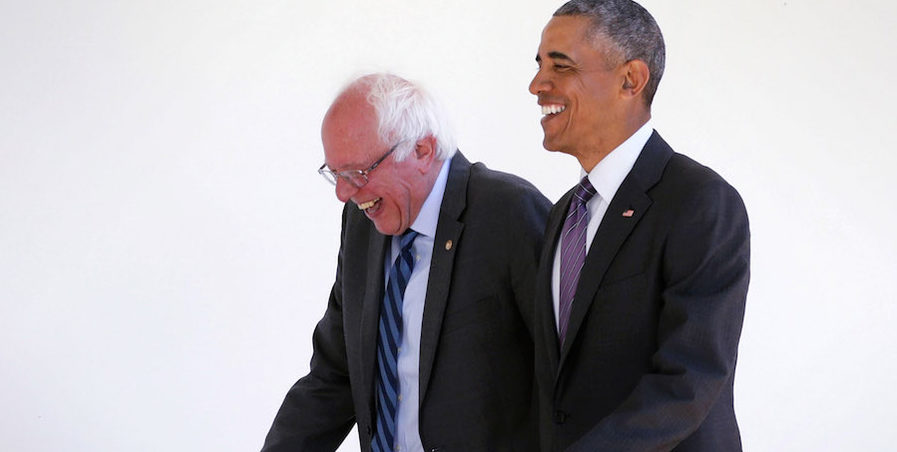
With calls growing for him to quit, Bernie Sanders came to the White House on Thursday for a meeting that President Barack Obama hoped to use to try to nudge the Vermont senator to accept defeat in the Democratic race. Obama planned to endorse Hillary Clinton after the meeting. The high-profile meeting in the Oval Office illustrated the intensifying effort within the Democratic Party to unite behind Clinton as the nominee so the party can focus fully on defeating Republican Donald Trump in the fall. Clinton declared victory over Sanders on Tuesday, having captured the number of delegates needed to become the first female nominee from a major party. Sanders, accompanied by his wife, Jane, arrived at the White House late Thursday morning by motorcade, stopping first for coffee and a scone at a cafe nearby, his spokesman said. He and Obama walked together along the Rose Garden colonnade, smiling and laughing before entering the Oval Office. After the private meeting, Sanders was expected to address reporters in the West Wing driveway before heading to the Capitol to sit down with Senate Democratic leader Harry Reid. Though Sanders has shown signs he understands the end of his race is near – he was laying off about half his team – he has vowed to keep fighting, stoking concern among party leaders eager for the primary race to conclude. Still looking like a candidate, Sanders planned a rally Thursday evening in Washington, which holds the final primary contest next week. The situation has put Obama, the outgoing leader of his party, in the sensitive position of having to broker detente between Clinton and Sanders without alienating the runner-up’s supporters, many of whom are angry over what they see as the Democratic establishment’s efforts to strong-arm him out of the race. Clinton is counting on Sanders’ supporters backing her to defeat Trump. Obama, who has made clear he believes the race is over, was expected to formally endorse Clinton following his meeting with Sanders. Aiming to pay tribute to the historic nature of the self-described Democratic socialist’s candidacy and his throngs of young supporters, Obama has sought to give the senator the courtesy of exiting the race on his own terms. “It was a healthy thing for the Democratic Party to have a contested primary. I thought that Bernie Sanders brought enormous energy and new ideas,” Obama said Wednesday during a taped appearance on “The Tonight Show Starring Jimmy Fallon“. “And he pushed the party and challenged them. I thought it made Hillary a better candidate.” Obama planned to use the meeting, requested by Sanders, to discuss how to build on the enthusiasm Sanders brought to the primary, the White House said. That’s a diplomatic way of saying it’s time for Sanders to pass the baton to Clinton. Now head-to-head in the presidential race, Clinton and Trump have one thing in common: Both are working to woo Sanders supporters. Trump has said he welcomes Sanders’ voters “with open arms” while Clinton has vowed to reach out to voters who backed her opponent in the Democratic primary. “He has said that he’s certainly going to do everything he can to defeat Trump,” Clinton said of Sanders in an Associated Press interview. “I’m very much looking forward to working with him to do that.” Trump, despite a string of victories this week that reaffirmed his place as the GOP nominee, was still working to convince wary Republicans that he’s presidential material. Looking ahead to an upcoming speech attacking Clinton and her husband, Trump tried to turn the page following a dust-up over his comments about a Hispanic judge’s ethnicity. That controversy and others before it have led prominent Republicans, including House Speaker Paul Ryan, to openly chastise their party’s nominee. Yet Trump’s dominance in the GOP race is hard to overstate: He now has 1,542 delegates, including 1,447 required by party rules to vote for him at the convention. It takes just 1,237 delegates to win the Republican nomination. For Sanders, any rationale for staying in the race has grown more tenuous as even some of his staunchest supporters have started looking to Clinton. U.S. Sen. Jeff Merkley of Oregon, the one Senate Democrat to endorse Sanders, said Clinton was the nominee and offered his congratulations. And U.S. Rep. Raul Grijalva, a Sanders backer from Arizona, suggested the time to rally behind Clinton would come after the District of Columbia primary on Tuesday. “Bernie’s going to do the right thing,” Grijalva said. Sanders has promised to continue his campaign through Tuesday’s contest. But about half his campaign staff was being laid off, two people familiar with the plans said. They spoke on condition of anonymity because they weren’t authorized to speak publicly about the layoffs. Obama’s aides have said he’s itching to get off the sidelines and take on Trump. The key question is whether voters who helped elect him twice will follow his lead now that he’s not on the ballot. Democrats have yet to see that powerful coalition of minorities, young people and women reliably show up for candidates not named Obama. “It’s going to be hard to get African-American turnout as high as Obama got it, and to get youth turnout as high as Obama got it,” said Celinda Lake, a Democratic pollster. “We have to work really hard.” Republished with permission of The Associated Press.
Mike Hubbard finishes testimony in his own ethics trial
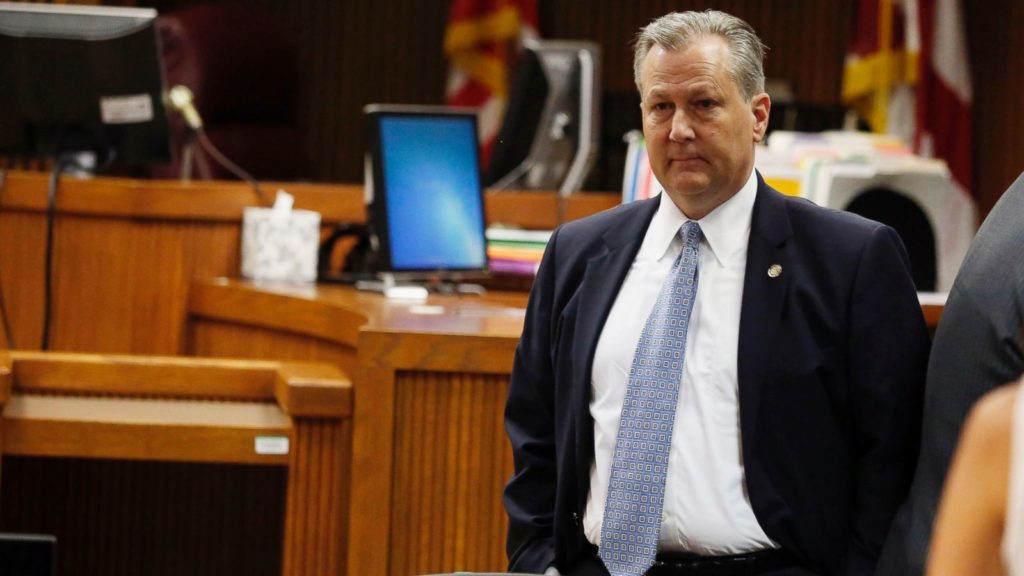
The Latest on the ethics trial of Alabama House Speaker Mike Hubbard (all times local): 10:30 a.m. Alabama House Speaker Mike Hubbard has finished testifying in his ethics trial. Prosecutor Matt Hart on Thursday morning showed jurors an email that Hubbard sent to a Publix lobbyist trying to arrange for company executives to meet with a drinking cup manufacturer in his district. The email was signed, “speaker of the house” and did not disclose that a related company was also paying Hubbard $10,000-a-month. Hubbard later explained it was an automatic signature generated by his email at his business, the Auburn Network. However, Hubbard’s defense took a stumble when he described the email as a request for advice to a longtime friend. Hubbard said the man recently died of an aneurysm. However, Hart noted the man was still alive. Hubbard admitted he must have confused him with someone else. ___ 5:24 a.m. Alabama House Speaker Mike Hubbard is returning to the witness stand for the third day in his ethics trial. A state prosecutor will resume his cross-examination of the Republican speaker Thursday morning. Prosecutor Matt Hart on Wednesday quizzed Hubbard on $2.3 million in contracts, party campaign business and investments his companies received. He also questioned Hubbard about an email he sent former Gov. Bob Riley, who is now a lobbyist, seeking employment help. Hubbard faces 23 felony ethics charges accusing him of using his political positions as Speaker and party chair to make money and solicit jobs and financial favors from lobbyists. Hubbard has maintained his innocence and said he took precautions to obey the state ethics law. Republished with permission of The Associated Press.
Federal judge permanently bars Alabama from blocking gay marriage
A federal judge is permanently barring Alabama from enforcing state laws to block gay marriage. U.S. District Judge Callie Granade of Mobile issued the order Tuesday in litigation that followed the U.S. Supreme Court decision that effectively legalized same-sex weddings nationwide. The judge writes that the order is needed because state laws against same-sex marriage remain on the books. She says the Alabama Supreme Court’s willingness to issue decisions conflicting with the U.S. Supreme Court demonstrate the need for permanent action. Granade notes that while same-sex opponent Roy Moore is currently suspended from the office of chief justice, other state justices have indicated they believe laws banning gay marriages were constitutional. Most counties already are issuing licenses to same-sex couples, so it’s unclear what impact the ruling will have. Republished with permission of The Associated Press.
