
Martha Roby: Obama’s amnesty actions struck down
The U.S. Supreme Court has dealt the final blow to President Barack Obama’s executive orders on immigration. As you may remember, President Obama attempted to bypass Congress in November 2014 and grant de facto amnesty to as many as five million illegal immigrants. A number of states, including Alabama, challenged the executive amnesty plans in federal court on the grounds that they violated the U.S. Constitution’s separation of powers. Although there are not currently 9 serving justices, an equally divided Supreme Court affirms the ruling of the court below. By upholding lower courts’ rulings against the Administration, the Supreme Court has effectively blocked the President’s orders from being implemented and affirmed that they were unconstitutional. The Supreme Court’s decision represents an important victory for the separation of powers, a fundamental principle of our Constitution meant to preserve self-governance. The framers strategically divided governing authorities among the three branches and set up a system of checks and balances to ensure no one branch became too powerful. Article I of the Constitution gives Congress, not the President, authority to “establish an uniform Rule of Naturalization.” Our laws have legitimacy because they are passed by representatives elected by and accountable to the people. That legitimacy has been undermined by expansions of executive authority over the past few decades. I believe this decision sends a strong message to President Obama and to future presidents that constitutional order and the rule of law must be followed. However, this issue isn’t going away. Our illegal immigration problem is very real. The President’s amnesty orders only exacerbated that problem by inviting even more illegal immigrants to cross the border and by poisoning any chance Congress could make progress toward meaningful solutions on this issue while he was in office. They were also unfair to legal immigrants who played by the rules and to the working Americans whose wages are undercut by reckless immigration policy. Amnesty won’t solve our immigration problems. We have to secure the border and enact better polices that discourage illegal entry, punish lawbreakers and promote America’s economic interests. In the wake of this ruling, our work to strengthen the United States immigration laws should continue right away. Hopefully our next president will be more willing to work with Congress in that regard. Thanks to this Supreme Court ruling, they won’t be able to go around Congress and unilaterally enact their own policies. That’s important for the preservation of our constitutional republic, no matter who the next president is. ••• Martha Roby represents Alabama’s 2nd Congressional District. She lives in Montgomery, Alabama, with her husband, Riley and their two children.
Yeas and Nays – How Alabama delegation voted this week: 6/24/16
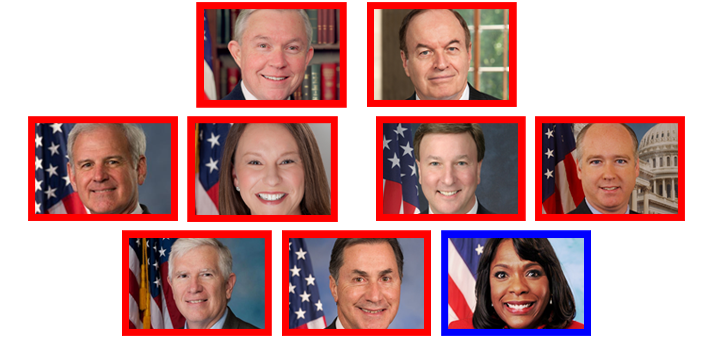
Here’s a look at how the Alabama delegation voted on major issues in the U.S. House of Representatives and the U.S. Senate this week: House votes Much of the U.S. House of Representative’s legislative schedule was postponed due to the House Democrats’ “sit-in” protest. A vote on overriding the president’s veto of H. J. Res. 88, a resolution that disapproves the rule issued by the Labor Department on April 8, 2016, commonly known as the fiduciary rule on retirement investment advice, which subjects broker-dealers who oversee retirement investments to the fiduciary standard under which they must provide investment advice that is in the best interest of the investor “without regard to the financial or other interests” of the financial institution, adviser or other party. A two-thirds vote of both chambers is needed to override a veto; the House originally passed the measure by a 234-183 vote, while the Senate originally cleared it by a 56-41 vote. The president vetoed the measure June 8. Passed House 239-180, but the vote failed to override a presidential veto. Yea: Rep. Bradley Byrne (AL-01); Rep. Martha Roby (AL-02); Rep. Mike Rogers (AL-03); Rep. Robert Aderholt (AL-04); Rep. Mo Brooks (AL-05); Rep. Gary Palmer (AL-06) Nay: Rep. Terri Sewell (AL-07) Conference Report to H.R.2577, the Military Construction, Veterans Affairs, and Related Agencies Appropriations Act for 2017. The conference report would provide $82.5 billion in discretionary funding in fiscal 2017 for the Veterans Affairs Department, military construction and military housing. It also would provide $1.1 billion in funding to combat the Zika virus, with roughly $750 million in offsets. Passed House 239-171. Yea: Rep. Bradley Byrne (AL-01); Rep. Martha Roby (AL-02); Rep. Mike Rogers (AL-03); Rep. Robert Aderholt (AL-04); Rep. Mo Brooks (AL-05); Rep. Gary Palmer (AL-06) Nay: Rep. Terri Sewell (AL-07) Next week the House is in recess and will be back in session on Tuesday, July 5. Senate votes The Senate only voted on amendments this week and passed no legislation. The Senate is scheduled to be in session next week.
House Speaker Paul Ryan proposes simpler tax code

House Republicans led by Speaker Paul Ryan unveiled a plan for a simpler tax code, the sixth and last installment of a GOP agenda designed to be a policy counterpoint to the personality-driven campaign of Donald Trump. Ryan and other Republicans announced the plan at a news conference Friday morning. The proposal would lower tax rates for both families and businesses, although it falls short of the 25 percent top rate for individuals that Ryan promised not long ago. Instead, the tax reform plan proposes a 33 percent top tax bracket instead of the current top rate of 39.6 percent restored by President Barack Obama in a 2013 victory over Republicans in the wake of his re-election. The Ryan plan also lacks the detail required to measure whether it maintains the current distribution of the tax burden by income range. The plan won’t face a vote this year but, like other elements of Ryan’s agenda, provides a template for potential action next year. “For families and individuals, the new tax system will simplify and lower tax rates. It also will provide for reduced but progressive tax rates on capital gains, dividends and interest income,” the proposal reads. “The approach reflected in this blueprint will be simple enough to fit on a postcard for most Americans.” Individual filers would retain tax breaks for mortgage interest, charitable giving and retirement savings in a decision that reflects the sweeping popularity of such measures. The measure also promises business and international tax reforms to make U.S. companies more competitive with overseas companies, including lowering the corporate tax rate from 35 percent to 20 percent. In exchange, businesses would lose a host of write-offs. Tax reform is a longtime promise of Republicans, and the code has gotten far more complex in the three decades since the landmark 1986 tax overhaul. But changing the code pits powerful interests against one another and exposes ideological rifts among Republicans and between Republicans and Democrats. The measure assumes the proposal would generate economic growth that would, in turn, boost revenues. Such “dynamic” effects permit policymakers to promise even lower tax rates that would not add to the budget deficit. Republished with permission of The Associated Press.
Lawyer: Alabama death row inmate mentally incompetent for execution

The U.S. Supreme Court says death-row prisoners must have “rational understanding” that they are about to be executed and why, but lawyer for an Alabama inmate say their client fails that test. A lawyer for 65-year-old Vernon Madison on Thursday told a panel of 11th U.S. Circuit Court of Appeals judges that stroke-induced dementia has made Madison unable to understand why the state plans to execute him. Madison was convicted in the 1985 killing of Mobile police Officer Julius Schulte. A state lawyer countered that while Madison’s health has deteriorated, the inmate still understands he is being punished for the crime he committed. The appeals court in May stayed Madison’s execution just seven hours before he was scheduled to get a lethal injection. Republished with permission of The Associated Press.
