
Donald Trump campaign plans $140 million ad buy

Donald Trump‘s campaign is planning for what it says will amount to $140 million worth of advertising from now until Election Day. The total, if executed, would include $100 million in television airtime and $40 million in digital ads, according to senior communications adviser Jason Miller. The plan represents a new approach for the billionaire businessman, who has repeatedly bragged in recent weeks about how much less he’s spent than Democratic rival Hillary Clinton and seemed to rely heavily on free media coverage of his large rallies. Through this week, the Trump campaign has put only about $22 million into TV and radio ads for the general election, according to Kantar Media’s political advertising tracker. Clinton has spent more than five times as much on those kinds of ads, $124 million so far. Trump’s new ad buy will include 13 states, from key battlegrounds such as Florida, North Carolina, Ohio and Pennsylvania, to new targets of Maine, New Mexico and Wisconsin, Miller said. About $40 million of the ads will play on national TV, he said. That averages to about $16.7 million per week in TV ads; Miller said the first $15 million ad buy was made Friday, although media buyers and services such as Kantar Media didn’t immediately see evidence of that. Clinton’s ad reservations going forward total about $11 million per week, but her campaign can add to those buys at any time. Trump’s advertising plan costs more than his campaign has in the bank, meaning he needs to dip into his own pockets or continue raising major money. As of Sept. 1, the campaign had about $50 million in cash, though in a news release earlier this month, the campaign said it had $97 million in cash when including his joint accounts with Republican Party allies. Trump has continued to experience strong fundraising online this month, campaign aides said. Miller said upcoming national television ads would focus on Trump’s key campaign themes, such as the economy and law and order. The local ads, however, are expected to focus on ways Trump’s policies might benefit local communities and families, Miller said. Republished with permission of the Associated Press.
Hillary Clinton, Donald Trump buff foreign policy bona fides on debate eve
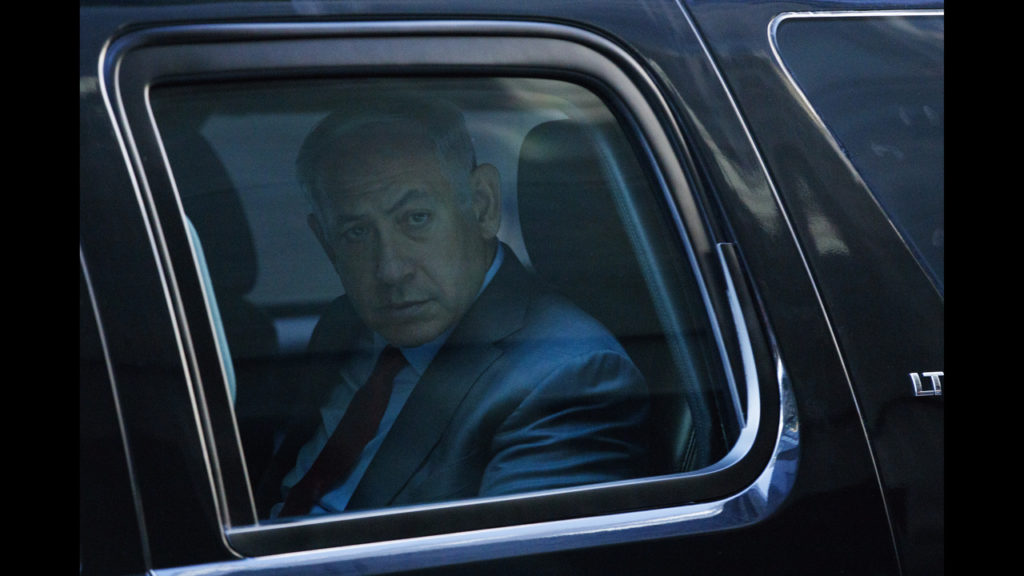
Hillary Clinton and Donald Trump were meeting separately with Israeli Prime Minister Benjamin Netanyahu Sunday, giving the each candidate fresh bragging rights about their knowledge of foreign policy and readiness to lead the nation on the eve of their first presidential debate. Trump and Netanyahu discussed “at length” Israel’s use of a fence to help secure its borders, an example Trump frequently cites when he’s talking about the wall he wants to build between the U.S. and Mexico. “Trump recognized that Israel and its citizens have suffered far too long on the front lines of Islamic terrorism,” the campaign said in a statement. “He agreed with Prime Minister Netanyahu that the Israeli people want a just and lasting peace with their neighbors, but that peace will only come when the Palestinians renounce hatred and violence and accept Israel as a Jewish State.” Clinton was expected to meet with the prime minister later in the day, also in New York. The meeting was designed to put Israel on good footing with the next U.S. president. But it also served to showcase the candidates’ expertise in foreign policy in the shadow of their first debate Monday, six weeks before Election Day. Clinton, a former senator and secretary of state, often says that Trump does not know enough about the world and lacks the temperament to be president. Trump has argued that he has extensive experience with foreign policy through his career as a business executive and blames Clinton for many of the nation’s stumbles in foreign policy. Meanwhile, the candidates deployed their top supporters to the Sunday shows to take early jabs at their opponents and lower expectations for a showdown expected to draw 75 million viewers — many of them disenchanted with both candidates, the least-popular presidential hopefuls in history. Facts and who will determine them during the 90-minute debate seemed to be a top concern of the campaigns’ strategists given Trump’s habit of saying things that are untrue and the public’s general distrust of Clinton. Robby Mook, Clinton’s campaign manager, told ABC’s “This Week” that he is concerned Trump will continue his habit of sometimes saying things that aren’t true and still get a passing grade. He called on moderator Lester Holt to correct any inaccuracies made by the candidates. But Trump’s campaign manager, Kellyanne Conway, said it’s not the job of debate moderators to fact check. Trump’s vice presidential running mate, Mike Pence, meanwhile, said that Gennifer Flowers will not attend the debate. Trump had tweeted that if frequent Trump critic Mark Cuban attended the showdown, he’d put Flowers, allegedly the former mistress of Clinton’s husband Bill, in the audience too. Conway said that Flowers had a right to be there if “somebody else gives her a ticket.” But Pence drew a harder line. “Gennifer Flowers will not be attending the debate tomorrow night,” Pence said on “Fox News Sunday.” The candidates were focused on other matters Sunday. Trump’s campaign said that during his meeting with Netanyahu, the Republican presidential nominee promised, “extraordinary strategic, technological, military and intelligence cooperation between the two countries” if he’s elected. The press was barred from covering the meeting between Netanyahu and Trump, but Trump’s campaign said in a statement that the men, who have known each other for years, discussed “many topics important to both countries,” including “the special relationship between America and Israel and the unbreakable bond between the two countries.” Among those topics: the nuclear deal with Iran, the battle against Islamic State militants, military assistance provided by the U.S. to Israel and other security issues. Republished with permission of the Associated Press.
Kay Ivey: The stage is set for budget reform
The end of the 2016 fiscal year is rapidly approaching with the current fiscal year ending on the last day of September. After five legislative sessions, our budget challenges remain a high priority and our fiscal future is shaky. The Alabama Legislature just completed the third Special Session in the last 12 months, along with two Regular Sessions, totaling five Legislative Sessions in the last 20 months. Based on statutory requirements, the Legislature has been obligated 300 calendar days during this period to conduct legislative business. On top of legislative duties while in session, Legislators have also been busy with budget and Medicaid hearings, as well as other obligations regarding their responsibilities as a Legislator. It is clear the Legislature has devoted a tremendous amount of time dealing with the General Fund Budget and the ever-increasing demands of Medicaid. Over the past year, the Legislature has struggled to identify an additional $85 million to fully fund Medicaid at $785 million. When I took office in 2011, the Medicaid appropriation was $345 million. During the past five years, funding for Medicaid has continued to increase and is expected to reach $865 million for Fiscal Year 2018, which begins a year from now. Before I leave office as Lieutenant Governor, the General Fund appropriation for Medicaid will be approaching $1 billion. For more than a decade, funding for Medicaid has grown at a double digit pace while the General Fund overall has increased by a single digit each year. Using our current budget models, in five years Medicaid and Corrections will consume nearly 100% of the General Fund. Recent Special Sessions called by the Governor have included requests for additional revenues as a result of increased taxes or revenue generated through a statewide lottery—most of the Governor’s proposals did not pass. However, one measure that did pass was an increased cigarette tax. As a result, the cigarette tax revenue is expected to have a substantial increase of $190 million this year. Alabama has one of the most unique budget models in the country. The vast majority of Alabama’s revenues are committed (or earmarked), representing one of the highest levels in the country. For almost a decade, Alabama has operated state government on one-time and non-reoccurring money either from the federal government, the State’s Trust Fund or the State’s Rainy Day Fund. The most recent Special Session was no different with current obligations and road projects funded through one-time BP Settlement monies as a result of the 2010 Deep Water Horizon disaster. Many believe the reality of our situation will result in a fiscal “train wreck” in the near future. Current budgets, earmarked revenues and growing demands for Medicaid, Corrections, Mental Health and Human Resources are on an unavoidable path that will provide extremely limited funds for the remainder of state government. On an optimistic note, Alabama continues to enjoy marginal economic growth with unemployment down to 5.4%, the lowest in nearly a decade. As more Alabama citizens enter the workforce, they and the businesses that employ them will contribute to our economy resulting in increased revenues to support our budgets. There may be light at the end of the tunnel with the recent creation of the Joint Legislative Task Force on Budget Reform (HJR62) led by Speaker Mac McCutcheon and President Pro Tem Del Marsh. The task force will begin evaluating and recommending budget reform proposals to be considered by the Legislature. I applaud Pro Tem Marsh and Speaker McCutcheon for providing the leadership to begin the process to consider budget reform. It is my understanding that the focus will be to determine how best to fund state government with existing revenues. Possible solutions include freeing up earmarked revenues and revaluating existing tax credits and deductions that will provide flexibility within our budgets and allow Legislators to prioritize and fund essential services of state government. Senator Clyde Chambliss and Representative Danny Garrett will lead the task force as co-chairs, along with Senator Greg Albritton, Senator Linda Coleman, Senator Bill Hightower, Senator Bobby Singleton, Senator Phil Williams, Rep. Anthony Daniels, Rep. Allen Farley, Rep. John Knight, Rep. Chris Pringle, Rep. Kyle South and Rep. Rich Wingo. The task force is expected to meet monthly prior to the upcoming Regular Session. The first meeting is set for Wednesday, September 28. As we near the end of this fiscal year, the Alabama Department of Revenue is projecting we will collect a record amount of revenue exceeding $10 billion. Even with a record amount of revenue, our antiquated budget models continue to create major obstacles to fulfilling our needs. The challenges we face with our budgeting process will not go away unless we begin to look further than the year ahead and start to implement solutions that fundamentally change the way we prioritize our needs and budget our revenues. After marginal success in recent special sessions and our continued appetite to operate on one-time money, the stage is set for true budget reform. It will take bold leadership and courage by Legislators to make decisions that will have a long-term impact on the future of our State. Now that the stage is set, I am encouraged by the opportunity before us and am hopeful we may accomplish this task with the attention and hard work of the task force members. ••• Kay Ivey is the lieutenant governor of Alabama. Elected in 2010, she was the first Republican woman to hold the office in Alabama’s history.
