
Updates from the 1st presidential debate

The Latest on the first of three presidential debates between Democrat Hillary Clinton and Republican Donald Trump (all times EDT): 10:45 p.m. Both candidates concluded the first presidential debate by saying they will accept the outcome if the other wins. Hillary Clinton spoke directly to viewers and said, “It’s not about us, it’s about you.” Donald Trump initially dodged the same question, saying he would make a “seriously troubled” America “great again.” He added: “I’m going to be able to do it. I don’t believe Hillary Clinton will.” But Trump finished his answer by saying that if Clinton wins, “I will absolutely support her.” ___ 10:43 p.m. Hillary Clinton is punching back at Donald Trump’s assertions that she doesn’t have the “stamina” to be president. Trump has questioned whether Clinton has the physical fitness to be president and he repeated the criticism to her directly during the debate. Clinton’s response? Trump shouldn’t talk about stamina until he’s tried out the busy schedule she kept up as secretary of state. Trump didn’t answer moderator Lester Holt’s original question about his past comments that Clinton doesn’t have the “presidential look.” Clinton suggested the remarks were about gender, and she reminded the crowd of Trump’s past comments calling women “pigs” and other derogatory names. ___ 10:42 p.m. Donald Trump says NATO needs to “go into the Middle East with us” to combat the Islamic State group. And he is taking credit for NATO focusing resources on combating terrorism. In fact, the alliance agreed in July to contribute aircraft and conduct training in Iraq and has increased intelligence coordination there. And NATO set up an anti-terrorism program in 2004 — years before Trump criticized them as a presidential candidate. Earlier this year, Trump criticized NATO for not focusing on terrorism. He said that afterward, he saw an article reporting that NATO was opening a new, major anti-terrorism division. He said Tuesday that NATO’s action was “largely because of what I was saying, and my criticism of NATO.” ___ 10:40 p.m. Donald Trump is avoiding a specific declaration on how he would use nuclear weapons if he’s elected president. The Republican nominee said during the first presidential debate that he “would not do first strike” because “once the nuclear alternative happens, it’s over.” That statement suggests he would not authorize a nuclear attack unless the U.S. was struck first. But in the same answer Trump said he “can’t take anything off the table.” He mentioned adversary nations such as North Korea and Iran. President Barack Obama has considered changing existing policy to state clearly that the United States would not deploy nuclear weapons without first being attacked by nuclear weapons. But he met resistance and has elected not to make such a shift. ___ 10:38 p.m. Hillary Clinton is accusing Donald Trump of being too easily provoked to keep the United States from going to war — perhaps even one involving nuclear weapons. Trump says: “I have much better judgment than she does. I have much better temperament.” That drew laughs from some in the debate crowd, and prompted Clinton to exclaim: “Woo! OK!” Clinton then pivoted to policy, defending the U.S.-led war in Afghanistan. Clinton said Iran was “weeks away” from a nuclear bomb when she became secretary of state — and says the Obama administration thwarted that progress. She continued that Trump didn’t have “good judgment or the right temperament” because he could take the country to war over small issues, like being mocked on Twitter. ___ 10:35 p.m. Donald Trump is continuing to insist he opposed the Iraq War before the U.S. invasion despite evidence to the contrary. Trump says during the debate that he “did not support the war in Iraq,” calling that charge “mainstream media nonsense.” But there is no evidence Trump expressed public opposition to the war before the U.S. invaded. Trump was asked in September 2002 whether he supported a potential Iraq invasion in an interview with Howard Stern. Trump briefly hesitated, then responded: “Yeah, I guess so.” Presented with the comment during the debate, Trump responds: “I said very lightly, I don’t know, maybe, who knows.” He’s also telling reporters to call Fox News host Sean Hannity to confirm private conversations he said they had about the war. Hannity is a top Trump supporter. Clinton voted in favor of the invasion in 2002 while she was a New York senator. She has since said it was a mistake. ___ 10:27 p.m. Donald Trump is interrupting the moderator of the first presidential debate to insist he has the best temperament for the office. Trump repeatedly made the assertion after clashing with moderator Lester Holt over his early support for the Iraq War. Then he segued to his temperament. “I think my strongest asset by far is my temperament,” Trump said. “I know how to win.” Clinton and her allies have repeatedly hit Trump over his temper and inability to take criticism. ___ 10:23 p.m. Hillary Clinton says one key to fighting terrorism in the United States is working closely with Muslims living here. Clinton says Donald Trump has “consistently insulted Muslims abroad, Muslims at home.” She says Muslim people can provide information that law enforcement may not be able to obtain anyplace else. Both candidates were asked to explain how they would combat terrorism in the U.S. Clinton says her plan includes an intelligence surge to obtain “every scrap of information” and to “do everything we can to vacuum up intelligence from Europe, from the Middle East.” ___ 10:20 p.m. Hillary Clinton says defeating the Islamic State group and taking out its leaders would be a top priority as president. Clinton says she’s hopeful the Islamic State group would be pushed out of Iraq by the end of the year. She says the U.S. could then help its allies “squeeze” the terrorist group in Syria. Clinton says she would do everything possible to take out the group’s leaders, and make that one of her administration’s organizing principles
At each other from the start: Hillary Clinton, Donald Trump debate
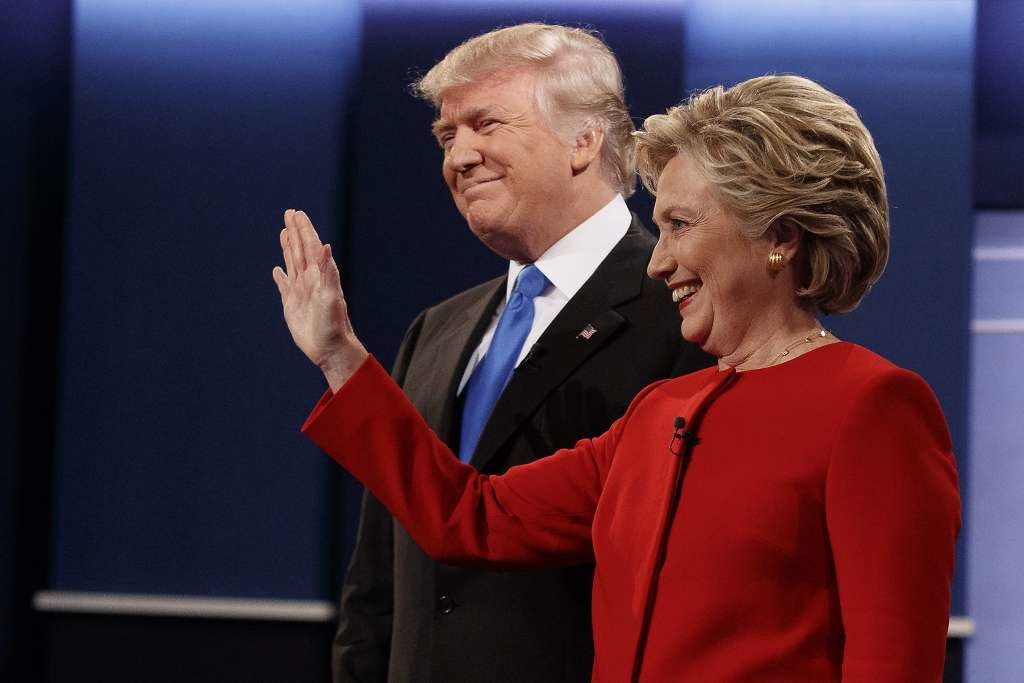
In a combative opening debate, Hillary Clinton emphatically denounced Donald Trump Monday night for keeping his personal tax returns and business dealings secret from voters and peddling a “racist lie” about President Barack Obama. Businessman Trump repeatedly cast Clinton as a “typical politician” as he sought to capitalize on Americans’ frustration with Washington. Locked in an exceedingly close White House race, the presidential rivals tangled for 90-minutes over their vastly different visions for the nation’s future. Clinton called for lowering taxes for the middle class, while Trump focused more on renegotiating trade deals that he said have caused companies to move jobs out of the U.S. The Republican backed the controversial “stop-and-frisk policing” tactic as a way to bring down crime, while the Democrat said the policy was unconstitutional and ineffective. The debate was heated from the start, with Trump frequently trying to interrupt Clinton and speaking over her answers. Clinton was more measured and restrained, but also needled the sometimes-thin-skinned Trump over his business record and wealth. “There’s something he’s hiding,” she declared, scoffing at his repeated contention that he won’t release his tax returns because he is being audited. Trump aggressively tried to turn the transparency questions around on Clinton, who has struggled to overcome voters’ concerns about her honestly and trustworthiness. He said he would release his tax information when she produces more than 30,000 emails that were deleted from the personal internet server she used as secretary of state. Tax experts have said there is no reason the businessman cannot make his records public during an audit. Clinton was contrite in addressing her controversial email use, saying simply that it was a “mistake”. She notably did not fall back on many of the excuses she has often used for failing to use a government email during her four years as secretary of state. “If I had to do it over again, I would obviously do it differently,” she said. The televised face-off was the most anticipated moment in an election campaign that has been both historic and unpredictable. Both sides expected a record-setting audience for the showdown at Hofstra University in suburban New York, reflecting the intense national interest in the race to become America’s 45th president. The candidates sparred over trade, taxes and how to bring good-paying jobs back to the United States. Clinton said her Republican rival was promoting a “Trumped-up” version of trickle-down economics – a philosophy focused on tax cuts for the wealthy. She called for increasing the federal minimum wage, spending more on infrastructure projects and guaranteeing equal pay for women. Trump panned policies that he said have led to American jobs being moved overseas, in part because of international trade agreements that Clinton has supported. He pushed Clinton aggressively on her past support for the Trans-Pacific Partnership trade pact while she was serving in the Obama administration. She’s since said she opposes the sweeping deal in its final form. “You called it the gold standard of trade deals,” Trump said. “If you did win, you would approve that.” Disputing his version of events, Clinton said, “I know you live in your reality.” Trump struggled to answer repeated questions about why he only recently acknowledged that Barack Obama was born in the United States. For years, Trump has been the chief promoter of questions falsely suggesting the president was born outside of America. “He has really started his political activity on this racist lie,” Clinton charged. Clinton aides spent the days leading up to the debate appealing for the media and voters to hold Trump to a higher standard than they believe he has faced for much of the campaign. Their concern was that if the sometimes-bombastic Trump managed to keep his cool onstage, he’d be rewarded – even if he failed to flesh out policy specifics or didn’t tell the truth about his record and past statements. Trump’s campaign has said the Clinton camp’s concerns reflected worries about the her debating skills. The centerpiece of Trump’s campaign has been a push for restrictive immigration measures, including a physical wall along the U.S.-Mexico border and an early proposal to temporarily bar foreign Muslims from coming to the U.S. But he’s been less detailed about other ideas, including his plan for stamping out the Islamic State group in the Middle East. Clinton, a former senator and secretary of state, is banking on voters seeing her as a steady hand who can build on the record of President Obama, whose popularity is rising as he winds down his second term in office. She’s called for expanding Obama’s executive orders if Congress won’t pass legislation to overhaul the nation’s immigration system and for broader gun control measures. Overseas, she’s called for a no-fly zone in Syria but has vowed to keep the military out of a large-scale ground war to defeat the Islamic State group. For Clinton, victory in November largely hinges on rallying the same young and diverse coalition that elected Obama but has yet to fully embrace her. Trump has tapped into deep anxieties among some Americans, particularly white, working-class voters who feel left behind in a changing economy and diversifying nation. While the real estate mogul lacks the experience Americans have traditionally sought in a commander in chief, he’s banking on frustration with career politicians and disdain for Clinton to push him over the top on Election Day. Republished with permission of the Associated Press.
AP FACT CHECK: Donald Trump, Hillary Clinton deny their own words in debate
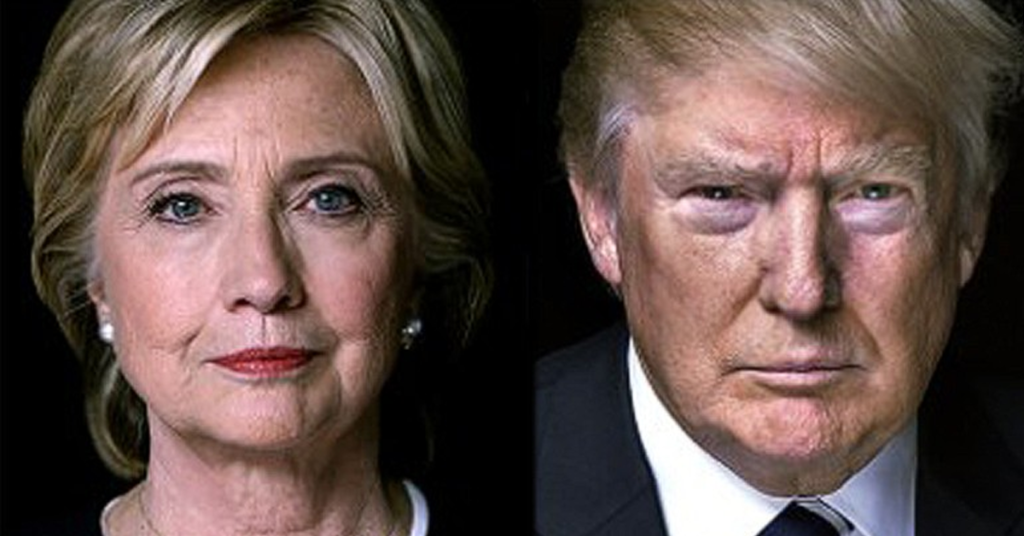
Donald Trump‘s habit of peddling hype and fabrication emerged unabated in the first presidential debate while Hillary Clinton played it cautiously in her statements, though not without error. They both denied making statements that they are on the record as saying. A look at some of the claims in the debate and how they compare with the facts: TRUMP: President Barack Obama “has doubled (the national debt) in almost eight years. … When we have $20 trillion in debt, and our country is a mess.” THE FACTS: Trump’s expressed concern about the national debt obscures that his own policies would increase it by much more than Clinton’s, according to the nonpartisan Committee for a Responsible Federal Budget. Trump’s tax cuts would increase the deficit by $5.3 trillion over 10 years, the group found, while Clinton’s proposals would boost the deficit by $200 billion. Those increases are on top of an already-projected increase of about $9 trillion over the next decade, according to the Congressional Budget Office. By 2026, debt held by the public would total $23.3 trillion under Clinton’s plans, and $28.4 trillion under Trump. — TRUMP: “The Fed, by keeping interest rates at this level, the Fed is doing political things. … The Fed is being more political than Secretary Clinton.” THE FACTS: This is a recurrent claim by Trump with no evidence to back it up. It’s the Federal Reserve’s job to help improve the economy and to the extent that happens, political leaders and their party may benefit. But presidents can’t make the Fed, an independent agency, do anything. Under former chairman Ben Bernanke and current chairwoman Janet Yellen, the Fed has attracted controversy by pegging the short-term interest rate it controls to nearly zero for seven years. After one increase in December, it is still ultra-low at between 0.25 percent and 0.5 percent, a rate that some economists worry could spark a stock-market bubble or inflation. Bernanke was initially appointed by Republican President George W. Bush, and reappointed by President Barack Obama. One reason Yellen is keeping rates low is that, in some ways, she agrees with Trump that hiring needs to keep growing to provide jobs for Americans who want them. — TRUMP: “You don’t learn a lot from tax returns.” THE FACTS: Americans stand to learn plenty if he releases his tax returns like other presidential candidates have done. They would provide vital information about his wealth, taxes paid, tax avoidance efforts, exact amounts of real estate holdings and charitable donations that can’t be gleaned from any other source. For these reasons, every major party candidate for the last 40 years has released at least a few years of recent tax returns. — CLINTON, denying Trump’s accusation that she called the Trans-Pacific Partnership trade deal the “gold standard” of trade agreements: “I did say I hoped it would be a good deal.” THE FACTS: Trump is correct. As secretary of state, Clinton called the deal that was taking shape the “gold standard” of trade agreements, in a 2012 trip to Australia, and championed the agreement in other venues around the world. She did not merely express the hope it would turn out well. Clinton flip-flopped into opposing the trade deal in the Democratic primary when facing Bernie Sanders, who was strongly opposed to it. — TRUMP, when Clinton accused him of calling climate change a hoax invented by the Chinese: “I did not say that.” THE FACTS: Yes he did, in the form of a 2012 tweet: “The concept of global warming was created by and for the Chinese in order to make U.S. manufacturing non-competitive.” He later claimed he was kidding, but he’s also repeated the claim that climate change is a hoax, and one that benefits China. He tweeted in January 2014: “Snowing in Texas and Louisiana, record setting freezing temperatures throughout the country and beyond. Global warming is an expensive hoax!” — TRUMP: “I’ve been under audit for almost 15 years.” THE FACTS: Trump has never provided evidence to the public that he is actually under audit. A letter released by his tax attorneys never used the word, merely describing his tax returns under continuous review. “Review” is not a formal term for any kind of action by the Internal Revenue Service. Trump has declined to provide the IRS’ formal notice of audit to The Associated Press and other news outlets. And former IRS officials have expressed skepticism that anyone would be audited so frequently. Trump cites an audit as the reason he won’t release his tax returns. — CLINTON: As part of a list of economy-building moves, called for “making college debt free so more young people can get their education.” THE FACTS: Clinton has proposed making college tuition free for in-state students who go to a public college or university. But tuition free doesn’t equate to debt free. Under her plan, the government would pay for in-state tuition at public colleges and universities for students from families earning less than $125,000 a year. That would leave students still bearing the cost of room and board, which makes up more than half of the average $18,943 sticker price at a four-year public university, according to the College Board. Experts worry about other effects: Will colleges raise tuition once the government starts paying, increasing the cost to taxpayers? Will more students flock to public colleges because of the subsidy, also raising costs? — TRUMP to Clinton: “You’ve been fighting ISIS your entire adult life.” THE FACTS: Hillary Clinton was born in 1947 and is 68 years old. She reached adulthood in 1965. The Islamic State group grew out of an al-Qaida spinoff, al-Qaida in Iraq in 2013, the year Clinton left the State Department. — TRUMP: “My father gave me a small loan in 1975.” THE FACTS: Trump got a whole lot more than a small loan. Aside from $1 million in financing from his father, Trump received loan guarantees, bailouts and a drawdown from his future inheritance. Tim O’Brien noted
Moderator Lester Holt under scrutiny during debate
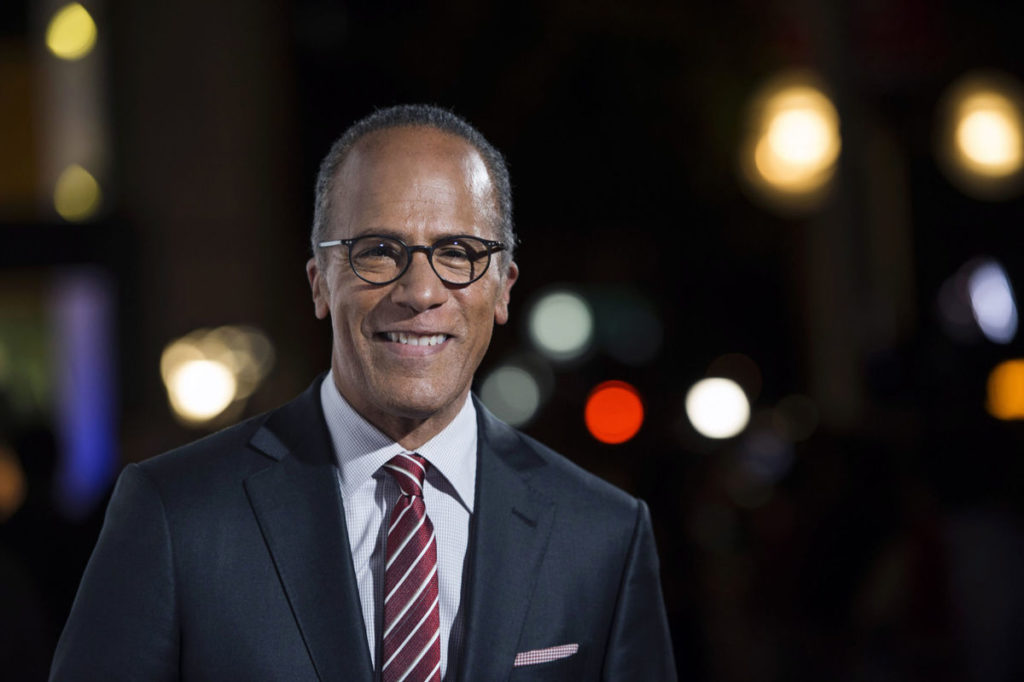
Everyone’s aware of the stakes for Hillary Clinton and Donald Trump during the first presidential debate, but there’s a third person in the equation who faces a different pressure: Lester Holt. The NBC News veteran is moderating his first general election debate, making him solely responsible for the questions asked each candidate and for steering the conversation. His performance will be closely watched, particularly in light of a dispute over the extent to which he should call politicians out for making untrue statements. Holt, 57, has kept quiet about his preparations. The NBC “Nightly News” anchor took over his job last year after predecessor Brian Williams was found to have lied about his role in news stories. Like the moderators for all three presidential debates this fall, it’s Holt’s first time in that role for a general election debate. He hosted a Democratic primary forum in January, and has interviewed Clinton and Trump three times each during the campaign. In a reflection of the attention that will be paid to Holt, his voter registration became an issue last week. “Lester is a Democrat,” Trump said in a Fox News Channel interview. “It’s a phony system. They are all Democrats.” Holt, however, is a registered Republican, according to New York state voting records. Asked about the misstatement on Monday, Trump campaign manager Kellyanne Conway said on MSNBC that it wasn’t a lie because Trump didn’t know Holt’s voter registration. Voting records show that Anderson Cooper of CNN, who is moderating the Oct. 5 debate, is registered unaffiliated with a party in New York and Chris Wallace of Fox News, the moderator on Oct. 19, is a registered Democrat in Washington, D.C. Martha Raddatz, who will join Cooper, lives in Virginia, which doesn’t register voters by party, and ABC would not discuss her affiliation. That illustrates on a small scale the issue of to what extent moderators, and journalists covering the debate, should point it out when a candidate says something untrue. It became part of the pre-debate discussion when Holt’s NBC colleague, Matt Lauer, was criticized for not confronting Trump earlier this month when the Republican falsely claimed he had not expressed support for the war in Iraq during a forum between the two candidates. The Clinton campaign says moderators should police false statements. Trump’s campaign says it’s not their role. Among journalists, there’s no consensus. Janet Brown, executive director of the Commission on Presidential Debates, said on CNN Sunday that in past debates moderators have generally believed the candidates should call their opponents out when something false is said. “I don’t think it’s a good idea to get the moderator into essentially serving as the Encyclopedia Britannica,” Brown said. Television networks were skittish Monday in discussing their fact-checking plans in advance. None admitted in advance to plans of flashing graphics onscreen to identify a false statement; that hasn’t been done in the past. NBC News said it is teaming with PolitiFact for digital fact-checking. CBS said it will assign fact-checkers that will provide context during the debate on the CBSNews.com website. In past years, some networks have assigned reporters post-debate to examine the accuracy of particular statements. The television industry will be watching to see if Monday’s debate can smash the previous record for the biggest presidential debate audience, the 80.6 million people who watched the only debate of the 1980 campaign between Jimmy Carter and Ronald Reagan. The most-watched debate this century was the first between Barack Obama and Mitt Romney in 2012, with 67.2 million voters, the Nielsen company said. During his television journalism career, Holt has been known more for hard work than flashiness. He was a news anchor in Chicago for 14 years before coming to NBC in 2000, and logged long hours on MSNBC during the Iraq War. The bass guitar is his off-screen passion. Last week he set aside debate prep to play during a Manhattan rooftop party for “Dateline NBC,” joining some fellow NBC employees running through songs by Alabama Shakes, Billy Squier and Jefferson Starship. Republished with permission of the Associated Press.
How to stream the high-stakes presidential debates
Television viewership for Monday’s presidential debate is expected to be high, but you don’t need a television to watch. There are plenty of ways to stream the showdown for free and get behind-the-scenes content and commentary, ranging from emoji responses to serious fact checks. A bigger question might be: Who isn’t streaming it? If you don’t have cable or satellite TV, or even an antenna, you can catch the streams that major news organizations will offer on their websites and apps. But many social networks and online outlets will offer the debate, too. Here’s your online guide to Monday’s debate, which starts at 9 p.m. EDT. All three presidential debates are expected to have similar streaming opportunities, and many outlets will cover the one for the vice presidential candidates as well. ___ TWITTER The service will stream Bloomberg Television’s live coverage of the presidential and vice presidential debates. To watch, go to https://debates.twitter.com, or visit Bloomberg’s bpolitics Twitter feed. Twitter says the streams will include special political programming and commentary from Bloomberg 30 minutes before and after each debate. You do not need a Twitter account — or be logged in — to watch. ___ FACEBOOK ABC News will show live streams from the debate and offer footage from watch parties, anchors and correspondents. The network says it will “incorporate viewers’ comments, questions and conversations” into its Facebook Live coverage. To find it, go to the ABC News Facebook page. Other organizations are hopping on the Facebook Live bandwagon as well, including Fox News, C-SPAN, The New York Times, CNBC and Telemundo. ___ YOUTUBE Google’s video streaming site is hosting debate streams from several news outlets, including NBC News, The Washington Post, Telemundo and Fox News. In addition, Google says “your favorite YouTube creators” such as the Young Turks and Complex news will be streaming live reports from the debates, using YouTube Live directly from their phones. ___ VIRTUAL REALITY For those with virtual-reality headsets, NBC News is planning special VR streams and content for each of the debates. It will also help organize virtual watch parties. Some of the events require RSVPs. ___ BUT WAIT, THERE’S MORE! Buzzfeed is promising “running emoji commentary of the action on Facebook Live.” Snapchat, meanwhile, will cover each debate as a “Live Story” within its app. CBSN, CBS News’ digital streaming service, will feature Instagram “Stories” in its live streaming coverage. Instagram Stories lets users share photos and videos from their day; they disappear automatically after 24 hours. ___ LAST, BUT NOT LEAST Bars across the country will be showing the debates. As with past debates, there will be drinking games and debate bingo for those interested. In New York City, the blog Gothamist assembled a list of places for “watching, boozing and laughing your way through the debate.” The gay club Eastern Bloc, for example, will feature a dance party and Hillary Clinton fundraiser following the debate. Whether you’re a fan of Clinton or Donald Trump, or you’re still deciding, check Meetup, Facebook or Google to find debate-viewing events near you. Republished with permission of the Associated Press.
How to stream the high-stakes presidential debates
Television viewership for Monday’s presidential debate is expected to be high, but you don’t need a television to watch. There are plenty of ways to stream the showdown for free and get behind-the-scenes content and commentary, ranging from emoji responses to serious fact checks. A bigger question might be: Who isn’t streaming it? If you don’t have cable or satellite TV, or even an antenna, you can catch the streams that major news organizations will offer on their websites and apps. But many social networks and online outlets will offer the debate, too. Here’s your online guide to Monday’s debate , which starts at 9 p.m. EDT. All three presidential debates are expected to have similar streaming opportunities, and many outlets will cover the one for the vice presidential candidates as well. — TWITTER The service will stream Bloomberg Television’s live coverage of the presidential and vice presidential debates. To watch, go to https://debates.twitter.com , or visit Bloomberg’s bpolitics Twitter feed. Twitter says the streams will include special political programming and commentary from Bloomberg 30 minutes before and after each debate. You do not need a Twitter account – or be logged in – to watch. — FACEBOOK ABC News will show live streams from the debate and offer footage from watch parties, anchors and correspondents. The network says it will “incorporate viewers’ comments, questions and conversations” into its Facebook Live coverage. To find it, go to the ABC News Facebook page. Other organizations are hopping on the Facebook Live bandwagon as well, including Fox News, C-SPAN, The New York Times, CNBC and Telemundo. — YOUTUBE Google’s video streaming site is hosting debate streams from several news outlets, including NBC News , The Washington Post, Telemundo and Fox News . In addition, Google says “your favorite YouTube creators” such as the Young Turks and Complex news will be streaming live reports from the debates, using YouTube Live directly from their phones. — VIRTUAL REALITY For those with virtual-reality headsets, NBC News is planning special VR streams and content for each of the debates. It will also help organize virtual watch parties. Some of the events require RSVPs. — BUT WAIT, THERE’S MORE! Buzzfeed is promising “running emoji commentary of the action on Facebook Live.” Snapchat, meanwhile, will cover each debate as a “Live Story” within its app. CBSN, CBS News’ digital streaming service, will feature Instagram “Stories” in its live streaming coverage. Instagram Stories lets users share photos and videos from their day; they disappear automatically after 24 hours. — LAST, BUT NOT LEAST Bars across the country will be showing the debates. As with past debates, there will be drinking games and debate bingo for those interested. In New York City, the blog Gothamist assembled a list of places for “watching, boozing and laughing your way through the debate.” The gay club Eastern Bloc, for example, will feature a dance party and Hillary Clinton fundraiser following the debate. Whether you’re a fan of Clinton or Donald Trump, or you’re still deciding, check Meetup, Facebook or Google to find debate-viewing events near you. Republished with permission of the Associated Press.
Suburban NY police prep for 2016’s first presidential debate
Demonstrators are expected at Hofstra University for Monday night’s showdown between Donald Trump and Hillary Clinton, but police are keeping them at a distance from the debate hall. Police are setting up a designated protest area that is across a six-lane roadway from the actual presidential debate site. They say the goal will be to keep opposing groups from tangling with each other. “We’ll segregate the groups in order not to pour gasoline on a fire,” said Thomas Krumpter, the acting Nassau County police commissioner. He said police will not tolerate “any violations of law, but we will do everything we can to protect people’s rights for free speech.” Police and state court officials said contingency plans are in place in the event of mass arrests. They are preparing for up to 10,000 demonstrators, though its unknown how many might actually attend. Susan Gottehrer, director of the Nassau County chapter of the New York Civil Liberties Union, said her organization will have about 10 people monitoring the activities of police and demonstrators. Hofstra University, 25 miles east of New York City, was tapped this summer to pinch-hit as host for the first presidential debate after Ohio’s Wright State University dropped out. Police officials say the experience of hosting presidential debates at Hofstra in 2008 and 2012 is helping them prepare for Monday night’s debate. Krumpter said 1,000 officers will be on hand for the event, in addition to the Secret Service and state police, up from 600 officers in 2008 and 700 in 2012. The estimated cost of policing the event for the Nassau department is nearly $2 million. Michael Balboni, a former adviser on public safety to two New York governors, said the basketball arena where the candidates will debate is ideally insulated within the campus, and hundreds of yards from dormitories and classrooms, allowing planners to have several layers of security zones. Republished with permission of the Associated Press.
Lynching memorial to open in Montgomery

Southern states have long welcomed tourists retracing the footsteps of the late Martin Luther King Jr. and others who opposed segregation. Now the Alabama city that was the first capital of the Confederacy is set to become home to a privately funded museum and monument that could make some visitors wince: a memorial to black lynching victims. The nonprofit Equal Justice Initiative has announced it is building a memorial in the state capital of Montgomery devoted to 4,075 blacks its research shows were killed by lynching in the U.S. from 1877 to 1950. The nonprofit’s director, Bryan Stevenson, said the aim is to help “change the landscape” of American racial discourse by openly acknowledging a painful past, much as Germany has Holocaust memorials and South Africa a museum on its past state-sanctioned segregation — apartheid. He said that while hundreds of whites were lynched in roughly the same period of U.S. history, the memorial’s focus will be on “terror lynchings” against blacks in a dozen Southern states — whether by hanging, gunshots, beatings, burnings or other forms of killing used in the past to terrorize black communities. “I don’t think we can afford to continue pretending that there aren’t these really troubling chapters in our history,” Stevenson said. “I think we’ve got to deal with it.” Set to open next year on the site of a former low-cost housing project, the monument is to be accompanied by a museum a few blocks away exploring the history of blacks in America from slavery to the present. Work is already under way on both. How they will be received is an open question. Pausing at a historical plaque while visiting Montgomery’s civil rights sites, North Carolina tourist Nancy Lange hesitated at the thought of a lynching memorial. “That is tough. I can’t even think beyond that word,” said Lange, 58, who’s white. But daughter Teresa Lange, 27, said a memorial could be valuable in teaching about America’s racial past and fostering conversation about today’s climate of Black Lives Matter, police violence against minorities and racial strife. “How many people talk about lynching? How many people talk about the hate crimes that still go on today?” she said. “As a tourist I think it would be a good thing. … I’d go see it.” Equal Justice Initiative said the monument and museum also would help counter glorification, in some quarters, of the Confederacy across the South while telling the painful story of race in America. The law firm and its founder, Stevenson, represent death row inmates and advocates for racial justice. The group already has erected bronze plaques around Montgomery to denote bygone slave markets; another group has built a memorial honoring civil rights martyrs, mostly African-Americans. Elsewhere in Montgomery, a marker explains the history of the church parsonage bombed while King lived there in 1956. The monument set for a hill in view of Alabama’s Capitol — where the Confederacy was formed — is to include thousands of names of lynching victims etched on hundreds of concrete columns. Each column represents a U.S. county where a lynching occurred. The names were gathered both in past research and new work by Equal Justice Initiative. The nearby museum is to house what organizers describe as the nation’s largest collection of information on lynching. Located in the nonprofit’s headquarters, it also will include presentations about the domestic slave trade, racial segregation and the incarceration of large numbers of blacks today. Stevenson said the final design of both the memorial and museum will depend on fundraising, though the Ford Foundation already has given $2 million. Alabama tourism director Lee Sentell said the project has the potential to be important. But he said his agency will need to find out more about the new project before deciding whether to promote it alongside civil rights attractions such as the Birmingham Civil Rights Institute or the Edmund Pettus Bridge in Selma, where marchers for voting rights were beaten by state police in 1965. “It is a difficult subject for most all of us Southerners to contemplate because people who are alive today have never had to give this subject much thought,” Sentell said. He added of the memorial that “the execution of the details will either make people glad they visited the location or not.” He said Alabama began promoting civil rights sites for tourism in the 1980s. A “Black Heritage Guide” published then was updated and later morphed into the “Alabama Civil Rights Trail,” a guide of museums and historic sites. Not everyone is on board with a lynching memorial. Marlin Taylor, an African-American visitor from Spokane, Washington, was surprised by it. “With the climate in America right now I don’t know that that’s a good idea,” Taylor said at the civil rights memorial outside the Southern Poverty Law Center, a public interest law firm. “I feel like that could be more divisive than anything.” But the Alabama commander of the Sons of Confederate Veterans, Jimmy Hill, supports it. He said telling the story of the lynchings will help people understand America’s tangled, painful past. “Yes, it’s going to hurt some people. There are some people who are going to see that and say they wish the story wouldn’t be told. But we are on the opposite side of that. We just want the whole story to be told,” Hill said. Republished with permission of the Associated Press.
Alabama drops ranks, is far from one of the best states for teachers
Things aren’t looking good for Alabama educators — the state is moving in the wrong direction when it comes to the “best and worst states for teachers.” According to a new study of 2016’s Best & Worst States for Teachers from personal finance website WalletHub, Alabama ranks 34th among the 50 states and the District of Columbia. That’s down four spots from last year’s ranking when the state ranked 30th on the list. The ranking reportedly measures the states against 16 criteria the WalletHub staff feels makes a state a good place for a teacher to be employed in a public elementary or secondary-school classroom. “In order to help educators find the best teaching opportunities in the country and draw attention to the states needing improvement in this regard, WalletHub analyzed the 50 states and the District of Columbia across 16 key metrics, ranging from the average starting salary, to pupil-to-teacher ratio, to school safety,” the report read. Alabama scored 48.35 points, coming in 34th overall. The state ranked 29th for job opportunities and competition, and number 24 for academic and work environment. According to the National Education Association (NEA) statistics, about a fifth of all newly minted public-school teachers leave their positions before the end of their first year — nearly half of them never last more than five. Many teachers, especially novices, transfer to other schools or abandon the profession altogether “as the result of feeling overwhelmed, ineffective, and unsupported,” according to ASCD. It’s therefore no surprise the high turnover rate among K–12 teachers has been likened to a revolving door. Hawaii is ranked as the worst state for teachers, while New Jersey was ranked as the best. Here’s how Alabama compares to the other states: Source: WalletHub
Presidential debate: Donald Trump built his image as he built his businesses

Donald Trump once claimed to be publicity shy. No joke. It’s right there in The New York Times of Nov. 1, 1976. In the same article, the 30-year-old real estate developer talks up his millions, showcases his penthouse apartment and Cadillac, and allows a reporter to tag along as he visits job sites and lunches at the “21” club before hopping an evening flight to California for more deal-making. So much for that shy-guy claim. Young and ambitious, Trump worked just as hard at building his image as he did at expanding his real estate empire. Along the way, he honed the communications skills that would benefit him at the negotiating table, turn him into a reality TV star and launch a presidential campaign. He’ll put them to the ultimate test as he goes one-on-one with Hillary Clinton in three nationally televised debates over the next month that will help determine the next president. Trump, who’d never participated in a debate before the presidential primaries, is keeping his preparations for Monday’s leadoff general-election debate low key – no mock face-offs or the like. “Really, you’re preparing all of your life for these,” he told Fox Business Network recently. “You’re not preparing over a two-week period and cramming.” Is he ready? Experts on public speaking find all kinds of faults with Trump’s oratory: His vocabulary is juvenile, his syntax is jumbled, he’s casual about accuracy, he’s demeaning, his voice is thin and nasal, he’s weak on policy details and more. And yet, Aaron Kall, who directs the University of Michigan’s Debate Institute and debate team, will venture to tell you this: “He performs like a maestro.” “He’s a media natural,” says Kall, who edited a book about Trump’s primary debate performances. “He really understands audiences and tailors a message to what he thinks that they want to hear.” Trump inherited a flair for promotion from his father. Fred Trump, who built homes and apartments in Brooklyn and Queens, used all sorts of gimmicks to sell his properties: He filled the scoop of a bulldozer with women in bikinis. He released balloons on Coney Island containing $50 discount coupons. He dressed up apartment building lobbies with bird cages. From the beginning, his son Donald never passed up an opportunity to be on camera. Long before NBC’s “The Apprentice” turned Trump into a reality TV star in 2004, he was advancing his biz-whiz image in TV and movie cameos, chatting up Howard Stern on the radio and filming ads for Pizza Hut, McDonald’s and more. Then, over 14 seasons of “The Apprentice” and “Celebrity Apprentice,” he sharpened his ability to work the camera, think on his feet and promote the Trump brand. As a presidential candidate, he’s drawn on those same skills to keep himself in the news, dishing out provocations and insults sure to guarantee the public’s attention. “Across his history, he evolved from a builder to a brand,” says Kathleen Hall Jamieson, director of the Annenberg Public Policy Center at the University of Pennsylvania. “He would not be successful were it not for his ingenuity at securing publicity.” A big question heading into Monday’s leadoff debate in Hempstead, New York, is which Trump will turn up on stage – the bombastic name-caller who dominated stages for most of the primary season or the more disciplined candidate of late who marveled during the final Republican debate, “I can’t believe how civil it’s been up here.” Voters looking for a smackdown may be disappointed. Kall says that because a key question for voters is whether Trump has the right temperament to be president, the Republican nominee needs to put the bluster on hold and offer a measured, thoughtful debate performance in which he shows a command of policy detail. Trump faltered on policy questions at times during the primary debates. At one point he appeared unfamiliar with the concept of the nuclear triad, which includes intercontinental ballistic missiles, submarine-launched missiles and strategic bombers. On another occasion, he seemed unaware China was not part of the proposed Trans-Pacific Partnership trade deal. Lillian Glass, an expert on speaking and body language, said Trump needs to be “completely focused on what is discussed and not talk about himself and how great his business was and what he did in the past. We know. We all know. Now, it’s time to focus on the issues.” There’s also Trump’s voice to consider. Ruth Sherman, a public speaking coach, says the public has grown so accustomed to Trump over the decades that people give him a pass on what she says is a poor speaking voice. “He doesn’t get criticized for the quality of his speaking voice but he should,” she says. “It’s a thin voice. It’s not smooth. It’s somewhat nasal.” Plenty of critics have highlighted the GOP nominee’s banal vocabulary – heavy on “great,” ”amazing,” ”stupid,” ”dumb,” ”bad” and “sad.” “It almost sounds at times as if he’s working from a random word generator in which there are a limited number of adjectives that are repeatedly used,” says Jamieson. But a big part of Trump’s appeal is his knack for simplification, skipping over the nuances of complex problems to dangle the promise of easy solutions. Trump may find that it was easier to pull that off on a crowded debate stage than it will be facing just Clinton, who is sure to try zero in on missing elements and policy gaps. Dan Schnur, director of the University of Southern California’s political institute and a veteran of John McCain’s 2000 presidential campaign, says of Trump: “For all his bombast, he must know that 90 minutes toe-to-toe with Hillary Clinton doesn’t leave him much margin for error.” Republished with permission of the Associated Press.
Showdown: Congress looks to override Obama veto of 9/11 bill
Congress is poised to override President Barack Obama‘s veto of a bill that would allow families of Sept. 11 victims to sue Saudi Arabia for the kingdom’s alleged backing of the terrorists who carried out the attacks that killed nearly 3,000 people. The showdown is expected this week. Proponents of the legislation say they have enough votes for what would be a first: During his nearly two full terms in office, Obama has vetoed nine bills. None has been overridden. While there is broad and bipartisan support for bucking the president, the bill’s opponents also are pushing hard to keep the measure from being enacted. They’re warning the U.S. will become vulnerable to retaliatory litigation in foreign courts that could put American troops in legal jeopardy. Here’s a look at the key issues surrounding the bill, the Justice Against Sponsors of Terrorism Act, as the veto override vote nears: — WHAT WOULD THE LEGISLATION DO? The legislation, known as JASTA, gives victims’ families the right to sue in U.S. court for any role that elements of the Saudi government may have played in the 2001 attacks that killed thousands in New York, the Washington, D.C., area and Pennsylvania. Under the terms of the bill, courts would be permitted to waive a claim of foreign sovereign immunity when an act of terrorism occurs inside U.S. borders. Saudi Arabia has objected vehemently to the bill. — WHY DID OBAMA VETO THE BILL? In his veto message issued on Friday, Obama said the bill would disrupt longstanding international principles on sovereign immunity and could create complications with even the closest allies of the United States. Foreign governments would be able to act “reciprocally” and allow their courts to exercise jurisdiction over the United States and its employees for allegedly causing injuries overseas through American support to third parties, according to Obama. As examples, Obama cited actions taken overseas by U.S.-backed armed militias, the improper use of U.S. military equipment, and abuses committed by U.S.-trained police units. The bill’s proponents have disputed Obama’s rationale as “unconvincing and unsupportable,” saying the measure is narrowly tailored and applies only to acts of terrorism that occur on U.S. soil. — WHAT’S THE CONCERN FOR AMERICAN TROOPS AND SECRETS? Rep. Mac Thornberry, the Texas Republican who chairs the House Armed Services Committee, said that even if none of the potential lawsuits against the United States succeeded, “the risks of discovery or trial in foreign courts, including the questioning of government employees under oath, will disclose sensitive information and subject Americans to legal jeopardy of various kinds.” Thornberry is opposed to the bill and is urging his colleagues not to override Obama’s veto. But attorneys for the 9/11 families said U.S. military personnel are not at risk of lawsuits. Should a foreign government enact a law that allows a claim against American service members, that nation would not be reciprocating but engaging in a “transparent and unjustifiable act of aggression” that the U.S. should respond to, they said. — IS THERE HEIGHTENED TENSION WITH A KEY MIDDLE EAST ALLY? An override of Obama’s veto is stoking apprehension about undermining a longstanding yet strained relationship with Saudi Arabia, a critical U.S. ally in the Middle East. Saudi Foreign Minister Adel bin Ahmed Al-Jubeir had previously warned lawmakers they were on a path to turning “the world for international law into the law of the jungle.” Sen. Lindsey Graham, R-S.C., last week advised his congressional colleagues against alienating Saudi Arabia at a time when the U.S. needs the kingdom’s support to defeat Islamic State militants. “If you want to lose Saudi Arabia as an ally, be careful what you wish for,” said Graham, a member of the Senate Armed Services Committee. “They’re the heart and soul of the Islamic world.” — HOW MANY VOTES ARE NEEDED TO OVERRIDE A VETO? A two-thirds majority of lawmakers present and voting is required in the House and Senate to override a veto. Obama has vetoed the fewest bills – just nine – since President Warren G. Harding was in office more than 90 years ago, according to a web page maintained by the offices of the House clerk and historian. By comparison, President Bill Clinton vetoed 37 bills and George W. Bush vetoed a dozen. Lyndon Johnson is the last president to never have a veto overridden. Republished with permission of the Associated Press.
Robert Bentley, Luther Strange call for VictoryLand shut down
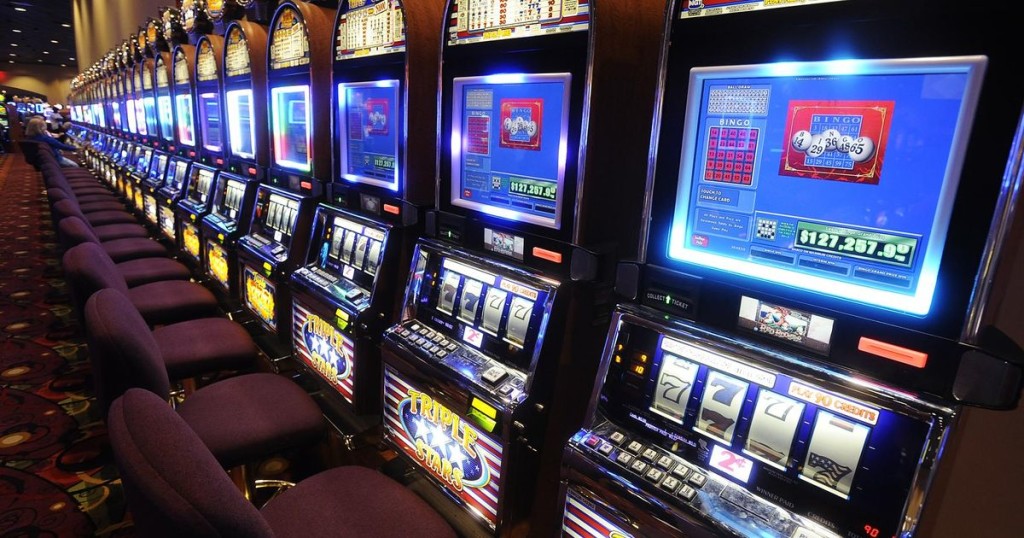
Gov. Robert Bentley and Alabama Attorney General Luther Strange have joined forces to shut down VictoryLand casino once again. The two officials sent a letter to Macon County Sheriff Andre Brunson and District Attorney E. Paul Jones asking them to close down VictoryLand on Thursday. Located in Shorter, Ala. the casino had previously been shuttered since 2013, when a raid by the state took 1,615 gambling machines and $260,000 in cash. The casino reopened on Sept. 13, with more than 3,000 people in attendance. “It is widely known that VictoryLand began operations on Sept. 13, 2016 and continues as of today’s date to operate electronic bingo machines,” the letter read. “This is a violation of Alabama law. Electronic bingo has clearly been disallowed by Alabama case law as a form of lottery prohibited under Alabama’s Constitution.” Bentley and Strange asked for a response by Friday, Sept. 30 with a written description on how they plan to enforce the state’s gambling laws. In March, the Alabama Supreme Court said the casino owners were passing off games as “bingo,” ruling the machines illegal. Last month, VictoryLand owner Milton McGregor announced the state closure was illegal, and the casino would reopen despite the court’s ruling saying both the sheriff and district attorney assured him the games are legal. “While it has taken longer than we hoped, the time is now here and we are pleased that hundreds of our people will have a new job and VictoryLand will be generating a badly needed shot in the arm for Tuskegee and this entire region of Alabama,” McGregor said in an earlier statement announcing the casino’s reopening.
