
Best and worst jokes from Donald Trump, Hillary Clinton at white-tie affair
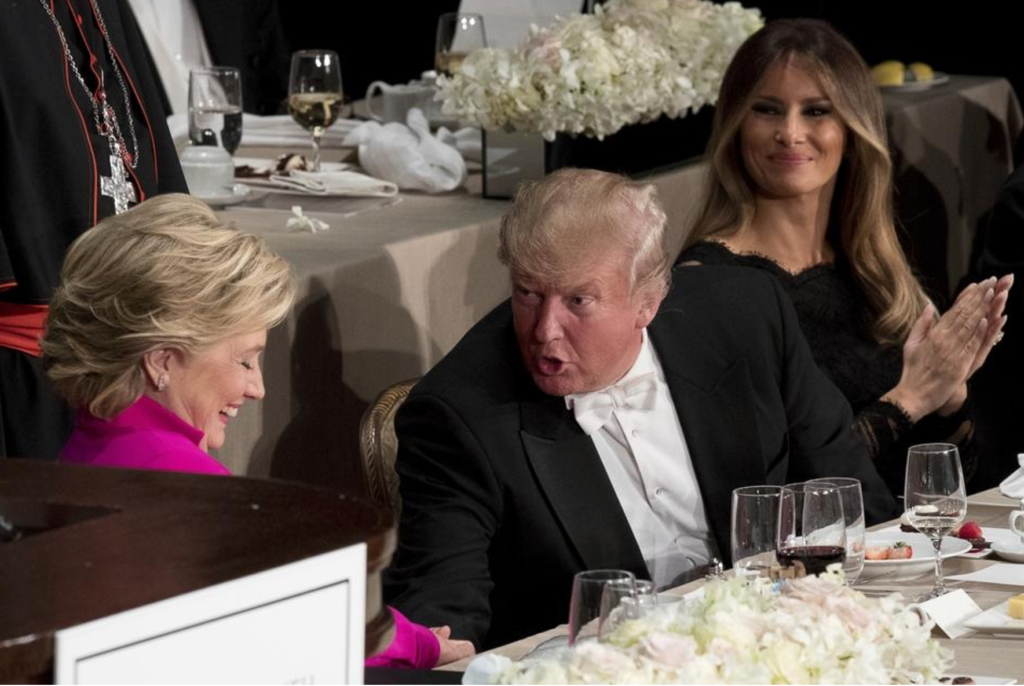
Every four years, the Alfred E. Smith Memorial Foundation Dinner is meant to be a campaign cease-fire, when the presidential nominees share the stage a final time before Election Day and trade warm-hearted jokes. But this year’s dinner, reflecting the bitter nature of the contest between Donald Trump and Hillary Clinton, was hardly jovial, with both candidates exchanging fierce jabs Thursday night that at times appeared to devolve into personal attacks. Some of Trump’s jokes were so pointed that many in the well-heeled crowd turned on the nominee midway through his remarks and showered him with jeers, an unprecedented act at a white-tie charity dinner that raised more than $6 million for poor children in New York. Trump and Clinton sat one seat apart for the evening, with New York’s Cardinal Timothy Dolan the only buffer. And when they entered and took their seats, they did not greet each other or make eye contact, though they did shake hands at the conclusion of the night. Dolan later called his seat “the iciest place on the planet.” Here’s a look at some of the best – and worst – jokes from both candidates: — TRUMP: – “I know that so many of you in the archdiocese already have a place in your heart for a guy who started out as a carpenter working for his father. I was a carpenter working for mine.” – “We have proven that we can actually be civil to each other. In fact, just before taking the dais, Hillary accidentally bumped into me and she, very civilly, said: ‘Pardon me.’ And I very politely replied, ‘Let me talk to you about that after I get into office.’” – “The media is even more biased this year than ever before – ever. You want the proof? Michelle Obama made a speech and everyone loves it, it’s fantastic. My wife, Melania, gives the exact same speech. And people get on her case.” – “Everyone knows, of course, Hillary’s belief that, ‘It takes a village,’ which only makes sense, after all, in places like Haiti, where she’s taken a number of them.” – “We’ve learned so much from WikiLeaks. For instance, Hillary believes that it’s vital to deceive the people by having one public policy and a totally different policy in private. . For example, here she is tonight, in public, pretending not to hate Catholics.” — CLINTON – “People look at the Statue of Liberty, and they see a proud history of a nation of immigrants – a beacon of hope for people around the world. Donald looks at the Statue of Liberty and sees a 4. Maybe a 5, if she loses the torch and tablet and changes her hair.” – “And if Donald does win, it will be awkward at the annual President’s Day photo, when all the former presidents gather at the White House, and not just with Bill. How is Barack going to get past the Muslim ban?” “- Now, you notice there is no teleprompter here tonight, which is probably smart, because maybe you saw Donald dismantle his prompter the other day. And I get that. They’re hard to keep up with, and I’m sure it’s even harder when you’re translating from the original Russian.” – “It is great, also, to see Mayor Bloomberg here. It’s a shame he’s not speaking tonight. I’m curious to hear what a billionaire has to say.” – “After listening to your speech, I will also enjoy listening to Mike Pence deny that you ever gave it.” Republished with permission of the Associated Press.
Who is Evan McMullin, third-party candidate surging in Utah
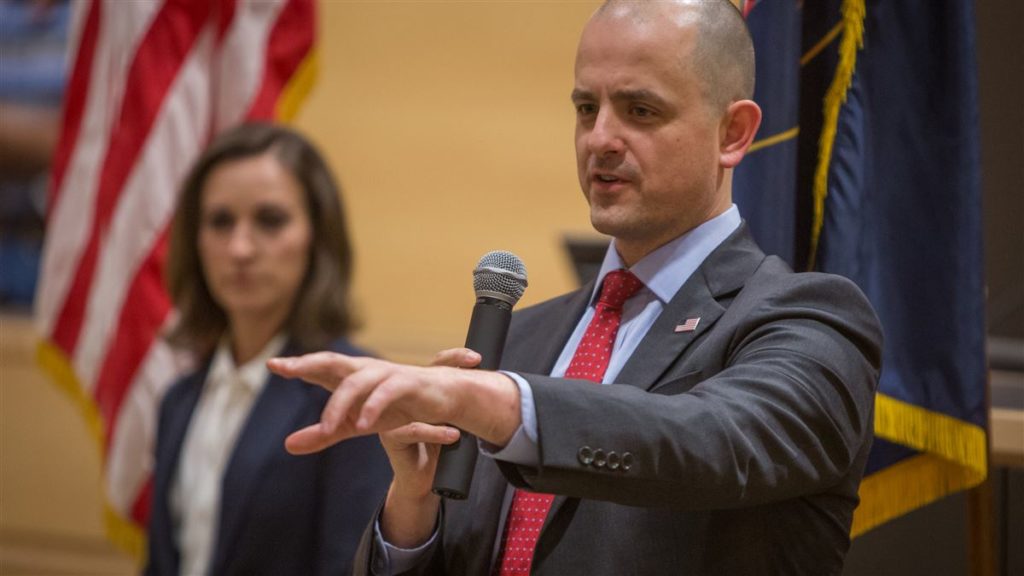
Two months after he jumped into the presidential race as a political unknown on the fringe, independent candidate Evan McMullin is surging in the polls in Utah and drawing large crowds at rallies as he becomes the conduit for conservative voters fed up with Republican Donald Trump‘s crudeness and antics. The Republican stronghold of Utah is suddenly a toss-up state amid widespread rejection of Trump, with polls showing McMullin closing in on the Republican nominee and Democrat Hillary Clinton. It means that Utah may do what seemed unthinkable: Elect a non-Republican presidential candidate for the first time since 1964. Though McMullin is only on the ballot in 11 states, there’s even talk of the 40-year-old becoming president in a wild, exceedingly unlikely scenario in which neither Trump or Democrat Hillary Clinton gets enough electoral votes and Congress is left to decide. McMullin’s stunning ascent into relevancy has everyone asking: Who is this guy? Born in Provo, Utah – the heartland of Mormon country – McMullin spent his childhood in a rural area of Washington outside Seattle. He did a two-year Mormon mission in Brazil and then returned to Utah to earn a degree in international law and diplomacy at the Mormon church-owned Brigham Young University. He spent 11 years in the CIA doing counter terrorism work before leaving the agency to get a master’s in business administration from the Wharton School of Business and have a brief stint in investment banking. He later became a national security adviser for the House Committee on Foreign Affairs. He was working as the chief policy director for U.S. House Republicans as he watched with amazement as Trump won the GOP nomination and no other conservative jumped in the race. By late summer, he realized he would have to run to give conservative voters an alternative to Trump and Clinton. Despite knowing he would endure ridicule and questions about his motives, McMullin went for it. McMullin is hopeful he can win Utah and make a dent in neighboring Idaho and Wyoming. But even if he doesn’t win any state, he said he’s already accomplished part of what he set out to do. “We believe it’s time in this country for a new conservative movement,” McMullin said. “That would be a conservative movement that’s welcoming to people of all races and religions… It’s a conservatism that is compassionate and wants to help people and understands people’s struggles and help them through these struggles.” McMullin is scheduled to host a rally Friday night in a Salt Lake City suburb before making campaign stops in Idaho and Colorado in the coming days. Damon Cann was a roommate of McMullin’s for three months in 1999 when they lived together at BYU housing in Virginia. Cann, now a Utah State University political scientist, remembers McMullin being an ambitious young man with a high motor who was very excited about starting his career in the CIA, taking very seriously all the agency rules. He even insisted on reporting an encounter with foreigners from across the hall who gave them cookies, Cann remembers. Handicapping this year’s race, Cann said McMullin has seized the opportunity created by the unpopularity of Trump and Clinton by persuading voters he’s a better option than Libertarian candidate Gary Johnson, whose policies don’t quite jibe with Utah’s culture. That includes being pro-abortion rights and accepting the legalization of gay marriage. His choice of a woman as his running mate, Republican campaign strategist Mindy Finn, is just one part of his campaign that has endeared him to Utah voters, especially young Mormons, Cann said. “People tend to have a higher level of social trust for people who are in the same group,” Cann said. “LDS people find Evan McMullin to be trustworthy on the account he shares their religious identification.” McMullin downplays the role his religion is playing in his ascent. “It’s about principles. They’re not only Mormon principles, they are the principles of millions of Americans,” McMullin said. “I am the only true conservative in this race.” Matthew Burbank, an associate professor of political science at the University of Utah, predicts Trump will narrowly win the state, making McMullin mainly an interesting historical footnote similar to Ross Perot‘s 1992 showing in Utah when he finished second to George H.W. Bush but ahead of Bill Clinton. But he’s among those impressed by how well McMullin has maneuvered this year’s bizarre political landscape to earn widespread attention. McMullin’s strategy to stake out general, conservative ideas seems to be working because most voters aren’t looking for detailed plans about what he would do as president because they know that’s not realistic. “He’s primarily a symbolic conservative,” Burbank said. “As long as he holds that position, some Utah voters will look at that and say, ‘I’d rather vote for him.’” Republished with permission of the Associated Press.
