
For Hillary Clinton, struggle to change public perception persists
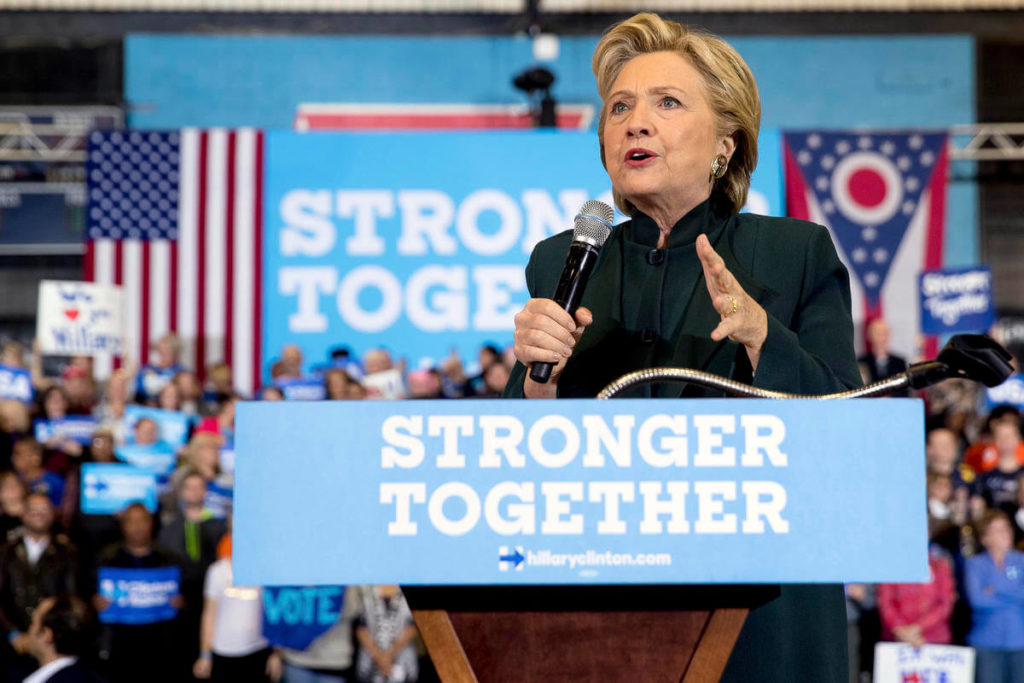
Hillary Clinton bested Donald Trump in three debates. She leads in many preference polls of the most competitive states. Barring a significant shift in the next two weeks, she is in a strong position to become the first woman elected U.S. president. But Clinton will end the campaign still struggling to change the minds of millions of voters who don’t think well of her, a glaring liability should the Democratic nominee move on to the White House. While many see her as better prepared to be commander in chief than Trump, she is consistently viewed unfavorably by more than half of the country. Most voters also consider her dishonest. Clinton’s advisers have spent months trying to erase that perception. They’ve set up small events where she had more intimate conversations with voters. They’ve tested a seemingly endless stream of messages aimed at assuring the public that the former secretary of state was in the race to do more than fulfill her own political ambitions. As Clinton starts making her closing argument to voters, her team appears to have come to terms that the mission remains unfulfilled. “Honest and trustworthy has become our most talked about metric because it’s not great,” said Jennifer Palmieri, Clinton’s communications director. “But we’ve never thought it’s the metric people make a decision on.” If Clinton wins, that theory may be proven true. Just 36 percent of voters believe Clinton is honest and trustworthy, according to a recent Washington Post/ABC News poll. That’s compared with about 60 percent who believe she has the qualifications and temperament to be commander in chief. The public’s perception of Clinton has bounced up and down throughout her time in public life. Her favorability rating fell below 50 percent at times during her years as first lady, but rose to its high water mark then and while she was as secretary of state under President Barack Obama. Democrats blame some of the current negative personal perceptions of Clinton on the hard-charging tactics she’s used to try to discredit Trump, though they believe her sustained assault on Trump’s character and temperament has been crucial. Party operatives also say Trump’s personal attacks on Clinton have made it all but impossible for more positive messages to break through. He’s called her a “liar,” a “nasty woman” and pledged to put her in jail. “When you’re under relentless assault from a reality TV star, it’s hard to come out of that with anybody feeling good about anyone,” said Bill Burton, a former Obama aide. Still, Clinton’s advisers acknowledge that some of her troubles have been of her own making, including her penchant for privacy. She’s spent nearly the entire campaign struggling to explain why she used a private email server in the basement of her home while she led the State Department. She hid a pneumonia diagnosis this fall from nearly all of her senior staff, then left the public unaware of her condition and whereabouts for 90 minutes after the illness caused her to rush out of a public event in New York. “She is a politician that does not seek to be the center of attention and is inherently more private than most politicians, certainly presidential candidates,” Palmieri said. “That doesn’t always serve you great in a campaign for president.” Clinton frequently shoots down questions about the public’s negative perceptions by saying she’s viewed more positively when she’s doing a job rather than running for one. There’s some evidence to back that up. When she ran for re-election to the Senate from New York in 2006, she won with 67 percent of the vote, a big jump from the 55 percent share from her first race in 2000. Her approval rating when she left the State Department, where her job kept her out of day-to-day politics, sat at an enviable 65 percent, according to the Pew Research Center. But if Clinton is elected president, she won’t have the luxury she had as secretary of state to stay away from the political fray — with Republicans in Washington in the opposition, and possibly Trump, too. The businessman keeps flirting with the idea he could contest the election results if he loses. There are also persistent rumors that, if he loses, he might try to harness the enthusiasm of his millions of supporters into some type of media venture. “The notion that Trump is going to go quietly into the night and wish her Godspeed is highly unlikely,” said David Axelrod, another former Obama adviser. “She’s going to have to contend with that and whatever it is he chooses to make his vehicle.” Clinton has begun acknowledging the challenge that could await her in the White House, if she wins, centering her closing argument to voters on a call for unity after a bitter campaign. “My name may be on the ballot, but the question really is who are we as a country, what are our values, what kind of a future do we want to create together,” she said Friday at a rally in Ohio. Some Democrats see the transition — the two-month-plus stretch between the Nov. 8 election and the Jan. 20 inauguration — as a crucial opportunity for her to signal, if she wins, that a Clinton White House would be different from a Clinton campaign. In a nod to bipartisanship, she could nominate a Republican for her Cabinet. Clinton could start moving on some of her more broadly popular policy proposals as a way of boosting her appeal, assuming no crisis demands immediate action. Still, Axelrod said changing the public’s view of Clinton will be a “long-term project.” “There’s no silver bullet to turn around years of wear and tear on her image,” he said. Republished with permission of the Associated Press.
Tim Kaine already reaching out to GOP
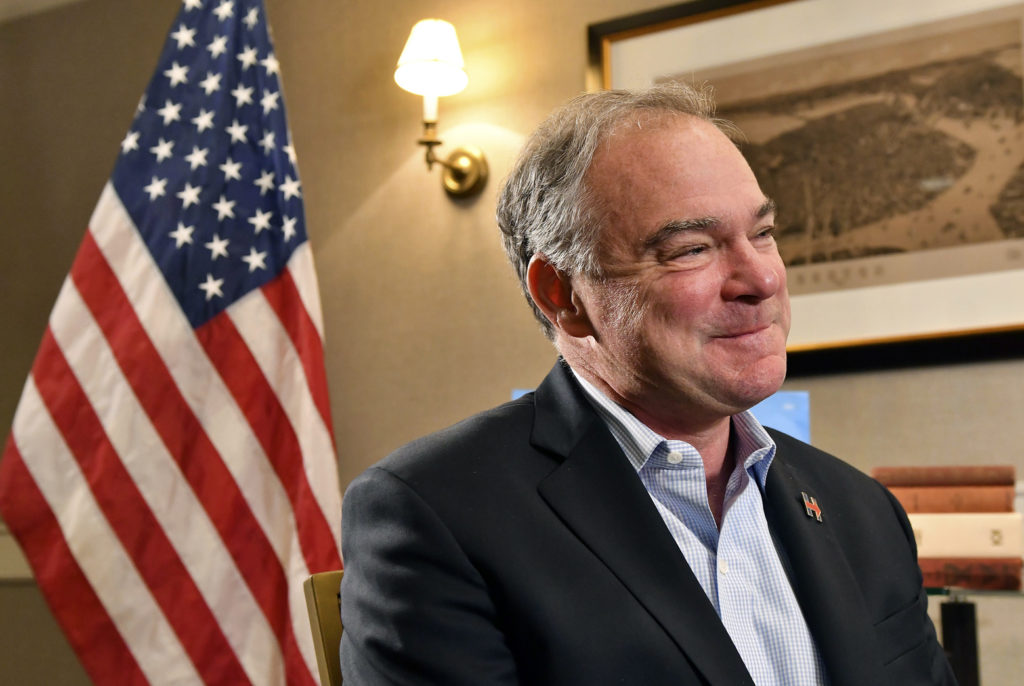
Tim Kaine is sounding a hopeful note that a Democratic White House could work with Republicans to bridge deep divides laid bare by this bitter presidential campaign. The vice presidential candidate told The Associated Press on Saturday that he and Hillary Clinton have already spoken about how to heal the nation if they should win. He said tackling economic anxieties, finding common policy ground with the GOP and perhaps bringing Republicans into the administration would be elements of unity, though he added that he and Clinton did not discuss Cabinet positions. “We have not run this campaign as a campaign against the GOP with the big broad brush — we’ve run it against Donald Trump,” Kaine said. He predicted: “We’re going to get a lot of Republican votes and that will also be part of, right out of the gate, the way to bring folks back together.” Clinton’s campaign has been preparing for the possibility that Trump won’t concede the election if he loses, based on his assertions that the contest is rigged. Kaine said he hasn’t talked with Clinton about that scenario. A self-described underdog, Kaine said he only recently began acknowledging the real possibility of victory. He’s hired Wayne Turnage, a former chief of staff, as his transition director and is considering issues he’d pursue as vice president. “It’s probably only been in the last couple of weeks that I’ve started to think about, OK, the prospect of winning is such that we better start doing some thinking about practicalities,” Kaine said. As vice president, Kaine said he would hope to be central in forging relationships between the administration and mayors and governors. Kaine served as the mayor of Richmond and governor of Virginia before winning his Senate seat in 2012. He also wants to help shape U.S. policy in Latin and South America, due to his fluency in Spanish and experience as a missionary in Honduras. Kaine still remains somewhat of an outsider in Clinton’s world. She has developed trusted relationships with several aides over decades and Kaine is a new addition to the mix. He’s at times been out of the loop on major developments, such as not knowing about Clinton’s pneumonia diagnosis in September until days later. The two campaign together infrequently, but communicate by text message, email and phone. Sometimes they talk every few days, but it could be as infrequent as once a week, Kaine said. Their scheduled joint appearance in Pennsylvania on Saturday was their first event together since Labor Day. But Kaine said he’s not worried about lacking a voice in a Clinton administration and expects to be a principal adviser to her on the most difficult issues if she wins. He said he thinks Clinton picked him over longtime confidants specifically because he was not a member of the inner circle from way back. “I’m not worried about, you know, getting my two cents in,” he said. Kaine said his experience as Virginia’s lieutenant governor and as Democratic National Committee chairman during President Barack Obama‘s first term has showed him how to be a strong adviser and asset for Clinton. Kaine might be well-positioned to work with Republicans, having won three statewide races — lieutenant governor, governor and senator — in historically Republican Virginia, although the state has started going Democratic in presidential contests. Now in his fourth year as a senator, he said he’s already talking with Republicans about working together after the election. Clinton is stepping up efforts to help Democrats recapture Senate control but Kaine didn’t make a specific pitch for a Democratic Senate. He said he’s more focused on finding policies Republicans and Democrats can agree on. “I have very good relations with Republicans in the Senate,” Kaine said. “There’s some people who really want to get some good work done.” Republished with permission of the Associated Press.
Hillary Clinton turns focus to down-ballot candidates in final days

Hillary Clinton is expanding her focus in the final days of the presidential race, seeking to help down-ballot congressional candidates. In Pittsburgh on Saturday, Clinton assailed incumbent Republican Sen. Pat Toomey, saying he had failed to “stand up” to Donald Trump in the face of his comments about Mexican immigrants and a Muslim-American military family. She also noted that Trump had “said terrible things about women” and “spread the lie that our first black president wasn’t born in America.” “If he doesn’t have the courage to stand up to Donald Trump after all of this, then can you be sure that he will stand up for you when it counts?” Clinton said of Toomey. Toomey is locked in a tight race with Democratic challenger Katie McGinty. Clinton called McGinty “exactly the kind of senator that Pittsburgh and western Pennsylvania needs. The attacks on Toomey were a new effort from the presidential nominee, who has largely focused her fire on Trump. Clinton did note that some Republicans have had the “grits and the guts” to push back against Trump. Toomey spokesman Ted Kwong said the Clinton comments show how McGinty would not be an independent voice in the Senate. “Today is just further proof that hyper-partisan, ethically challenged Katie McGinty will be a rubber stamp for everything Hillary Clinton wants to do in Washington,” he said. “Pat Toomey has been, and will continue to be, an independent leader in the Senate on issues ranging from gun safety to ending Wall Street bailouts.” Clinton told reporters on her plane in Pittsburgh that she does plan to focus more on helping other Democrats. The move shows her growing confidence in her own race and her hope that Democrats recapture the Senate. Republished with permission of the Associated Press.
Donald Trump team says ‘we are behind’ but can still win the race
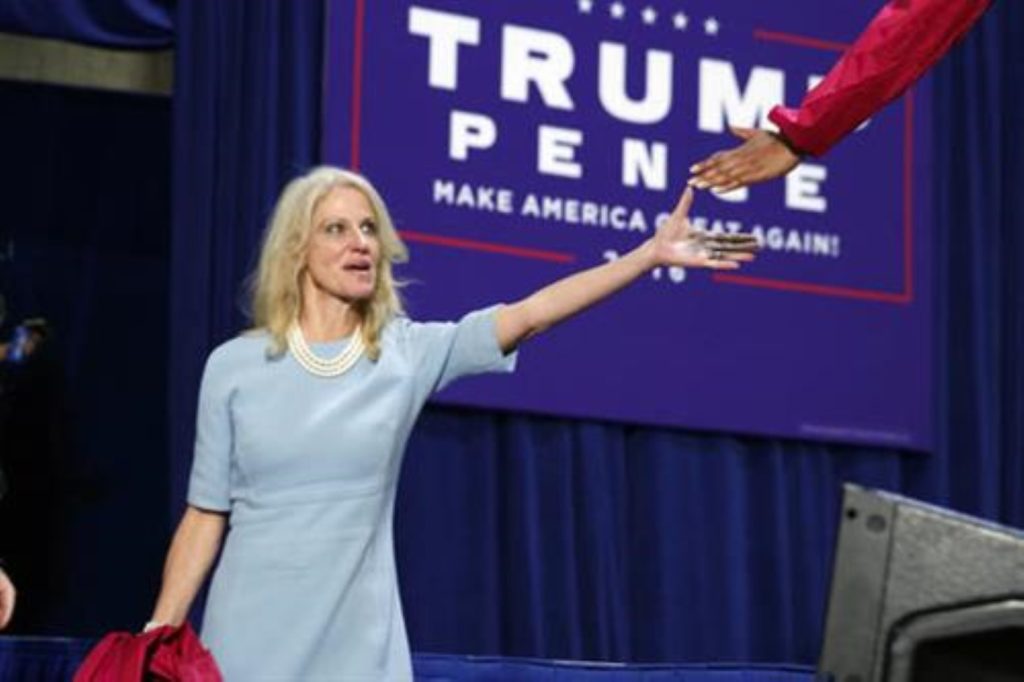
Donald Trump‘s campaign bluntly acknowledged Sunday that the real estate mogul is trailing Hillary Clinton as the presidential race hurtles toward a close, but insisted he still has a viable path to win the White House. With barely two weeks left and early voting underway in most of the U.S., Trump’s team said “the race is not over” and pledged to keep campaigning hard — even in states like Virginia and Pennsylvania that polls show are now trending Clinton’s way. Campaign manager Kellyanne Conway laid out a path to the requisite 270 electoral votes that goes through make-or-break states Florida, Iowa, North Carolina and Ohio. “We are behind. She has some advantages,” Conway said Sunday. Yet she argued that Clinton’s advantages — like a slew of bold-name Democrats campaigning for her — belied her lack of true support. “The current president and first lady, vice president, all are much more popular than she can hope to be.” Added Republican National Committee Chairman Reince Priebus: “We expect to win.” Yet even as Clinton appeared to be strengthening her lead, her campaign was careful not to declare premature victory. “We don’t want to get ahead of our skis here,” said Clinton campaign manager Robby Mook. He said the “battleground states” where both candidates are campaigning hardest “are called that for a reason.” As part of his closing message, Trump was laying out an ambitious agenda for his first 100 days as president. Yet he undermined his own attempt to strike a high-minded tone on policy issues when he announced in the same speech that he planned to sue the numerous women who have accused him of groping and other unwanted sexual behavior. “All of these liars will be sued once the election is over,” Trump said Saturday during an event near the Civil War battlefield of Gettysburg. He added: “I look so forward to doing that.” Asked about Trump’s remarks, Clinton told reporters between rallies Saturday in Pittsburgh and Philadelphia that she was done responding to what her Republican opponent is saying as Election Day nears and would instead focus on helping elect other Democrats. A day earlier, Clinton attacked Pennsylvania’s Republican senator, Pat Toomey, saying in Pittsburgh that he has refused to “stand up” to Trump as she praised his Democratic challenger, Katie McGinty. Noting Trump’s comments about Mexican immigrants and his attacks on a Muslim-American military family, she said of Toomey: “If he doesn’t have the courage to stand up to Donald Trump after all of this, then can you be sure that he will stand up for you when it counts?” Clinton rejected Trump’s allegation, offered without evidence, that the dozen or so women who have come forward are being prompted by her campaign or the Democratic National Committee. The accusers emerged after the former reality TV star boasted of kissing women and groping their genitals without their consent. “These accusations are not coming from our campaign,” Mook said. On Saturday, an adult film actress said the billionaire kissed her and two other women on the lips “without asking for permission” when they met him after a golf tournament in 2006. Trump has denied that all the other allegations, while insisting some of the women weren’t attractive enough for him to want to pursue. “He’s been waterboarded by these issues,” said former Arizona Gov. Jan Brewer, a Trump supporter, lamenting the “oppression” of her candidate in the media. Though mostly a recap of policies he’s proposed before, Trump’s speech included a few new elements, such as a freeze on hiring new federal workers and a two-year mandatory minimum sentence for immigrants who re-enter the U.S. illegally after being deported a first time. In a pledge sure to raise eyebrows on Wall Street, he said he’d block a potential merger between AT&T and media conglomerate Time Warner. Throughout the GOP primary, Trump was criticized for shying away from detailed policy proposals. But his speech, which aides said would form the core of his closing argument to voters, underscored how the billionaire has gradually compiled a broad — if sometimes vague — policy portfolio that straddles conservative, isolationist and populist orthodoxies. Mook and Brewer spoke on CNN’s “State of the Union” and Priebus on CBS’ “Face the Nation.” Conway spoke on “Fox News Sunday” and on NBC’s “Meet the Press.” Republished with permission of the Associated Press.
Business owners replace idealists in legal-pot movement

Business owners are replacing idealists in the pot-legalization movement as the nascent marijuana industry creates a broad base of new donors, many of them entrepreneurs willing to spend to change drug policy. Unlike in the past, these supporters are not limited to a few wealthy people seeking change for personal reasons. They constitute a bigger coalition of business interests. And their support provides a significant financial advantage for pro-legalization campaigns. “It’s mainly a social-justice movement. But undoubtedly there are business interests at work, which is new in this movement,” said Kayvan Khalatbari, a one-time pot-shop owner and now head of a Denver marijuana consulting firm. The donors offer a wider foundation of support for the marijuana-related measures on the ballot next month in nine states. The campaigns are still largely funded by national advocacy organizations such as the Drug Policy Alliance, the Marijuana Policy Project and the New Approach PAC. But those groups are less reliant on billionaire activists. On the other side, legalization opponents are attracting new support from businesses as diverse as trucking, pharmaceuticals and even gambling. In 2012, Colorado and Washington became the first states to pass ballot initiatives legalizing recreational marijuana for adults. Oregon, Alaska and Washington, D.C., followed in 2014. The result is a bigger pool of existing businesses that see expansion potential in more states authorizing use of the drug. Take Darren Roberts of Boca Raton, Florida, co-founder of High There!, a social network for fans of pot. He donated $500 this year to a campaign to legalize marijuana for medical purposes in Florida. Roberts is also encouraging his customers to donate to legalization campaigns in their own states. “I would say it’s a combination of both the philanthropic social interest and the potential financial interest,” Roberts said. All five states considering recreational marijuana — Arizona, California, Maine, Massachusetts and Nevada — have seen more money flowing to groups that favor legalization than to those fighting it. The same is true in the four states considering starting or reinstating medical marijuana — Arkansas, Florida, Montana and North Dakota. The donors who contribute to anti-legalization efforts have changed, too. Some deep-pocket donors who drove opposition campaigns in years past are opening their pocketbooks again. Casino owner Sheldon Adelson of Nevada, for example, gave some $5 million in 2014 to oppose a medical-pot measure in Florida. This year, as his home state considers recreational pot and Florida takes a second look at medical marijuana, Adelson has spent $2 million on opposition in Nevada and $1 million to oppose legalization in Massachusetts. Other casinos are donating to Nevada opposition efforts, too, including MGM Resorts International and Atlantis Casino & Resort. Nevada gambling regulators have warned that marijuana violates federal law. Some new opponents have also emerged, moving beyond the typical anti-pot base that includes law enforcement groups, alcohol companies and drug-treatment interests. A pharmaceutical company that is working on a synthetic version of marijuana’s psychoactive ingredient, Insys Therapeutics Inc., has given at least $500,000 to oppose full marijuana legalization in its home state of Arizona. The company did not return a message for comment on the donation. Company officials said in a statement last month that Insys opposes the Arizona ballot measure because marijuana’s safety has not been demonstrated through the federal regulatory process. Other new names popping up in opposition disclosures include U-Haul, which gave $25,000 to oppose legalization in Arizona, and Julie Schauer, a Pennsylvania retiree who gave more than $1 million to a group opposing legalization. Neither returned messages seeking comment on their donations. Smaller donors to opposition campaigns say they are hopelessly outgunned by the young pot industry, but are giving out of a sense of duty. “Everyone’s talking about it like it’s a done deal, but I can’t sit by when I’ve seen firsthand the destruction that marijuana does to people,” said Howard Samuels, a drug-treatment therapist in Los Angeles who donated some $20,000 to oppose recreational legalization in California. Samuels and other marijuana opponents insist that the pot industry cynically hopes to get more people addicted to the drug to line its own pockets, comparing pot providers to tobacco companies. But marijuana-industry donors insist that they are simply carrying on a tradition started by the tie-dye wearing drug activists who pushed legalization long before there was any business model attached to it. They insist they would contribute financially even without any money-making potential. “When a movement becomes an industry, of course the advocacy picture gets shuffled,” said Bob Hoban, a Denver attorney specializing in marijuana law and a $1,000 donor to the Marijuana Policy Project. “It shifts away from activists to more traditional business interests, because the skill sets don’t exactly transfer.” Republished with permission of the Associated Press.
