
Uber, Google develop app for Election Day rides
Election Day is only days away, and Uber and Google have teamed up to help voters cast ballots. As part of its ongoing campaign to boost the turnout among Uber users, the San Francisco-based ride-sharing service has worked with Google a special in-app feature available Nov. 8 that will help locate polling locations – and quickly request a ride with a simple tap on the smartphone. On Election Day, Uber users will see a reminder to get out and vote; the unique feature will let them enter the address where they are registered, helping to locate the appropriate polling sites by hitting the “Find Your Polling Place” before requesting a ride. New Uber users riding for the first time can enter the code VOTETODAY for $20 off. Unlike other Uber promotions, trips will be subject to standard charges, with no free or discounted rides for existing users on Election Day. According to the Uber blog: “Given the important decision people around the country will make on Nov. 8, we wanted to make getting to and from your polling place easier than ever.”
Sheldon Adelson to boost Donald Trump with $25M of ads in campaign final days
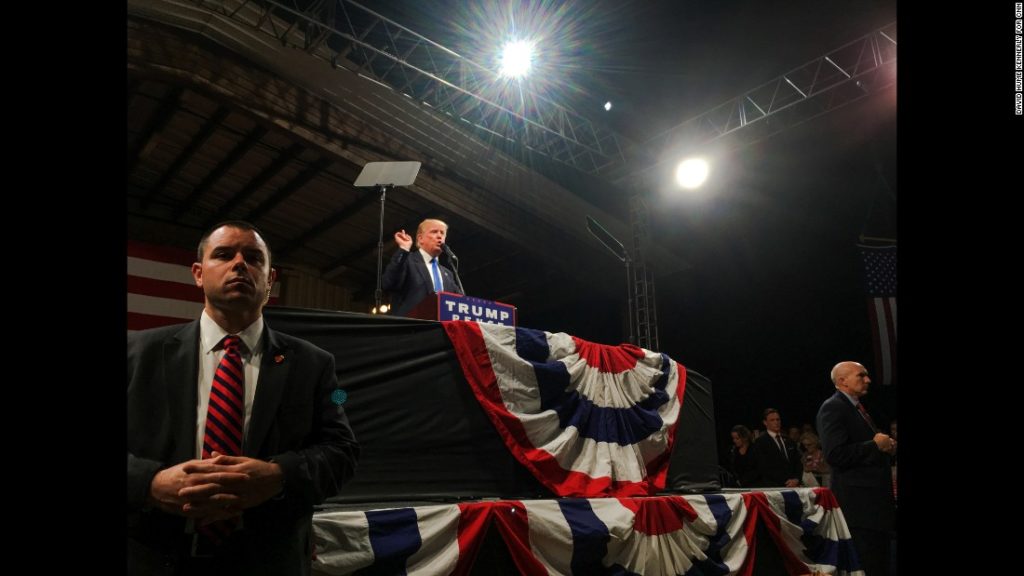
Donald Trump is set to receive more than $25 million of new advertising, thanks to a pair of outside groups looking to boost the GOP candidate in the final days of a grueling presidential campaign. This unexpected boost, first reported by CNN, could help the GOP nominee come in line with Hillary Clinton’s television ad buys. Two outside groups supported by billionaire casino magnate Sheldon Adelson are looking to bring Trump into dollar-for-dollar parity with Democrats. Future 45 super PAC, along with the affiliated nonprofit 45 Committee will sink another $25 million, according to Brian Baker, the group’s president. Baker tells CNN it is “one of the biggest political efforts launched in the final week of a presidential campaign ever.” Included in the new ad buy is another dozen new ads on social media platforms such as Snapchat, as well as spots targeting Spanish-speaking voters and millennials. One of the spots, which premiered on YouTube Thursday, features a woman impersonating Hillary Clinton using a hammer and drill to smash phones and computers – a nod to Clinton’s persistent email controversy. Despite strong fundraising in September, both groups have not spent much recently, at least until this new wave of cash and advertising. As his campaign winds down, Trump and his committees were expected to spend about $20 million, a figure much less than that of Clinton and her supporters. Nevertheless, both Clinton and Trump – as well as their outside groups – have spiked in television purchases during the final days. Clinton and her allied groups expect to spend $53.5 million; for Trump and his groups, ad buys equal about $30.5 million.
Hillary Clinton, Donald Trump use whatever they’ve got in the final push

Knock on every door. Marshal every volunteer. Lob every attack. Hillary Clinton and Donald Trump are opening the final weekend of a marathon campaign by pulling out every tool they have to get their supporters to vote. Polls show critical battleground states may still be up for grabs ahead of Tuesday’s election. Clinton and her allies rushed to shore up support among African-Americans, acknowledging signs of weaker-than-expected turnout in early vote data. That has raised a red flag about diminished enthusiasm that could spell trouble for Democrats up and down the ballot. The Democrat was due to campaign in Pennsylvania and Michigan on Friday, states long considered Democratic strongholds. She’s been pounding Trump for his record on race, accusing him of tacitly encouraging support from white supremacists. “He has spent this entire campaign offering a dog whistle to his most hateful supporters,” Clinton said at a rally in Greenville, North Carolina. The Democrat got a boost Friday in the Labor Department’s monthly jobs report which showed the unemployment rate declined to 4.9 percent while wages went up in October. It’s the sort of news that might nudge voters to continue current economic policies, as Clinton has promised. But this campaign has rarely seemed to hinge on policy. The big personalities on both sides have overshadowed more nuanced questions. Heading into the final days, both campaigns are presenting the choice as a crossroads for democracy. For Trump, that means zeroing in on questions about Clinton’s trustworthiness and a new FBI review of an aide’s emails. Trump warned Thursday that never-ending investigations would prevent his Democratic opponent from governing effectively, speaking directly to voters who may be reluctant Trump supporter but are also repelled by the possible return to Washington of Clinton and her husband, former President Bill Clinton. “Here we go again with the Clintons – you remember the impeachment and the problems,” Trump said Thursday at a rally in Jacksonville, Florida. “That’s not what we need in our country, folks. We need someone who is ready to go to work.” In spite of a close race in national polling, Trump’s path to victory remained narrow. He must win Florida to win the White House, which polls show remains a neck-and-neck race. Early voting has surged in the state. The number of early voters so far, 5.26 million, has already exceeded the overall early voting figure for 2012, and voting will continue this weekend. Republicans have a very narrow edge in ballots cast. North Carolina also has emerged as critical state for Trump – in part because of early signs that African-American turnout there is lagging. Both campaigns are so focused on the two states, the candidate and allies have been nearly running into each other at airports. Trump tweeted about gazing at Air Force One at the Miami airport Thursday, using the moment to rip President Barack Obama for campaigning instead of governing. Both candidates are leaning on surrogates to help carry their message. While Clinton rallies voters in Pittsburgh and Detroit, Obama was to campaign Friday in North Carolina. Bill Clinton was headed to Colorado and Vice President Joe Biden was due in Wisconsin, both states Clinton was believed to have locked up weeks ago. Clinton planned to end her day at a get-out-the-vote rally in Cleveland, using hip-hop artist Jay-Z to draw young people to her cause. On Thursday, she campaigned with former primary opponent Sen. Bernie Sanders and pop star Pharrell Williams. Trump was set to headline events Friday in New Hampshire, Pennsylvania and Ohio, while running mate Mike Pence is visiting Michigan, North Carolina and Florida. While Trump’s children, Eric and Ivanka Trump, hit the trail Thursday, his wife, Melania, made her first speech in months. She vowed to advocate against cyberbullying if she becomes first lady, although she made no reference to her husband’s frequent use of Twitter to call his opponents “liars” and “crooked.” Republished with permission of the Associated Press.
Lawmakers upset over Robert Bentley’s comments, ‘Alabama’s education system sucks’
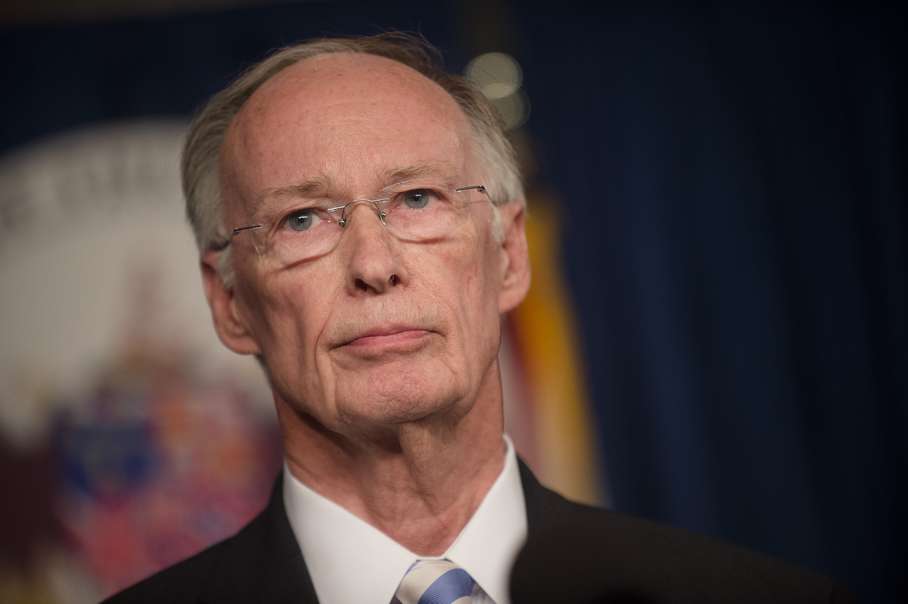
2016 just isn’t Gov. Robert Bentley‘s year. The governor has again found himself the center of public scrutiny having been caught on film addressing the Alabama Association of Regional Councils Conference Wednesday saying “Alabama’s education system sucks.” “I don’t use that term very much but I want to tell you this, when we are 51st on our NAEP scores in 4th-grade math in this state, that’s pretty sad and it’s intolerable,” Bentley told the crowd. The state’s recent NAEP, National Assessment of Educational Progress, scores reveal the Yellowhammer State tied with the District of Columbia and New Mexico for a last-place ranking. While the new state school superintendent, Michael Sentance, like Bentley, he wants to improve education in the state, some lawmakers are are none too happy with the governor’s candid, public remarks. Hayden-Republican Rep. David Standridge, in a statement calling on Bentley to apologize said Alabama schools could improve, but “it is totally and wholly unacceptable for the governor to slam both hard working teachers and students with a blanket statement of disapproval.” “To simply say everything sucks, to me, is not a good representation of the excellence that we have in some places,” Decatur-Republican Rep. Terri Collins, chair of the House Education Policy Committee. Collins believes there are “pockets of excellence” in schools across the state.
Campaigning for Hillary Clinton, Barack Obama reflects on his own legacy
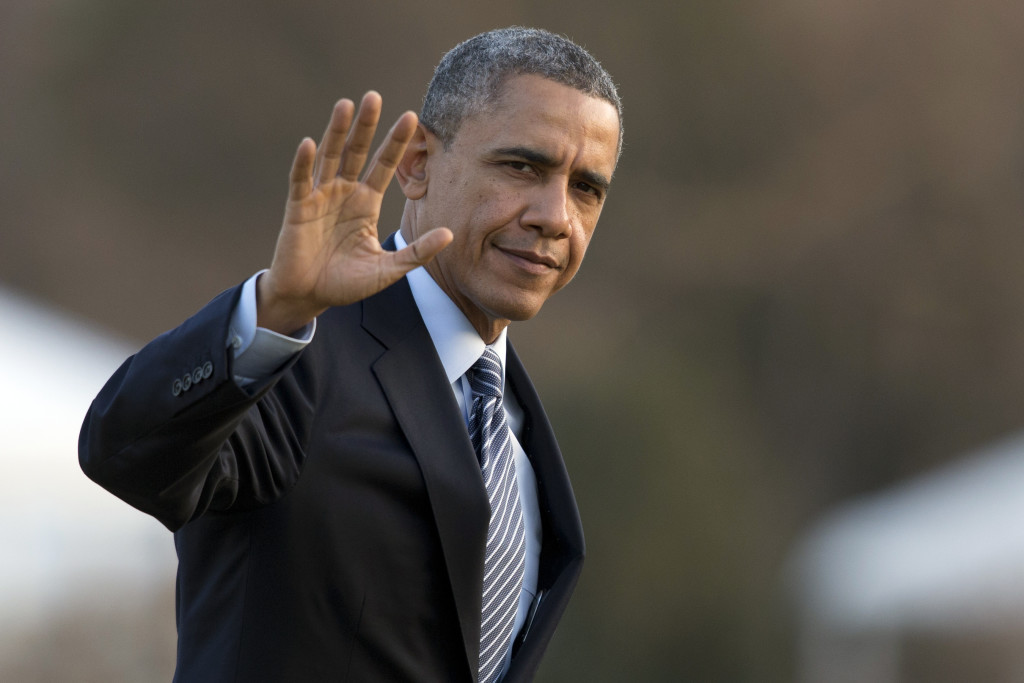
President Barack Obama likes to say that historians, not he, will evaluate his legacy with the perspective only hindsight can provide. Yet as he campaigns across the country for Hillary Clinton, Obama is offering his own first draft of the way he hopes his eight years in office will be remembered. For Obama, the final stretch of the campaign has been a nagging reminder that his presidency is about to close, and an opportunity for self-reflection that the president has seized. After all, Obama’s chief argument for Clinton is that only by electing her over Donald Trump can his supporters protect his accomplishments. “We have been busy, which is why I’ve got gray hair,” Obama told some 7,000 supporters at a rally for Clinton on Thursday in Florida. Lest the country forget, he used his speech to revisit what he considers his greatest-hits list: 20 million Americans who have gained health coverage, unprecedented steps on climate change, the death of Osama bin Laden. He seemed particularly pleased to have spotted a road sign advertising $1.99-a-gallon gas, despite his naysayers’ predictions in 2008 that it would climb to many times that if he were elected. Obama, who has put most of his to-do list on hold until after Election Day, planned to echo those themes Friday during a pair of rallies for Clinton in North Carolina – and again on Sunday and Monday in battlegrounds Florida, New Hampshire and Pennsylvania. Until recently, Obama’s aides were reticent to even use the word legacy, and took to calling it “the L-word” instead. White House aides said that grew out of a sense of communal superstition, reinforced by frequent reminders from Obama and White House chief of staff Denis McDonough that there was plenty of unfinished business and no distractions would be welcome. But as Inauguration Day grows closer, the White House has started working to frame Obama’s legacy for the public, through events designed to take stock of progress and a series of essays Obama has published about health care, economics and globalization. Obama was expected to pen more in-his-own-words pieces elaborating on legacy issues during his finals weeks in office. To be sure, this year’s election has had no shortage of reminders of how deeply divided the U.S. remains, despite Obama’s hopes to “break the fever” by uniting Americans of all political and ethnic backgrounds. Even many Republicans who detest Trump have argued that it’s frustration with Obama’s failures that have enabled Trump’s staggering success. At Obama’s rallies for Clinton, attended largely by die-hard Obama supporters whose enthusiasm for Clinton is in question, there’s a sense of nostalgia that has only recently started creeping in at the White House. As he did in 2008 and in 2012, Obama once again is facing tens of thousands cheering his name. Many are holding signs saved from his 2008 and 2012 campaigns. Jen Psaki, the White House communications director, said returning to the campaign trail has given Obama an opportunity to see how Americans are digesting what the last eight years have meant for their lives. She said the reality of the campaign drawing to a close has been a poignant reminder that Obama’s successor will be inaugurated in less than 80 days. “It gets realer the closer you get,” Psaki said. Republished with permission of the Associated Press.
Yard signs give grassroots voices to a polarized
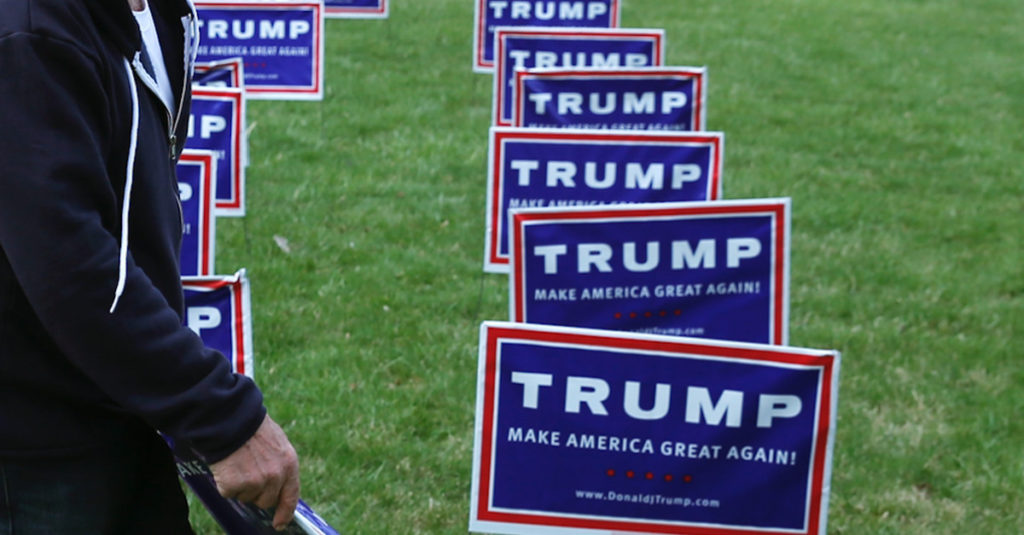
“Sign, sign, everywhere a sign – blockin’ out the scenery, breakin’ my mind.” Apologies to the Five Man Electrical Band and its 1971 hit song, but campaign yard signs are sprouting like weeds in this particularly polarizing election cycle. With them have come vandals carving Trump signs into “Rump” signs, and vigilantes defying local ordinances to festoon their properties with dozens of partisan placards. How is it that these analog expressions of political preference survive in our digitally driven, social media-dominated age? Do they even work? — SIGNS OF THE TIMES Political scientists and historians differ on when Americans began using yard signs, but it’s been nearly two centuries. John Quincy Adams had signs printed for his campaign for the presidency in 1824. Experts say the current wire-frame versions began appearing in the 1960s as suburbs – and lawns – sprouted. Their usefulness is questionable, but Donald Green, a professor of political science at Columbia University, says his latest research, published this past March, suggests signs could provide a 1 to 2 percentage point boost to a candidate in a very tight contest – though he doubts they’d be a deciding factor in the race for the White House. “They’re not enormously effective, but they’re not ineffective, either,” Green says. “They could kick you over the line in a very tight race.” — HOMESPUN MESSAGES Presidential campaigns typically give away signs or sell them online as a fundraising tool. But in this extra-raucous election year, voters have been making their own to send unique messages. A hand-painted sign fashioned from sheet metal in the Berkshires of western Massachusetts reads: “Benghazi Hillary for Prison Now.” One that’s been widely circulated on Facebook features a Trump sign doctored to make it read “RUM: Make America Great Again,” complete with a photo of Johnny Depp as Capt. Jack Sparrow. Another popular alternative: Signs imploring the universe to send a giant meteor and “just end it already.” Anand Sokhey, an associate professor of political science at the University of Colorado Boulder, says it’s all part of America’s quadrennial political theater. “People need to find creative ways to express themselves,” he says. “We’ve asked people their motives in displaying these things. They tend to be more ideologically extreme, more activist.” — SIGN AND PUNISHMENT Nationwide, campaign signs have been defaced or simply have vanished, leaving the candidates’ supporters seething. Local party leaders in western Michigan’s Ottawa County and in central Ohio’s Licking County say hundreds of Trump and Clinton signs have been vandalized or stolen. A Massachusetts man rigged a fake booby trap around a Trump yard sign after two other signs went missing; in battleground Pennsylvania, a woman duct-taped alarms and trip wires to her two Clinton signs. Also in Pennsylvania, a man says he’s had 13 Trump signs stolen, one by a man wearing goggles and a hazmat suit, and in the Boston suburb of Easton, a trick-or-treater dressed in a green Gumby costume tore down a “Make America Great Again” sign. There’s been no shortage of down-ticket misdeeds, either. In Rhode Island, former Democratic state Rep. Brian Coogan is accused of stealing a local rival’s signs and faces larceny and conspiracy charges. Although there’s no national clearinghouse for violations, many states impose civil penalties with fines of up to $1,000 for removing, defacing or destroying political advertising. Residents in an upscale Pittsburgh neighborhood have been receiving unsigned postcards asking them to remove campaign signs from their yards. One indignant homeowner had the card enlarged and planted it on his lawn next to signs supporting Clinton and other Democrats. Republished with permission of the Associated Press.
Melania Trump vows to take on cyberbullying as first lady
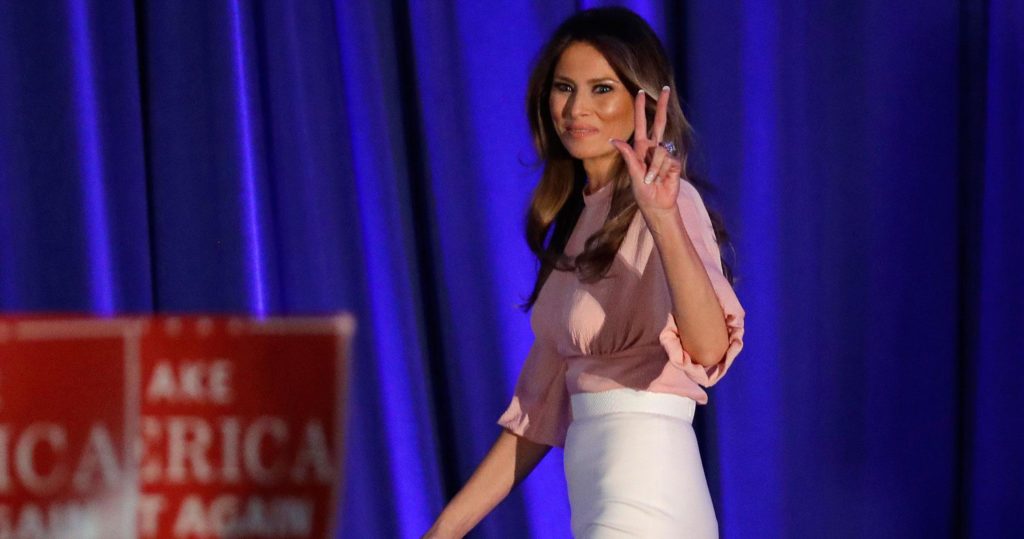
Donald Trump‘s wife, Melania, made a rare appearance on the campaign trail on Thursday, pledging to focus on combatting online bullying and serve as an advocate for women and children if her husband is elected to the White House. Her description of the perils of social media seemed at odds with her husband’s divisive and bullying rhetoric throughout the campaign. “Our culture has gotten too mean and too rough, especially to children and teenagers,” said Mrs. Trump, delivering a get-out-the-vote speech in the Philadelphia suburbs with less than a week to go before Election Day. “It is never okay when a 12-year-old girl or boy is mocked, bullied or attacked” in the school yard, she argued, but it is “absolutely unacceptable when it is done by someone with no name hiding on the internet.” “We have to find a better way to talk to each other, to disagree with each other, to respect each other,” she said. The highly personal speech, which also touched on conversations with her young son, her marriage and her own experience as an immigrant, appeared aimed at humanizing her husband in front of an audience of suburban women who are critical to Trump’s hopes in Pennsylvania and other key states. For years, Trump has used his Twitter account to berate and insult his rivals along with reporters, pundits and others who he feels have slighted him. Some educators have even described a so-called “Trump effect” increase in bullying inspired by Trump’s bombastic rhetoric. Nonetheless, Mrs. Trump told the audience, “We need to teach our youth American values: kindness, honesty, respect, compassion, charity, understanding, cooperation.” The appearance came as Trump’s rival Hillary Clinton and her allies have tried to paint the Republican nominee as anti-women, a strategy Democrats see as the best hope for rattling him and driving female voters away. Thursday’s speech at the Main Line Sports Center was Mrs. Trump’s first since she addressed the Republican National Convention in July. That speech was well-received initially, but was quickly overshadowed by the discovery that sections had been plagiarized from first lady Michelle Obama’s address to the 2008 Democratic National Convention. While Mrs. Trump has given several television interviews and appeared by her husband’s side at events, the former model is more often seen than heard. She explains her frequent absence from the campaign trail by saying her priority is raising the couple’s 10-year-old son, Barron. In her remarks, Mrs. Trump described her husband as a “fighter,” beholden to no one, who “will never give up.” “He certainly knows how to shake things up, doesn’t he?” she joked. She also spent time describing how, growing up in her native Slovenia, “America was the word for freedom and opportunity. America meant: If you could dream it, you could become it.” Receiving U.S. citizenship after a 10-year process, she said, was “the greatest privilege in the world.” There were plenty of “Women for Trump” signs in the crowd of several hundred, who repeatedly interrupted Mrs. Trump’s 10-minute speech with cheers and applause. Throughout the audience were the suburban women whose votes Trump hopes to shore up on a path to victory Tuesday. Kris Goodman, 65, of Berwyn, said she believes Mrs. Trump would be a “great first lady” and an asset to her husband in the White House. Goodman, who has already voted absentee for the Republican nominee, said she was impressed with Trump’s wife at the convention this summer. “I think both she and (Trump’s daughter) Ivanka are great examples of women of this century,” Goodman said. “What’s in the media, I don’t think portrays his record and how he deals with women.” In addition to his wife, Trump’s four oldest children have also been campaigning across the country, along with supporters like House Speaker Newt Gingrich and former New York City Mayor Rudy Giuliani. Meanwhile, Clinton’s campaign has deployed her husband, former President Bill Clinton, along with President Barack Obama, Mrs. Obama and a long list of celebrity backers to help her get out the vote. Republished with permission of the Associated Press.
Voter intimidation arguments head to federal court
Democrats will argue before a federal judge in New Jersey on Friday that Republicans are coordinating with GOP presidential nominee Donald Trump to intimidate voters, charges that the Republican Party says are not true in either the federal case or in the four other states where Democrats are waging similar battles. The legal challenge is one of several around the country filed by Democrats claiming Republicans and the Trump campaign are pushing supporters to intimidate and confront voters on Election Day. Trump has called on his supporters to act as “election observers” in certain areas of the country to help prevent fraud. A federal judge in Las Vegas on Thursday said he hasn’t seen evidence that Trump’s campaign is training people to intimidate voters. Republicans also fought back against charges of wrongdoing in Arizona on Thursday, while arguments will be heard on Friday in Ohio and in Pennsylvania on Monday. The nearly identical legal challenges seek court orders intended to block volunteer GOP poll watchers from harassing people headed to the polls. The federal case being heard in Newark, New Jersey, seeks to link some of those poll watchers and state parties with the Republican National Committee, arguing that any collaboration on voter intimidation or ballot security efforts would violate an agreement that the RNC has been forced to follow since 1982. The consent decree was created after Democrats alleged that the RNC helped intimidate black voters during New Jersey’s 1981 gubernatorial election. The RNC and New Jersey’s Republican party allegedly had off-duty law enforcement officers stand at polling places in urban areas wearing “National Ballot Security Task Force” armbands. Some had guns visible. The RNC admitted no wrongdoing, but agreed to the decree to settle the case. The decree only regulates work done by the RNC and is scheduled to end next year. The Democratic National Committee wants it extended another eight years, but needs to convince a judge that the RNC has violated the 34-year-old rules. The DNC says in court papers that the RNC has supported Trump’s efforts to “intimidate and discourage” minorities from voting. It cites past statements made by Trump’s campaign manager and vice presidential nominee Mike Pence about collaborating with the RNC and also has sworn statements from five Democratic election workers in Las Vegas who say Republican counterparts were working on the RNC’s behalf when they gave voters bad information. The RNC denies all of that, pointing out that campaign manager Kellyanne Conway later said she was mistaken and Pence also said he had no knowledge of any effort between the campaign and the RNC to ensure ballot integrity. The RNC says that the election workers cited by the DNC were not employed by the RNC. The RNC says it has made complying with the consent decree a “top priority.” It says it informed Trump’s campaign in August that it would not participate in any ballot security programs, and also informed state parties about the decree. “The RNC has … never authorized the Trump campaign to act on its behalf. Just the opposite,” a lawyer wrote. “The RNC has repeatedly informed its staff and the Trump campaign that neither Donald Trump nor his campaign speaks or acts on behalf of the RNC.” In both the state and federal cases, Democrats cite the work of Roger Stone, a Trump friend and informal adviser, who has launched an effort to sign up supporters to volunteer to fight “voter fraud.” Stone also was Republican New Jersey Gov. Tom Kean‘s campaign manager in the 1981 race that led to the consent decree. The Democrats allege that Trump’s calls to supporters to show up at the polls to prevent voter fraud amounts to illegal intimidation tactics and that Stone is organizing volunteers to confront voters. But Republicans say there is no evidence that any intimidation is happening. State and federal laws already bar intimidation and the Democrats are asking for orders that would unconstitutionally bar protected political speech, they’ve argued in court documents. In Nevada, U.S. District Judge Richard Boulware said Thursday he doesn’t expect to issue a restraining order that Democrats sought ahead of Tuesday’s election, but won’t issue a final ruling until a hearing on Friday about whether Stone was encouraging what Democrats call “vigilante voter intimidation.” In Phoenix, Stone’s attorney said Democrats have not produced evidence that his client or “Stop the Steal” is intimidating voters. “My client is engaging in legal First Amendment speech,” attorney Paul Jensen told U.S. District Judge John Tuchi. Adam Gitlin, counsel for the nonpartisan Brennan Center for Justice’s Democracy Program, said that no matter what happens in the legal arguments, he worries the rhetoric on voter intimidation and ballot security could discourage people from voting. “The most important thing that people can do is go out and vote this election and make sure you cast a ballot,” Gitlin said. “This kind of rhetoric can be discouraging, both to voters who may be concerned about intimidation, and to Mr. Trump’s own supporter who may doubt that their vote is going to count, which is also untrue.” Republished with permission of the Associated Press.
James Comey considered a ‘bad choice’ for FBI post by Hillary Clinton aide
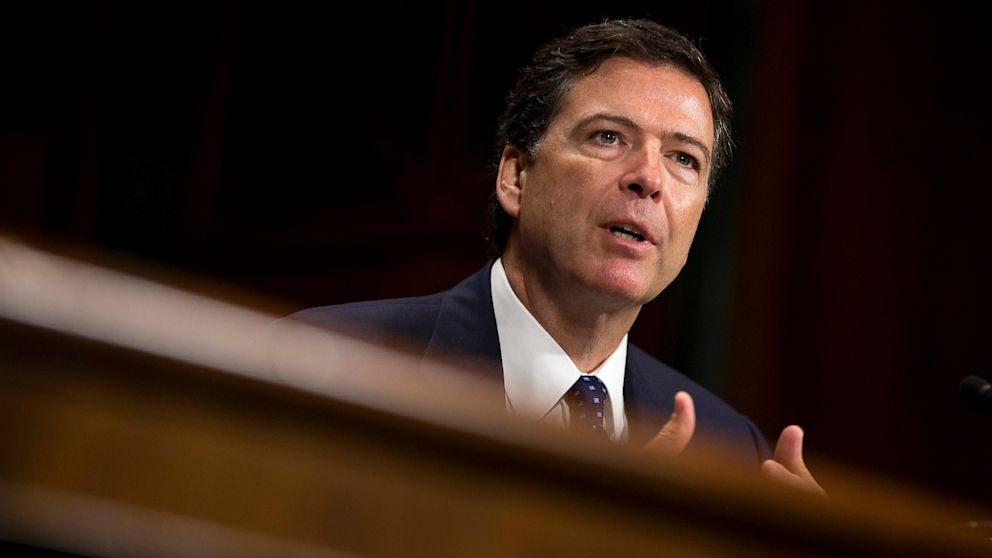
A senior aide to Hillary Clinton privately dismissed FBI Director James Comey as “a bad choice” in October 2015, according to newly released emails from WikiLeaks. The blunt assessment foreshadowed the dramatic tension that has escalated between Comey and the Democratic presidential candidate in the final days before the election. Clinton communications director Jennifer Palmieri forwarded to colleagues a news article in which the FBI director suggested that crime could be rising because police officers were becoming less aggressive as a result of the “Ferguson effect,” anti-police sentiment following unrest earlier that year in Ferguson, Missouri. Comey was widely criticized over the remarks. Palmieri wrote, “Get a big fat ‘I told you so’ on Comey being a bad choice.” She sent the email to Clinton’s campaign chairman, John Podesta, and to the private email address of someone who appeared to be White House spokesman Eric Schultz. Neither responded, and Palmieri did not appear to write further about the subject. Palmieri was the White House director of communications when Comey was appointed FBI director by President Barack Obama in September 2013. The release of the hacked email came days after Comey notified Congress that during an investigation of Clinton aide Huma Abedin‘s now-separated husband, former Rep. Anthony Weiner, FBI agents found indications that a laptop used by Weiner contained some emails related to the FBI’s earlier probe of Clinton’s private computer server and emails. The disclosure roiled the presidential campaign, and last week Palmieri openly criticized Comey about the notification. “By taking this highly unusual, unprecedented action this close to the election, he put himself in the middle of the campaign,” Palmieri said of Comey. Comey had announced in July that he was recommending against criminal charges in the investigation of Clinton’s use of her private server, but the FBI director also delivered blistering criticism that Clinton and her colleagues at the State Department were “extremely careless in their handling of very sensitive, highly classified information.” The Palmieri email was among more than 2,000 messages newly published Thursday by WikiLeaks. The emails were hacked from Podesta’s private account. The U.S. government has said the Russian government was responsible, although WikiLeaks founder Julian Assange said earlier in the day that no government or any other state parties had given the stolen emails to WikiLeaks. He offered no evidence to support his denials, and the wording of his statement did not rule out the possibility that the emails were obtained by a state actor and then provided to another party who then passed them to WikiLeaks. In another hacked email published Thursday, Palmieri told Podesta and longtime Clinton adviser Neera Tanden in June 2011 that it was time to “bust in that house and get Huma the hell out of there.” Palmieri was not explicit in the reference but it appears to have been prompted by the sexting scandal involving Weiner that forced him to resign from his New York congressional seat. Palmieri sent the email, which she titled “time to get in the hazmat suits,” the day before Weiner stepped down after admitting he had sent a sexually suggestive picture of himself to a 21-year-old woman over Twitter. A January 2016 email to Podesta included a message describing a pitch for a music television show involving former president Bill Clinton’s brother, Roger. “Think American Idol meets country music. A panel of judges will pick from the nation’s best undercover stars. Starring Roger Clinton,” said the message, forwarded to a Bill Clinton aide. The idea circulated to Hillary Clinton’s campaign aides, who refrained from commenting. Another email revealed that appearing on the season opener of “Saturday Night Live” took precedence over delivering the keynote dinner address for the annual gala of the Human Rights Campaign, the nation’s largest LGBT rights group – at least in the minds of Clinton’s campaign aides. Lining up an appearance on “SNL” was the Clinton campaign’s top effort for the fall 2015 television season. The campaign’s deputy communications director, Kristina Schake, called a “surprise guest spot” on the comedy series’ Oct. 3 show the “top ask” among television venues. “Talked to the producers,” Schake wrote in an email dated Aug. 6, 2015. “They will write a skit for her and want to confirm asap. Would need to skip the HRC Gala in DC that night, but this opportunity seems more important given the impact it would have.” As it turned out, Clinton managed to deliver a keynote address for the HRC gathering after all – during its Saturday breakfast in Washington. Vice President Joe Biden was the dinner’s keynote speaker. Clinton traveled to New York to appear on “SNL” as hoped, playing a bartender named Val who commiserates with Kate McKinnon‘s Clinton. Other TV shows the campaign sought for Clinton appearances, according to the email: “The Tonight Show Starring Jimmy Fallon,” ”The Late Show with Stephen Colbert, “Jimmy Kimmel Live,” ”Live with Kelly and Michael,” Charlie Rose‘s talk show and “CBS This Morning.” Republished with permission of the Associated Press.
