
Sean Spicer cites ‘studies’ to back Donald Trump voter claim
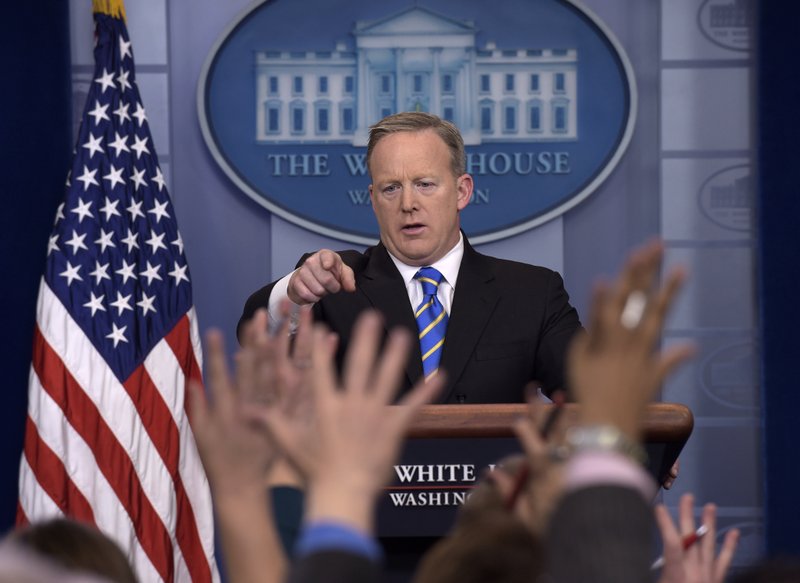
The Latest on President Donald Trump (all times local): 2 p.m. A spokesman says President Donald Trump’s belief that there were millions of illegal votes cast in the November election is based on “studies and evidence.” But spokesman Sean Spicer did not provide examples of that evidence. Trump first made the false claim during the transition. He reiterated the statement in a meeting Monday night with lawmakers, blaming illegal ballots for his loss of the popular vote. Spicer says Trump “continues to maintain that belief.” There has been no evidence to support the claims that there was widespread voter fraud in the election. Spicer’s only attempt to support Trump’s assertion was to point a 2008 Pew Research survey that showed a need to update voter registration systems. __ 1:55 p.m. An Agriculture Department research agency has banned the release of news releases, photos and other material to the public. In a memo to employees at USDA’s Agricultural Research Service, chief of staff Sharon Drumm said the agency would immediately cease releasing any “public-facing” documents. “This includes, but is not limited to, news releases, photos, fact sheets, news feeds, and social media content,” read the email memo obtained by The Associated Press. A statement released by ARS spokesman Christopher Bentley said the agency “values and is committed to maintaining the free flow of information between our scientists and the American public as we strive to find solutions to agricultural problems affecting America.” The statement said some material would still be available on the agency’s website. Buzzfeed News first reported the memo. __ 1:50 p.m. The White House says President Donald Trump has accepted House Speaker Paul Ryan‘s invitation to address a joint session of Congress on Feb. 28. Ryan announced the invitation on Tuesday and informed reporters after a meeting with House Republicans. Ryan had met with Trump Monday night at the White House. Trump also met with Republican and Democratic congressional leaders on Monday. Trump was meeting Tuesday at the White House with top Senate leaders. The speech will be Trump’s first to Congress. He was sworn into office on Friday. __ 12:45 p.m. The Trump administration has instituted a media blackout at the Environmental Protection Agency and barred staff from awarding any new contracts or grants. Emails sent to EPA staff since President Donald Trump’s inauguration on Friday and reviewed by The Associated Press detailed the specific prohibitions banning press releases, blog updates or posts to the agency’s social media accounts. The Trump administration has also ordered a “temporary suspension” of all new business activities at the department, including issuing task orders or work assignments to EPA contractors. The orders are expected to have a significant and immediate impact on EPA activities nationwide. The EPA did not respond to phone calls and emails requesting comment Monday or Tuesday. ___ 12:25 p.m. President Donald Trump is hanging up some new art in the White House press area — and it’s none too subtle. The panoramic photo shows the crowds gathered near the U.S. Capitol for Trump’s inauguration on Friday. It’s a nod to the ongoing interest the president has in making it clear that his event was well-attended. Trump tweeted: “A photo delivered yesterday that will be displayed in the upper/lower press hall. Thank you Abbas!” For emphasis, the official Twitter account of the president retweeted the @realDonaldTrump message. The photo was taken by Washington-area photographer Abbas Shirmohammadi, and it notes the wrong date — Jan. 21, although it does appear to depict the correct event. Trump and press secretary Sean Spicer have taken pains to play up the crowd size, sometimes exaggerating the number in attendance. They’ve excoriated the media for what they said is an effort to downplay enthusiasm for Trump’s inauguration. __ 11:50 a.m. President Donald Trump has taken steps to streamline the permitting process for manufacturing. He also wants pipelines to be made in the U.S. and an expedited process for environmental reviews and approvals. The steps came as Trump signed executive actions to advance construction of the Keystone XL and Dakota Access oil pipelines. Former President Barack Obama blocked construction in late 2015 of the Keystone line from Canada to the U.S. Meanwhile, the Army Corps of Engineers is studying alternative routes for the Dakota Access pipeline. Trump describes the regulatory process as a “tangled up mess.” He says if the answer is no, it should be a quick no. If the answer is yes, Trump says “let’s start building.” ___ 11:35 a.m. President Donald Trump says he will announce his pick to fill the vacant Supreme Court seat sometime next week. Trump told reporters in the Oval Office on Tuesday that he’ll be “making my decision this week” and “we’ll be announcing it next week.” “We have some outstanding candidates,” the president said. “And we’ll pick a truly great Supreme Court justice.” The Supreme Court has only had eight justices since Justice Antonin Scalia died last year. President Barack Obama nominated a replacement but Republicans in the Senate refused to bring the choice up for a vote. During his campaign, Trump publicly identified nearly two dozen candidates for the vacancy. __ 11:25 a.m. President Donald Trump has signed executive actions to advance the construction of the Keystone XL and Dakota Access oil pipelines. Trump tells reporters in the Oval Office that the moves on the pipelines will be subject to the terms and conditions being renegotiated by the U.S. President Barack Obama killed the proposed Keystone XL pipeline in late 2015, saying it would hurt American efforts to reach a global climate change deal. The pipeline would run from Canada to U.S. refineries in the Gulf Coast. The U.S. government needs to approve the pipeline because it crossed the border. The Army decided last year to explore alternate routes for the Dakota pipeline after the Standing Rock Sioux tribe and its supporters said the pipeline threatened drinking water and Native American cultural sites. __ 10:50 a.m. FBI Director James Comey is staying in his
Donald Trump acts to advance Keystone XL, Dakota Access pipelines
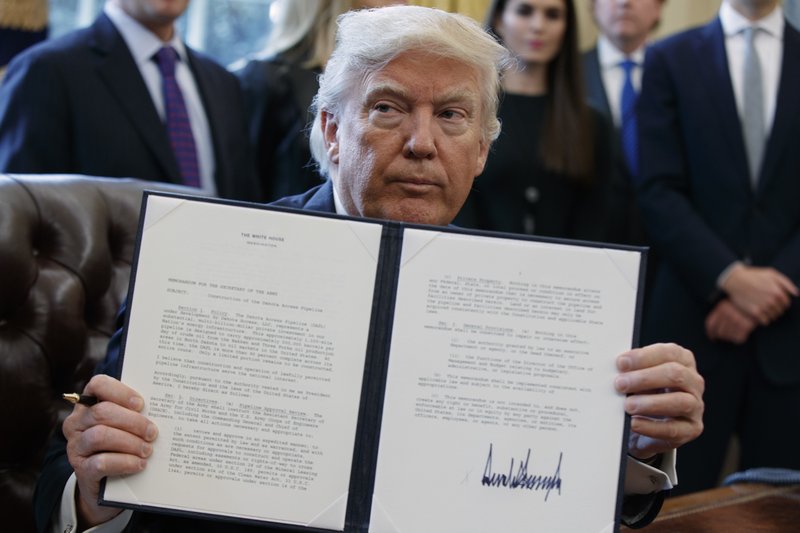
Dealing a blow to former President Barack Obama‘s legacy on climate change, President Donald Trump signed executive actions Tuesday to advance the construction of the Keystone XL and Dakota Access oil pipelines, a move cheered by congressional Republicans and decried by environmentalists. Trump told reporters at the White House that the actions on the pipelines will be subject to the terms and conditions being negotiated by U.S. officials. “From now on we are going to start making pipelines in the United States,” Trump said from the Oval Office. Obama killed the proposed Keystone XL pipeline in late 2015, declaring it would have undercut U.S. efforts to clinch a global climate change deal that was a centerpiece of his environmental legacy. The pipeline would run from Canada to U.S. refineries in the Gulf Coast. A presidential permit is needed to approve the pipeline because it would cross the U.S border. The Army decided last year to explore alternate routes for the Dakota pipeline after the Standing Rock Sioux tribe and its supporters said the pipeline threatened drinking water and Native American cultural sites. The company developing the 1,200-mile pipeline, Texas-based Energy Transfer Partners, disputes that and says the pipeline will be safe. The Dakota pipeline is set to carry North Dakota oil through South Dakota and Iowa to a shipping point in Illinois. “Today’s news is a breath of fresh air, and proof that President Trump won’t let radical special-interest groups stand in the way of doing what’s best for American workers,” said Sen. John Cornyn of Texas, the second-ranking Republican in the Senate. In July, the Army Corps of Engineers granted the company needed permits, but in September the agency said further analysis was needed. On Dec. 4, the assistant army secretary for civil works, Jo-Ellen Darcy, declined to allow the pipeline to be built under Lake Oahe because she said alternate routes needed to be considered. Energy Transfer Partners called the decision politically motivated and said that Obama was delaying the matter until he left office. Nearly 600 pipeline opponents have been arrested in North Dakota since last year. An encampment on Corps land along the pipeline route was home to thousands of protesters who call themselves “water protectors,” though the camp’s population has thinned due to harsh winter weather and a plea by Standing Rock Chairman Dave Archambault for the camp to disband. Trump touted the stalled Keystone project during a late October campaign swing through Florida, saying: “We’re going to approve energy infrastructure projects like the Keystone pipeline and many more.” He listed the project among his top priorities for the first 100 days of his administration, saying it could provide “a lot of jobs, a lot of good things.” Trump also supports the Dakota pipeline. Until last year, Trump owned a small amount of stock in Energy Transfer Partners and at least $100,000 in Phillips 66, an energy company that owns one-quarter of the pipeline. Trump sold the shares last year as part of a wide-ranging stock divestment, a spokesman said. A spokesman said in December that Trump’s support for the Dakota project “has nothing to do with his personal investments and everything to do with promoting policies that benefit all Americans.” Environmental groups blasted the order as a bid by Trump to serve the oil industry. Trump’s nominee for secretary of state, Rex Tillerson, is a former Exxon Mobil CEO, and his pick for energy secretary, former Texas Gov. Rick Perry, owns stock in Energy Transfers. “Donald Trump has been in office for four days and he’s already proving to be the dangerous threat to our climate we feared he would be,” said Michael Brune, executive director of the Sierra Club. He and other activists said the fight against the projects was not over. “It’s a dark day for reason, but we will continue the fight,” said Bill McKibben, co-founder of the environmental group 350.org and a leader of a five-year fight against Keystone XL. McKibben added: “People will mobilize again.” Republished with permission of The Associated Press.
Senate delays Jeff Sessions’ Attorney General confirmation vote to Jan. 31
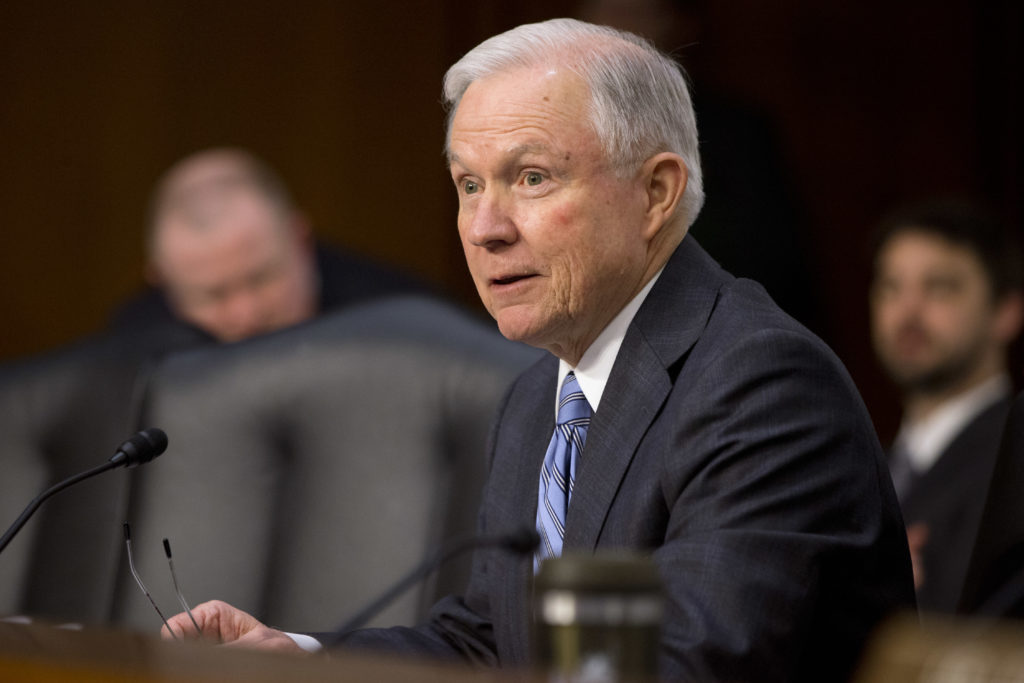
While many of President Donald Trump‘s Cabinet picks are being confirmed, Alabama Republican Sen. Jeff Sessions will have to wait another wait on his confirmation vote to be America’s next attorney general. The U.S. Senate Judiciary Committee on Tuesday announced the committee will delay a week, until Jan. 31, at the request of California Democrat Sen. Dianne Feinstein, the senior Democrat on the committee. Per the committee’s rules, any member may request a one week delay. On Sunday, Sessions submitted nearly 200 pages of written responses to questions to the committee. Feinstein said she and her Democratic colleagues need more time to review the responses. A spokesman for Feinstein said she requested the extra week “to give the committee more time to conduct its due diligence.” The panel was scheduled to vote on Sessions’ nomination during a Tuesday morning committee meeting, but when Iowa-Republican Sen. Chuck Grassley, the committee’s chairman, convened he noted that Democrats wanted to delay the nomination, and said, “of course I’ll honor that request” per the committee’s rules. The committee’s approval is a first step to Sessions’ confirmation being scheduled for a full Senate vote. Despite Democratic opposition, Sessions is expected to be confirmed when his nomination makes its way to the Senate floor.
New study: Donald Trump to inherit $559B deficit, stable economy

President Donald Trump has inherited a stable economy and a government that is on track to run a $559 billion budget deficit for the year, congressional analysts said Tuesday. The estimates from the nonpartisan Congressional Budget Office say the economy will hold relatively steady, with economic growth rising slightly to 2.3 percent this year and unemployment averaging less than 5 percent for the duration of Trump’s term. Trump is promising higher growth as his administration curbs regulations, overhauls the tax code, and repeals the Affordable Care Act, former President Barack Obama‘s signature accomplishment. The latest CBO figures are in line with previous projections. The deficit continues to be an intractable problem that would steadily worsen over time and CBO continues to warn that such rising deficits and debt “would have significant consequences” and act as a drag on the economy if left unchecked. “After declining for several years, federal budget deficits are on a path to rise during the next decade,” the report says. The projections come as Trump and Republicans controlling Congress are working to repeal much of President Barack Obama’s signature health care law, boost the Pentagon budget, and reform the loophole cluttered tax code. Balancing the budget would require crushing cuts to domestic agencies and big health programs like Medicare. Trump’s nominee to run the White House Budget office, Rep. Mick Mulvaney, R-S.C., testified before the Senate Budget Committee Tuesday morning. His remarks offered few clues about the direction the new administration will take in tackling the deficit. Trump has made clear that he’s not interested in unpopular cuts to Medicare and Social Security, though reductions in the Medicaid program for the poor, disabled and elderly are being contemplated. Obama inherited an economy in recession and deficits exceeding $1 trillion a year. Deficits moved lower over his two terms, registering $587 billion last year. For Trump, however, CBO says that “the economy will grow, during the coming decade, at roughly the modest rate observed since the end of the 2007-2009 recession,” the report says. But there’s also the risk of a downturn in the economy after a recovery that spanned Obama’s tenure. Economists generally prefer to measure the deficit against the size of the economy. By that gauge, the current-year deficit would register 2.9 percent of gross domestic product, a level that many economists say is sustainable, at least in the short term. But deficits would gradually rise as a percentage of GDP, which CBO warns could provoke a debt crisis in coming years and limit the options of policymakers to respond to unanticipated challenges. Budget Committee Chairman Diane Black, R-Tenn., called the latest study “Obama’s legacy of an unsustainable national debt and an economy that’s leaving too many people behind.” Black promised that Trump and the Republicans controlling Congress “are preparing pro-growth legislation that will get our economy moving at full steam again and tackle our fiscal problems head-on.” The health insurance markets created under so-called Obamacare will average 10 million customers a month signed up this year, CBO said. That’s fewer than the congressional agency had previously estimated and also less than what the outgoing Obama administration projected, an average of 11.4 million a month. Medicaid expansion — the other arm of Obama’s program — will cover an average of 12 million people a month this year, CBO said. Republished with permission of The Associated Press.
Lynneice Washington becomes first African American woman DA in Alabama
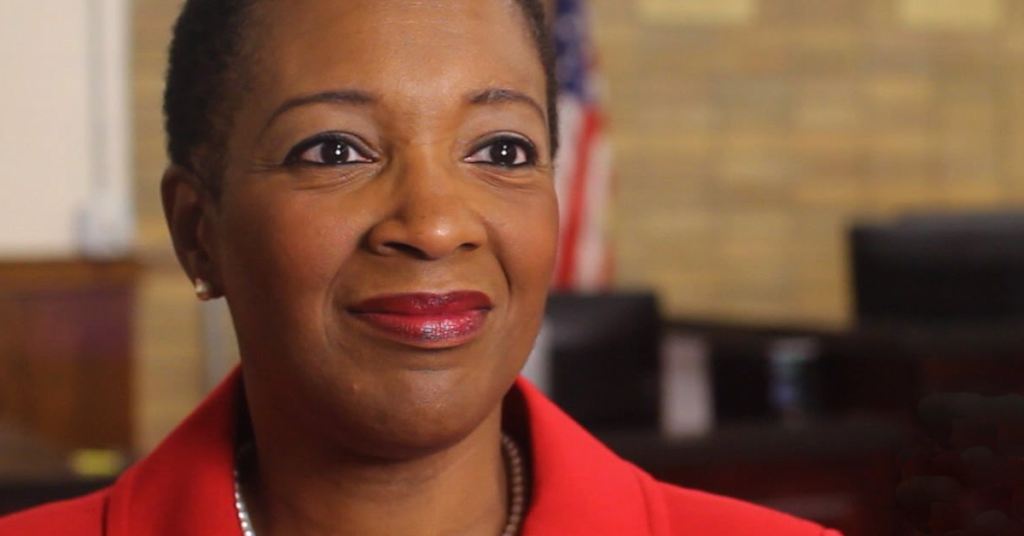
Last week was a historic week for Alabama as Lynneice Washington took the oath of office as Bessemer Cutoff district attorney on Tuesday, becoming the first African American woman to hold the position. The Auburn University at Montgomery alumna narrowly beat incumbent Bill Veitch for the position by only 284 votes, according to the secretary of state’s office. “I know the people, I know the community and I think it’s time, it’s time for change and I plan to be the one to implement that change, positive change,” Washington told WIAT. “I want to include, I want to be rooted in the community.” Most recently Washington served as the presiding judge in Bessemer Municipal Court, before retiring to run for DA. Prior to that the Birmingham-native worked as an assistant district attorney from 2002 to 2010, in the same office where she’s now the DA.
2 GOP senators would let states keep Obama health care law
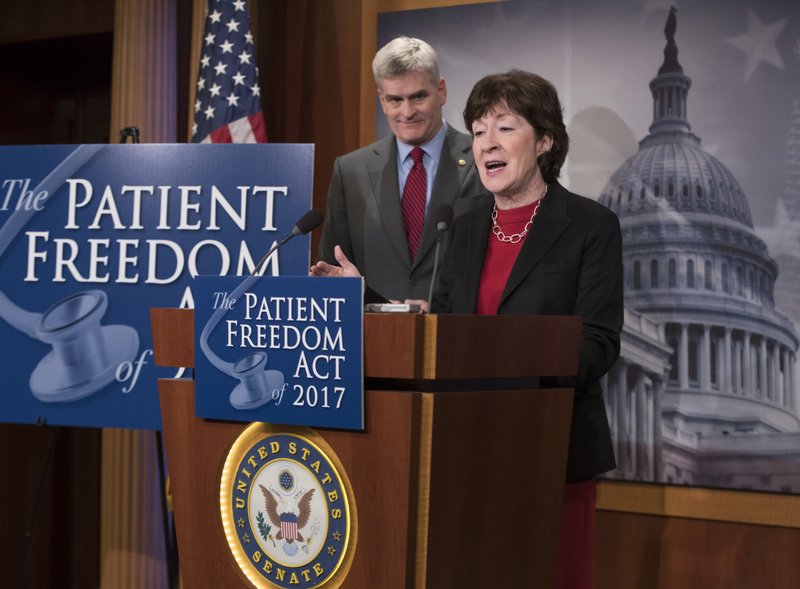
Two Republican senators said Monday that they’ll propose legislation that lets states keep former President Barack Obama‘s health care overhaul or opt for a new program providing trimmed-down coverage. The plan by Sens. Bill Cassidy of Louisiana and Susan Collins of Maine would retreat from years of GOP cries to repeal Obama’s law and replace it with a still undefined Republican alternative. It comes as GOP lawmakers face pressure from President Donald Trump to quickly void and replace the health law and as Republicans continue hunting for a proposal that would unite them. “It has been a Republican principle that power is best held by individuals and states, not the federal government,” Cassidy told reporters. Trump has said he wants to keep some of the Obama overhaul’s consumer protections, like requiring insurers to cover people with pre-existing medical problems. Collins and Cassidy said their bill preserves many of those. But Trump and congressional GOP leaders have not suggested letting states retain the entire statute. Such a proposal could dismay conservative voters who for years have viewed Republican calls to repeal the law as a top-tier promise and goal. Cassidy said he’s discussed the proposal with Senate Majority Leader Mitch McConnell, R-Ky., who he said is “waiting to see how this plays out.” Cassidy described the senators’ proposal as a way to help Republicans overcome a key obstacle: To enact a full replacement for Obama’s law, they will need 60 Senate votes in a chamber they control by just 52-48. “If you can say to a blue-state senator who’s really invested in supporting Obamacare, you can keep Obamacare but why force it upon us, we think that helps us get to 60,” Cassidy said, using the law’s nickname. Collins said the bill is still being written but would protect families and give insurers time to transition to new programs. She said if Republicans don’t advance legislation and start the health care debate, “Then we will fail the American people.” Senate Minority Leader Chuck Schumer, D-N.Y., said the GOP measure would reduce care and drive up medical costs for consumers. “Ultimately, this proposal is an empty facade that would create chaos — not care — for millions of Americans,” he said. If states decide against keeping Obama’s statute, the senators’ proposal would let them adopt a program that charges consumers a high deductible and helps cover some basic medical services like emergency care and prescriptions. Insurers would not be allowed to refuse coverage to people with pre-existing medical problems, and money states would get under existing law would instead go to patients in the form of a tax-advantaged health savings account they’d use to pay for care. States could also design their own programs but would receive no federal payments if they did. Congressional leaders of both parties met with Trump on Monday at the White House, with participants saying they discussed health care and other issues, including infrastructure. No. 2 Senate GOP leader John Cornyn of Texas said Trump told them he intended to enact an alternative that is “better and more affordable” than Obama’s overhaul. Cornyn said that prompted pushback from Congress’ two top Democrats, House Minority Leader Nancy Pelosi of California and Senate Minority Leader Chuck Schumer of New York, but he and others said the conversation was not specific. House Speaker Paul Ryan, R-Wis., met with administration officials later in the Capitol, with Vice President Mike Pence saying, “Good progress tonight.” Later this week, congressional Republicans will stage a retreat in Philadelphia at which health care will be a chief topic. Also late Monday, a memo prepared for Tuesday’s Senate Finance Committee hearing on Trump’s nomination of Rep. Tom Price, R-Ga., to become health secretary said that in financial disclosure forms he’s filed, Price undervalued around 400,000 shares of stock he purchased last August in an Australian drug company. The bipartisan staff memo, obtained by The Associated Press, said Price reported the shares were worth $50,000 to $100,000, based on the purchase price then. Those shares were worth up to $250,000 when he filed his forms to the Finance committee in December, the report said. The shares are in Innate Immunotherapeutics Ltd., which Democrats have accused Price of purchasing based on insider information. Price has denied that. The memo said Price had omitted from submitted forms any mention of a 2010 House Ethics Committee investigation into his campaign fundraising that was later dropped, as well as late tax payments and improper deductions involving rental properties. Republished with permission of The Associated Press.
Failed Alabama maritime museum reopening on Mobile Bay
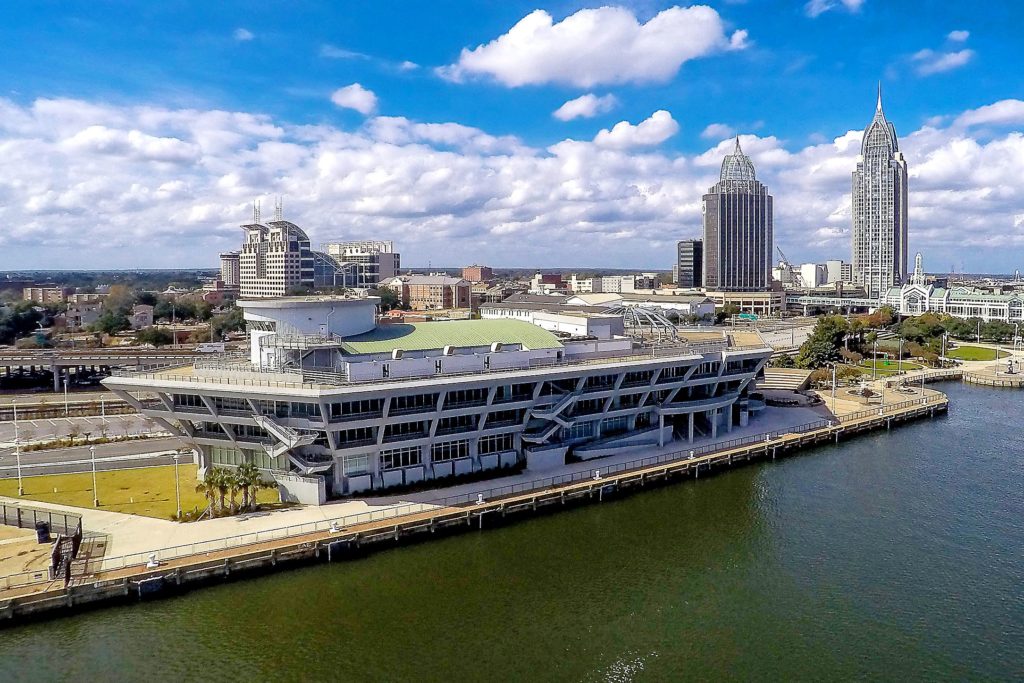
A more than $60 million museum that failed shortly after it opened in Mobile after it opened is set to reopen. The mayor’s office tweets that the GulfQuest National Maritime Museum is reopening on the city’s waterfront on Feb. 18. That’s during Mardi Gras season, when thousands of visitors are in town for parades and balls. The mayor’s office says the museum will feature a new exhibit on ship wrecks, plus new hours, free parking and lower ticket prices. The 90,000-square-foot museum is shaped like a ship but struggled to attract visitors after opening. The mayor’s office pulled the plug and shut down the museum in November after only 13 months in operation. The city says GulfQuest will be open to the public Wednesdays through Saturdays beginning Feb. 22. Republished with permission of The Associated Press.
Senate Democrats to propose $1 trillion infrastructure plan
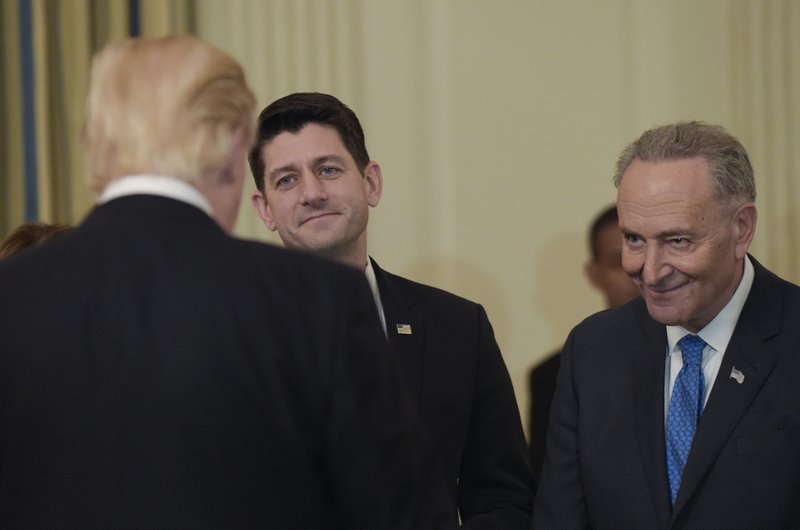
Senate Democrats on Tuesday will propose spending $1 trillion on transportation and other infrastructure projects over 10 years in an attempt to engage President Donald Trump on an issue where they hope to find common ground. Details of the plan provided to The Associated Press include $200 billion for a “vital infrastructure fund.” An example of the types of projects that could be eligible for financing from the fund is the Gateway Program to repair and replace rail lines and tunnels between New York and New Jersey, some of which are over 100 years old and were damaged in Superstorm Sandy in 2012. The project, which would double the number of trains per hour using the tunnels and help enable high-speed Amtrak service, is estimated to cost about $20 billion. Republican leaders, who have said previously that they’re waiting for Trump to offer his own proposal, are unlikely to embrace the Democratic plan. It’s not clear where Democrats would get the money for their proposal. Infrastructure was raised at a meeting Monday between Trump and lawmakers from both parties. Senate Majority leader Mitch McConnell, R-Ky., has said he doesn’t want another infrastructure plan that is effectively an economic stimulus program like the one Congress passed in 2009 at former President Barack Obama‘s behest. “They thought that was an area maybe to find common ground, and then Sen. McConnell made the important point it needs to be paid for because we’ve got $20 trillion in debt,” Sen. John Cornyn of Texas, the No. 2 Senate Republican leader. Trump bemoaned the state of America’s roads, bridges, airports and railways during the presidential campaign and promised to generate $1 trillion in infrastructure investment, putting people to work in the process. But Trump has offered few specifics. Administration officials have indicated they expect Trump to offer details this spring. “Senate Democrats are walking the walk on repairing and rebuilding our nation’s crumbling infrastructure,” Senate Minority leader Charles Schumer, D-N.Y., said. “We ask President Trump to support this common sense, comprehensive approach.” Democrats estimate their plan would create 15 million jobs. Besides transportation, the plan includes money for expanding broadband access in rural areas, water treatment and sewer construction, veterans’ hospitals and schools. A proposal by two of Trump’s financial advisers circulated just after the election calls for using $137 billion in tax credits to generate $1 trillion in private investment in infrastructure projects over 10 years. But investors are typically interested only in projects that have a revenue stream like tolls to produce a profit. Elaine Chao, Trump’s nominee for transportation secretary, told senators last week that she wants to “unleash the potential” of private investors to boost transportation. Charging tolls for roads and bridges is often unpopular. A recent Washington Post poll found that 66 percent of the public opposes granting tax credits to investors who put their money into transportation projects in exchange for the right to charge tolls. The American Association of State Highway and Transportation Officials and transportation industry lobbying groups want a hike in direct federal spending instead of tax credits. What is needed most, they say, is money to address the growing backlog of maintenance and repair projects, most of which are unsuitable for tolling. Republished with permission of The Associated Press.
Donald Trump courts business, labor in delicate balancing act
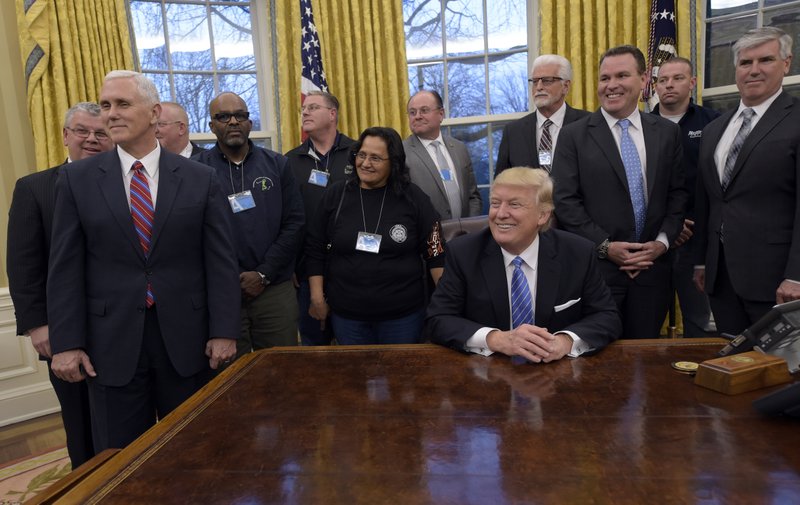
President Donald Trump‘s opening work day offered a look at his tricky balancing act between American businesses and the working-class voters who propelled his march to the White House. The name of the game, Trump tweeted before dawn: “Jobs.” He then met with American business executives to both charm and threaten them into doing business in the U.S. The real estate titan later served notice he was pulling the U.S. out of participating in a proposed Pacific trade pact and promised to renegotiate a 23-year-old agreement with Canada and Mexico — both of which, Trump has said, are bad for jobs. Trump also bore down on the one sector of the American economy he says has too many jobs: The federal government, whose hiring and wages he froze with the stroke of an executive order pen. Before the day was out, Trump had gathered union leaders — from those representing sheet metal workers to carpenters — to listen to their concerns and hear their applause over his assault on what he called “ridiculous” trade deals. It’s all part of an audacious plan to grow the economy by 4 percent a year while shrinking the trade gap and creating 25 million jobs over the next decade — despite obstacles that have vexed presidents of both parties for decades. “We’re going to put a lot of people back to work; we’re going to use common sense,” Trump insisted Monday. At one point, he called reporters back into his meeting with labor leaders to hear Doug McCarron of the United Brotherhood of Carpenter praise Trump’s inaugural address. The speech “hit home for the people who have been hurting,” said McCarron, who had endorsed Hillary Clinton in the presidential race. Trump’s approach tracks with exit polls that showed two-thirds of white voters without a college degree chose him over Clinton. These voters comprised nearly half of all of Trump’s voters, according to the survey conducted for The Associated Press and television networks by Edison Research. In an AP-NORC poll last January, 82 percent of non-college educated white voters called reducing unemployment a very or extremely important issue for the next president, putting it among their top economic issues. There was ample evidence, too, that those voters were not recovering economically from the recession with the rest of the nation. In an April 2016 AP-NORC poll, 7 in 10 non-college whites said their pay had stayed the same or lost ground in previous years. Trump seemed well-aware of his constituency — promising during the campaign that bringing American jobs back was a top priority for him, too. After the election, he boasted several times of persuading the heads of American companies to cancel plans to move. In one notable case, Trump took credit in December for keeping what he said were 1,100 jobs at the Carrier Corp. factory in Indianapolis from being outsourced to Mexico. The number was closer to 800. United Steelworkers Local 1999 President Chuck Jones accused the president-elect of exaggerating, and a Twitter war erupted. Trump fumed that Jones had done “a terrible job representing American workers.” Trump spent Monday trying to make the case that he can do better. But on workplace issues, it remains unclear how strong a friend Trump is to labor and the working class Americans who powered his victory. Some of the new president’s actions on Monday were symbolic: The U.S.’s participation in the Trans-Pacific Partnership, for example, was already dead due to withering enthusiasm among Republicans, Democrats and labor unions, among others. Business leaders have long been under pressure to operate inside the nation’s borders. And he wouldn’t say when he’d start renegotiating NAFTA, the 1994 free trade agreement blamed by many for inspiring American businesses to send good-paying jobs to less expensive shores. It was enough to win some plaudits from the Twittersphere — AFL-CIO President Richard Trumka called the move on TPP “an important first step toward a trade policy that works for working people,” but did not mention Trump’s name in the statement. In fact, other parts of Trump’s agenda conflict with labor’s wish list, a conflict personified by his choice to lead the department charged with enforcing workplace rules. Fast food executive Andrew Puzder, CEO of the parent company of Hardees, Carl’s Jr., and other chains, has said that large increases in the minimum wage — one of labor’s top priorities — would lead to job losses. He wrote in a May 2016 op-ed that President Barack Obama‘s overtime rule would be “another barrier to the middle class rather than a springboard” for workers. A pair of pro-labor interest groups, Jobs for Justice and the Economic Policy Institute, have set up a web site and Twitter hashtag devoted to Puzder’s nomination called, “#antilaborsecretary.” And 22 Senate Democrats are calling for Puzder’s confirmation hearing Feb. 2 to include current and former workers who have complained of poor or illegal treatment at his restaurants. The workers’ stories, the senators wrote, raise concerns about Puzder’s “commitment to enforcing federal labor laws — the secretary of labor’s chief responsibility.” For his part, Puzder tweeted Jan. 16: “I am looking forward to my hearing.” Republished with permission of The Associated Press.
