
No matter the issue, Donald Trump knows a guy
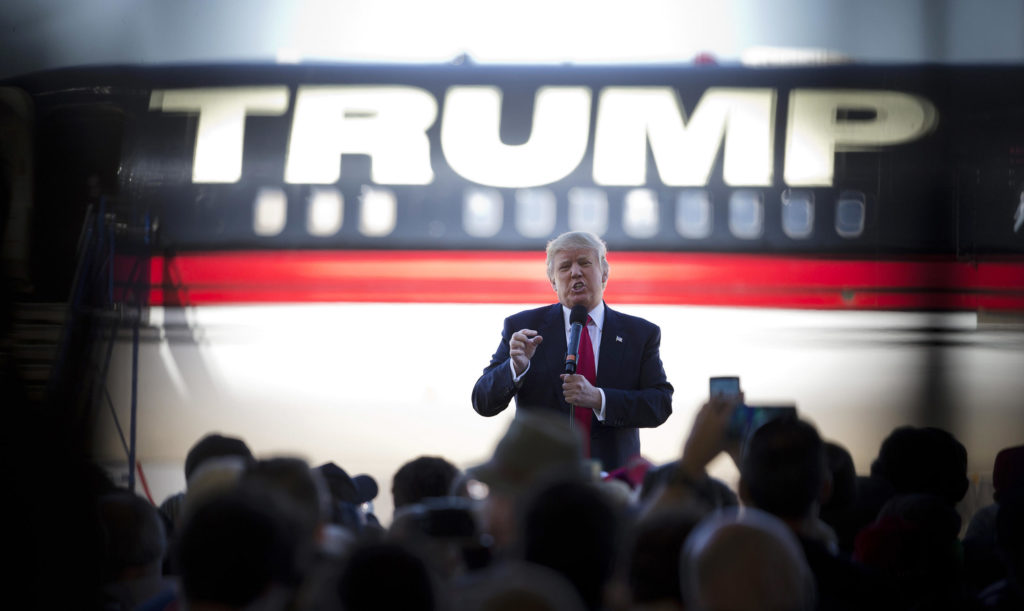
President Donald Trump knows a guy. No matter what issue Trump is addressing, he seems either to know somebody with a relevant personal experience or he’s got a firsthand tale to recount. When he met airline CEOs on Thursday, Trump said his own pilot — “who’s a real expert” — had told him about problems with obsolete equipment. When he met business and economic experts a week earlier, Trump cited the difficulties his friends in business were having borrowing money from banks as he spoke about the need to reduce financial regulations. When he approvingly sized up Britain’s vote to leave the European Union, Trump said last month that he’d had a “very bad experience” in his own businesses when dealing with the EU bureaucracy. “Getting the approvals from Europe,” he said, “was very, very tough.” Call him the anecdotal president: For good or ill, Trump processes policy proposals through his own personal frame of reference. “It’s all about him,” says Jeff Shesol, who wrote speeches for President Bill Clinton. “His frame for Europe, his frame for the airlines, his frame for the banking system … is himself.” It’s not necessarily a bad thing to draw on real-world experiences in developing or justifying policy. Plenty of presidents and politicians have recognized the value of anecdotal storytelling in advancing their agendas. President Barack Obama offered his own improbable life story as a metaphor for the wide-open possibilities available to all Americans. And he frequently drew on the concerns that came up in the 10 letters a day that he read from people who wrote to the White House. Clinton was famous for sketching his encounters with ordinary Americans. President Lyndon Johnson drew on his early experiences teaching disadvantaged Mexican-Americans in stressing the importance of education and economic opportunity for all Americans. “I think it was then that I made up my mind that this nation could never rest while the door to knowledge remained closed to any American,” Johnson said after signing the Higher Education Act of 1965. “Great Communicator” Ronald Reagan related the story of a woman who falsely collected welfare payments — then parlayed it into a stereotype of “welfare queens” cheating the system. Kathleen Hall Jamieson, a University of Pennsylvania professor specializing in political communication, says that in his first three weeks in office, Trump has surpassed even Reagan in his reliance on the use of “argument by anecdote.” “Given the extemporaneous nature of Trump’s presidency,” she says, “we can reasonably assume that these individual moments are playing a more important role for him” in developing policy than they did for presidents past. The risk, she adds, is that an overreliance on personal experiences “can lead to the assumption that something is typical when it’s atypical.” With Trump, it’s hard to tell exactly what goes into his policymaking. But the billionaire businessman-turned-politician cites experiences from his own, very rarefied world that wouldn’t necessarily track those of ordinary Americans. When he complained about onerous EU regulations, Trump appeared to be alluding to his failure to get approval for a sea wall at the Trump Organization’s golf resort in Ireland. When he talked during the campaign about crumbling airport infrastructure, he mentioned the potholes at New York’s LaGuardia Airport — where Trump would have landed in his gilded private jet. When he talked about the dangers of nuclear weaponry during the campaign, he would often invoke the expertise of his “brilliant” late Uncle John, a scientist at MIT. In some cases, Trump may be drawing lessons from somewhat scrambled tales. In calling for an investigation into alleged wide-scale voter fraud, for example, Trump has privately related a story about a pro golfer who either told Trump he had trouble voting himself or who had a friend who wasn’t allowed to vote even as others who somehow looked like they should be eligible to vote cast ballots, according to The New York Times. Golfer Bernard Langer, a German citizen who is not eligible to vote in the U.S., later issued a statement to Golf Digest saying that elements of the story had gotten lost in translation. Langer said he’d told a friend the story of someone who couldn’t vote, and that tale had made its way to someone with ties to the White House and “from there, this was misconstrued.” As for Trump’s difficulties with the EU, he did run into regulatory problems with the proposed sea wall at his Irish golf course, but he also encountered local opposition to that project. In an interview in December, Trump said he’d also sought approval for a “massive, beautiful expansion” of the course but had dropped the idea after getting the OK from Ireland because it would have taken years to get EU clearance. However, there’s no record of him seeking approval for such an expansion. Republished with permission of the Associated Press.
From protests to ‘pussy hats,’ Donald Trump resistance brews online
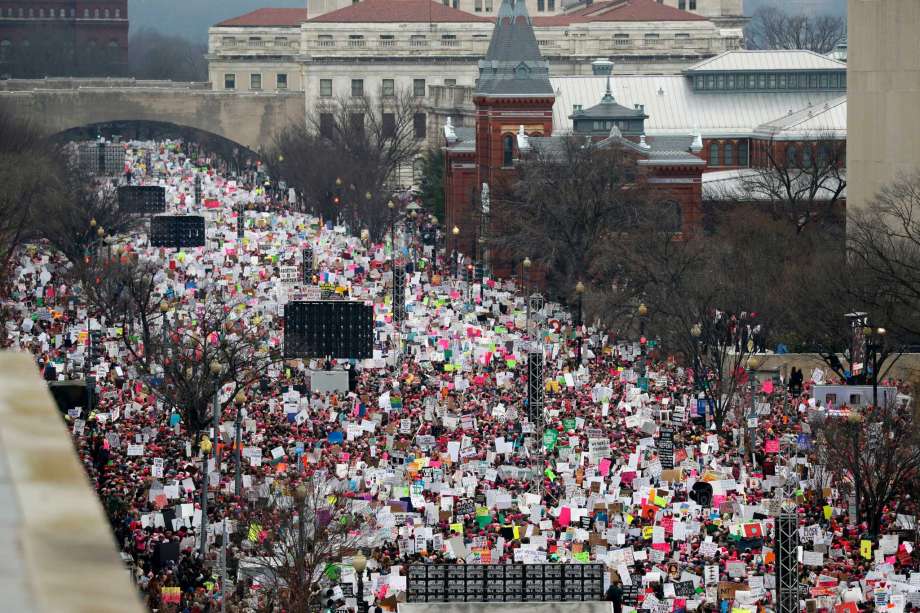
The revolution may not be televised — but it apparently will be tweeted. And Facebooked. And Instagrammed. Not long after President Donald Trump temporarily barred most people from seven majority-Muslim countries from entering the U.S., social activist Dex Torricke-Barton took to Facebook. “I’m thinking of organizing a rally,” he posted. Within a few hours, more than 1,000 people expressed interest. The resulting protest a week later, in front of San Francisco’s City Hall, drew thousands more. Torricke-Barton is far from alone. From organizing protests on the fly to raising money for refugee and immigrant rights groups, people have been using social media to fuel the resistance against Trump in ways their organizing predecessors from the 1960s could have hardly imagined. ROOTS OF PROTEST In Queens, New York, for instance, a group of 27 women met up to write postcards to their state and local representatives during a “Postcard-Writing Happy Hour” organized through Facebook. And on Ravelry, the social network for knitters and crocheters, members have been trading advice and knitting patterns for the pink “pussy hats” that emerged as a symbol during the Women’s March on Washington and similar protests elsewhere after Trump’s inauguration. “This is an incredible project because it’s mixed between digital and physical,” says Jayna Zweiman, one of the founders of the Pussyhat Project. “We harnessed social media for good.” In 1969, activists planned massive marches around the U.S. to protests the war in Vietnam. The protests, called the Moratorium, drew millions of people around the world. But “it took months, a lot of effort, a national office of the organization to get it off the ground,” says Christopher Huff, a Beacon College professor focused on social movements of the 1960s. “The women’s march was achieved at a much larger scale at a fraction of the time.” This immediacy is both an asset and a disadvantage. While online networks help people rally quickly around a cause, Huff says, they don’t necessarily help people grasp the “long-term effort” required to sustain a movement. ONLINE, THEN OFF In Silicon Valley and across the tech world, Trump’s travel ban created a stir that went well beyond the industry’s usual calls for deregulation and more coding classes for kids. Between aggregating donations, issuing fiery statements, and walking out of work in protest, tech company executives and employees took up the anti-Trump cause at a scale not seen in other industries. New York-based Meetup, for instance, broke with nearly 15 years of helping people form and join interest groups on a non-partisan basis. “We’re vital plumbing for democracy,” the company wrote in a Medium post this week. “But after Donald Trump’s order to block people on the basis of nationality and religion, a line had been crossed.” So Meetup held a company-wide “resist-a-thon” — a riff on the hackathons tech companies hold to devise new technologies — to help people get involved in the anti-Trump movement known as “the resistance.” It then unveiled more than 1,000 new “#resist” Meetup groups that people can join for free (it’s normally $15 a month to run a group). As of Wednesday, some 35,000 people had joined the #resist Meetup groups, and scheduled 625 events around the world. Torricke-Barton, who in earlier incarnations wrote speeches for Facebook CEO Mark Zuckerberg and Alphabet Chairman Eric Schmidt, said he and two sisters of Iranian descent organized their last-minute protest using Facebook groups and Messenger. That’s quite a contrast with Torricke-Barton’s earlier experience protesting violence in Darfur more than a decade ago. Back then, “lawyers, marketers, communications people would help you get (the protests) off the ground … networks had to be created in advance,” he said. “Now, protests can start without any kind of infrastructure.” FOLLOW THE MONEY Shortly after Trump’s order, the venture capitalist Bijan Sabet tweeted a link to the fundraising platform Crowdrise alongside an explanation of his support for the American Civil Liberties Union— and then asked his followers to do the same. Sabet figured it might take as long as two months to reach his $50,000 goal. It took three days. That weekend, the ACLU raised $24 million, far more than the $4 million it receives in a typical year. Sabet, whose father is from Iran, says he’s seeing civic involvement “level up,” and that social media is pushing that along. Previously, he said, people would maybe say, “yeah, I’m a bit frustrated, but I don’t have all the information, I don’t know how to get involved.” Now, there’s no excuse. LITTLE THINGS The effects of social media aren’t limited to huge efforts. A week or so after the election, Marisa Frantz, an art director in Cerrillos, New Mexico, created a private Facebook group called “America is Watching.” To join, all people had to do was comment “yes.” If they then posted their zip code in comments, Frantz would send them contact information for their senators and representative, Frantz’s sister-in-law, Sarah Bailey Hogarty, explained in an email. “Like many of us, I was floundering around feeling terrible and afraid,” said Hogarty, a digital producer for the San Francisco Museum of Modern Art. “I wanted to do something, but I had no idea where to start.” Hogarty called the group her “foothold to resistance.” Now, the group has more than 1,000 members across the U.S. and organizes weekly “calls to action,” such as contacting senators and representatives about a particular issue determined by a poll of the group. Groups like this demonstrate how social media has helped “lower the barrier to entry” into social activism, in the words of Tarun Banerjee, a sociology professor at the University of Pittsburgh. “What social media can do really well is spread awareness,” Banerjee said. “Can people make President Trump back down because of social media? Probably not. But it can shine the light.” Republished with permission of the Associated Press.
Famed war hero Lt. Gen. Hal Moore dies at 94 in his Auburn home
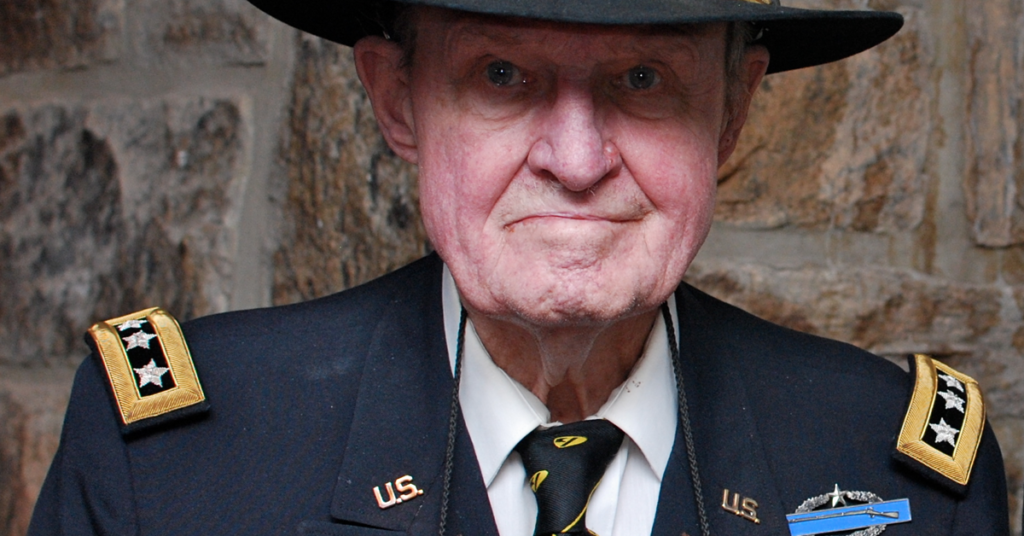
Retired Lt. Gen. Harold G. “Hal” Moore, the American war hero known best for saving the lives of most of his men in the first major battle between the U.S. and North Vietnamese armies, has died. He was 94. Moore died late Friday in his sleep in his Auburn, Ala. home just two days before his 95th birthday. Born in Bardstown, Kentucky, he served in the U.S. military for 32 years. The general is best known for his actions during the Battle of Ia Drang, where he served as the commander of 1st Battalion, 7th Cavalry Regiment. Moore was awarded the Distinguished Service Cross, the nation’s second highest award for valor, for his actions during that battle. In 2002, Mel Gibson portrayed this fearless patriot in the movie “We Were Soldiers.” Moore is survived by three sons and two daughters — Harold Gregory Moore III, retired Lt. Col. Stephen Moore, Julie Moore Orlowski, Cecile Moore Rainey, and retired Col. David Moore — and 11 grandchildren and four great grandchildren. His wife Julie passed away in 2004. Arrangements are still being finalized, but a funeral mass will be held at St. Michaels Roman Catholic Church in Auburn later this week. A memorial service and burial will follow at Fort Benning. Memorial donations may be made in memory of Moore to the Ia Drang Scholarship Fund, which was established in 1994 using proceeds from his book and speaking engagements. The fund is used to help the children and grandchildren of the veterans of the Ia Drang battles. Please send checks to the Ia Drang Scholarship Fund, c/o Executive Director, 1st Cavalry Division Association, 302 North Main, Copperas Cove, TX 76522.
