
Daniel Sutter: Can we end illegal immigration?

Our immigration policy prior to the election of President Donald Trump could be fairly described as strict limits on legal immigration combined with toleration of large-scale illegal immigration. Tolerated illegal immigration as policy has a number of weaknesses. I think that we should put immigration on a legal footing. We could end tolerated illegal immigration by ratcheting up enforcement of current laws, which is what President Trump promised on the campaign trail and what his efforts to complete the border wall with Mexico implies. Or we could significantly increase legal immigration. I think either option may now be preferable to hypocrisy as policy. Let’s consider the current limits on legal immigration. The wait for visas under the family reunification program can be a decade or more, while the H-1B and lottery visa programs have far more applicants than available slots (13.6 million lottery applications for 50,000 visas in 2008). Generally only graduate or professional degree holders can secure long-term work visas. Illegal immigration is also far from easy. Almost 250,000 people were deported in 2016, and over 500,000 were apprehended trying to enter illegally. The difficulty of legal or illegal entry allows human traffickers to charge huge sums for assistance: $4,000 to cross from Mexico, and $60,000 for entry from India. And this hefty payment does not guarantee entry. Over the past decade, over 3,700 people have died crossing from Mexico. Large-scale illegal immigration entails several costs. For starters, illegal immigrants are vulnerable to abuse and exploitation because they cannot turn to law enforcement for protection once here. Reports of sex trafficking and sweatshops in the U.S. frequently involve illegal immigrants. Illegality creates space for truly inhumane treatment. Persons here illegally can impose avoidable costs on Americans. For example, many illegal immigrants drive without licenses and insurance, contributing to 12% of drivers nationally who are uninsured. Billions of dollars of accident costs each year then get passed on to insured drivers. More ominously, we cannot perform background checks on illegal immigrants. While the overwhelming majority of legal and illegal immigrants come here to work, we can and should protect against entry by criminals and terrorists. We essentially outsource background checks, which should be done by the Department of Homeland Security, to the human traffickers. Perhaps most significantly, tolerated illegal immigration causes a loss of respect for the law. The law should assist people in leading productive lives. Order in society relies on people largely voluntarily following the rules regulating our behavior, like driving and paying taxes. We follow the rules because we understand that life is better when everyone does so. Furthermore, our policy basically forces Americans who just want to run businesses to break the law. Many firms must hire undocumented workers to remain cost competitive because few Americans are willing to do jobs in agriculture, food service, and construction. And some entrepreneurs get prosecuted for hiring illegal workers, which the system essentially forced them to do. Should we end illegal immigration by more enforcement or liberalizing legal immigration? One’s answer depends on one’s personal values. Each option entails costs and consequences. As the status quo demonstrates, enforcement has limits. Immigrants come here illegally because wages are much higher than in their home countries. Consequently tougher enforcement will just increase the price of illegal crossings. The cost of totally securing the border may be prohibitive. Furthermore, tougher enforcement will leave us with fewer immigrants willing to do hundreds of thousands of jobs, which might go unfilled. A lack of labor will increase prices for many of the things that we buy. And it could increase imports: we might have to import grapefruit and tomatoes from countries where labor is available. Ultimately I think increasing legal immigration will increase respect for the law and improve border security. President Trump should make sure that the border wall has a big gate to welcome people wanting to come here to work. This will put most of the human traffickers on the border out of business and allow us to focus on people still trying to enter illegally. ••• Daniel Sutter is the Charles G. Koch Professor of Economics with the Manuel H. Johnson Center for Political Economy at Troy University and host of Econversations on TrojanVision. The opinions expressed in this column are the author’s and do not necessarily reflect the views of Troy University.
Donald Trump executive order targets clean water rule, Alabamians react
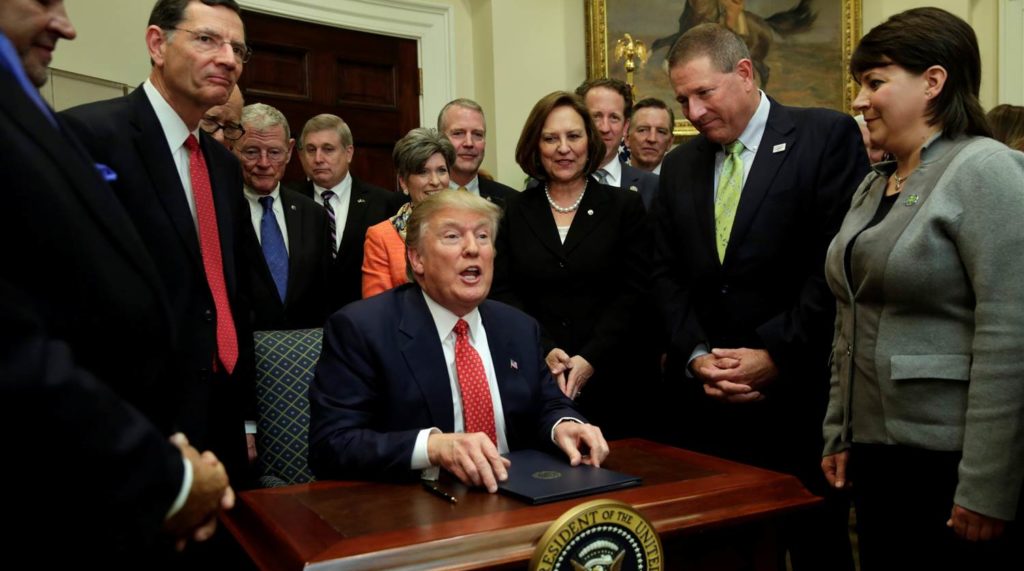
President Donald Trump‘s latest executive order rolls back a controversial Obama-era water regulation that designates what smaller bodies of water, tributaries and wetlands are under the control of the Environmental Protection Agency (EPA) and the U.S. Army Corps of Engineers. Issued Tuesday, the order directs both departments to rescind or revise the 2015 Waters of the United States (WOTUS) rule, which expanded federal jurisdiction under the Clean Water Act. The act allows the EPA to regulate “waters of the United States,” while failing to include what that term meant. Trump’s order could ultimately lead to a re-write of the law or a complete repeal. On Tuesday afternoon, Trump was surrounded by farmers, homebuilders and county commissioners all opposed to and affected by the rule, in the White House Roosevelt Room where he signed the order. “The EPA so-called Waters of the United States rule is one of the worst examples of federal regulation, and it has truly run amok, and is one of the rules most strongly opposed by farmers, ranchers and agricultural workers all across our land,” Trump said Tuesday. “It’s prohibiting them from being allowed to do what they’re supposed to be doing. It has been a disaster.” Former Alabama Attorney General and current U.S. Sen. Luther Strange lauded the order. “As Attorney General of Alabama, I joined other Republican Attorneys General, including my good friend and now Administrator of the EPA, Scott Pruitt, to stop the EPA from implementing a rule that was nothing more than a naked power grab,” Strange said in a statement. “This executive overreach ignored the private property rights of Alabama farmers and is the perfect example of another one-size-fits-all approach from Washington that fails to recognize the unique needs of each community or the role of state and local government. I’m thankful for the President’s actions and encourage the complete repeal of WOTUS by Congress.” Alabama Agriculture Commissioner John McMillan echoed Strange’s approval on Wednesday, heartily endorsing the order. “No other Obama environmental regulation had the potential to adversely affect every square foot of our state and economic sector than WOTUS,” said McMillan. “This punitive regulation threatened Alabama farmers, landowners and foresters with severe fines and requirements that were deceptively vague.” He added that WOTUS affected county and municipal governments, as it contained stringent and unnecessary regulations on water and sewer systems. “Nearly every family in Alabama would have experienced spikes in’ their water and sewer bills.” “Environmental quality and farming are not mutually exclusive but complement each other,” he explained further. As an outdoorsman used to tell me, ‘We should never forget that we all live downstream.” McMillan pointed out that Washington bureaucrats should know that the best enforcers of environmental standards are those men and women who work the land and depend on water quality. “This new administration in Washington understands the value of reducing federal intrusiveness,” McMillan said.
Senate confirms Montana Rep. Ryan Zinke as Interior secretary
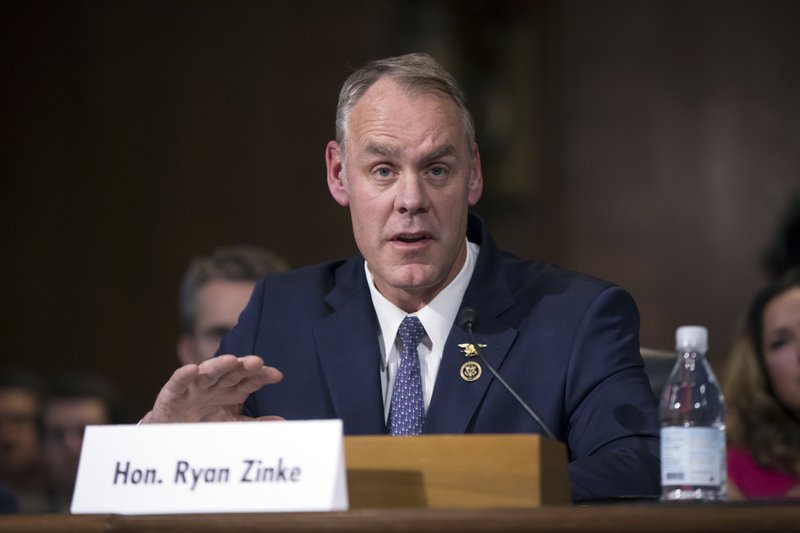
Montana Rep. Ryan Zinke won Senate confirmation Wednesday as President Donald Trump‘s Interior secretary, giving him responsibility for overseeing the nation’s 400 million acres of public land, mostly in the West. The Republican-controlled Senate approved the nomination, 68-31 as 16 Democrats and one independent joined with 51 Republicans to support the choice. Several Democrats from Western states as well as those facing tough re-elections next year, including Montana’s Jon Tester, Indiana’s Joe Donnelly and Joe Manchin of West Virginia, voted for Zinke. Trump’s choice to lead Housing and Urban Development, Ben Carson, cleared a Senate hurdle on a 62-37 vote. Carson’s confirmation was expected later this week. With Zinke’s approval, the Senate has confirmed 16 out of 22 of Trump’s Cabinet and Cabinet-level nominations. Zinke, 55, a former Navy SEAL and Montana state senator, resigned as a delegate to the Republican National Convention last year to protest the GOP’s position in favor of land transfers to state or private groups. Still, his stance on public lands has come into question in recent weeks after he voted in favor of a House rule that would allow federal land transfers to be considered cost-free and budget-neutral, making it easier for drilling and development. Senate Minority Leader Chuck Schumer, D-N.Y., said Zinke at Interior should “concern every lover of our great and grand national parks.” Dismissing the Republican’s claim to be like the late President Teddy Roosevelt, Schumer said, “You can’t be a Roosevelt conservationist if you sell off public lands.” Countering the Democrat, Montana Republican Sen. Steve Daines said Zinke “will be a strong advocate for our public lands.” Zinke, a Republican in his second term as Montana’s sole House member, told senators at a January hearing that federal land management should be done under a multiple-use model that allows hiking, hunting, fishing and camping along with harvesting timber, mining for coal and drilling for oil and natural gas. Zinke also pledged to tackle an estimated $12 billion backlog in maintenance and repair at national parks and stand firm against attempts to sell, give away or transfer federal lands. Sen. Maria Cantwell of Washington state, the top Democrat on the Senate Energy and Natural Resources Committee, said she is not convinced that Zinke will be able to “stand up” to Trump and prevent oil, gas and mining companies from unduly exploiting public lands. Cantwell also said Zinke appears willing to support transfer of some federal lands to states, citing his vote for the GOP-sponsored rules package. She worries that Zinke may weaken or repeal recent designations by President Barack Obama of national monuments, including Utah’s Bears Ears monument. Senate Energy Chairwoman Lisa Murkowski of Alaska called Zinke an excellent choice, noting that the fifth-generation Montanan is an avid hunter, fisherman and skier. “He was born in the West. He lives in the West. He understands it, he understands its people,” Murkowski said. Zinke also has “firsthand experience in trying to solve” problems faced by the Interior Department and has “shown he understands the need for the department to be a partner of Alaska and our Western states,” Murkowski said. During his hearing, Zinke rejected Trump’s claim that climate change is a hoax, saying it is indisputable that environmental changes are affecting the world’s temperature and human activity is a major reason. “I think where there’s debate is what that (human) influence is and what can we do about it,” he said. Zinke also pledged to work with members of Congress on monument designations, noting the strong opposition to Bears Ears by Utah’s congressional delegation and governor. “I think the state should have a say on it,” he said. Republished with the permission of The Associated Press.
Donald Trump budget plan draws strong opposition from Republicans
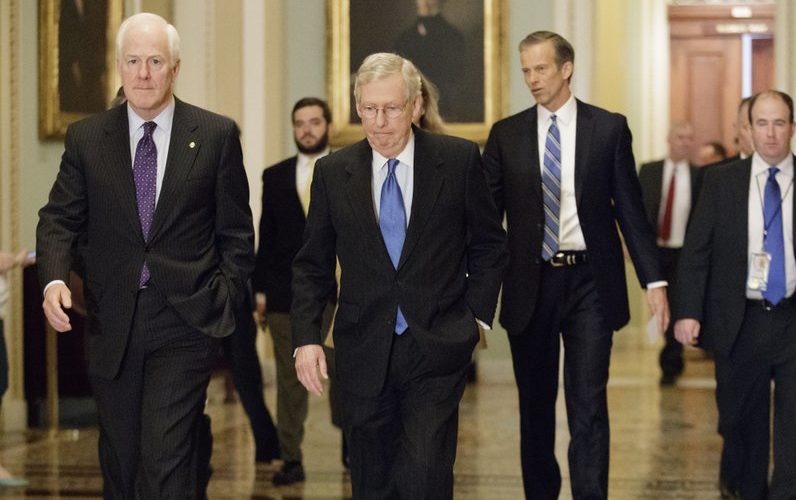
President Donald Trump‘s plan to impose sharp cuts to foreign aid and domestic programs is a non-starter in the Republican-led Congress — and that’s according to top GOP lawmakers. Senate Majority Leader Mitch McConnell, R-Ky., who once headed the panel responsible for the foreign assistance budget, told reporters that Trump’s cuts to foreign aid probably couldn’t pass muster on Capitol Hill. “The diplomatic portion of the federal budget is very important and you get results a lot cheaper frequently than you do on the defense side,” McConnell told reporters. “So speaking for myself, I’m not in favor of reducing the (foreign aid) account to that extent.” Trump’s draft budget plan would add $54 billion to the Pentagon’s projected budget, financed by taking an equal amount from domestic agencies and departments. Diplomacy and foreign aid would face a 37 percent cut that would be felt across the State Department and the U.S. Agency for International Development. Trump said in his Tuesday night joint address to Congress that his budget “calls for one of the largest increases in national defense spending in American history …. (and) will also increase funding for our veterans.” Trump’s budget was panned by the Senate’s top Democrat, Chuck Schumer of New York. “The same time he’s talking about medical research he’s going to slash it,” Schumer said on Wednesday. “Education. He talked about the great issue of education. Same thing. His budget is going to slash education to smithereens.” The initial reaction among Republicans signaled that Trump faces a fight with his party over the $1 trillion-plus portion of the federal budget that is passed each year by Congress. That discretionary part of the budget has been squeezed over the past few years, while Republicans controlling Congress have largely ignored the ever-growing tide of automatic-pilot spending on benefit programs like food stamps, student loans, and Medicare. The proposed cut to the State Department’s diplomatic corps and the foreign aid budget are particularly striking, and likely to include security contractors at diplomatic missions abroad after the GOP criticized Democrats for security at the U.S. facilities in Benghazi, Libya, where four Americans died in a 2012 attack. “What the president wants is to move spending from, say, overseas back in this country,” said Trump’s budget director, former tea party Rep. Mick Mulvaney, R-S.C., on “Good Morning America” on ABC. “That’s why you’ll see fairly significant reductions in his proposals regarding foreign aid.” Such a cut fits into Trump’s “America first” worldview, but is alarming to lawmakers who see diplomacy and foreign aid as a small but crucial component of the federal budget, just more than 1 percent. Republican Sen. Marco Rubio of Florida, a primary rival of Trump, delivered an impassioned speech on the Senate floor in defense of foreign aid. Rubio argued that spending on foreign aid is critical to the U.S. economy and national security. “I promise you it’s going to be a lot harder to recruit someone to anti-American and anti-American terrorism if the United States of America was the reason why they are even alive today,” said the senator, a member of the Foreign Relations Committee. Other Trump targets include the Environmental Protection Agency, the IRS, and many grant programs for state and local government. Public housing vouchers for the poor are targeted as well, much to the consternation of the pragmatic-minded lawmakers on the House and Senate Appropriations committees, whose programs were significantly curbed by a hard-fought 2011 budget and debt agreement. “We’ve reduced our discretionary spending over the last seven or eight years an incredible amount,” said House Appropriations Committee Chairman Rodney Frelinghuysen, R-N.J. “Maybe some people don’t like those agencies, but it’s been pretty difficult for them to meet their mandate.” Top congressional priorities include aid to disadvantaged schools, Pell Grants for low-income college students, medical research, Amtrak subsidies, and water and sewer projects. “There are important priorities within the domestic side, on the discretionary side of domestic spending,” added Sen. Jerry Moran, R-Kan. McConnell noted that it requires Democratic votes in the Senate to pass appropriations bills. That works to the advantage of more pragmatic Republicans. Many GOP lawmakers would prefer cuts to entitlement programs rather than already-strapped agency operating budgets — and that’s fine with party conservatives. “We can no longer expand federal spending without finding savings somewhere,” said Rep. Andy Harris, R-Md. “And so, the people who want to protect nondefense discretionary, they’re going to have to realize at some point we may have to look at the entitlement programs.” Trump has said he wants to leave Social Security and Medicare alone, though Mulvaney says other entitlement programs are likely to be addressed in Trump’s full budget submission in May. Republished with the permission of The Associated Press.
Robert Bentley prison construction bill heads to committee vote

Alabama lawmakers are expected to vote as early as Wednesday on legislation being pushed by Gov. Robert Bentley. The bill, proposes an $800 million bond issue to build four “super-prisons” and would close 14 existing prisons. The Alabama Senate Judiciary Committee is scheduled to debate the proposal Wednesday after a public hearing. In his annual State of the State address in February, Bentley said the prison plan is vital because of the federal mandate to fix overcrowding and substandard conditions. ”Nearly all DOC facilities are double sometimes triple capacity, infrastructure is collapsing and the tensions created among inmates and officers by the deteriorating facilities and overcrowded conditions have even become deadly,” Bentley said in the address. “Alabama is about to embark on a complete transformation of the state’s prison system.” He continued, “The Alabama Prison Transformation Initiative will transform Alabama’s prison system into a national model for the 21st century. The initiative will consolidate 14 of 16 maximum custody level prisons into four large-scale, state-of-the-art regional correctional facilities — three men’s facilities and one women’s facility to permanently replace Tutwiler Prison for Women.” As of September, Alabama prisons were at 175 percent of their intended occupancy — housing roughly 23,000 prisoners in facilities designed for 13,000. In October, the U.S. Justice Department opened a statewide investigation into violence, rape, overcrowding, among other problems and conditions in Alabama’s prisons for men. Similar versions of the proposed plan passed both the House and Senate last year, but failed to win final approval.
Supreme Court revives challenge by black voters in Virginia
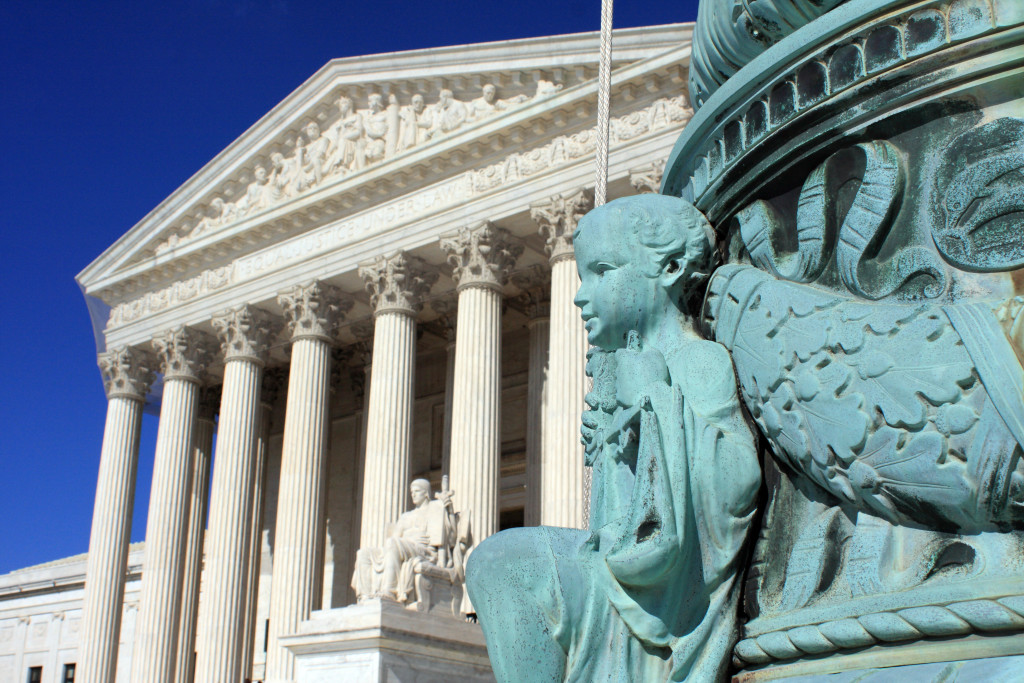
The Supreme Court gave new life Wednesday to a challenge by African-Americans in Virginia who say lawmakers packed some legislative districts with black voters to make other districts whiter and more Republican. The justices tossed out the part of a lower court ruling that upheld 11 districts in which African-Americans made up at least 55 percent of eligible voters. Justice Anthony Kennedy said in his majority opinion that the three-judge federal court used the wrong legal standard when it determined that race did not play too large a role in creating the 11 districts. The high court upheld one challenged district in which the lower court found that race was an important factor and that lawmakers were justified in considering race. For all the districts at issue, the state argued that the 55 percent threshold was necessary so that minority voters could elect a candidate of their choice, an important consideration under the federal Voting Rights Act. The black voters who sued over the state’s 2011 districting plan argued that it diluted the voting power of African-Americans. Virginia Gov. Terry McAuliffe, who took office after the redistricting and backed the lawsuit, said the decision is a “victory for democracy in Virginia,” according to McAuliffe spokesman Brian Coy. “The governor has long believed that Virginia’s legislative lines are unconstitutionally racially gerrymandered,” Coy said. Marc Elias, the lawyer for the Virginia voters, said the ruling was a big win because it established that states could employ traditional principles of redistricting that include geographically compact districts and still be open to a challenge that they engaged in racial gerrymandering. But the justices did not take up Elias’ request that the Supreme Court strike down the districts. It is now up to the lower court to figure out whether the districts were improperly drawn. Because the court left it to the lower court to sort out, election law expert Richard Hasen at the University of California at Irvine law school termed the outcome “more of a punt than a major decision.” Chief Justice John Roberts and Justices Stephen Breyer, Ruth Bader Ginsburg, Elena Kagan, Anthony Kennedy and Sonia Sotomayor joined Kennedy’s opinion. Roberts’ decision to join the majority was notable because he often is on the other side in cases involving race and electoral district. Justices Samuel Alito and Clarence Thomas, who also are skeptical of the use of race in drawing political districts, agreed with most of the outcome of the case, but differed with their colleagues on the details. The Virginia case was one of two redistricting disputes the court heard in December. The other, involving North Carolina congressional districts, remains undecided. Republished with the permission of The Associated Press.
Analysis: A softer Donald Trump wins praise. But will it last?
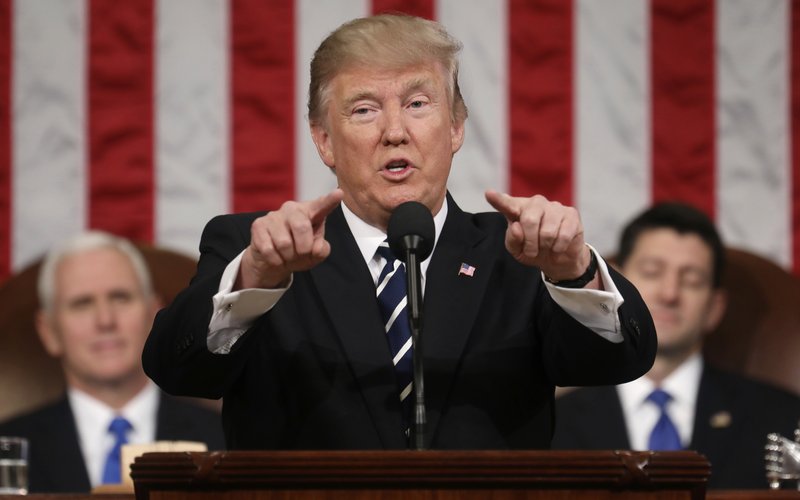
Donald Trump finally gave Republicans what they’ve spent months begging him to deliver: a pivot to presidential behavior. The question now is how long it lasts. Days, weeks, months — or simply until the next tweet? Just a little more than a month into his presidency, the new president clearly wanted to use his first speech to Congress to reset the chaotic start of his administration. Gone was the dark tone that marked his inaugural address, replaced by optimism and pleas for bipartisan support. Standing before lawmakers, Supreme Court justices and military leaders, the famously unrestrained Trump was softer, sober and practically subdued. “I am here tonight to deliver a message of unity and strength, and it is a message deeply delivered from my heart,” he said, in the opening of his hour-long speech. His administration reveled in the rave reviews on Wednesday morning. “What the American people saw is the president I serve with every day — broad shoulders, a big heart,” Vice President Mike Pence said, in an interview with NBC’s “Today Show.” The White House delayed the signing of his revamped travel ban, saying they were still putting the final touches on the new executive order but also, presumably, to avoid competing with positive press from the speech. Republican leaders were scheduled to join the president for lunch at the White House to discuss how they move forward with key agenda items. But though the prime-time address to Congress and the nation wrapped Trump’s signature nationalistic politics in presidential prose, it is unlikely to overcome the deep divisions created by his first few weeks in office. For a candidate who sold himself as a master dealmaker, Trump has shown little inclination to get deeply involved with the kind of nitty gritty negotiating that defines the legislative process. That’s left the Capitol reeling. Republicans have united control for the first time in decades but no agreement over the specifics of long-promised plans to repeal “Obamacare” and revamp the tax code. The federal civil service is in not-so-subtle revolt. And weeks of protests and raucous town halls are putting fresh political pressure on lawmakers from both parties to resist his agenda. Trump, meanwhile, faces record low approval ratings — just 44 percent of Americans approve of his job performance, according to a new NBC News/Wall Street Journal survey. He needed to use his prime-time address to show he could steady his flailing White House and focus on the difficult work required to pass his legislative agenda. Trump is nearing the end of big achievements he can enact by executive order, forcing him to rely on Congress to turn the bold promises of his campaign into actual achievements. So, he embraced his inner statesman. The candidate who won the White House by taking a hard-line stance on immigration seemed to express openness to a bipartisan immigration bill. The president whose administration spent much of its first weeks in office battling with the media, intelligence community, federal judiciary and even Hollywood celebrities asked for an end to “trivial fights.” In his speech, he called on Washington to “work past the differences of party.” Less than 24 hours earlier, he’d blamed former President Barack Obama for town hall protests and security leaks and called House Minority Leader Nancy Pelosi “incompetent” in a Fox News interview. He said his generals, not the commander in chief, were responsible for a military raid in Yemen that killed a Navy SEAL. Hours later, Trump’s tribute to the slain solider, as his crying widow stood in the audience, became a signature moment of his address. And after questioning the authenticity of a wave of bomb threats against Jewish community centers in a private Tuesday meeting with attorney generals, he opened his remarks by condemning the flood of anti-Semitic attacks and other racially motivated crimes. For House GOP leaders, Trump came tantalizingly close to backing their plan to overhaul the tax code by imposing a new tax on imports while exempting exports. He appeared to lend support to the House Republican leaders’ plan for Obamacare, embracing the “tax credits” and health savings accounts that are a centerpiece of the GOP policy. But on other issues, Trump offered barely a blueprint for his initiatives. He repeated his campaign pledge to make a $1 trillion investment in infrastructure, adding no new details to a proposal that’s sure to face fierce resistance from budget hawks. Big promises to make childcare more affordable, ensure paid family leave, invest in women’s health and a major education bill were mentioned merely in passing. There was no discussion of how his administration would fund any of the new — and expensive — programs, putting him in direct conflict with a Republican Party that has long focused on cutting the deficit. Republished with the permission of The Associated Press.
Steve Flowers: BP oil spill money, a missed opportunity for Alabama’s natural resources
We have unbelievable natural resources in Alabama starting with the Tennessee Valley and transcending to the beautiful white sands at Gulf Shores. Many of our natural resources have been exploited over the years. The prime example would be the exploitation of our rich vaults of iron ore discovered in Jefferson County in the early 20th Century. It created the city of Birmingham, the Steel City of the South. U.S. Steel swept in and bought the entire region and used cheap labor in the mines and steel mills and kept poor whites and blacks in poverty wages and shantytowns. They owed their soul to the company store. Finally, they organized into labor unions. The United Steel Workers Union Local in Birmingham became the largest in the nation. Alabama also became the most unionized state in the south. The TVA workers and Reynolds Aluminum workers in the Tennessee Valley were all unionized. The tire workers in Gadsden, Opelika, and Tuscaloosa were unionized. The federal workers around Ft. Rucker in the Wiregrass were union. The largest employer in Mobile was the docks. The dockworkers were unionized. When you combine these locales with the steelworkers in Birmingham, we were a pretty unionized state. In the course of our recent history, we have been more prudent with our natural resources. The prime example of that would be during the late 1970s when we sold the oil rights in Mobile Bay to Exxon Mobil. We got a fair price, and we put the entire corpus aside and preserved the money into a trust called the Heritage Trust Fund. Governor Fob James deserves credit for this accomplishment. It is the crowning achievement of his two terms as governor. It is quite a legacy. Not all governors leave a legacy. Ole Fob has one. Not as much can be said for our most recent governors. Don Siegelman, Bob Riley, and Robert Bentley cannot point to any accomplishment that will distinguish their time as governor. Jim Folsom Jr., who only served two years as governor, can lay claim to having lured and landed Mercedes, which has been the crucible that has catapulted us into the second leading automaker in the nation. Governor Bentley was given a golden opportunity to garner a place in history with the one-time BP oil spill money. Granted, it was not as much money as the Exxon Mobil oil rights nor did we get as good a settlement as could have been garnered. We will only see $693 million of the $1 billion settlement because we bailed out and sold out to get our money up front. Compared to Louisiana and Florida, it was not a good settlement. Essentially this one-time windfall will be squandered. The BP money was appropriated in a special session last September. The Legislature spent the entire BP oil settlement proceeds with a compromise bill that divided the money between state debt repayments, roads for Baldwin and Mobile counties and Medicaid. The allocation was $400 million for paying off state debts, $120 million for highway projects in Baldwin and Mobile counties, and a total of $120 million to Medicaid over the next two years. There had been a contentious battle over the funds for Baldwin and Mobile going back to last year’s regular session. Lawmakers from the coastal counties fought diligently for the road money because their counties received the brunt of the 2010 oil spill. Lawmakers from North Alabama felt that the BP settlement should compensate all Alabamians equally. Sen. Arthur Orr (R-Decatur), who chairs the Education Budget Committee in the Senate, led the fight for North Alabama and Sen. Trip Pittman (R-Baldwin), who chairs the Senate General Fund Committee, spearheaded the battle for Baldwin/Mobile. Senators compromised the final day of the special session. The money from BP is spent. The only thing to show for it will be some highway to the beach. They ought to at least name it the BP Expressway. It would be the only legacy from the windfall. See you next week. ___ Steve Flowers is Alabama’s leading political columnist. His weekly column appears in over 60 Alabama newspapers. He served 16 years in the state legislature. Steve may be reached at www.steveflowers.us.
