
First daughter Ivanka Trump gets West Wing office
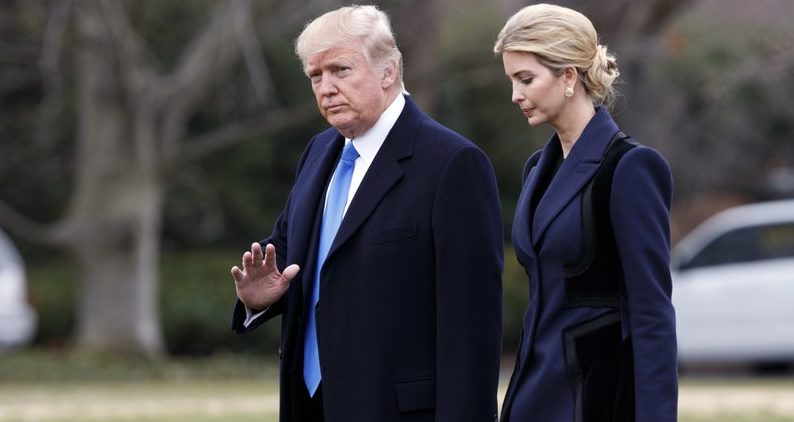
Cementing her role as a powerful White House influence, Ivanka Trump is working out of a West Wing office and will get access to classified information, though she is not technically serving as a government employee, according to an attorney for the first daughter. Since President Donald Trump took office, his eldest daughter has been a visible presence in the White House, where her husband, Jared Kushner, already serves as a senior adviser. On Friday, she participated in a meeting on vocational training with the president and German Chancellor Angela Merkel. Jamie Gorelick, an attorney and ethics adviser for Ivanka Trump, said Monday that the first daughter will not have an official title, but will get a West Wing office, government-issued communications devices and security clearance to access classified information. Gorelick said Ivanka Trump would follow the ethics rules that apply to government employees. “Our view is that the conservative approach is for Ivanka to voluntarily comply with the rules that would apply if she were a government employee, even though she is not,” said Gorelick, who also helped Kushner with the legal strategy that led to his White House appointment. “The White House Counsel’s Office agrees with that approach.” Ivanka Trump’s role has already come under scrutiny because there is little precedent for a member of the first family with this kind of influence. The White House did not immediately respond to a request for comment. A person with knowledge of Ivanka Trump’s thinking, who requested anonymity to discuss private conversations, said she believes she can offer more independent perspective to her father by not serving as a White House staffer. A popular surrogate for her father on the campaign trail, Ivanka Trump moved her young family to Washington at the start of the administration and signaled plans to work on economic issues, like maternity leave and child care. In a statement, she said: “I will continue to offer my father my candid advice and counsel, as I have for my entire life.” Federal anti-nepotism laws prevent relatives from being appointed to government positions. But the Justice Department’s Office of Legal Counsel recently said the president’s “special hiring authority” allowed him to appoint Kushner to the West Wing staff. Gorelick noted the office also made clear that the president could consult family members as private citizens, arguing that this is what Ivanka Trump will be doing. The first daughter has sought to distance herself from the Trump Organization and her lifestyle brand, which offers shoes, clothing and jewelry. She has removed herself from executive roles and will have a more hands-off approach to the brand — though she will still get certain information and will have the power to veto new deals if they raise ethical red flags. Richard Painter, a University of Minnesota law professor who served as President George W. Bush‘s chief White House lawyer on ethics, said that Ivanka Trump is effectively working as a White House employee. He said that “means that she, like her husband, has to follow the rules. It’s not a huge deal if she stays out of things that affect her financial interests.” Painter said that means Trump should avoid anything to do with foreign trade with countries where her products are made, as well as recuse herself from real estate matters, given Kushner’s family real estate business. Trump says she will follow ethics rules and some of her financial information will be included in Kushner’s official disclosures. She would have to disclose additional financial information if she were in a senior White House role, said Painter. That could include more details about her lifestyle brand, including her contracts and income. Attorney Andrew Herman, who has advised lawmakers on ethics issues, said he thought the administration should make her role official. He said: “I think the right way to do that is to make her a special government employee. But that implicates all kind of formal and disclosure issues.” Ivanka Trump continues to own her brand. But she has handed daily management to the company president and has set up a trust to provide further oversight. The business cannot make deals with any foreign state, and the trustees will confer with Gorelick over any new agreements. Ivanka Trump will also be able to veto proposed new transactions. Ivanka Trump has also barred the business from using her image to promote the products in advertising or marketing. To be sure, the trustees are in the family — her husband’s siblings Joshua Kushner and Nicole Meyer. But Gorelick said the goal of the trust wasn’t to shield Trump from everything, but to remove her from the day-to-day operations. She also acknowledged that the arrangement did not eliminate conflicts, but she said Trump is trying to minimize them and will recuse herself from any administration decision-making that affects her business. With the Trump Organization, Ivanka Trump has stepped down from a leadership role and will receive fixed payments rather than a share of the profits. Ivanka Trump has also written a book, “Women Who Work,” that will be released in May. The proceeds and royalties will be donated to charity, Gorelick said. Republished with permission of The Associated Press.
Robert Bentley to defend his special election decision next month
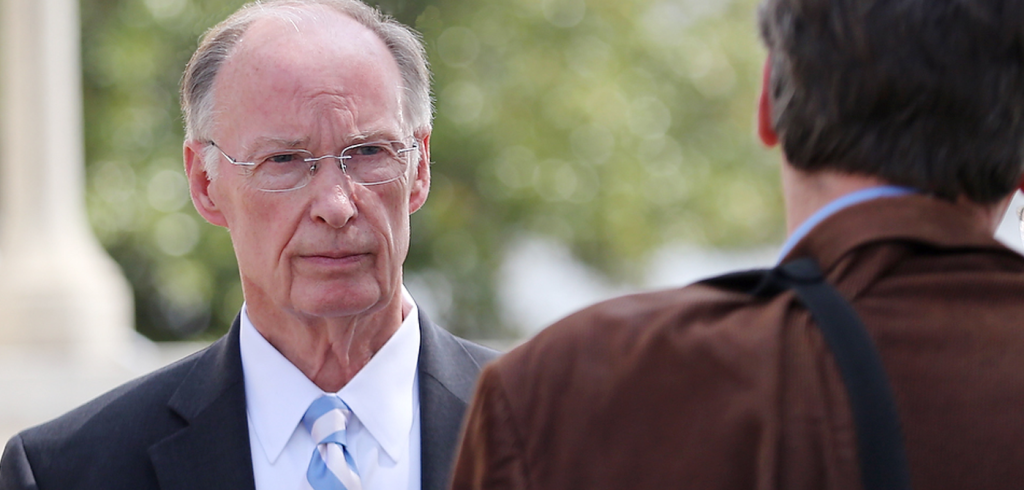
Gov. Robert Bentley will have to defend his decision to set the special election to fill Jeff Sessions’ vacated U.S. Senate seat for 2018 in a hearing next month. Bentley’s decision is being challenged in court by Republican State Auditor Jim Zeigler and retired District Attorney Tommy Chapman, a Democrat, who contend the governor set the election so far in the future in order to give sitting Senator and former Alabama Attorney General Luther Strange two years of incumbency as payment to halt an investigation. A state House committee investigating Bentley but was told to stop Nov. 3 after Strange said his office was doing “related work.” Strange had announced he would run for the vacant U.S. Senate seat but would not apply for appointment by Bentley. He then proceeded to interview with Bentley for the job, which he was appointed to Feb. 9. After his appointment, Strange said in a news conference that he never claimed he was investigating Bentley. “The whole thing stinks,” Zeigler said. “We’ve got a Bentley appointed senator instead of a peoples’ elected senator.” The pair, joined by attorney Doyle Fuller, are asking for a declaratory judgment that Bentley’s decision to push the election back to 2018 is illegal. Alabama law says, in part, that the governor must set a special election “forthwith” in the case of a vacancy, but only specifically addresses when a vacancy occurs within the four months preceding a general election, however the Ziegler team is citing a Feb. 13 finding by the Legislative Reference Service that the governor is required to set the special election immediately. “Bentley and Strange think they have gotten away with this illegal election. They have not gotten away with it yet, and the people of Alabama will remember this at election time,” Zeigler said. The case will go before Judge J.R. Gaines of the Montgomery County Circuit Court. Zeigler released a statement Tuesday telling Alabamans not to buy in to rumors that Bentley is resigning, calling the rumors a “devious way” to get the state House to adjourn without impeaching Bentley. “The rumors that Gov. Bentley will resign are just a diversion to get citizens to stop contacting their State Representatives urging impeachment – and to get the state House to back off,” he said. “If people think Bentley may resign, they will not be pushing for impeachment.”
Robert Bentley, lawmakers head to DC ahead of health care vote
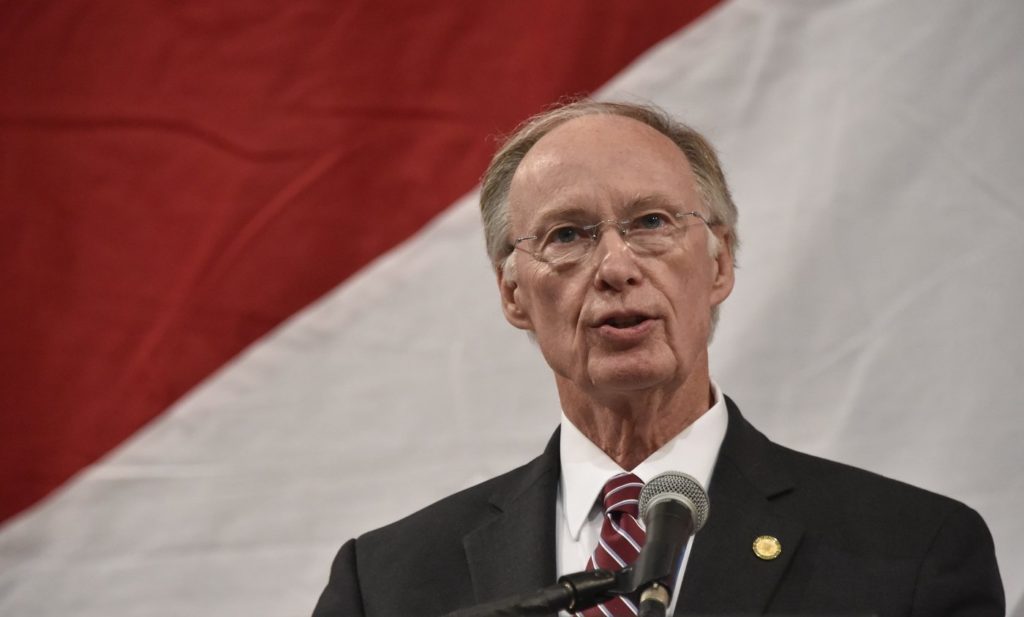
Gov. Robert Bentley and other state leaders are starting the week in Washington, D.C. ahead of the expected House vote on the American Health Care Act. Joining Bentley are state House Speaker Mac McCutcheon, state Sens. Greg Reed and Tripp Pittman, and Alabama Medicaid Commissioner Stephanie Azar. During the trip, the officials plan to meet with Health and Human Services Secretary Tom Price as well as congressional leaders to discuss the potential impact the Republican-backed bill, as well as the repeal of the Affordable Care Act, could have on Alabama’s Medicaid system. “As a Physician and as Alabama’s Governor, I have stood in opposition to the Affordable Care Act from day one. It’s not about health care of patients, and it’s certainly anything but affordable,” Bentley said in a statement Monday. “Alabama stood strong against the expansion of Medicaid because we simply cannot afford it. Now that a Repeal of the ACA appears imminent, we want to insure Alabama’s Medicaid system will be supported, and states given broad flexibility in any efforts to replace this unworkable and expensive law. We want to insure Alabama’s needs are known and clearly understood before a vote takes place.” Tuesday, Bentley and the officials plan to meet with members of the Alabama congressional delegation as well as White House administrators before returning Tuesday evening. “We have a strong Alabama team in Congress, and we have stayed in close contact throughout the effort to pass a new healthcare law,” Bentley said. “One size does not fit all when it comes to sovereign states and their needs. I am confident our Alabama delegation will always do what’s in the best interest of our people.” The trip follows a series of meetings between Bentley and other non-expansion state governors and the Alabama Republican Party Executive Committee addressing states’ concerns with the repeal and replacement of the Affordable Care Act.
Ronda Walker: Sensationalism sells, and the truth be damned

If you were to read a headline that stated, “Dog found on roadside” you might not even take the time to read the full article. But if the headline stated, “Fifty mutilated puppies found on roadside” that would definitely grab your attention. How about, “Flashes of light seen in night sky during storm” versus “Unexplained flashes of light seen by dozens could be UFOs.” Sensationalism sells, and the truth be damned. The United States federal budget process is very complicated; I do not understand it and won’t act like I do. But in my best Schoolhouse Rock attempt I will sum it up like this: the President submits a budget request to Congress, then the House and Senate have to come to some agreement on what they want to do, then Congressional hearings take place, and eventually the document (much evolved from the original version) goes back to the President for signature. There are a kabillion (official number) programs that receive federal funds. So many programs, in fact, that our country has a $20 trillion deficit. Twenty Trillion Dollars. That is a ridiculous and unsustainable figure. President Donald Trump recently submitted his budget request to Congress, the first step in the process, and the media absolutely freaked out. When everyone got their eye on the White House budget, it was probably some smart Democrat staffer on the Senate side that said, hey, let’s distract the entire nation from looking at this budget by scaring them to death with a headline that reads, “President Trump to gut Meals on Wheels program – seniors nationwide will begin to starve to death within the week.” And that’s exactly what they did, and it worked. It worked because first, the general public does not understand the budget process and they actually believe the President can unilaterally set the federal budget. And two, it worked because the news said it was true, so it must be true. Wrong. Meals on Wheels, administered in central Alabama by the Montgomery Area Council on Aging (MACOA), is a phenomenal program with a life-changing impact on local seniors. This program ensures homebound seniors in our area receive a hot midday meal. In addition to a nutritious meal, the seniors get a friendly smile and loving concern by the volunteer delivering their meal. Meals on Wheels is a program I support both personally as well as publicly through the appropriation of county funds. MACOA is a well run and effective organization and I encourage everyone to donate to MACOA or your local Meals on Wheels provider program. Last week the media reported that the White House budget gutted funding to the Meals on Wheels program – that assertion is false. The White House does not make unilateral budget decisions, moreover Meals on Wheels isn’t even a federal program. This was all a ploy to confuse and distract us from the real issue of the day – our $20 trillion deficit. Twenty Trillion Dollars. As educated Americans we have got to learn to stop chasing these false headlines. We have got to stop blindly reacting to what we read in the media, social and otherwise. But oftentimes we get all Chicken Little about a false issue not because we mistakenly believe it. We oftentimes spread the false narrative because it will help us win an argument, or it will help our side look better. That horrible monster Donald Trump is starving seniors to death; I told you he is a bad President. Yet, that same angry person that just lashed out about Trump never said a peep when President Barack Obama went year after year, after year and never submitted a budget at all which threw agencies dependent on federal funding into a tailspin of uncertainty. Let’s take a look at what actually happened. The White House wants to cut funding to a federal program called Community Development Block Grants (CDBG). It is important to note that Presidents Bush and Obama both proposed cuts to CDBG as well, it just happened without all of this manufactured uproar about taking meals away from the elderly. CDBG funds are federal funds given to states and localities to use at their discretion – and the use and effectiveness of these monies has been questioned for years, thus the desire to scale back on the spending for this program. A few localities designate a small amount of CDBG funds to their local Meals on Wheels program, so those programs could indeed be impacted in the event CDBG gets reduced. However the vast majority of federal dollars to Meals on Wheels comes not from CDBG but from the Department of Health and Human Services through the Older Americans Act. And, the majority of money spent on this program comes from state, local, and private funding, not federal. Every day I read media reports and social media posts that are full of false information and opinion and people buy it hook line and sinker. It’s exhausting. Political spin and trickeration is nothing new. There are lies coming from both sides of the political aisle, likewise there is truth coming from both sides. As caring and involved Americans, we must do our due diligence, dig deep, and understand the facts for ourselves. Please never just rely on one source for your news, read multiple articles and authors and form an education conclusion. And, don’t forget to support your local Meals on Wheels provider! ••• Ronda M. Walker is a wife, mother of four and the Vice Chairman of the Montgomery County Commission.
Robert Bentley’s office denies resignation rumors
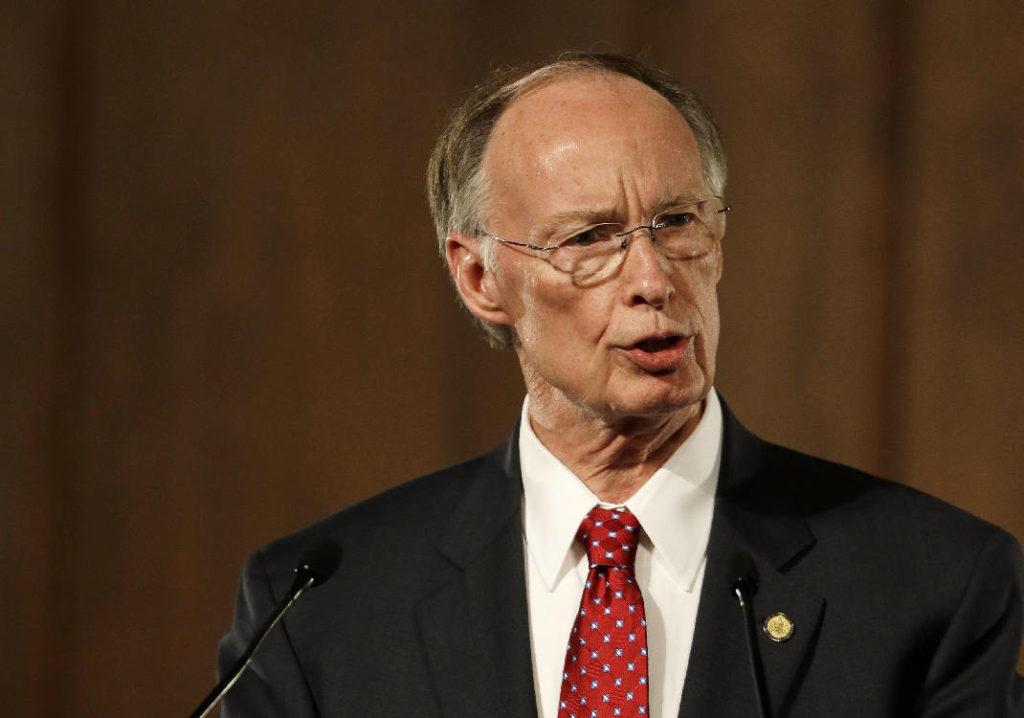
If Gov. Robert Bentley has anything to say about it, he’s not going to be leaving office before his term is up. A spokesperson for the governor on Monday confirmed Bentley’s plans to stay in office, denying resignation rumors the embattled Republican would vacate his office early. “Gov. Bentley takes very seriously his call to serve as Alabama’s 53rd Governor, and considers it the greatest honor of his life,” spokesperson Yasamie August said in a statement to AL.com. “He has plans only to continue to serve the people of this state, and as he stated so clearly in his 2017 State of the State address, to “finish the race.” The rumor mill surrounding a potential Bentley resignation began last week when the 74-year-old governor was twice treated at the hospital for an irregular heartbeat. The visits lead to speculation that stress is causing his health to suffer, despite the fact his office has said the medical issues have not impacted his work. Fueling the rumors further, Hartselle-Republican state Rep. Ed Henry in an interview with WTVY said he believes Bentley would resign no later than next month to avoid possible impeachment. “From what I’m hearing I would expect by mid-April that the governor either will have resigned or the impeachment committee will be moving at a very rapid pace,” Henry told WTVY. Bentley, 73, last spring admitted making inappropriate remarks to his senior political adviser but denied accusations of an affair with her and of interfering in law enforcement business, accusations both raised by his fired law enforcement secretary. Following the news, twenty-three representatives, led by Rep. Henry, signed articles of impeachment, accusing Bentley of willful neglect of duty and corruption in office. The legislative probe officially began in June 2016, but it has been off to a slow start, as lawmakers find their way through an impeachment process that has not used in a century. In November, the chairman of the House Judiciary Committee suspended impeachment hearings per the state’s attorney general’s office, as they are conducting a related investigation.
Alabama lawmakers to vote on death penalty bill

No capital murder sentencing procedure in the United States has been more criticized than that of Alabama’s. As the only state in the country that permits elected trial judges to override jury verdicts to give criminals the death penalty instead of a life sentence, Alabama’s judicial sentencing procedures are once again the topic of debate. On April 4, when lawmakers from the Alabama House of Representatives return from a two-week spring break, they will debate this controversial 1976 policy that has resulted in judicial overrides 107 times in the past four decades. Last month, the Alabama Senate approved a similar bill doing doing away with judicial override on a 30-1 bipartisan vote. Pike Road- Republican stateSen. Dick Brewbaker, the bill’s sponsor, clarified the bill only affects future cases and not any inmates currently on death row. He says judicial override in death penalty cases is contrary to the tradition of American justice that a jury from the community should determine both the verdict and sentence. In a recent study by the Alabama-based Equal Justice Initiative, one of the groups opposed the state’s death penalty system, found that in nearly all of those cases judges imposed death sentences. The study also revealed twenty-one percent of 199 people currently on the state’s death row were sentenced through such judicial overrides. [Photo Credit: Yolanda Martinez | The Marshall Project]
Auburn names Steven Leath new university president
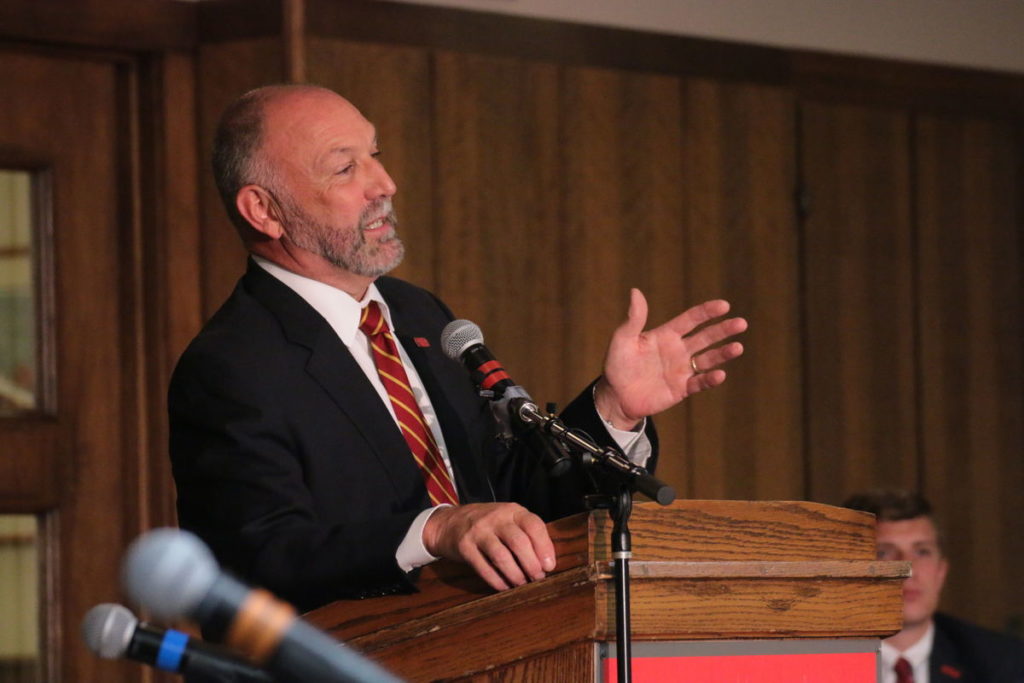
Iowa State University President Steven Leath will be retiring his cardinal and gold for blue and orange when he becomes the new president of Auburn University on July 15. Auburn University’s board of trustees on Monday unanimously selected Leath for the position as the university’s 19th president following a six-month national search. Leath replaces Jay Gogue, who announced his retirement in September. “This is a great day for Auburn,” said trustee Raymond Harbert, who chaired the 14-member presidential search committee. “Dr. Leath is a strategic leader who will work alongside the campus community and alumni to elevate Auburn to the next level in instruction, research and outreach.” Leath served as Iowa State’s president since 2012. While president, Iowa State achieved its highest student graduation rate, lowered student debt, grew research expenditures, set fundraising records and secured the university’s largest private gift for an academic facility. Prior to that he served as vice president for research at the University of North Carolina. “We found an accomplished leader through an inclusive search process with all campus constituencies represented,” said Larry Teeter, professor of forest economics and immediate past chair of the university senate. Teeter served on the presidential search committee along with others representing Auburn students, faculty, staff and alumni. In an email to the Iowa State community, Leath announced his resignation as president of the Iowa State to “pursue an outstanding opportunity at Auburn University.” Calling it his “destiny” to lead “one of the nation’s great Land-grant universities to even greater prominence.”
Billionaire Bill Gates meets with Donald Trump to talk foreign aid
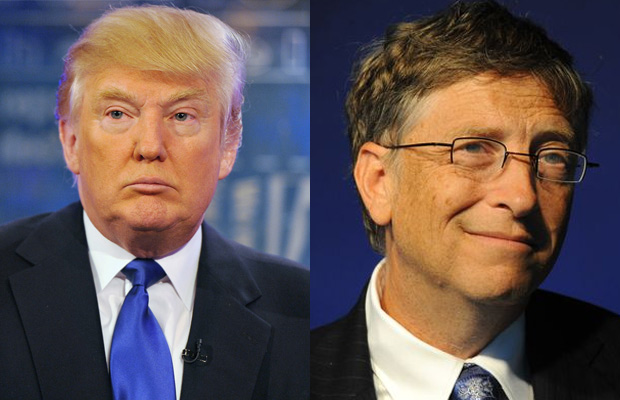
Tech billionaire Bill Gates is meeting with President Donald Trump to discuss progress in programs for global health and development as well as domestic education. Gates, who as the co-founder of Microsoft is the world’s wealthiest man, will highlight the “indispensable role that the United States has played in achieving these gains,” his foundation said in a statement. Monday’s meeting comes just days after the administration submitted a budget blueprint that cuts foreign aid. The Trump administration’s budget message said it was time “to prioritize the security and well-being of Americans” and “ask the rest of the world to step up and pay its fair share.” Republished with permission of The Associated Press.
Birmingham ranks 8th most Trumpcare-affected city

After seven long years of waiting to repeal President Barack Obama‘s signature health care law, Republicans released their own, the highly-anticipated alternative, proposal earlier this month. Following its release, many politicians from both sides of the aisle were none too pleased with its details. The nonpartisan Congressional Budget Office said that it would raise the average health-insurance premium for an individual policyholder by 15 to 20 percent just one or two years from now and lower federal subsidies. Thus, affecting the wallets of Americans across the country. One of the cities most affected by the new proposal? Alabama’s very own Birmingham. According to a new report of 2017’s Cities Most Affected by Trumpcare from the personal finance website WalletHub, Birmingham is the 8th most affected among the 457 U.S. cities and the fifth most affected among mid-sized cities. To gauge the impact of the Republican-proposed health plan on people who buy their own insurance, WalletHub’s analysts compared the cities based on the differences in premium subsidies that the average household would receive under Obamacare and Trumpcare. Impact of Trumpcare on Birmingham: Avg. Obamacare Premium Subsidy: $9,494 Avg. Trumpcare Premium Subsidy: $5,000 Subsidy Difference: -$4,494 *Impact measured by difference in premium tax credits received by average household under proposed and current health laws (highest difference = most affected) Other Alabama cities ranked by how affected they are by “Trumpcare”: Mobile: 23rd Montgomery: 43rd Tuscaloosa: 46th Here’s how Birmingham compares to the rest of the country: Source: WalletHub
Birmingham’s Hope for Gabe Foundation taking message coast to coast

President of the Birmingham, Alabama-based Hope for Gabe Foundation Scott Griffin was thrilled when the Alabama Legislature formed a Rare Disease Advisory Council last week. Still, he wants to take the message of the importance of access to drugs and treatment for rare diseases beyond Alabama’s borders. So the Hope of Gabe Foundation is doing just that. The group is hitting the road, traveling across the country to educate the public and policymakers about access to drugs through its third cross-country bicycle race. “The Alabama Legislature passed a Rare Disease Advisory Council in Alabama this past week,” said Griffin. “The Hope for Gabe Foundation will take Alabama’s story of collaborative success from coast to coast.” For the next six months, the non-profit will endeavor to raise awareness about about Duchenne Muscular Dystrophy and educate the public about legislation that can help save lives through a cross-country bicycle ride, called Ride4Gabe. Griffin’s son, Gabe, is eleven and suffers from the terminal disease Duchenne and desperately hopes for a cure for his son someday soon. Dr. Brian Toone, a Samford professor who lives in Hoover, Ala. is an internationally known competitive cyclist who will participate in the annual endurance cycling race called Race Across America, or R.A.A.M. Toone has become close with the Griffins over several years and participated in the foundation’s annual Ride4Gabe efforts. This year’s bicycle race will take the team from Oceanside, CA to Annapolis, MD and cover approximately 3,080 miles. Toone’s effort will be promoted as RAAM and will use the slogan “Racing for Accelerated Access to Medicine.” Access is currently a major issue in the Duchenne community and Griffin believes policymakers can learn from the story and apply those lessons to future legislation at the state and federal level. “In the last year we’ve seen the first-ever drug approved that targets the underlying cause of Duchenne,” said Toone. “It is infuriating that insurance companies are refusing to cover it even though it is safe and the leading American doctors who treat Duchenne say it should be approved. On the other hand, we think it is ridiculous the FDA is allowing another company to charge $90,000 to our insurance companies for a different drug that was recently approved by the FDA since we have been getting that same drug from Europe for Gabe at a cost of $500 a year since 2010.” Toone says that while winning the Race Across America is obviously on his mind, he is most inspired by his ability to demonstrate rigors and fatigue that kids with Duchenne and other rare diseases feel each and every day. “I’ll be cycling around the clock for about ten days as I cross the country from coast to coast,” said Toone. “When I am too tired to get myself on or off my bicycle I will thank God for my good health and look to rare disease patients like Gabe, who cannot pedal for themselves, to inspire me along the way.”
Battered by scandal, Marines issue new social media policy

Battered by a nude photo-sharing scandal, the Marine Corps has issued a longer and more detailed social media policy that lays out the professional and legal ramifications for service members culpable of online misconduct. Among the coming changes: a requirement that all Marines sign a statement acknowledging they have read and understand the new guidelines. The adjustments are designed to give leaders more leeway in prosecuting or punishing offenders. Former and current female Marines have reported their photographs and those of women in other services being posted on social media pages without their consent. Investigators are also looking into threatening and obscene comments Marines wrote accompanying the images. The new policy makes it clear how existing rules and the Uniform Code of Military Justice can be used to prosecute offensive, indecent or disrespectful online activities. But it creates no new laws, underscoring the legal quagmire posed by the internet and the constraints on military leaders posed by privacy laws and the First Amendment right of free speech. Released in recent days by Gen. Robert Neller, the Marine commandant, the Corps’ new guidance is one result of the ongoing criminal investigation. “Marines should think twice before engaging in questionable online activities, and must avoid actions online that threaten the morale, operational readiness and security, or public standing of their units, or that compromise our core values,” the policy states, addressing any content or comments that are deemed defamatory, threatening, harassing or discriminating on the basis of race, color, sex, gender, age, religion, national origin, sexual orientation or other criteria. It makes clear that bad behavior can be punished under the military code. The Marine Corps isn’t the only service making changes. The Army is sending out a new message to its force, signed by senior leaders including Gen. Mark Milley, the Army chief of staff, and warning soldiers that online misconduct is unacceptable and passive tolerance of bad behavior by others is also wrong. The Army has routinely updated its social media policy to emphasize treating soldiers with dignity and respect, including in February before the Marine scandal surfaced. The services are urging any victims of improper photo-sharing to come forward. The Naval Criminal Investigative Service said it is getting more tips every day, but investigators acknowledge the legal hurdles in finding and prosecuting offenders. Twenty women have reported that they’re victims. The probe has expanded in the last two weeks, as services beyond the Marines examine if their members are involved. So far, they say no victims from the other services have come forward. No men have said they were victimized. One problem for investigations is that photos were shared by Marines and others on a private Facebook page that was members-only and men-only. And they were mainly housed on a Google Drive linked to the page. The Facebook page has been taken down and that Google drive link is also gone, although officials say the photos likely migrated to other sites. Because the page is gone, investigators must rely on screenshots showing the screen names of military members, as well as reports from victims who heard about or saw the images. Tracking offenders is difficult because many may not use real names. Another challenge: The bulk of the photos are selfies. Many were likely provided willingly by the person in the picture to someone else, or possibly posted on Instagram or another such site. The question then becomes whether sharing an explicit photo that was provided willingly is a crime. A number of states have laws prohibiting so-called revenge pornography, and the military is looking at making a similar addition to its code, a change several senators are suggesting. But such a law may require prosecutors to prove the posting’s intent was to harm the individual and that it had an impact. Both can be difficult to prove. Officials also have to tread carefully to avoid restricting free speech. As an example, attempting to prohibit anyone from looking at or posting a nude photo on the internet would be difficult to do and nearly impossible to enforce. The military, however, has greater ability to punish service members beyond strictly legal violations. Officers can be charged with conduct unbecoming an officer, and service members can be punished for harming the good order and discipline of their unit, or their military service. These broader categories give commanders greater flexibility in ordering administrative punishment or even forcing service members to leave the military. Republished with permission of The Associated Press.
Counting Americans: A new Mideast box on census is sensitive

Zahraa Ballout isn’t “white,” and she certainly isn’t “some other race.” If the government gives her the choice of checking a new “Middle East/North Africa” box on a census form, would she? Yes, she says, despite some reservations about what it would mean to stand out after Americans elected a president who wants to ban travel from some countries in the region and has spoken favorably of registering Muslims in the U.S. “I would feel some wariness because you don’t know exactly the consequences or what’s coming next after you check the box,” says 21-year-old Ballout, a student in Dearborn, Michigan, who’s been in the country three years. “I don’t want to fool myself to think that checking another box (other than the new one) is going to protect me in some way.” Ballou’s risk-benefit analysis reflects a new caution surrounding the way the U.S. government counts Americans, an every-decade exercise mandated in the Constitution that influences the nation’s day-to-day operations in ways big and small. That includes representation in Congress and how taxpayer money is doled out – for education, public health, transportation and more. The Census Bureau on Feb. 28 for the first time recommended including the new category, which would mostly affect Muslims. The Office of Management and Budget is expected to make the decision later this year. The move is the product of years of research and decades of advocacy for Arab and other groups from the region that pre-date Donald Trump‘s presidential campaign. The Census Bureau said that when it tested a new MENA category in 2015, people of Middle Eastern or North African descent tended to check off that box. When it wasn’t there, they’d select “white” or, increasingly, “some other race.” Including the separate category, the agency said, is “optimal” to get a more accurate count of Americans. “There’s nothing for me to hide,” said Hussein Dabajeh, 30, a lifelong Dearborn resident who said his ancestors arrived from what’s now Lebanon in 1911. Dabajeh says he’d check the MENA box. “I can be American of Arab descent without being un-American.” The disparity can be seen in a basic statistic. The Arab American Institute estimates as many as 3.7 million people in the United States have Arab roots. The Census Bureau estimates there are 1.8 million Arab Americans in the U.S, according to data it has collected. Among other things, that means there are no accurate national numbers to provide clues to whether certain medical ailments are – as suspected – unusually common in people of that background, experts say. Both tallies show explosive growth in that population since 2000. And both support the new box on the 2020 census that would represent people with backgrounds from 19 countries in the region. But singling oneself out in that way has become sensitive at a time when Trump has linked a crackdown on Muslims with better national security. As a candidate, he called for a “total and complete shutdown of Muslims entering the United States.” As president, Trump has twice ordered travel bans on people from certain majority-Muslim nations. Federal courts have blocked those orders, but on Friday, the Trump administration said it would appeal the latest ruling. In 2016, Trump said the government should investigate mosques in the U.S. in much the same way the New York Police Department’s now-shuttered “Demographics Unit” spied on Muslims with help from the CIA. The group assembled databases on where Muslims lived, shopped, worked and prayed, infiltrated Muslim student groups, put informants in mosques and monitored sermons, The Associated Press reported in 2011. “The fear is legitimate. It’s something I worry about,” said Maya Berry, executive director of the Arab American Institute, which has been pushing for the change since before the 1990 census, when it put up posters reading, “We want to be counted, do you?” “It’s very hard for us now to sort of reject that wholly, because we’ve been working on it for decades,” she adds. “We’ve been telling our members: We understand why you’re concerned, it’s a legitimate concern. Let’s just proceed with caution.” Former Census director Robert Groves traces the worries in part to one “black mark” on the department’s history. During World War II, the Census Bureau provided the government with neighborhood information to help it sweep up 120,000 people of Japanese descent for imprisonment, under an order by President Franklin D. Roosevelt. But he points out that the law prohibits workers from disclosing personal census information. “The culture of the Census Bureau and this law has been successful over successive decades in allowing me and others to say this is the best protection that can be given to people,” said Groves, now provost of Georgetown University. While some members of the MENA community share the concerns, they also believe the government is powerful enough to discriminate against anyone. “There are better ways to do that than the census,” said Germine Awad, a University of Texas psychologist born in Egypt but raised in the United States. “That could happen at any moment.” Republished with permission of The Associated Press.
