
White House distances Donald Trump from Paul Manafort after AP report

The White House is distancing itself from former Donald Trump campaign chairman Paul Manafort, saying his secret work for a Russian billionaire detailed in an Associated Press report happened during “the last decade.” White House press secretary Sean Spicer says nothing in Wednesday’s AP report references any action by the president, the White House or any Trump administration official. Spicer says Trump was not aware of Manafort’s clients from the past decade and there are “no suggestions” Manafort did anything improper. Spicer also says former presidential rival Hillary Clinton had her own Russia ties. He says Clinton campaign chairman John Podesta sat on the board of a Russian-based energy company and Hillary Clinton was “the face of a failed Russia reset policy.” Republished with permission of The Associated Press.
Alabama law firm starts petition demanding payday loan reform
An Alabama law firm launched a petition Wednesday calling on state lawmakers to pass a bill to put more stringent regulations on payday lenders. Bond & Botes, which has offices statewide, says payday lenders “skillfully set” traps for borrowers that see them taking out loans with interest rates and fees far higher than traditional loans and that Alabamans are being disproportionately hurt by these lenders. “We believe that payday loan reform would be a significant, positive step for the citizens of Alabama,” firm partner Bradford Botes said. “Our state does not have a good track record on this issue; interest rates for payday loans can be more than 450 percent, among the nation’s highest. By population, we also have a higher concentration of payday lenders than any other area of the United States. The firm’s petition, found on Change.org, is directed at Senate President Pro Tempore Del Marsh, Sen. Slade Blackwell who chairs the Banking and Insurance Committee, Senate Majority Leader Greg Reed, and Senate Minority Leader Quinton Ross. “These companies work hard to convince us that they provide a needed service in lending to people unable to participate in traditional options for loans,” the firm said in the petition. “But the truth is that payday lenders enrich themselves at the expense of those who can least afford it.” The Alabama Legislature has taken up bills to regulate the payday loan industry in the past, though none have made it into law. A bill that would have required reasonable payment terms and interest rates failed to make it through its committee references last year, and a 2017 version is currently waiting for a House vote after passing the full Senate. The House version of the bill, HB 321, is sponsored by a bi-partisan group of 45 legislators and would add a cap to the interest rate on payday and other types loans at 36 percent.
What they’re saying about the American Health Care Act: Martha Roby
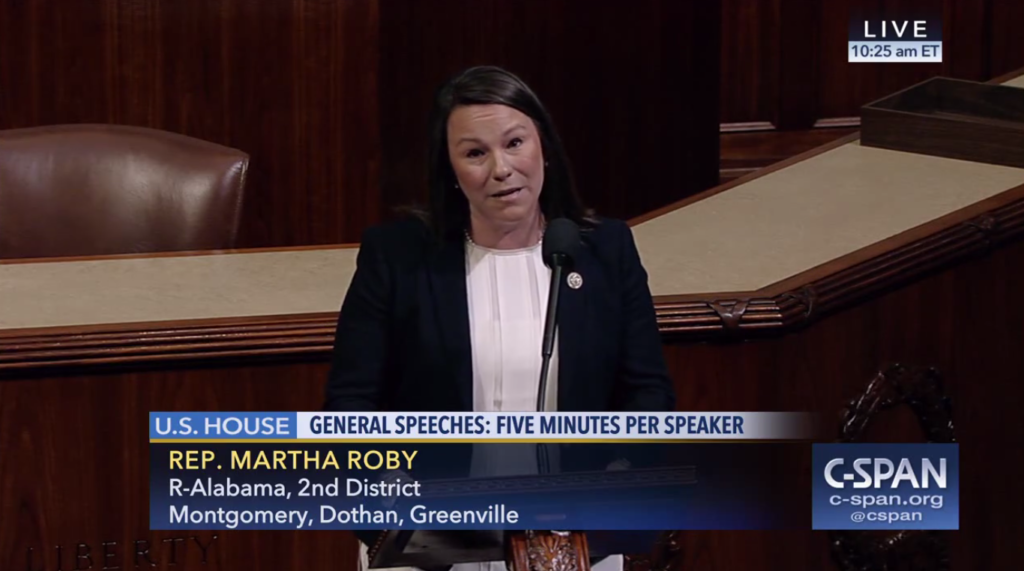
The U.S. House of Representatives is poised to hold a highly anticipated vote on the Republican health care bill Thursday night — the seventh anniversary of former President Barack Obama signing the Affordable Care Act, commonly called Obamacare — and would rewrite the current health care system. On Wednesday, Alabama 2nd District U.S. Martha Roby voiced her support for the bill, titled the American Health Care Act (AHCA) on the House floor, and called on her fellow House conservatives to keep their promise to repeal and replace Obamacare. In a speech, Roby reminded her colleagues of the repeated promises Republicans have made to do away with Obamacare for the last seven years. “I’ve heard from countless constituents negatively impacted by Obamacare,” Roby said. “And in response, I made a promise – the same promise President Trump and every conservative in Congress has made over and over: give us the majority in the House and Senate, give us a Republican in the White House, and we will repeal Obamacare and replace it with reforms that work.” Roby readily acknowledged no bill is perfect, but she said passing the ACHA is the best opportunity for Congressional Republican to deliver on their promises to constituents. She continued, “Mr. Speaker, I am confident that this bill puts us on a path toward lower costs and better care – and away from government-controlled health insurance. It represents our opportunity to undo the damage of Obamacare and help American families like we said we would. For seven years we have been promising, and this is our chance to deliver.” If passed, the bill will be taken up by the Senate. Watch Roby’s floor speech below: Read the full text of Roby’s remarks as prepared: Thank you, Mr. Speaker. Seven years ago this week, in this chamber, the House gave final passage to the Affordable Care Act, better known as Obamacare. I wasn’t in Congress then. Many of us weren’t. But for my fellow conservatives here today, that vote seven years ago marked a decision point or a moment of affirmation to answer the call to public service and help chart a better way for this country. And for seven years we have made the case against Obamacare. As the law has been implemented, that case has largely been made for us. Millions have been forced away from the health care plan and doctor they liked, despite promises to the contrary. This year alone, in Alabama, health insurance premiums are rising by 58 percent. That’s on top of already steep increases the past two years. Our average deductible for the supposedly affordable Bronze plan is now six thousand dollars. I’ve heard from countless constituents negatively impacted by Obamacare. I’ve listened to their stories about how higher costs and fewer choices have made it that much harder to keep their families healthy and make ends meet. And in response, I made a promise; the same promise President Trump and every conservative in Congress has made over and over: give us the majority in the House and Senate, give us a Republican in the White House, and we will repeal Obamacare and replace it with reforms that work. So Mr. Speaker, I am pleased that we are finally in a position to deliver on that promise. The voters gave us what we asked of them, and it’s only right that we keep our end of the bargain. With the American Health Care Act, we begin the process of repealing Obamacare once and for all. This bill dismantles the taxes, mandates, and entitlement spending that make up the core of Obamacare. It cuts taxes on prescription drugs, over-the-counter medications, insurance premiums, and medical devices. It eliminates the individual and employer mandate penalties that have forced millions into expensive, inadequate plans. It replaces the Obamacare entitlement with refundable tax credits so that people who don’t receive insurance through work can put their own tax dollars toward a health plan of their choice. Mr. Speaker, many have asked why our plan to repeal and replace Obamacare is a process. Why is this bill only one step and not the full package? It’s an understandable question. For the last several years, Americans have been sold the false hope that the government has a magic wand with which it can quickly solve all their problems. The truth is, of course, that it can’t. It never can. And the only proof you need is Obamacare itself. That’s why Congressional Republicans and the Trump Administration are taking completely a different approach than President Obama and the Democrats used seven years ago. Instead of claiming “we need to pass the bill so you can find out what is in it,” we have worked in a transparent way. The bill text has been posted online for three weeks. It has gone through three separate committee mark-ups, and will come to the House floor in regular order. Instead of one giant bill like Obamacare, we are using a more responsible, three-step process. First, we’ll repeal Obamacare with all its taxes, mandates and spending through budget reconciliation. Next, the Trump Administration will use its executive authority to weed out the more intricate Obamacare policies one-by-one to stabilize the market and lower costs. And finally, Congress will move forward with legislation addressing more specific policies, such as allowing individuals to purchase insurance across state lines. I believe this will ultimately lead to better, more stable health care policy that empowers patients, increases choices, and lowers costs. Mr. Speaker, no bill is perfect. I’m sure if every member of this body came up with their ideal health reform bill, they’d each be pretty different. It’s supposed to be that way, because we all represent different districts with different needs. There may well be some changes made here in the House or in the Senate that can make the bill better. That’s part of the process, so I certainly remain open to those. But, Mr. Speaker, I am confident that this bill puts us on
Rosemary Elebash and Jeff Lynn: Wanted: Skilled workers to ensure Alabama’s success

Ask business people to rank their top problems, and you find a consistent pattern. Taxes and regulations usually battle each other for the top spot. Finding qualified workers consistently ranks No. 3. These results — from monthly surveys of members of the National Federation of Independent Business — illustrate a critical problem in our country and a major roadblock to economic growth. To put it simply: We have plenty of people who need jobs. We have plenty of businesses that have jobs to fill. But the available people and the available jobs don’t always line up. Too many prospective employees lack the necessary skills for jobs that are in demand. This skills gap is crippling to individuals who miss out on job opportunities. But it is also crippling to business and economic growth. Companies that lack an adequate supply of workers can’t succeed and grow to their full potential. Rather than moving forward, they are often forced to divert resources and time in a never-ending cycle of trying to hire and train new workers. This is an issue for all Alabama employers, but especially for small businesses. Large corporations at least have human resources departments to help recruit qualified workers. At a small business, the person who places the help-wanted ad is very likely the same person who takes out the trash and signs the checks: the owner. Despite Alabama’s remarkable success in landing big manufacturing projects over the past 25 years, most of our jobs are created by smaller, existing businesses. Day after day, our state’s lack of qualified workers is costing small businesses the ability to create and fill new jobs. This hinders our state’s economic growth. Fortunately, Alabama business leaders, economic developers, educators and elected officials have set out on a new course to make sure our businesses have the workforce they need to thrive, now and in the future. Our community college system is working more closely than ever with the business community, economic developers, and other education partners to ensure students learn the skills that employers need. The system is working hand-in-hand with workforce development councils to align programs with employers’ needs in different communities across our state. Community colleges are also working with K-12 schools, four-year universities, the state Commerce Department, AIDT and others to ensure seamless transitions between workers and training and jobs. We are all working hard to be more nimble and quick, responding to technological changes that continually alter the workplace. Fostering these efforts is a new collaboration called AlabamaWorks, which is a business-driven workforce development system encompassing all of the state’s job-training and placement services. A one-stop-shopping website (AlabamaWorks.com) links employers, job seekers and students to the resources they need. A key challenge is making Alabamians aware of the resources – and the opportunities — that exist. Businesses need to know where to go for solutions for their workforce needs. High school students and adults need to know where to go to get the skills they need to succeed. And we all need to appreciate the varied avenues to success. Most of us know today that a high-school education alone is not enough. But too few of us appreciate the full range of career options that fall somewhere between a high school diploma and a four-year college degree. In Alabama, AIDT facilities in Decatur and Mobile recently hosted hundreds of high school students to highlight today’s technical and manufacturing careers, many requiring two years of training or less. These events showcased Alabama’s great training facilities, but also served as a reminder that the facilities are only as valuable as the people they train. “It does no good if we have the jobs and the training facility, if we don’t have the people and if our young people are not being interested and attracted to high-tech manufacturing,” State Sen. Arthur Orr said at the Robotics Technology Park near Decatur. Manufacturing jobs are just one example of our workforce development needs. Businesses across the state of Alabama can tell stories about projects stalled and plans delayed because they were unable to find qualified workers. At the NFIB and the Alabama Community College System, we understand the need, and we are committed to taking the steps necessary to make sure we have the right people in the right pipelines for the right jobs. If we fail to do so, we are jeopardizing the future success of our businesses, our people, and our state. ••• Rosemary Elebash is the state director for the National Federation of Independent Business in Alabama. Email: Rosemary.Elebash@nfib.org. Jeff Lynn is the senior executive director of workforce and economic development for the Alabama Community College System. Email: Jeff.Lynn@accs.edu.
Paul Manafort had plan to benefit Vladamir Putin government

President Donald Trump‘s former campaign chairman, Paul Manafort, secretly worked for a Russian billionaire to advance the interests of Russian President Vladimir Putin a decade ago and proposed an ambitious political strategy to undermine anti-Russian opposition across former Soviet republics, The Associated Press has learned. The work appears to contradict assertions by the Trump administration and Manafort himself that he never worked for Russian interests. Manafort proposed in a confidential strategy plan as early as June 2005 that he would influence politics, business dealings and news coverage inside the United States, Europe and the former Soviet republics to benefit the Putin government, even as U.S.-Russia relations under Republican President George W. Bush grew worse. Manafort pitched the plans to Russian aluminum magnate Oleg Deripaska, a close Putin ally with whom Manafort eventually signed a $10 million annual contract beginning in 2006, according to interviews with several people familiar with payments to Manafort and business records obtained by the AP. Manafort and Deripaska maintained a business relationship until at least 2009, according to one person familiar with the work. “We are now of the belief that this model can greatly benefit the Putin Government if employed at the correct levels with the appropriate commitment to success,” Manafort wrote in the 2005 memo to Deripaska. The effort, Manafort wrote, “will be offering a great service that can re-focus, both internally and externally, the policies of the Putin government.” Manafort’s plans were laid out in documents obtained by the AP that included strategy memoranda and records showing international wire transfers for millions of dollars. How much work Manafort performed under the contract was unclear. The disclosure comes as Trump campaign advisers are the subject of an FBI probe and two congressional investigations. Investigators are reviewing whether the Trump campaign and its associates coordinated with Moscow to meddle in the 2016 campaign. Manafort has dismissed the investigations as politically motivated and misguided, and said he never worked for Russian interests. The documents obtained by AP show Manafort’s ties to Russia were closer than previously revealed. In a statement to the AP, Manafort confirmed that he worked for Deripaska in various countries but said the work was being unfairly cast as “inappropriate or nefarious” as part of a “smear campaign.” “I worked with Oleg Deripaska almost a decade ago representing him on business and personal matters in countries where he had investments,” Manafort said. “My work for Mr. Deripaska did not involve representing Russia’s political interests.” Deripaska became one of Russia’s wealthiest men under Putin, buying assets abroad in ways widely perceived to benefit the Kremlin’s interests. U.S. diplomatic cables from 2006 described Deripaska as “among the 2-3 oligarchs Putin turns to on a regular basis” and “a more-or-less permanent fixture on Putin’s trips abroad.” In response to questions about Manafort’s consulting firm, a spokesman for Deripaska in 2008 — at least three years after they began working together — said Deripaska had never hired the firm. Another Deripaska spokesman in Moscow last week declined to answer AP’s questions. Manafort worked as Trump’s unpaid campaign chairman last year from March until August. Trump asked Manafort to resign after AP revealed that Manafort had orchestrated a covert Washington lobbying operation until 2014 on behalf of Ukraine’s ruling pro-Russian political party. The newly obtained business records link Manafort more directly to Putin’s interests in the region. According to those records and people with direct knowledge of Manafort’s work for Deripaska, Manafort made plans to open an office in Moscow, and at least some of Manafort’s work in Ukraine was directed by Deripaska, not local political interests there. The Moscow office never opened. Manafort has been a leading focus of the U.S. intelligence investigation of Trump’s associates and Russia, according to a U.S. official. The person spoke on condition of anonymity because details of the investigation were confidential. Meanwhile, federal criminal prosecutors became interested in Manafort’s activities years ago as part of a broad investigation to recover stolen Ukraine assets after the ouster of pro-Russian President Viktor Yanukovych there in early 2014. No U.S. criminal charges have ever been filed in the case. FBI Director James Comey, in confirming to Congress the federal intelligence investigation this week, declined to say whether Manafort was a target. Manafort’s name was mentioned 28 times during the hearing of the House Intelligence Committee, mostly about his work in Ukraine. No one mentioned Deripaska. White House spokesman Sean Spicer said Monday that Manafort “played a very limited role for a very limited amount of time” in the campaign, even though as Trump’s presidential campaign chairman he led it during the crucial run-up to the Republican National Convention. Manafort and his associates remain in Trump’s orbit. Manafort told a colleague this year that he continues to speak with Trump by telephone. Manafort’s former business partner in eastern Europe, Rick Gates, has been seen inside the White House on a number of occasions. Gates has since helped plan Trump’s inauguration and now runs a nonprofit organization, America First Policies, to back the White House agenda. Gates, whose name does not appear in the documents, told the AP that he joined Manafort’s firm in 2006 and was aware Manafort had a relationship with Deripaska, but he was not aware of the work described in the memos. Gates said his work was focused on domestic U.S. lobbying and political consulting in Ukraine at the time. He said he stopped working for Manafort’s firm in March 2016 when he joined Trump’s presidential campaign. Manafort told Deripaska in 2005 that he was pushing policies as part of his work in Ukraine “at the highest levels of the U.S. government — the White House, Capitol Hill and the State Department,” according to the documents. He also said he had hired a “leading international law firm with close ties to President Bush to support our client’s interests,” but he did not identify the firm. Manafort also said he was employing unidentified legal experts for the effort at leading universities and
Steve Flowers: For 2018 governor’s derby, a cavalcade of characters
We are on the cusp of one of the best political years in modern political history in the Heart of Dixie. Prior to the 1970s, our constitution disallowed succession of office for our state constitutional offices. In other words, you could not run for two consecutive four-year terms. That is why George Wallace ran his wife in his place in 1966. George and Lurleen campaigned side-by-side. George would wink at the crowds still drawn to courthouse squares by a country band and say, “I’m going to be her No. 1 adviser.” By the way, she won in a landslide. She beat eight male opponents without a runoff, including two former governors, an agriculture commissioner, the sitting state attorney general and two powerful state senators. However, you could serve a four-year term and wait out four years and run for a second term. Only two men had done that in Alabama history. Prior to the constitutional change in the 1970s, Bibb Graves of Montgomery had done it early in the century and Big Jim Folsom did it in 1946 and again in 1954. Now that governors can succeed themselves, it has become common practice for governors to serve eight years rather than four. Thus, the 2018 governor’s race will be a once in an eight-year opportunity. Folks, we are in for one heck of a year and the bell rings June 6. Therefore, the horses will begin lining up over the next few months. It will be a great cavalcade of characters. The early favorite horse in the 2018 Derby is Roy Moore. The Chief Justice’s expulsion from the bench by the Judicial Inquiry Commission has propelled him to stratospheric levels in polling. Leading a horserace is a good analogy for Moore since he traditionally rides his horse to vote at his polling place in Gallant in rural Etowah County. Some of you may question Moore’s popularity, but the numbers are there in every poll. The JIC has made him a martyr. Alabama is a very religious state and being thrown out of office by an unaccountable commission for being against homosexual marriages is a pretty good issue to run on in the Bible Belt. Roy Moore is the wild card in the early 2018 jockeying. Most folks have him in the governor’s race. However, he has two other options. Attorney general or the U.S. Senate seat. He would probably win either of these posts. The governor’s office is another question. Historically, people do not think of him as governor. He lost miserably both times he ran, whereas he wins handily for a state judgeship. His best race is for attorney general or U.S. Senate. Twinkle Andress Cavanaugh has a free shot in 2018. She was just re-elected to a four-year term as Public Service Commission President. She is already out running for governor and sometimes the early bird gets the worm. State Agriculture Commissioner John McMillan is term-limited in that job that he has done well for eight years. He is well liked by everyone who knows him and is planning to run for governor. Young Boozer has also served his two-term eight-year limit as State Treasurer. He is a wild card and gives no hints as to what his future political plans are for 2018. Young is not a natural politician. He is an erudite Stanford-educated successful banker who was perfectly suited for the State Treasurer’s post and he has done an excellent job. Secretary of State John Merrill is probably the best retail politician in the state at this time. Lots of people have encouraged him to run. However, he is one of the few constitutional officeholders who can run for re-election in 2018. He will probably bide his time and run for re-election. State Senate President Pro Tem Del Marsh of Anniston is itching to pull the trigger on the governor’s race, but being a powerful state senator does not translate into statewide name identification. However, Marsh is said to be wealthy. If he were to spend $3 to $5 million of his own money, he could be a player. The very popular mayor of Huntsville, Tommy Battle, is seriously considering the race. If he joins the fray he could be a player. He would come out of the Tennessee Valley with a strong start. There are a lot of votes in North Alabama. We are in for a heck of a campaign year. I will keep you posted. See you next week. ___ Steve Flowers is Alabama’s leading political columnist. His weekly column appears in over 60 Alabama newspapers. He served 16 years in the state Legislature. Steve may be reached at www.steveflowers.us.
Daniel Sutter: Technology, sharing and regulation

The ride sharing company Uber has used technology to evade law enforcement in cities where its service was not approved. The case raises several interesting questions, perhaps most importantly involving the future of the sharing economy. Uber has battled entrenched and regulated taxi companies. Hopefully these battles will not distract or stall the unleashing of the enormous potential of sharing to improve our lives. Uber connects people willing to pay for rides with people willing to provide them using their own vehicles via a smart phone app. The company performs background checks on drivers, sets prices, but does not own vehicles. Driving strangers for a fee sounds like taxi service, which is why Uber has run afoul of taxi regulations. Police in cities where Uber is illegal have tried sting operations to catch drivers, but have been frequently “greyballed,” as reported by the New York Times. Uber’s technology does not just suspend the account of a questionable rider. Instead, it lets the rider line up a ride, but then cancels the ride. The same thing happens again if the rider puts in another request. The technology has been adept at identifying law enforcement accounts Greyballing has helped Uber enter new markets without permission and build up loyal riders, who then push for legalization. The company has admitted to and agreed to stop using greyballing to evade law enforcement where its service is not legal. Before condemning the technology, Uber has good reasons to block certain people from hailing rides. Consider a rider banned from the service for abusing drivers. The banned rider can always create a new account, so Uber cannot actually “blackball” a rider. If the new account is canceled, the rider could create yet another account, which might slip through. Letting a banned rider wait for rides which never arrive can better prevent misbehavior. How one evaluates Uber’s evasion likely depends on one’s assessment of taxi regulation. Economists have publicized the costs of taxi regulation for decades. Taxi regulation uses medallions for legal cabs. Cities limit the number of medallions, allowing taxi companies to charge higher fares than under competition. Regulation also sets maximum fares, but rates generally allow taxis to earn significant profits. The price of medallions on the market shows the profitability of regulated taxis. The medallion is just a legal authority and does not help provide rides, and thus differs from the cars, gasoline, tires, maintenance, drivers, insurance, and dispatchers that provide transportation. The value is due to profit, and medallions in New York City sold for $1.2 million prior to Uber’s emergence. Cities have enabled taxi cartels that charge customers more than necessary. If you believe that taxi regulation rips off consumers to enrich cab companies, you might agree with libertarian Jeffrey Tucker’s characterization of greyballing as a “public service.” Indeed, Uber’s app has eliminated the economic rationale for taxi regulation. Before the internet and smart phones, travelers had difficulty accessing information about reliable cab service in unfamiliar cities. The greater potential for passengers to get ripped provided more justification for government regulation. The market no longer needs government assistance. Using technology to bring down taxi cartels that have proved impervious to reform is attractive. But I often emphasize respect for the law, and thus am conflicted about undermining laws which we have been unable to change through the political process. I think that peoples’ obligation to obey the law places a duty on politicians to only enact or maintain laws that serve the public interest. We should expect respect for the law to decay when politicians pass laws enriching some citizens at the expense of others. Reasonable people may disagree about whether Uber is on the side of the angels in battling taxi cartels. But this ultimately is a separate issue from capturing the economic value in cars, homes, jet skis, power tools, and clothes which do not get used frequently. I just hope that Uber’s fight against taxi regulation, which might end badly for the company, does not sidetrack the sharing economy. ••• Daniel Sutter is the Charles G. Koch Professor of Economics with the Manuel H. Johnson Center for Political Economy at Troy University and host of Econversations on TrojanVision. The opinions expressed in this column are the author’s and do not necessarily reflect the views of Troy University.
Darryl Paulson: Do universities discriminate? The assault on conservative speakers at American universities

Free speech is an essential element for vibrant intellectual discourse and discovery at American universities. Part of that speech requires the students and faculty to be exposed to competing ideas. Too often, one side, the conservative side is missing in action not by choice, but by exclusion. Since 2000, the Foundation for Individual Rights in Education (FIRE) has found over 300 cases where speakers were disinvited or shouted down on college campuses. The vast majority of these were conservatives. Increasingly on university campuses, the prevailing view is that you are free to share your views as long as they do not offend or challenge existing orthodoxy. We do not want to give a platform to those who do not share our views on race, gender, ethnicity or political issues. In other words, the “not welcome” sign applies to conservative speakers, as well as those whose politics offends the sensibilities of students. The list of rejected speakers is far too long to detail, but I will provide a listing of a small percentage of individuals who were deemed persona non grata at universities. Christian LaGarde, head of the International Monetary Fund and one of the most influential persons in the world, was rejected by Smith College after students accused her of being connected to “global capitalism.” How could one of the leading women’s university’s reject LaGarde, one of the most powerful woman in the world. Being too close to capitalism overrode any gender sympathy. If only she had been a Marxist, or at least a socialist. Former Secretary of State Madeleine Albright, a leading academic as well as Bill Clinton‘s Secretary of State, was rejected by Scripps College because she was a “genocide enabler.” New York City Police Commissioner Ray Kelly, was booed off the stage at Brown University primarily for being the police commissioner of New York City. Students and faculty protested his aggressive policing and racial and ethnic insensitivities. Condoleeza Rice, one of the leading Soviet scholars in the world, former provost at Stanford University, the national security adviser to George W. Bush (2001-05) and Bush’s Secretary of State (2005-09), was deemed unfit to speak at Rutger’s after students attacked her role in the Iraq War. Human rights advocate Ayana Hirsi Ali, a Somali-born Muslim, has become a leading critic of female genital mutilation in Africa, as well as a critic of the oppression of women under Islam. The author of three best-selling books, Hirsi Ali was named by Time as one of the 100 most influential women in the world. It would seem that students and faculty would welcome the opportunity to hear the views of Hirsi Ali. Not so. Brandeis rejected Hirsi Ali because of her association with the conservative American Enterprise Institute and her criticism of radical Islam. The most recent conservative to be booed and assaulted by students was Charles Murray. No one denies that Murray’s views are controversial, but does that mean his views should not be heard. It does on college campuses. Murray was invited to speak at Middlebury College in March 2017 by the schools American Enterprise Club, a conservative student organization. Murray was to discuss his latest book, The State of White America, 1960-2010. Murray’s book explored the growing cultural gap between the white elite and the white middle-class, an issue of growing significance in light of the 2016 presidential election and Donald Trump‘s victory. When his appearance was announced, 450 Middlebury alumni protested his talk and criticized the university for giving him a platform. Better to remain in the darkness then open up anyone’s views to the light. Opponents argued their opposition had nothing to do with “free speech.” It seems to me it had everything to do with free speech. Although most conservative speakers are automatically suspect on American campuses, Murray is hardly a provocateur. His views may be controversial, but they have stimulated intellectual debate for decades. Murray is a prolific writer and social critic and he currently is The Bradley Fellow at the American Enterprise Institute. Before facing the packed audience, Middlebury’s vice president for communication, opened the forum by telling students “You’re going to love this part.” He then proceeded to tell students about respecting Middlebury’s policy of respecting the rights of speakers. University president Laurie Patton began her remarks by declaring: “Let me state the obvious. We are a left-leaning campus.” She then made it abundantly clear that no one should interpret her presence as an endorsement of Murray’s views. I wonder how many liberal speakers receive the same warm welcome. As soon as Murray began to talk, the students turned their backs to him and then spent the next 20 minutes chanting slogans. No one asked the students to stop disrupting Murray or asked the students to leave as Middlebury policy requires. After chanting such catchy slogans for 20 minutes, including “Who is the enemy. White Supremacy,” and “Your message is hatred. We cannot tol-er-ate it.” Never mind they had not heard one word from Murray because of their great intolerance. The university announced that Murray and Middlebury professor Allison Stanger, who was selected to pose questions to Murray, would be taken to an undisclosed location where their discussion would be live-streamed. On their way to the undisclosed facility, Murray and Stanger were assaulted by the mob. Stranger’s hair was pulled in one direction by a protester, as another protester pulled her in the opposite direction. Stanger was taken to a hospital and fitted with a neck brace. Did Middlebury students feel remorse for their actions? Absolutely not. In fact, they blamed the university security personnel for the disruption and said that Stanger’s hair was “inadvertently caught” during the chaos. This is a little like children telling their parents, “It wasn’t my fault. I didn’t do it’” The student newspaper was filled with comments justifying what transpired. To many of the students, some ideas are so illegitimate that they should not be heard. So much for free speech. One student, Nic Valenti, wrote
