
Alabama’s long history with Senate special elections
With Alabamians about to head to the polls Tuesday, Sabato’s Crystal Ball published a look back over the Yellowhammer State’s long and fascinating history with Senate special primary elections. Since the ratification of the 17th Amendment, which requires U.S. Senators to be directly elected, Alabama has had five special elections for Senate. The first of those five, held in 1914, was actually “the first to test the authority of a Governor to fill a vacancy since the direct election amendment to the Constitution was adopted” according to a Los Angeles Times article published at the time. The amendment, in part, states “that the legislature of any state may empower the executive thereof to make temporary appointments until the people fill the vacancies by election as the legislature may direct.” But the Alabama Legislature, which didn’t meet annually during that era, wasn’t scheduled to be back in session until 1915. The second race, in 1920, brought about the preferential primary voting system, which requires candidates to win a majority of the vote to secure their party’s nomination. If that doesn’t happen in the primary election, the top two finishers duke it out in a runoff election. The same system is still in place today, and if recent polls are anything to go by, the primary runoff will have to be used on the GOP side again this year. The lead up to the 1938 election saw Alabama with its first female senator, Dixie Bibb Graves, who was appointed by her husband, then-Gov. Bibb Graves, so he could avoid showing any favoritism among candidates in his party. Once the special primary election was decided, Graves rescinded his wife’s appointment and put the winner, J. Lister Hill, into the seat before holding the general election. In the fourth special election saw George Sparkman win a seat in the Senate and avoid a primary runoff with a narrow 50.1 percent victory. He went on to hold the seat for 32 years and is to this day the state’s longest-serving senator. He could have never made it to office, though, if it were not for his two primary opponents splitting the conservative vote down the middle in a contentious campaign. Alabama’s most recent Senate special election was held in 1978, and it is the most similar to the 2017 edition. After the death of Sen. Jim Allen his wife, Maryon Pittman Allen, was appointed to the seat. She was considered a favorite early on in the race but fell sharply in the polls after bad-mouthing then-Gov. George Wallace in a Washington Post interview. The move marked her as undignified and, more importantly, not conservative, though she came in second place in the primary and ultimately lost the runoff by 15 points.
Donald Trump endorsement could affect the special election ‘bigly’
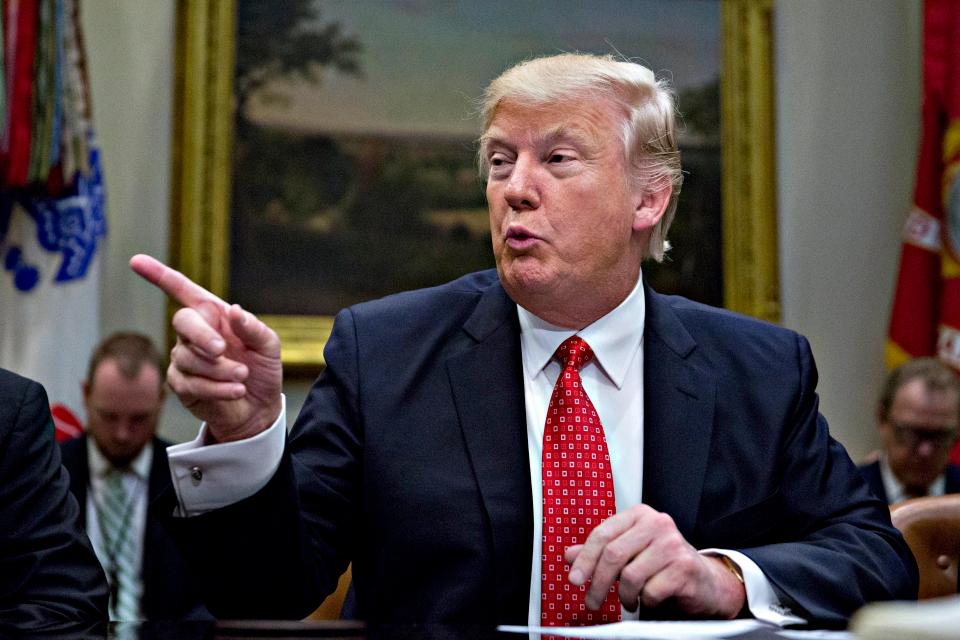
President Donald Trump endorsed sitting Sen. Luther Strange Tuesday, which means more in Alabama than just about anywhere else according to an analysis posted on FiveThirtyEight. Trump enjoys 85 percent job approval among likely primary voters despite his nationwide ratings hovering in the mid-30s. That high likability among voters has caused Strange and fellow Senate candidates Roy Moore and U.S. Rep. Mo Brooks to try to tie themselves “as tightly as possible” to the president, writes Harry Enten. The strategy is quite a reversal for the three Republicans, all of whom declined to endorse Trump during the presidential primary season last year, but times change. Despite his ties to Senate Majority Leader Mitch McConnell, disgraced former Gov. Robert Bentley and other establishment Republicans, Strange is polling far higher among Trump supporters than those that disapprove of the president. Though Moore polls equally well among Trump supporters, he pulls even more support from religious conservatives. The former Alabama Supreme Court Justice has 38 percent support among likely voters who identify as evangelical Christians, the best numbers of the nine Republicans in the race, though he only pulls 14 percent of those who don’t identify as evangelical. Brooks, who comes in third place in most polls, is in opposite land: His base of support comes from voters who view Trump negatively. That is likely due to the many ads by McConnell’s committee, Senate Leadership Fund, attacking the CD 5 congressman for being “insufficiently pro-Trump,” since by all metrics Brooks is one of the more conservative Republicans in the House. He has a very conservative voting record, is a member of the Freedom Caucus, has the backing of Sean Hannity and has courted conservative outside groups during the campaign. Strange and Moore are jockeying for first place in the nine-way primary race. The same poll showed Brooks with 18 percent support, followed by state Sen. Trip Pittman with 8 percent and Alabama Christian Coalition president Randy Brinson with 2 percent. Eleven percent were undecided. Unless one of the candidates can secure a majority of the vote in the Aug. 15 primary, Alabamians will have to decide between the top two vote-getters in a Sept. 26 runoff. The general election is slated for December 12.
Big check with a little problem comes out of Kay Ivey’s office this week
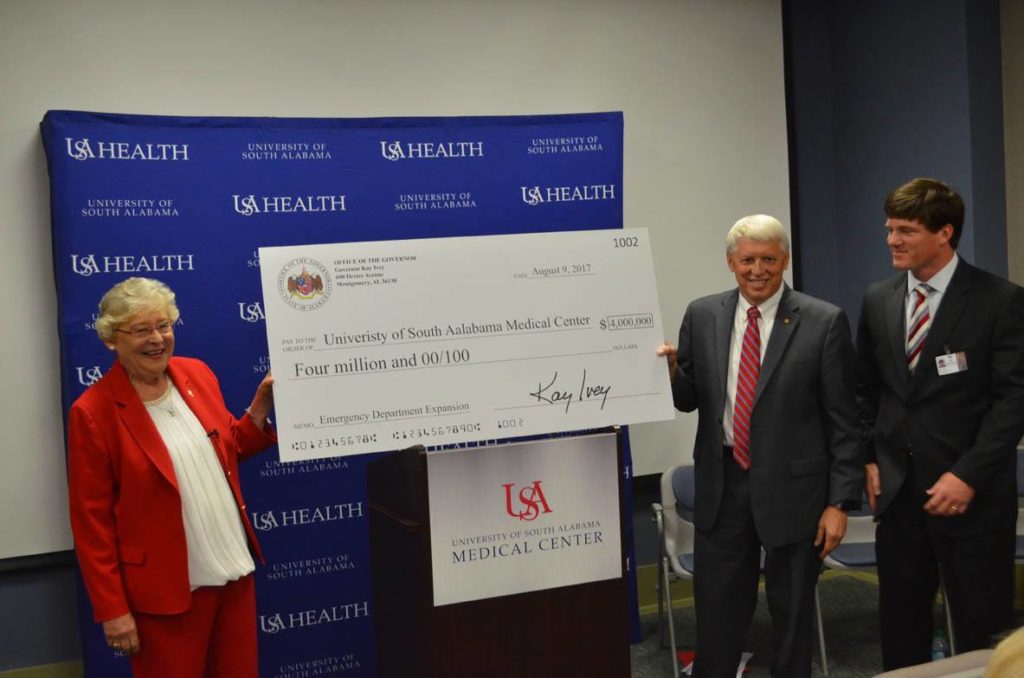
The Alabama governor’s office gave away a great big check on Wednesday. But you won’t see a photo of it on their social media, anymore, because there was a little bit of a problem on said great big check. In large print, an oversized $4 million check was presented to the University of South Alabama and it contained not just one, but two misspelled words. It was made out to the “Univeristy of South Aalabama Medical Center.” The check presentation followed a tour Gov. Kay Ivey took of the University of South Alabama Medical Center on Wednesday. There, Ivey announced that $4 million from an economic development bond issue will be directed to the cost of renovating and expanding the hospital’s Level 1 Trauma Center. Ivey’s team had originally tweeted a photo of the check, misspellings and all, only to take it down upon realizing the error Press Secretary Daniel Sparkman confirmed to Alabama Today. According to Sparkman, the office in the process of having a new check issued to the medical center. Don’t get us wrong, we’re not letting this little print faux pas take away from Team Ivey’s many successes in cleaning up the mess Gov. Robert Bentley‘s left behind. If this is the worst problem coming out of the Ivey administration it’s safe to say she’s brought the office quite a long way in just four short months. After all, what’s a typo here and there when you’re saving saving the state? But come on staff, Ivey trusts you to be her eyes and ears. Maybe someone on the team needs their annual eye exam, cause we’re talking about two pretty obvious oversights here.
Daniel Sutter: Good Samaritans and health insurance

The Affordable Care Act (ACA) taxes Americans without health insurance. The unpopular individual mandate violates personal freedom and was targeted by Congressional Republicans in their recent “Obamacare” repeal efforts. The health insurance mandate addresses a conundrum known as the Samaritan’s Dilemma, which arises frequently in public policy. A strong case exists for the individual mandate even though it infringes on personal freedom. In the Biblical parable, the Good Samaritan stopped to assist a traveler who had been beaten by robbers after several other travelers passed by. The tale teaches us to treat people, even strangers, with compassion. Economist James Buchanan first explained the Samaritan’s Dilemma, which concerns an implication of compassion. Knowledge that a Good Samaritan will be there to assist if needed leads people to take risky actions, like say traveling the road from Jerusalem to Jericho through bandit territory. Such interactions occur frequently. For instance, availability of a search and rescue team can induce hikers to try longer, more difficult trails, increasing the number of hikers needing rescue. The presence of a lifeguard can lead weak swimmers to venture farther out into the water. Today we often have government to assist our fellow citizens instead of waiting on a Good Samaritan. The Samaritan’s Dilemma plagues government as well. Politicians face enormous pressure to assist persons in distress due to natural disasters or illness. This assistance undermines the incentive for personal responsibility. The challenge for Good Samaritans is strategic: How to keep the increased demand for help from overwhelming our resources? A wealthy Samaritan cannot care for everyone if they all need help. As individuals, we frequently help friends and relatives whom we know well; we can consequently evaluate if their distress is truly due to circumstances beyond their control. Government programs typically are designed to help anyone, especially strangers. We can sometimes manage the dilemma by charging for help, like with ambulance rides or wilderness rescues. Charges limit the incentive of people to take advantage of compassionate taxpayers, but the inability of some persons needing assistance to pay a charge limits this mechanism’s usefulness. Governments also manage the Samaritan’s Dilemma by limiting our freedom, as with the ACA’s individual insurance purchase mandate. Let’s see how this works. Debates over health care sometimes imply that the uninsured do not receive life-saving emergency care. This is not true in America; the uninsured get treated in emergency rooms, with costs shifted to patients able to pay their bills. People can take advantage of our willingness to provide life-saving medical care regardless of whether people can pay. I think that we can say that everyone who can afford it has a responsibility to purchase health insurance to avoid burdening others. But we are not going to withhold care when needed. So this responsibility must be enforced by a law. Social Security addresses a form of the dilemma arising from people outliving their savings. If we will have the government support any retiree who runs out of savings, fewer people will save for retirement. Forcing savings through Social Security or employer-provided pension plans reduces the need for assistance to retirees. Disaster assistance also faces the Samaritan’s Dilemma since it makes living in flood zones attractive. We can limit the dilemma by forcing flood zone residents to buy flood insurance. Or government can restrict freedom even further and prohibit living in flood zones altogether. Does the Samaritan’s Dilemma justify restricting freedom? Personally I do not think so. We should simply accept that helping anyone, regardless of how they wound up in distress, will be really costly. Restricting freedom, however, is a natural reaction for taxpayers frustrated about paying for others’ possibly irresponsible acts. Freedom and compassion are virtues, but often conflict in the design of government policy, and quite often this leads to restrictions on freedom, like the ACA’s individual mandate. A third virtue, namely responsibility, could avoid this conflict, but is also undermined by government compassion. ••• Daniel Sutter is the Charles G. Koch Professor of Economics with the Manuel H. Johnson Center for Political Economy at Troy University and host of Econversations on TrojanVision. The opinions expressed in this column are the author’s and do not necessarily reflect the views of Troy University.
Study: Donald Trump actions trigger health premium hikes for 2018
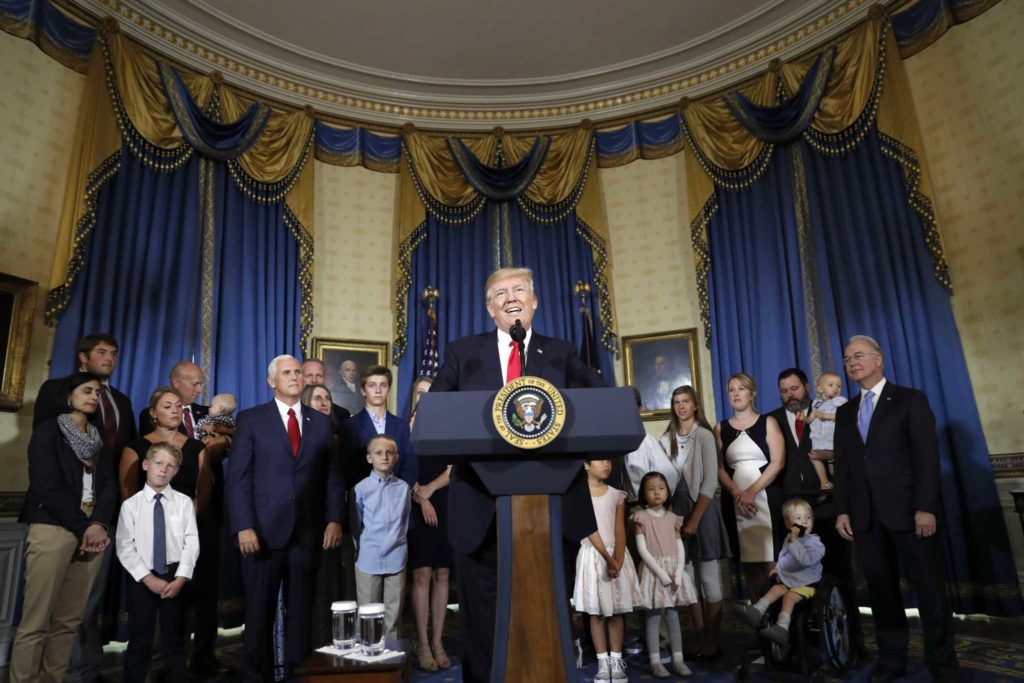
The Trump administration’s own actions are triggering double-digit premium increases on individual health insurance policies purchased by many consumers, a nonpartisan study has found. The analysis released Thursday by the Kaiser Family Foundation found that mixed signals from President Donald Trump have created uncertainty “far outside the norm,” leading insurers to seek higher premium increases for 2018 than would otherwise have been the case. The report comes with Republicans in Congress unable to deliver on their promise to repeal and replace the Obama-era Affordable Care Act. Trump, meanwhile, insists lawmakers try again. The president says “Obamacare” is collapsing, but he’s also threatened to give it a shove by stopping billions of dollars in payments to insurers. Some leading Republicans are considering fallback measures to stabilize markets. Researchers from the Kaiser Foundation looked at proposed premiums for a benchmark silver plan across major metropolitan areas in 20 states and Washington, D.C. Overall, they found that 15 of those cities will see increases of 10 percent or more next year. The highest: a 49 percent jump in Wilmington, Delaware. The only decline: a 5 percent reduction in Providence, Rhode Island. About 10 million people who buy policies through HealthCare.gov and state-run markets are potentially affected, as well as another 5 million to 7 million who purchase individual policies on their own. Consumers in the government-sponsored markets can dodge the hit with the help of tax credits that most of them qualify for to help pay premiums. But off-marketplace customers pay full freight, and they face a second consecutive year of steep increases. Many are self-employed business owners. The report also found that insurer participation in the ACA markets will be lower than at any time since “Obamacare” opened for business in 2014. The average: 4.6 insurers in the states studied, down from 5.7 insurers this year. In many cases, insurers do not sell plans in every community in a state. The researchers analyzed publicly available filings through which insurers justify their proposed premiums to state regulators. To be sure, insurers continue to struggle with sicker-than-expected customers and disappointing enrollment. And an ACA tax on the industry is expected to add 2 to 3 percentage points to premiums next year. But on top of that, the researchers found the mixed signals from the administration account for some of the higher charges. Those could increase before enrollment starts Nov. 1. “The vast majority of companies in states with detailed rate filings have included some language around the uncertainty, so it is likely that more companies will revise their premiums to reflect uncertainty in the absence of clear answers from Congress or the administration,” the report said. Once premiums are set, they’re generally in place for a whole year. Insurers who assumed that Trump will make good on his threat to stop billions in payments to subsidize co-pays and deductibles requested additional premium increases ranging from 2 percent to 23 percent, the report found. Insurers who assumed the IRS under Trump will not enforce unpopular fines on people who remain uninsured requested additional premium increases ranging from 1.2 percent to 20 percent. “In many cases that means insurers are adding double-digit premium increases on top of what they otherwise would have requested,” said Cynthia Cox, a co-author of the Kaiser report. “In many cases, what we are seeing is an additional increase due to the political uncertainty.” That doesn’t sound like what Trump promised when he assumed the presidency. In a Washington Post interview ahead of his inauguration, Trump said, “We’re going to have insurance for everybody.” “There was a philosophy in some circles that if you can’t pay for it, you don’t get it,” he added. “That’s not going to happen with us.” People covered under Obama’s law “can expect to have great health care,” Trump said at the time. “It will be in a much-simplified form. Much less expensive and much better.” But the White House never produced the health care proposal Trump promised. And the GOP bills in Congress would have left millions more uninsured, a sobering side-effect that contributed to their political undoing. The Trump administration sidestepped questions about its own role raised by the Kaiser study. Spokeswoman Alleigh Marre said rising premiums and dwindling choices predate Trump. “The Trump administration is committed to repealing and replacing Obamacare and will always be focused on putting patients, families and doctors, not Washington, in charge of health care,” Marre said in a statement. The ongoing political turmoil for people who buy individual health insurance stands in sharp contrast to relative calm and stability for the majority of Americans insured through workplace plans. The cost of employer-sponsored coverage is expected to rise around 5 or 6 percent next year, benefits consultants say. Republished with permission of The Associated Press.
Oil spill fines will pay for 300 new Gulf conservation jobs
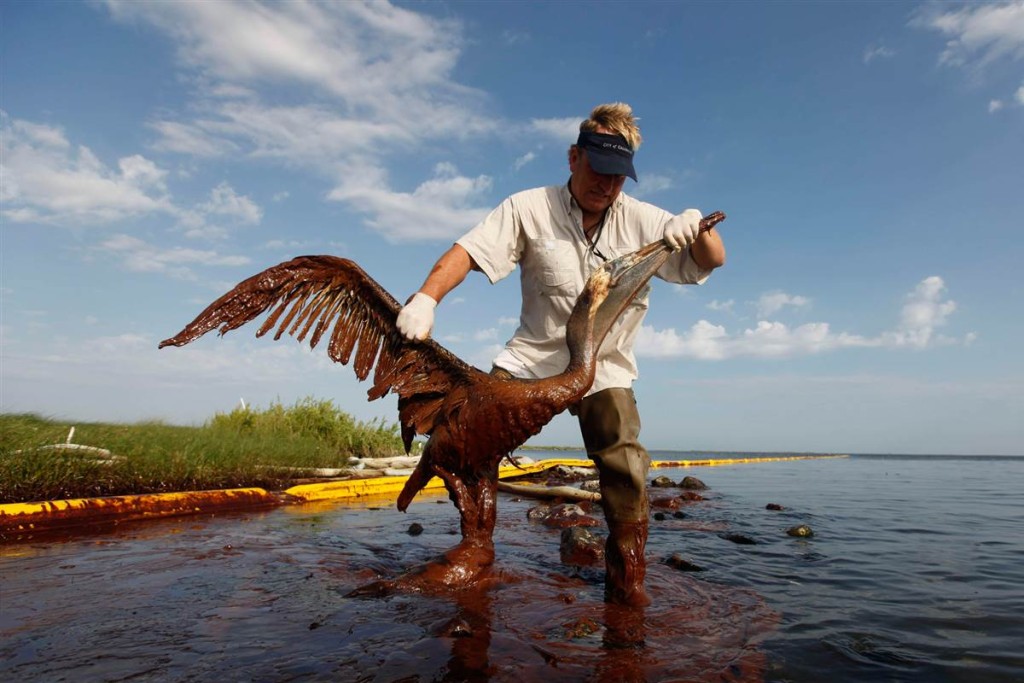
Three hundred new conservations jobs will open up in the next few years in states along the Gulf of Mexico, paid for by about $7 million in BP oil spill penalties. Employment will ramp up gradually, with 10 new jobs in each state next year, 20 more in 2019 and another 30 the following year, for a total of 60 new jobs in each of the five states by 2020, conservation official Jeff DeQuattro said Wednesday. “We’ll be recruiting in October, November, December, with boots on the ground in January,” said DeQuattro, The Nature Conservancy’s director of restoration and program director for the new GulfCorps. Meetings to discuss possible projects will begin Friday, DeQuattro said. Officials say GulfCorps workers will learn marketable restoration skills on projects that could include planting native vegetation, removing invasive species, repairing banks and shorelines and creating turtle or bird habitat on beaches. “We hope this can expand for 15 years as oil spill money is being spent,” DeQuattro said in an earlier interview. “We’re creating the infrastructure for this to last much longer than this three-year period.” The conservancy, The Corps Network and the Student Conservation Association are working together under a RESTORE Act grant administered by the National Oceanic and Atmospheric Administration. The RESTORE Act set up a trust fund for 80 percent of the water pollution penalties paid after July 2012 by companies involved in the 2010 oil spill. A well that BP PLC was drilling from the Deepwater Horizon rig blew in April 2010, killing 11 men. It took nearly three months to cap the well, which spewed an estimated 134 million gallons (507 million liters) of oil in the nation’s worst offshore oil spill. “This project will address critical environmental issues along the Gulf while employing young adults who live in communities directly impacted by the Deepwater Horizon oil spill,” Mark Burget, The Nature Conservancy’s executive vice president, said in a news release. DeQuattro said the program is designed to fill in gaps from bigger projects. “A lot of the oil spill projects are going to be done by large contracting firms with heavy equipment and machinery. There’s a need for these tactical teams to go in and do things these contractors can’t do with their equipment or don’t want to do,” he said. NOAA and RESTORE Council representatives from each state will work with GulfCorps to decide specific projects in Texas, Louisiana, Mississippi, Alabama and Florida, DeQuattro said. “I’m presenting some project ideas that are out there already, but they may have other suggestions,” he said. Republished with permission of The Associated Press.
