
Groups seek to halt Donald Trump transgender military policy change

Two LGBT-rights organizations asked a federal judge in Washington on Thursday to bar President Donald Trump from changing the government’s policy on military service by transgender people. The groups, backed by several former military leaders, filed a motion asking the judge to grant a preliminary injunction to keep Trump from reversing course on a 2016 policy change that allowed transgender individuals to serve openly. Trump slammed that change in a memo last Friday and announced he was directing a return to the former policy under which service members could be discharged for being transgender. Trump directed the Pentagon to extend indefinitely a ban on transgender individuals joining the military, and he gave Defense Secretary Jim Mattis six months to come up with a policy on “how to address” those who are currently serving, leaving the door open to permitting their continued service. Until Mattis has made that determination, “no action may be taken against” the currently serving transgender individuals. Trump also directed Mattis to halt the use of federal funds to pay for sexual reassignment surgeries and medications, except in cases where it is deemed necessary to protect the health of an individual who has already begun the transition. Lawsuits challenging the changes have been filed in courts in Washington, Seattle and Baltimore. The Washington lawsuit was filed earlier this month after Trump wrote on Twitter in July that the federal government “will not accept or allow” transgender individuals to serve “in any capacity” in the military, statements that preceded his memo last Friday. The groups behind the lawsuit, GLBTQ Legal Advocates & Defenders (GLAD) and the National Center for Lesbian Rights, say the memo’s changes would violate service members’ constitutional rights to equal protection and due process. As part of the preliminary injunction motion filed Thursday, former military leaders said in court papers that changing the open service policy would be harmful. The former officials – including former Navy Secretary Ray Mabus, former Air Force Secretary Deborah Lee James and former Army Secretary Eric Fanning – served during the Obama administration, which in June 2016 changed longstanding policy to allow troops to serve openly as transgender individuals. Republished with permission from the Associated Press.
Harvey shuts down major fuel pipeline supplying Alabama, East Coast

The Colonial Pipeline, which provides nearly 40 percent of the South’s gasoline, has shut down after Hurricane Harvey forced the closure of refineries and some of the pipeline’s own facilities. The company chose to shut down a one of its two lines, which supplies fuel to the Yellowhammer State among others, due to the storm’s effect on facilities west of Lake Charles, La. “Once Colonial is able to ensure that its facilities are safe to operate and refiners in Lake Charles and points east have the ability to move product to Colonial, our system will resume operations,” the company said in a news release. The news immediately sent gasoline prices across the country so a two-year high, Reuters reported Wednesday night. The average for a gallon of regular gasoline rose from roughly $2.35 a week ago to $2.45, AAA reported. The pipeline transports more than 3 million barrels of diesel, gasoline and jet fuel each day from the Houston area to the New York harbor and includes more than 5,500 miles of pipeline, most of which is underground. It last closed in September 2016 after a leak and gas spill in Helena, Ala. leading to days of empty gas station pumps and higher prices in Alabama, Georgia, Tennessee and across the Carolinas. The company said it estimates it will be able to return to full service Sunday,
ALEA offers Labor Day weekend safety tips

The Alabama Law Enforcement Agency (ALEA) will be out in force this Labor Day weekend, on the lookout for those breaking the law and putting others in danger, as Alabamians head outside for summer’s unofficial grand finale. The ALEA is anticipating a surge of late-summer travel over the long weekend with heavier-than-usual traffic on Alabama’s roadways and waterways. “Safety is one of our top priorities throughout the year, but it’s especially important during extended holiday weekends, when so many want to enjoy one last seasonal road trip to the lake, beach or other warm-weather attraction,” Alabama’s Secretary of Law Enforcement Hal Taylor said in a statement. During Labor Day weekend, which runs from 12:01 a.m. Friday, Sept. 1, to midnight Monday, Sept. 4, Troopers in ALEA’s Highway Patrol and Marine Patrol Divisions will step up patrol and enforcement efforts across the state to promote safety and work to prevent crashes, injuries and deaths. Troopers will conduct sobriety checks throughout the weekend, in an effort to remove impaired individuals from behind the wheels of vehicles and boats, as part of the state’s participation in the national “Drive Sober or Get Pulled Over” safety campaign. Taylor has offered five tips he’s dubbed, “Five to Stay Alive,” for all traveling through Alabama this Labor Day weekend: Avoid driving and/or boating under the influence of alcohol or drugs. If you are impaired, do not drive or operate a boat. Designate a sober driver in advance, call a cab, use public transportation or call a sober friend or family member to get you home safely. Simply obey the law. Avoid speeding, following too closely and other dangerous – sometimes deadly – behavior on Alabama’s roadways and waterways. Buckle up – no matter how short your trip. Ensure all of the vehicle’s occupants are buckled up (or using a child restraint system) and those on your boat are using or have access to personal flotation device (PFDs are required at all times for ages 8 and younger.) Avoid the water during inclement weather, particularly when it includes thunder and lightning. Be even more cautious when traveling through construction zones.
Push to simplify taxes is on but don’t touch some deductions

President Donald Trump and congressional Republicans have pledged to overhaul the nation’s complex tax code. To slash taxes, they say they’ll curb a web of expensive deductions and credits to allow more revenue to flow to the government. Problem is, they’re likely to run into a wall of resistance from people and groups drawn together by a singular warning: Don’t touch my deduction. Major cherished tax breaks – from deductions for mortgage interest and charitable donations to incentives for 401(k) contributions – have deep-pocketed supporters and lobbyists who are sure to fight to preserve those benefits. They add up to hundreds of billions of dollars in lost potential revenue that could otherwise go to rebuilding roads and bridges or social programs or even to help finance broader tax cuts for people and companies. “On every single item, there’s a group out there ready to battle,” says Thomas Cooke, a professor and tax expert at Georgetown University. This makes the outlook thorny for a tax rewrite effort this fall, a Trump priority that Republicans consider a political imperative looking ahead to next year’s midterm elections. The collapse of GOP health care legislation raises the stakes for taxes, with Trump’s team talking about action by year’s end. The president and the GOP agree on the broad goals: Simplifying the tax code, lowering the rate for corporations from the current 15-35 percent range, and bringing relief for the middle class. But details have to be filled in. “First, we need a tax code that is simple, fair and easy to understand,” Trump said Wednesday at a rally in Missouri. “That means getting rid of the loopholes and complexity that primarily benefit the wealthiest Americans and special interests.” Among the seemingly unassailable benefits, the most cherished may well be the deduction of interest paid on mortgages. Touted as a pillar in the promotion of homeownership, the benefit cost the government an estimated $77 billion in the budget year that ended last Sept. 30, according to Congress’ Joint Committee on Taxation. The benefit allows homeowners to deduct up to $1 million in interest payments on a primary (and a secondary) residence. It is fiercely defended by the National Association of Realtors, which spent $64.8 million on lobbying on various issues last year including the mortgage deduction, according to the Center for Responsive Politics. Roughly 28 million Americans deduct mortgage interest from their income taxes, with the biggest concentrations in the high housing-cost states of California, New York, New Jersey, Virginia and Maryland, according to the Tax Policy Center, a joint venture of the Urban Institute and the Brookings Institution. House Republicans say they’ve got a more efficient way to encourage home buying. Under their plan, the standard deduction would be increased from the current $12,600 for married couples filing jointly, for example, to $24,000. They argue that a majority of homeowners would no longer choose to itemize deductions and claim the mortgage-interest benefit. They’d be better off using the bigger standard deduction. Another possibility is halving the mortgage deduction to $500,000. That would surely set up a pitched battle. Other highly popular benefits: -Employees’ earnings from defined-contribution retirement plans such as 401(k)s aren’t taxed until retirement; pay-ins by both employers and employees also receive tax-preferred status. That cost $82.7 billion in the most recent budget year. Among the ideas circulating among some Republicans is reversing that by taxing investment earnings upfront, not upon retirement; or reducing the limits on pre-tax contributions. With about 55 million U.S. workers holding some $5 trillion in their 401(k) accounts, the plans have become a touchstone of retirement security for the middle class. A coalition of groups representing employers, consumers and the financial industry recently expressed concern to the powerful chairman of the Senate Finance Committee. With lawmakers looking for revenue sources to offset prospective tax cuts, “Any changes to the retirement system made solely for short-term budgetary gains, and not for policy reasons, could hurt Americans’ long-term retirement security,” the Save Our Savings coalition said in a letter to Sen. Orrin Hatch, R-Utah. -Deductions for donations to charitable, religious and other nonprofit organizations. Estimated cost: $41.5 billion. Americans are generous, House Republicans note, and charitable giving should be encouraged with a tax incentive. But only 25 percent of taxpayers benefit from the deduction because the rest don’t itemize. The solution is to make the charitable deduction more efficient by simplifying taxpayers’ compliance and record-keeping, the Republican plan says. Under the plan, all itemized deductions would be eliminated except for two: mortgage interest and charitable donations. -Tax-free employer-paid health insurance premiums and other medical expenses, including long-term care insurance, clocking in at $143.8 billion. Employees aren’t taxed on the benefits, while employers can deduct them as a business expense. -Tax credit for children under age 17, $55 billion. An individual can claim a $1,000 credit for each qualifying child. The credit starts phasing out for single filers earning over $75,000 a year and for joint filers earning over $110,000. Some lawmakers have proposed increasing the credit to $2,500, by combining the exemption for dependents and the child care credit. Organizations including the Child Poverty Action Group and the National Association for the Education of Young Children have stressed the importance of using tax policy to help children and families. They express concern that such benefits for children could get caught up in the Republicans’ drive to eliminate “special interest” loopholes in the tax overhaul. Rep. Kevin Brady, the Texas Republican who heads the tax-writing Ways and Means Committee, acknowledged in a recent speech, “The fight will get tough.” Republished with permission from the Associated Press.
Bradley Byrne to host Secretary of Education Betsy DeVos in Mobile
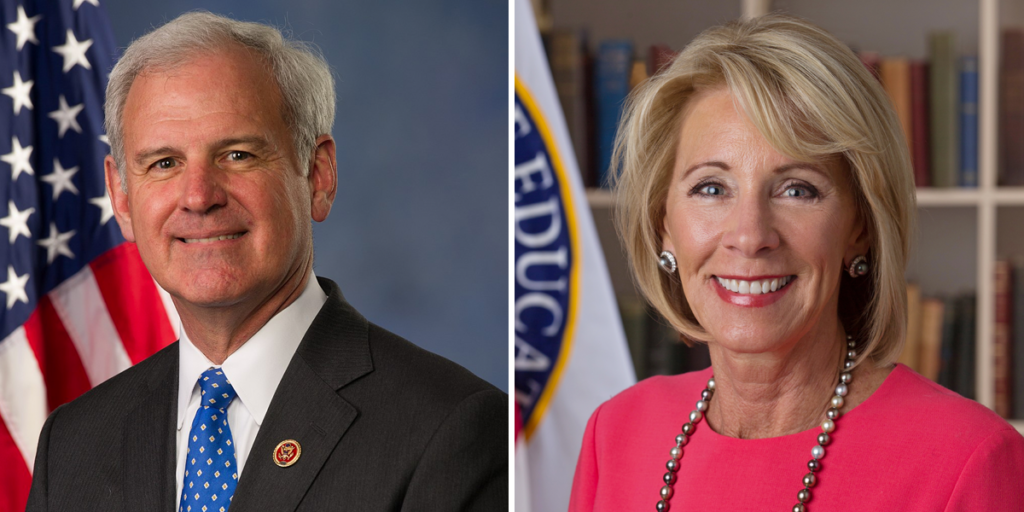
U.S. Secretary of Education Betsy DeVos is making a visit to Mobile, Ala. to visit educational institutions in the area, according to the office of Alabama 1st District U.S. Rep. Bradley Byrne. Byrne announced DeVos will spent a large part of Thursday, August 31, learning more about the range of education opportunities in Southwest Alabama. During her time in Mobile, DeVos will visit ACCEL Day and Evening Academy, Alabama’s first tuition-free public charter school; the AIDT Maritime Training Center, which helps train workers for Austal USA and other shipbuilding jobs; and Council Traditional School, a kindergarten through 5th grade school in the Mobile County School System. DeVos’ Mobile itinerary is as follows: ACCEL Day and Evening Academy: 9:30 a.m. CT Tour of AIDT Maritime Training Center: 11:00 a.m. CT Council Traditional School: 1:15 p.m. CT
A torn Donald Trump still weighing fate of young immigrants

With a deadline looming, President Donald Trump remains torn over the fate of hundreds of thousands of young immigrants who were brought into the country illegally as children — a decision that will draw fury no matter what he decides. Trump railed against the Deferred Action for Childhood Arrivals program during his campaign, slamming it as illegal “amnesty.” But he changed his tune after the election, calling DACA one of the most difficult issues he’s grappled with. The program has given nearly 800,000 people a reprieve from deportations. It has also provided the ability to work legally in the U.S. in the form of two-year, renewable work permits — permits the Trump administration has continued to grant as the president has mulled the issue. On Wednesday, White House press secretary Sarah Huckabee Sanders said DACA was still the subject of “a very lengthy review” process. “It’s something that’s still being discussed and a final decision hasn’t been made,” she said. Activists on both sides of the issue — as well as some people close to the White House — strongly expect the president to announce as soon as this week that he will move to dismantle the program, perhaps by halting new applications and renewals. But others caution that Trump remains torn as he faces a September 5 deadline set by a group of Republican state lawmakers, who are threatening to challenge DACA in court if the administration does not start to dismantle it by then. To buy more time, administration officials have considered asking the lawmakers to push back their deadline by several months, according to two people familiar with the discussions. The people, who spoke on condition of anonymity because they were not authorized to publicly discuss the matter, said such a delay was seen as a chance to avoid forcing a contentious immigration showdown in Congress at the same time lawmakers are trying to pass a budget deal, raise the debt ceiling and provide relief for states devastated by Harvey. Texas Attorney General Ken Paxton, leading the group threatening to sue, is likely to be consumed by storm recovery efforts in coming months, providing possible cover for the delay. Trump could also simply ignore the deadline, leaving the matter up to Congress and the courts. Trump’s administration has been split, as usual, between immigration hard-liners such as senior policy adviser Stephen Miller and Attorney General Jeff Sessions, who argues DACA is unconstitutional, and more moderate individuals such as the president’s son-in-law Jared Kushner and daughter Ivanka, who want to protect the so-called “dreamers,” according to people close to the administration. Trump’s former chief strategist, Steve Bannon, also urged him to make good on his campaign promise to eliminate the program. “The White House is deeply split,” said former House Speaker Newt Gingrich, an informal Trump adviser. He said targeting DACA would be a dire mistake for the president, earning the ire of nearly 800,000 people, along with their friends and families. “To me, it would be utterly irrational to pick a fight over the dreamers,” Gingrich said, adding that ending the program would further hamper the president and isolate his administration. Gingrich said senior Trump aides who believe DACA is unconstitutional were using the lawsuit threat as an “excuse” to push Trump to act. Instead, he said, the president would be wise to let the deadline pass, and call on Congress to approve legislation protecting those covered by the program. Meanwhile, activists supporting DACA have been mounting a furious lobbying effort, operating phone banks, meeting with lawmakers, sending letters and staging protests to draw attention to the fate of what are undoubtedly the most sympathetic immigrants living in the country illegally. Many came to the U.S. as young children and have no memories of or connection to the countries they were born in. Trump had been unusually candid about his struggles with the issue. During a February press conference, Trump said the topic was “a very, very difficult subject for me, I will tell you. To me, it’s one of the most difficult subjects I have.” “You have some absolutely incredible kids — I would say mostly,” he said, adding, “We’re going to show great heart.” The decision comes at a fraught time for the president, who finds himself increasingly under fire, with his poll numbers hanging at near-record lows. In the wake of his much-criticized response to the violence in Charlottesville, Virginia, and continued questions about his campaign’s ties to Russia, Trump is increasingly isolated and concerned about maintaining the loyalty of his core supporters. “His campaign promise was solid. It was that he was going to end DACA. He didn’t say he was going to phase it out. He said he would end it,” said Rep. Steve King of Iowa, a vocal opponent of the program. King said he expected Trump to make good on his promise, and he rejected another possible solution: using DACA as a bargaining chip to win funding for Trump’s southern border wall or other immigration legislation. “It would be immoral to trade away our Constitution,” he said. But Mario H. Lopez, president of the conservative Hispanic Leadership Fund, which disagreed with the way the Obama administration implemented the policy, said there were no upsides to punishing people who were brought to the country through no fault of their own. “Punishing kids for what their parents did is just a bad idea,” he said. “It’s bad politics, it’s bad policy. It’s just bad all around.” If permit renewals are put on hold, more than 1,400 recipients will lose their ability to work each day, according to a report by the Center for American Progress and FWD.us, two advocacy groups. The Obama administration created the DACA program in 2012 as a stopgap way to protect some young immigrants from deportation as it continued to push for a broader immigration overhaul in Congress. Republished with permission from the Associated Press.
