
Martha Roby: Strengthening protections for brave whistleblowers

The House recently passed S. 585, the Dr. Chris Kirkpatrick Whistleblower Protection Act, and sent it to the President’s desk for his signature. This legislation will strengthen penalties for those who retaliate against federal employee whistleblowers, add protections and opportunities for whistleblowers placed on probation, and ensure that all federal employees have a greater knowledge of whistleblower rights and protections. I strongly supported this bill and took the opportunity to speak on the House floor urging my colleagues to pass it. I shared my experience working with whistleblowers inside the Central Alabama Veterans Health Care System (CAVHCS) to demonstrate why we need better protections for those who shine a light on wrongdoing and stronger penalties for those would retaliate against them. This month marks three years since the Director of the Central Alabama VA became the first senior manager in the country fired as a result of the waitlist scandal. As you know, this was a major step toward turning around one of the nation’s worst VA systems and restoring trust with the veterans it is supposed to serve. Progress has been made, but we still have a lot of work to do to improve service at CAVHCS. However, none of the progress that we have made would have been possible without the brave whistleblowers inside the VA who told me the truth about what was going on inside those walls. Two brave individuals in particular, Sheila Meuse and Rich Tremaine, told me the truth about major instances of misconduct and mismanagement when nobody else would. Seeing no other way to achieve change, they shared their story with The Montgomery Advertiser at great personal risk to their careers. The stories are well known: the missing X-Rays, the manipulated pulmonology records, the crack house incident – the list goes on. The instances of mismanagement, negligence, and even criminal activity were shocking, and their exposure led to a major shakeup inside the VA. Four CAVHCS senior managers were removed and the entire chain of command from Montgomery to Atlanta to Washington, D.C. was replaced. Without the brave whistleblowers, we would have probably never known, and I doubt anything would have changed. To me and to the veterans who’s lives they probably saved, these whistleblowers are heroes, but that’s not how they were treated by VA officials. They were treated as enemies and outcasts and faced severe retaliation because they did the right thing. Rich Tremaine actually testified before the House Committee on Veterans Affairs and detailed the systemic way some VA officials attempted to silence and marginalize him. The effects of his blowing the whistle on wrongdoing follow him to this very day even though he is far away from Montgomery, Alabama. You see, my experience working to clean house at our Central Alabama VA taught me a frustrating truth about the culture in some parts of the VA. The system routinely goes out of its way to protect those who don’t do their jobs and even harm veterans, but then it goes after those who try to stop that misbehavior. For years because of poorly written civil service laws and powerful unions, too many VA employees got the message that misconduct, negligence, and poor performance would be tolerated, but blowing the whistle on that kind of behavior would not be. All too frequently VA employees who are caught doing the wrong thing are “reprimanded,” shuffled around to different jobs, or allowed to quietly retire, while those who try to do right by veterans by shining a light on misconduct are persecuted, intimidated, or worse. There’s a reason federal employees face retaliation for speaking up. It’s not because people are naturally mean or because there’s some type of misunderstanding. The reason whistleblowers face systemic retaliation is because it works. When a brave whistleblower faces intimidation and persecution for their actions the other employees see it and they know what will happen to them if they come forward and tell the truth. This practice has a powerful effect, and we saw it firsthand in Montgomery. That is so wrong, and its time to put a stop to it by punishing those who do it with harsher penalties. We need to rethink our civil service laws in this country to make sure public servants live up to the honor and responsibility of the public trust. I am confident that the legislation we recently passed is another step in the right direction, and I will continue to fight for needed improvements to the VA that our nation’s veterans deserve. ••• Martha Roby represents Alabama’s Second Congressional District. She lives in Montgomery, Alabama with her husband Riley and their two children.
Mo Brooks named founding member of newly formed House NASA Caucus

28 members of Congress, including Alabama 5th District U.S. Rep. Mo Brooks, have formed a new bipartisan, congressional caucus. The House National Aeronautics and Space Administration (NASA) Caucus is dedicated to bringing attention to space agency’s economic and national security importance and serve as a forum to educate policymakers on current NASA initiatives. “It is an honor to serve as the Congressman representing the Tennessee Valley, home to Alabama’s Marshall Space Flight Center – one of NASA’s largest field installations with nearly 6,000 civil service and contract employees,” said Brooks, who serves as Vice-Chair of the Space Subcommittee on the House Science, Space, and Technology Committee. “Without the contributions of the dedicated engineers, scientists, and other talented professionals we would be unable to inspire the next generation with the dream of continued space exploration.” The announcement of the caucus, led by California-Republican Rep. Steve Knight and Ohio-Democrat Rep. Marcy Kaptur, was made Wednesday on the anniversary of the launch of Pioneer I in 1958, NASA’s first spacecraft. “I am excited to report that there is a renewed commitment to space exploration on Capitol Hill and you can feel the excitement. The recently launched NASA Caucus will help bring to the forefront NASA’s most important endeavors, and I look forward to working with my colleagues to further America’s global leadership in space,” added Brooks. Brooks joins 27 colleagues and founding members of the caucus: Steve Knight (CA), Marcy Kaptur (OH), Brian Babin (TX), André Carson (IN), Kathy Castor (FL), Jim Costa (CA), Barbara Comstock (VA), Charlie Crist (FL), Debbie Dingell (MI), Anna Eshoo (CA), Al Hastings (FL), Bill Johnson (OH), David Joyce (OH), Ro Khanna (CA), Blaine Luetkemeyer (MO), Zoe Lofgren (CA), Ralph Norman (SC), Pete Olson (TX), Steven Palazzo (MS), Ed Perlmutter (CO), Bill Posey (FL), Jamie Raskin (MD), Dana Rohrabacher (CA), Linda T. Sánchez (CA), Scott Taylor (VA), Debbie Wasserman Schultz (FL), Randy Weber (TX). An official launch event to celebrate the establishment of the caucus will take place in December.
Social Security recipients will see 2 percent boost in 2018

Millions of Social Security recipients and other retirees will get a 2 percent increase in benefits next year, the largest increase since 2012, thought it comes to only $25 a month for the average beneficiary. The cost-of-living adjustment, or COLA, affects benefits for more than 70 million U.S. residents, including Social Security recipients, disabled veterans and federal retirees. That’s about one in five Americans. The Social Security Administration announced the COLA Friday. By law, the COLA is based on a broad measure of consumer prices generated by the Bureau of Labor Statistics. Advocates for seniors claim the inflation index doesn’t accurately capture rising prices faced by seniors, especially for health care. “It doesn’t make your life any easier. It’s really made it tight,” said Barbara Bogart, who retired from a home health care company. “You have to be so careful to make it each month.” Bogart, 75, who lives near Indianapolis, said she gets less than $1,000 a month from Social Security, her only source of income. “I have all the normal costs that people have. I have groceries, gas for my car,” she said. “I have to be cautious.” Some conservatives argue that the inflation index is too generous because when prices go up, people change their buying habits and buy cheaper alternatives. Consumer prices went up only slightly in the past year despite a recent spike in gasoline prices after a series of hurricanes slowed oil production in the Gulf Coast, said Max Gulker, senior research fellow at the American Institute for Economic Research. “For the most part, there was a decline in energy prices for a lot of the year,” Gulker said. “But at the end of the year we saw that uptick in gas from the hurricanes.” The average monthly Social Security payment is $1,258, or about $15,000 a year. Congress enacted automatic annual increases for Social Security in 1975. Presidents often get blamed when increases are small or zero. But President Donald Trump has no power to boost the increase, unless he persuades Congress to change the law. In 2009, President Barack Obama persuaded Congress to approve one-time payments of $250 to Social Security recipients as part an economic stimulus package. Over the past eight years, the annual COLA has averaged just above 1 percent. In the previous decade, it averaged 3 percent. Multiple years of small or no COLA reduces the income of retirees for the rest of their lives, said Mary Johnson of The Senior Citizens League. “Think about the length of a retirement period. Eight years is about a third of a (healthy) retirement,” Johnson said. “It’s squeezing them. It’s causing them to dip into savings more quickly. The lifetime income that they were counting on just isn’t there.” The COLA is based on the Consumer Price Index for Urban Wage Earners and Clerical Workers, or CPI-W, a broad measure of consumer prices. It measures price changes for food, housing, clothing, transportation, energy, medical care, recreation and education. The cost of medical care has gone up by 1.5 percent over the past year, according to the September report released Friday. Housing prices are up by 2.8 percent while the cost of food and beverage has gone up by 1.2 percent. Gasoline prices are up 10 percent from a year ago, according to AAA, though they have dropped in the past month. The COLA is calculated using the average CPI-W for July, August and September, and comparing it to the same three months from the previous year. Social Security is financed by a 12.4 percent tax on wages, with half paid by workers and the other half paid by employers. Next year, the maximum amount of earnings subject to the Social Security tax will increase from $127,200 to $128,700. About 175 million workers pay Social Security taxes. Of those, about 12 million workers will pay more in taxes because of the increase in taxable wages, according to the Social Security Administration. Republished with permission from the Associated Press.
Betsy DeVos touts school choice, STEM as education priorities
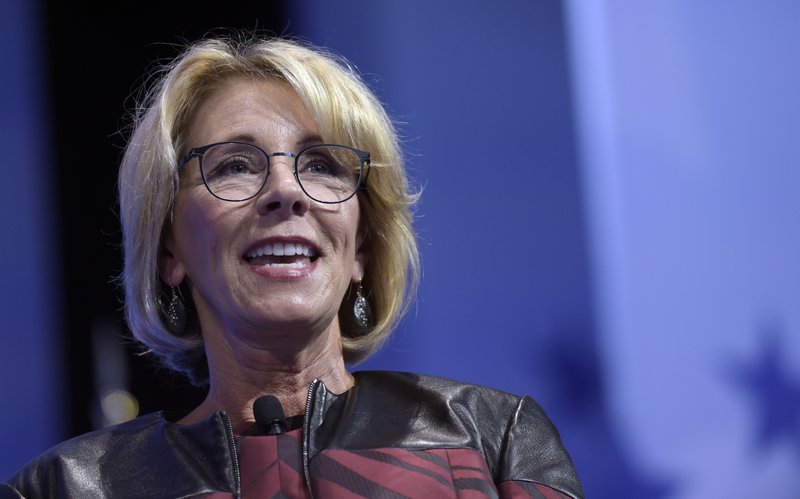
Education Secretary Betsy DeVos has put forth a new set of priorities for states, schools and universities competing for federal grant money. The priorities include school choice, science and technology, special education and school safety. The Education Department awards approximately $4 billion per year in new and continuation competitive grants across some 80 programs, the agency said Thursday. Education secretaries have historically used these competitions to push their priorities. “It’s a little nudge,” said Chad Aldeman, an associate partner at Bellwether Education Partners. “This allows the department to nudge the education field toward these priorities.” There are a total of 11 priorities on DeVos’ list. After receiving public comments on these proposals, the agency will settle on one or several of them. Promoting school choice has been a key focus of the Trump administration. School choice refers to providing parents and their children with options besides their district public school, such as charter schools, vouchers or education savings accounts to attend private schools. DeVos and her supporters say these options better serve students’ individual needs and can benefit children whose local schools are underperforming. Critics say charter and private schools don’t necessarily outperform neighborhood schools and they lack accountability mechanisms. Sen. Patty Murray of Washington, the top Democrat on the Senate committee devoted to education, criticized DeVos’ priorities as a way to privatize education and said the department should be focusing on supporting local, public education. “Since her confirmation hearing, I have voiced concern that Secretary DeVos would abuse her position to prioritize privatization, and that’s exactly what we’re seeing,” Murray said. “Instead of listening to the millions of students, parents and teachers who stood up against her extreme ideological agenda, her proposal will allow her to prioritize applicants that would siphon taxpayer funds away from the public schools that serve the vast majority of students.” Republished with permission from the Associated Press.
Joe Biden: New campus sex assault guidelines not an improvement
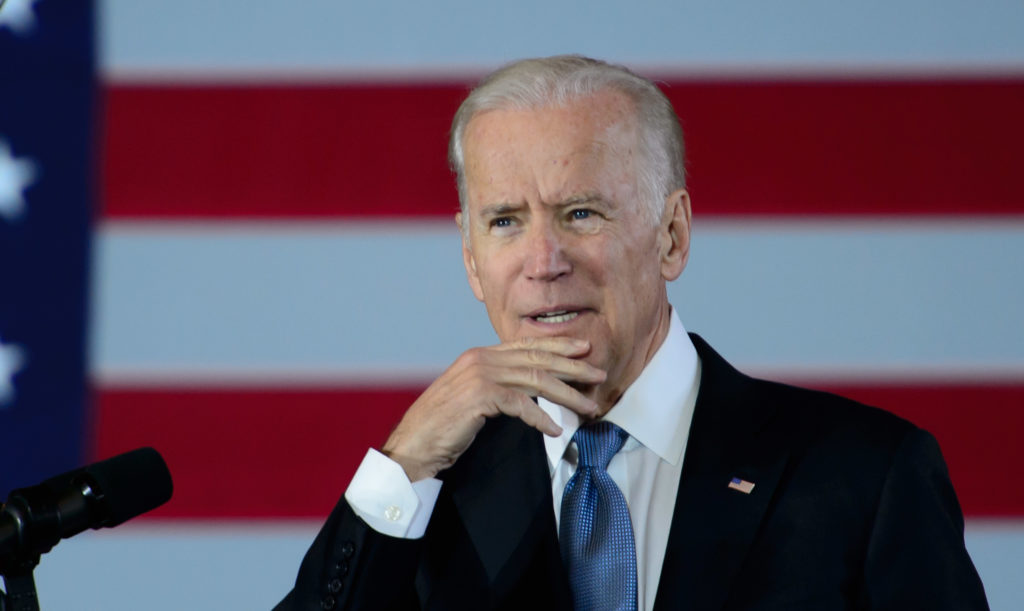
Former Vice President Joe Biden, speaking to students at Rutgers University on Thursday, defended college sexual assault guidelines he helped champion that recently were relaxed by the Trump administration. During a 45-minute speech to about 2,000 students on combating sexual violence, Biden also took shots at disgraced film executive Harvey Weinstein over recent sexual assault revelations and at President Donald Trump. Last month, the Trump administration replaced Obama-era guidance on investigating campus sexual assault that allows universities to require higher standards of evidence. The original guidance, released in 2011 and updated in 2014, instructed universities to use a “preponderance of the evidence” standard when assessing and investigating a claim of sexual assault. Education Secretary Betsy DeVos‘ new interim guidelines let colleges choose between that standard and a “clear and convincing evidence” standard, which is harder to meet. Biden, a Democrat who was behind domestic violence legislation as a senator in the 1990s, said DeVos considers the old guidelines “unfair to men.” He said she and others are trying to confuse the issue. “It’s a civil proceeding,” he said. “To say ‘You were engaged in this behavior and the preponderance of evidence demonstrates it, and that’s why you are being penalized in the following way.’ They make it sound like what it’s not – putting the violator in jail. Don’t let them confuse you.” Biden called Weinstein’s conduct “disgusting” and “immoral” and said, “It is my hope there are more consequences, that the statute hasn’t run out. This man deserves more than to lose his company.” Rutgers said this week it won’t return a $100,000 donation from Weinstein that’s being used to help fund the Gloria Steinem Chair in Media, Culture, and Feminist Studies. After several students recalled their own personal experiences of sexual assault, Biden praised Rutgers for its efforts in support of victims of sexual assault and dating violence. On Trump, Biden said, “I know our president talks about locker room talk,” referring to the Republican president’s explanation for derogatory comments he made about women during last year’s campaign. “They didn’t talk that way in my locker room,” Biden said and noted, “usually the guy who starts that conversation is the ugliest SOB in the room.” Biden, who had campaigned for the Democrat running for governor in New Jersey before the speech, spent nearly an hour shaking hands and taking selfies with students, who greeted him with thunderous cheers when he first took the stage. Republished with permission from the Associated Press.
Paul Ryan blasts states that send billions to federal government
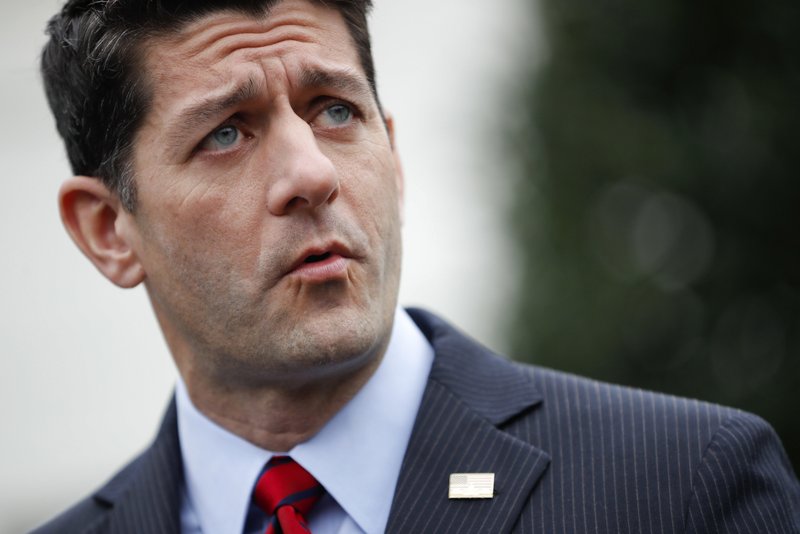
The top House Republican on Thursday blasted high-tax states that deliver billions to the federal government as he faced a backlash from rank-and-file GOP lawmakers over a sweeping tax-cut proposal. But beyond the tough rhetoric from Speaker Paul Ryan, disgruntled lawmakers met privately with Republican leaders and reached for possible compromises to break the impasse. The GOP lawmakers from high-tax states oppose the plan’s proposal to repeal the popular federal deduction for state and local taxes. It’s used in large numbers by residents of their states. With Republicans splintered, the future of the $6 trillion tax overhaul plan is threatened by the GOP defections. The success of the package is a political imperative for Republicans who have pinned their hopes on a big legislative achievement to help them retain control of Congress in next year’s elections. It’s also President Donald Trump’s highest legislative priority to fulfill his promise of boosting economic growth. Ryan went on the offensive against high-tax states like California, New York and New Jersey even though the GOP lawmakers from those states need to be brought on board to support the tax overhaul plan. But Ryan contended the rest of the country is “propping up profligate, big-government states” that levy high taxes on their residents and spend recklessly. “States that got their act together are paying for states that didn’t,” the Wisconsin lawmaker said at an appearance at the conservative Heritage Foundation. In fact, California, New York and New Jersey send many billions more in taxes to Washington than they get back in federal spending, new data show. Divided by total state residents, New York gets back 81 cents for every $1 it pays in, New Jersey receives 74 cents and California 96 cents, according to an analysis released last month by the Rockefeller Institute of Government. New York contributed $48 billion more in taxes to the federal government than it received in government spending – the biggest deficit the analysis found. New Jersey gave $31 billion more in taxes than it got back and California $17 billion more, the data show. The figures were for the budget year ending Sept. 30, 2015. The state-local deduction is claimed by around 44 million people and costs the government an estimated $1.3 trillion in lost revenue over 10 years. “There’s a number of proposals on the table,” said Rep. Tom MacArthur, R-N.J., emerging from the meeting of his colleagues from high-tax states with GOP leaders, including House Majority Whip Steve Scalise, R-La., and Rep. Kevin Brady, R-Texas, head of the tax-writing Ways and Means Committee. “There’s more than one way to skin this cat,” MacArthur said, but added, “It has to be soon.” MacArthur and others who attended wouldn’t specify what compromises were being considered short of complete repeal of the deduction. One possibility they were asked about would cap the deduction at a single taxpayer’s annual income of $400,000 ($800,000 for a married couple). That would affect just the top 1 percent of taxpayers, according to Amir El-Sibaie, an analyst at the business-friendly Tax Foundation. It could bring in $481 billion in revenue over 10 years, compared with an estimated $1.8 trillion if the deduction were fully repealed, El-Sibaie calculates. At the White House, Trump’s position on ending the deduction appeared hardened. His chief economic adviser, Gary Cohn, discounted a news report Thursday that the president had expressed concerns over the proposed repeal. Asked whether Trump was rethinking the move, Cohn said no. Opposition to ending the deduction has produced an unusual alliance of the Republican lawmakers from high-tax, Democratic-leaning states; state and local government officials; public employee labor unions; and business groups like Realtors. Wary of the financial pinch their constituents and members could sustain from losing the deduction, they are pressing the Trump administration to reconsider. Some opponents contend that repealing the deductions would subject people to being taxed twice and would amount to a federal revenue grab on the backs of homeowners who pay property taxes. And governors like New York Democrat Andrew Cuomo, a potential 2020 presidential candidate, have rallied against the change. “There will be a transfer of wealth of over a trillion dollars to the federal coffers,” said Matt Chase, executive director of the National Association of Counties. Randi Weingarten, president of the American Federation of Teachers, said eliminating the deduction would not only “devastate funding for public schools, infrastructure, law enforcement and other vital services” but also boost taxes on the middle class. “For what? Tax cuts for the wealthy.” The White House has argued that the plan is focused on helping middle-class workers, contending that lowering corporate rates will boost jobs while the tax cuts and simpler tax code will reduce their burden. Republished with permission from the Associated Press.
Daniel Sutter: Protectionism for college sports?

College sports provide great opportunities for young people to play at a high level, make life-long friends and memories, and pay for their education. Student-athletes learn important life and business lessons about things like team work and time management. But who should get these opportunities, American or international students? I have observed a seemingly large proportion of international student-athletes in my classes in several sports over the years. To see if my perception was accurate, I examined the current rosters of Southeastern and Sun Belt conferences men’s and women’s tennis and golf teams. Four Alabama universities play in these conferences, including Troy in the Sun Belt. Tennis and golf, unlike football or softball, are played in many countries and should feature a large supply of skilled international recruits. In the SEC international students make up 43 percent of the tennis teams and about a quarter of the golf teams. The Sun Belt is even more international, at 39 percent for golf and 79 percent for tennis. Sun Belt rosters in these four sports include over 170 international student-athletes. What should we make of this? First, international students attending American universities and receiving athletic scholarships are totally separate questions. International students contribute enormously to our university communities, and I have had the opportunity to teach many excellent international students. Classmates from across the globe enrich American students’ experience by keeping academic standards high and bringing a diversity of cultures to campus. The international students benefit enormously as well, both from the education received and the experience. International exchanges are undoubtedly a win-win proposition for America’s universities. Furthermore, there are very good reasons for college sports to include the best student-athletes, beginning with competition. Sports are generally very meritorious, and many athletes would likely agree that the best players deserve scholarships. Additionally, young Americans wishing to pursue professional careers eventually must compete against the world’s best, and so might as well do so in college International recruiting elevates the quality of play and affords teams a competitive advantage, which fans often demand. The college I attended recruited hockey players from Canada, including several future NHL stars who helped win a national title. I happily celebrated the championship. Golf and tennis, however, are “non-revenue” sports, with few fans. Universities fund non-revenue sports and their scholarships using other athletics revenues or student fees. Because public universities use tuition and ultimately tax dollars, one can argue that athletic scholarships, at least in non-revenue sports, should help young Americans go to college. Additionally, public policy has specifically encouraged women’s sports through Title IX of the Education Amendments Act of 1972. Noting how polls show that Americans’ overwhelmingly support Title IX, the Women’s Sports Foundation claims that “The American public believes that sports participation is as important for our daughters as it is for our sons.” I totally agree with this sentiment, but it seemingly implies that American women should get to play. Signing more skilled international student-athletes helps teams enjoy success. This success benefits coaches and athletic directors. We should expect coaches to recruit the best student-athletes allowed by rule. Consequently, reserving more scholarships for Americans may require an NCAA rule, but it would hardly be without precedent in sports. The Canadian Football League, for example, limits the number of American players allowed. And a limit need not exclude international student-athletes totally. Normally preventing willing, qualified foreign workers from filling jobs increases costs and hurts our economy. And yet the economic consequences for non-revenue college sports are quite minor, as the cost would be basically unchanged. The absolute level of play may be somewhat lower, but conference and national champions will still be crowned every year. Our public universities use tuition and ultimately tax dollars to fund college sports competitions with little fan interest. The educational value of sports generally may make this worthwhile, and Federal policy specifically encourages women’s sports. Our universities definitely should continue to welcome international students, but we should also think about for whom we are staging college athletics. ••• Daniel Sutter is the Charles G. Koch Professor of Economics with the Manuel H. Johnson Center for Political Economy at Troy University and host of Econversations on TrojanVision. The opinions expressed in this column are the author’s and do not necessarily reflect the views of Troy University.
