
Martha Roby: Addiction is more than just statistics

Did you know that more than 64,000 Americans died of a drug overdose last year? The majority of those were heroin or opioid overdoses. Our country is in the midst of a heroin and opioid epidemic, with 91 Americans dying every day from an overdose. The problem is particularly acute in Alabama, where opioid drugs are prescribed at a higher ratio than any other state in the nation. Alabama averages an alarming 1.2 opioid prescriptions per person, according to the Centers for Disease Control. Opioids are derived from the opium poppy and are commonly used in strong pain relief medications such as morphine, codeine, hydrocodone, and oxycodone. Doctors often prescribe these powerful pain relief drugs to patients recovering from surgery or suffering from chronic pain. These drugs have a high potential for abuse and addiction, especially when improperly prescribed or taken. Too often patients who have become addicted turn to heroin when they are no longer able to access or afford the prescription pain killers. Anyone who has ever struggled with addiction or known a loved one who has understands that this issue is much more personal than just statistics. No one makes a conscious decision to become addicted to pills or heroin. It happens gradually and can affect almost anyone. While patients suffering from extreme pain need access to strong medication, we need better tools to prevent addiction, help people get treatment, and stop drug traffickers who push and profit from abuse. I’m pleased to report that President Donald Trump has declared the opioid crisis in the United States to be a national health emergency. This important designation will redirect federal resources to most effectively fight this epidemic. It requires federal agencies to devote more grant money already in their budgets to addressing the problem and to overcome any bureaucratic delays in the dispersion of these grants. It also shifts some federal grants toward expanding access to medical services in rural areas. The President’s action builds upon the Comprehensive Addiction Recovery Act, which Congress passed last year to improve the prevention, treatment, recovery, and police enforcement of prescription drug abuse. Attorney General Jeff Sessions has formed the Opioid Fraud and Abuse Detection Unit within the Department of Justice. Federal prosecutors have already taken action against those peddling prescription drugs in Alabama, including a Birmingham pharmacy technician who manipulated cancer patients’ medicine to feed his own addiction and two Haleyville pharmacy workers who took part in a scheme to generate fraudulent prescriptions. Action is also being taken on the state and local level. Last month, Alabama Attorney General Steve Marshall announced he is joining with 40 other state attorneys general to investigate suspect opioid manufactures. I’m grateful for the strong measures being taken by federal, state, and local law enforcement to address this problem. As a member of the House Appropriations Committee, and specifically the subcommittee that funds the Department of Justice, I’m proud to support these efforts. Our most recent House-passed appropriations bill included a $37 million funding increase to enhance opioid investigations and prosecutions. The bill also includes $103 million for programs to address drug abuse through drug courts, treatment, and prescription drug monitoring. If you or someone you know struggles with addiction, please know that there are resources in our state to help. In 2015, the Alabama Drug Abuse Task Force launched the Zero Addiction Campaign to prevent and treat drug addiction. Visit www.zeroaddiction.org to find addiction treatment services in your county. ••• Martha Roby represents Alabama’s Second Congressional District. She lives in Montgomery, Alabama with her husband Riley and their two children.
Christian homeless shelter accused of requiring attendance, tithing at Alabama’s largest megachurch

A Christian women’s shelter in Alabama is being accused of forcing homeless residents to attend the state’s largest megachurch and when they finally get employed, tithe 10 percent of their income to the church. AL.com reports Jessie’s Place, a women and children’s shelter in downtown Birmingham, is asking the women who stay there to specifically attend Alabama’s largest megachurch, Church of the Highlands, regardless of their church preferences. And ultimately, once employed, to tithe the Bible-recommended 10-percent to the church. Dana Johnson, who has been homeless on and off for two years, told AL.com her story saying that the shelter required her to attend Church of the Highlands rather than her own church, First Presbyterian Church of Birmingham. When her pastor at the First Presbyterian, Rev. Shannon Webster, found out, she reached out to Jessie’s Place asking why the women were all required to attend the same church. LaTonya Melton, director of Jessie’s Place, responded to Webster explaining the shelter policy “prevents women from lying and saying they went to church when they didn’t. She also said that tithing is required, but the women can tithe to whichever church they want.” Tony Cooper is the executive director of Jimmie Hale Mission, which operates Jessie’s Place, says he has no problem with the tithing, but does take issue with telling the women where to specifically tithe. “We are a Christian ministry,” Cooper told AL.com. “Tithing is just a part of our Christian walk. We’re trying to get them to exercise the discipline of giving back to God what’s his. We charge them nothing. It’s not like we’re trying to get their money. The tithe does not go to us. We’re trying to teach them Christian discipline. Tithing is part of the budgeting process. Whatever your policies are, they’re not going to please everybody.”
National Space Club honors Huntsville Mayor Tommy Battle with award

The National Space Club honored Huntsville Mayor Tommy Battle with its prestigious Community Service award at the 26th annual Dr. Wernher von Braun Memorial Dinner Thursday night at the U.S. Space and Rocket Center’s Davidson Center. Battle was recognized for his visionary role supporting critical science and the technological aspects of the Huntsville community. “It was very easy to choose Mayor Battle,” said Alicia Ryan, CEO of LSINC and the program chair for the event. “For one he’s an amazing leader. He has this ability to think about the education, economic development and the community at large. And some of the things he’s done lately have been very significant.” In particular, Ryan said, Battle was “the driving force” behind the new Cyber Camp that led to this honor. Cyber Camp is a new program at the Space Camp, through a partnership between UAH, Cyber Huntsville and the Space Center, to introduce students to basic cyber skills and hopefully encourage them to enter that field as adults. “He had the idea, and he had the idea to put it at Space Camp,” Ryan said. “He needs to get full credit for that.” Mayor Battle said he was honored and flattered to be chosen for the award, and noted there were many others more deserving of the recognition. “We all know how important the space industry has been to Huntsville, and all the STEM (science, technology, engineering and mathematics) fields are wrapped up in that,” Battle said. “We all need to support that at the grassroots level, in educating our students and the future scientists and engineers of the future, as well as our existing corporate citizens here.”
Richard Shelby voices support for Donald Trump’s efforts to combat opioid epidemic
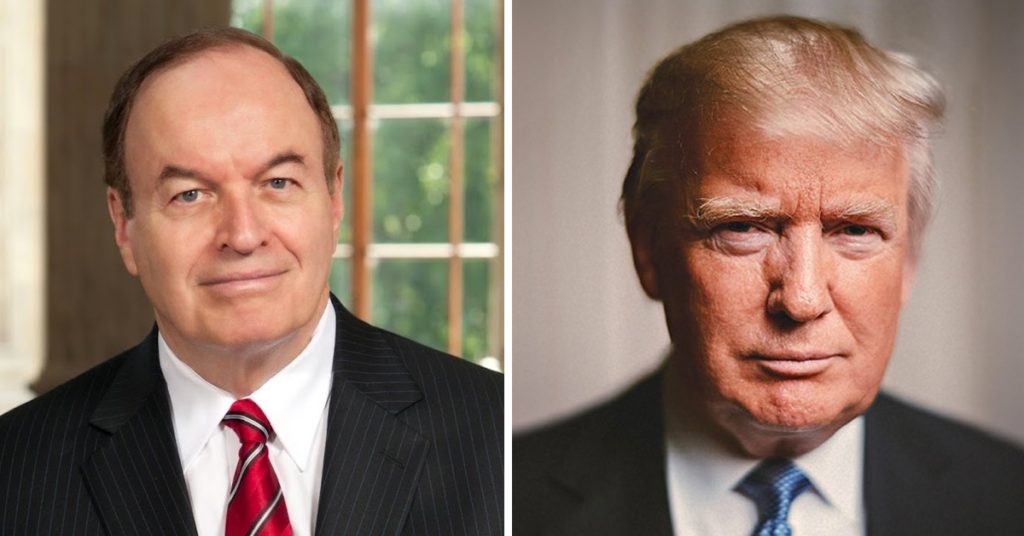
President Donald Trump announced his administration would declare the opioid crisis a public health emergency Thursday, which the White House says is killing 175 people every day. Following Trump’s announcement, Alabama U.S. Senator Richard Shelby, Chairman of the Senate Commerce, Justice, and Science (CJS) Appropriations Subcommittee, voiced his support for the president’s declaration. “I applaud the President and his Administration on their efforts to end the opioid epidemic. This is a real emergency, and it affects just about every community in our country,” said Shelby. “Senator Jeanne Shaheen and I have been working on our Appropriations Subcommittee to make sure that both law enforcement and the Justice Department have the tools they need to fight this epidemic. It is going to take a massive effort, and I fully support President Trump’s attention to this matter.” The growing epidemic regarding the misuse, abuse, and addiction to certain prescription pain medications and other types of opioids in the United States, such as heroin, remains a concern for communities across the country. The prescription of opioid painkillers has been the driving force behind increased opioid usage and subsequent overdose related deaths. In the FY2017 CJS Appropriations bill, Shelby secured $276.5 million to the Drug Enforcement Administration, Bureau of Prisons, and Department of Justice grants to combat the nation’s drug addiction and opioid crisis.
Slow-moving White House brings new Russia sanctions a step closer

The Trump administration has given Congress a list of Russian officials who may soon become off-limits to anyone who wants to avoid U.S. sanctions, as criticism mounted over the administration’s tardy execution of new penalties on Moscow. Anders Fogh Rasmussen, the former NATO chief and adviser to Ukraine’s leader, said Russian President Vladimir Putin “must be laughing right now” at how successfully he’s undermined Western democracy. He said the lack of answers from the Trump administration would be seen as a sign of weakness that Putin would exploit. “He’s achieved much more than he could have ever dreamed of when it comes to undermining the credibility of Western democratic institutions,” Rasmussen said Thursday in an Associated Press interview. “When he’s watching the ongoing discussion here in Washington, I think it’s unbelievable for him that he could achieve that much for a very modest investment in whatever he might have invested in interference in the election or whatever.” The former prime minister of Denmark, Rasmussen joined a growing chorus of Russia critics expressing exasperation that an Oct. 1 deadline came and went without new penalties to punish Russia for interfering in the U.S. election. A law Trump signed in August requires the administration to produce a list of individuals linked to Russia’s defense and intelligence agencies. Anyone who does business with those individuals could then be hit themselves with U.S. sanctions. With pressure building, Secretary of State Rex Tillerson approved the belated list and authorized its release, State Department spokeswoman Heather Nauert said. Tillerson’s deputy spoke Thursday to Republican Sen. Bob Corker, the Senate Foreign Relations Committee chairman and among those seeking an explanation for the delay. The State Department was also sending others in Congress the list of individuals, along with guidance about how businesses and foreign countries can avoid running afoul of the sanctions, officials said. Tillerson has said one reason for the delay has been concern about how the sanctions may affect business and major U.S. allies who do business with Russia’s defense and intelligence sectors. Turkey, a NATO ally, has a deal with the Kremlin to buy the S-400, Russia’s most advanced air defense missile system. And key security partner Saudi Arabia recently struck an array of deals with Moscow, including contracts for Russian weapons. Although the list has not yet been made public, it’s expected to be released more broadly in the coming days, giving businesses and nations a chance to wind down transactions with the off-limits individuals and entities. A three-month grace period will expire on Jan. 28, Nauert said. Many of the Russian officials have previously been targeted by U.S. sanctions, said individuals familiar with the list given to Congress. These individuals weren’t authorized to discuss it publicly and requested anonymity. The new, congressionally required sanctions were in addition to existing U.S. penalties on Russia for its support of separatists in eastern Ukraine and 2014 annexation of Ukraine’s Crimea region. In a letter to Trump this week, 20 Democratic lawmakers said the administration had done “nothing to hold Russia accountable” for interfering in the 2016 election. “This inaction is baffling and unacceptable. It allows Russia or any other hostile actor to believe they can attack American democracy with impunity,” said New York Rep. Eliot Engel and the other Democrats. In the Senate, the chairman of the Armed Services Committee, John McCain of Arizona, and the top Democrat on the Foreign Relations Committee, Ben Cardin of Maryland, called the administration’s announcement “a step in the right direction.” “We are encouraged that the sanctions list includes many targets from the Russian defense and intelligence sectors that Congress previously identified and look forward to more closely reviewing the list to ensure that it is comprehensive,” they said in a joint statement. U.S. officials have also cited legal hurdles to getting the sanctions in place. But Rasmussen said the lack of clear communication from the administration was muddying the intended U.S. message that Russian aggression and interference won’t be tolerated. “If there are such legal complications, the administration should as soon as possible engage with Congress to solve those problems, at least inform Congress about those obstacles,” Rasmussen said. “Otherwise, the administration will leave the suspicion it’s because of a hesitation.” Rasmussen, who began advising Ukrainian President Petro Poroshenko earlier this year, called for the U.S. to provide lethal, defensive weaponry to Ukraine’s forces. That move has been under consideration for years, including under President Barack Obama. The U.S. has not yet taken the step despite floating the possibility publicly on several occasions. “So far, nothing has happened from the administration side,” Rasmussen said. Still, he said that just the threat of U.S. weapons potentially flowing to the Ukrainians had affected Putin’s deliberations about Ukraine in a positive way. He said he believed Putin’s recent proposal to send U.N. peacekeepers to eastern Ukraine reflected the Russian leader’s “attempt to find a way out of all of this.” Republished with permission from the Associated Press.
