
Birmingham Civil Rights Institute celebrates 25 years of education, dialogue and history
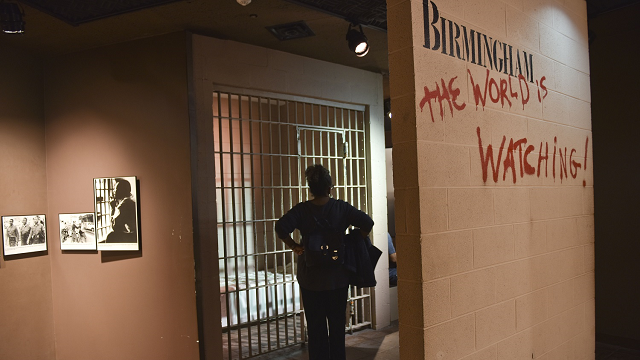
The dignified domed building on 16th Street North in downtown Birmingham looks as though it was always meant to be there. The Birmingham Civil Rights Institute (BCRI) is flanked by historic Sixteenth Street Baptist Church to the north and Kelly Ingram Park to the east. This year, the BCRI is celebrating its 25th anniversary. Former Birmingham Mayor Richard Arrington Jr. said establishing the institute was a priority when he was elected to office in 1979. He put together a 21-member task force that eventually led to the opening of the facility. “It was very important to me that young people understand the history here,” said Arrington, Birmingham’s first African-American mayor, who is now a professor at Miles College. “It is easy to think that things have always been the way they are now, but what happened in Birmingham in the 1960s is not ancient history.” The BCRI, which opened in November 1992, recalls a time in Birmingham’s history that many initially wanted to forget. Some opposed the creation of the institute. Today, many recognize and laud the institute for confronting the city’s past, shining a light on international civil rights issues and honoring the foot soldiers who sacrificed to end segregation and help make Birmingham the city it is today. Since its opening, more than 2 million people have visited the BCRI, and its role today is more important than ever. “Almost everyone would agree that this is a very challenging and troubling time in our history,” said BCRI President and CEO Andrea Taylor. “We can play a very important role by providing a place where people can gain factual information and share dialogue; by providing a place where people have an opportunity to interact with different people by building coalitions; and by providing a place where people can continue to learn, share and grow in an increasingly complex society.” Birth of the BCRI Arrington has been a part of the BCRI since its planning stages, but he has always credited the idea to late Birmingham Mayor David Vann, who visited a Holocaust museum in Israel and returned to Birmingham with a mounting interest in establishing a civil rights museum. Vann lost his bid for re-election, but Arrington pledged that he would continue the commitment to build a museum dedicated to the people who gave their lives for equality. Arrington tapped civic leader Odessa Woolfolk in 1986 to lead the institute’s task force, which had a goal of formulating the plans — from mission statement to content and design. Talent was recruited from the city’s education, arts and business communities to work on the project. “What happened here in Birmingham was transformative,” said Woolfolk, BCRI founding board chair. “We wanted to tell the story of how a movement of nonviolence was used to resolve conflict.” Woolfolk, who grew up in Titusville, was the ideal person to chair the task force. She was an educator who had public policy experience, and she had vivid memories of the bomb that ripped through the Sixteenth Street Baptist Church and when nonviolent groups were met with fire hoses and snarling dogs. Plus, she was a teacher at historic Ullman High School during the civil rights movement in Birmingham. Woolfolk knew instantly that she wanted to be a part of creating such a monument in the city. Old wounds Those years of steering the task force were difficult, Woolfolk recalled. It was a challenge to convince so many people that the institute was necessary to educate a new generation of children who had not witnessed what happened. “People just wanted to forget the pain of that time,” she said. Arrington agreed with Woolfolk. “No one wanted to open old wounds,” he said, pointing out some in the business community, whom felt the BCRI would be only for black patrons and, worse, cause a backlash against whites in the city. Blacks had reservations about the project, too, because they didn’t trust the city to get the story right. Nonetheless, the city’s history had to be told — openly and honestly. Members of the original task force, including Ed LaMonte, a retired Birmingham-Southern College political science professor, and Robert Corley, a professor in the Department of History at UAB, said the BCRI had to address some uncomfortable subjects. “I remembered the (Sixteenth Street Baptist) church bombing,” said Corley, who grew up in Birmingham and was the regional director of the National Conference of Christians and Jews. “I was (5 years old) when the demonstrations happened, and at the time I was trying to figure out my values and how I fit into the world.” “I was very eager to be a part of it,” Corley continued. “We wanted it to be not just a museum but an institute where there is an ongoing discussion. We also needed something that could educate children here about what really happened.” Funding Arrington placed two bond issues before voters in Birmingham: one that included revenue for schools, recreation and public works; and another to fund a civil rights museum. Both times, items involving the museum failed. Arrington persisted and was able to generate the $12 million necessary to build the institute, but he still encountered resistance from Birmingham’s corporate community. However, when business leaders had the opportunity to view plans for the facility, along with the storyline for the exhibition, they eventually came to understand the potential and offered their backing, raising an additional $5 million to complete the exhibition and provide financial support through the first several years of operation. Woolfolk continued to push forward, and eventually the task force made decisions on the design and exhibitions. She especially wanted to give credit to Birmingham’s foot soldiers, those residents who were on the front lines and made a huge difference during the city’s demonstrations. Doors opened After eight years of planning, the doors of the 28,000-plus-square-foot building opened in 1992—with many who had been opposed now onboard. Woolfolk noted that those same business leaders that were hesitant to support the institute had come around and were investing in it. “When there was something to look at, we got
Kay Ivey appoints Mike Anderton as Jefferson County District Attorney

Gov. Kay Ivey on Wednesday appointed Mike Anderton to fill the vacancy of the Jefferson County District Attorney. Anderton’s appointment follows the ouster of DA Charles Todd Henderson who was found guilty of first-degree perjury by a jury in October. “I am proud to appoint Mike Anderton as Jefferson County District Attorney. Out of all the applicants, Mike had the most experience, and I know he will work effectively, and with integrity, for the people of Birmingham and all of Jefferson County,” Ivey said. Ivey continued, “Having dedicated his legal career to bringing justice to innocent victims and their families, and working 33 years in the Jefferson County DA’s Office, I am confident in Mike’s abilities to effectively serve as District Attorney.” After graduating from Auburn University with a Bachelor of Arts degree in Speech Communication and beginning his professional career, Anderton went on to earn his Juris Doctorate from Cumberland School of Law. He began his legal career in the Fifth Judicial Circuit in Alexander City, Ala., in 1982 as an Assistant District Attorney. In 1984, he began working in the Jefferson County District Attorney’s Office and still serves there presently. During his prosecutorial career, Anderton has participated in approximately 350 felony and misdemeanor jury trials, including numerous capital murders, homicides, drug offenses and property crimes. He was also part of the original “Vertical Prosecution Unit” which was formed by the District Attorney’s Office in 1991, to meet the special needs of victims and families of homicides and child sexual and physical abuse. Since 1987, he has served as Division Chief, wherein he supervises eight Deputy District Attorneys and many support personnel. “I thank Governor Ivey for placing her trust in me to serve as Jefferson County District Attorney. I am committed to putting my years of experience as a prosecutor to work for the people of the 10th Judicial Circuit in my new role as District Attorney,” Anderton said in a news release. “The Jefferson County District Attorney’s Office needs to continue its tradition of stability and integrity. I look forward to leading my office in the pursuit of justice, citizens’ trust and victims’ rights.” Anderton’s appointment is effective Friday, Dec. 1, 2017. He will serve until the 2018 general election.
83k Alabama children may lose health insurance due to missed deadline by Congress

On September 30, federal funding for the Children’s Health Insurance Program (CHIP) expired. Across the country, states are readying themselves for what happens when their current funds run out. In Alabama, funds for ALL Kids — the state’s CHIP that is administered by the Alabama Department of Public Health (ADPH) — is poised to be depleted in February should Congress not reauthorize funding for the program. Meaning the 83,000 families who rely on the service will lose access to health care. “Our best estimates indicate that we will exhaust CHIP funds in February,” Cathy Caldwell, Director of the Bureau of Children’s Health Insurance at the Alabama Department of Public Health (ADPH) told Alabama Today. More than 83,000 children in the state are covered by All Kids program. Meanwhile, another 75,000 are covered by an Alabama Medicaid component of CHIP. ALL Kids covers eligible children that live in Alabama whose households make up to 312 percent of the poverty line — up to $51,481 a year for a household of two, up to $64,732 for a household of three, and up to $77,982 for a household of four. Qualifying families pay premiums, which range from $52 to $104 per child per year, depending on income, along with co-pays Children must also: Be under age 19 Be a U.S. citizen or an eligible immigrant Not be covered by other insurance Not be a resident in an institution Not be covered by or eligible for Medicaid At the moment Alabama has no set plans when to warn families the program is ending. “We have not yet finalized a date,” added Caldwell. On Nov. 3, the U.S. House of Representatives voted to reauthorize CHIP by a 242 to 174 vote, largely along party lines with Republicans overwhelming supporting the legislation and Democrats against it. The bill advanced to the U.S. Senate, which has yet to take up its own version that passed out of committee last month. It remains unclear if, and when, CHIP will be reauthorized.
Daniel Sutter: Economists versus tax deductions

The current debate in Congress over tax reform highlights a favorite argument of economists: that we should eliminate loopholes, like the deductions for mortgage interest or state and local taxes, and use the savings to lower tax rates. The argument illustrates both core economic principles and the limitations of a purely economic analysis. Government needs resources to purchase military equipment, pay for medical care, or build new prisons. If the government spends $1 million, we citizens must pay $1 million in taxes. But taxes also affect peoples’ choices, meaning that $1 million in revenue for the government will cost the economy more than $1 million. We can see this by considering the mortgage interest deduction. When you pay $1,000 on a mortgage, the interest paid reduces the income tax you owe. Factoring the taxes avoided in, the mortgage payment might only cost $800. Paying $1,000 in rent costs the full $1,000. This makes buying a home more attractive relative to renting, and so some people who would prefer to rent instead of buy at these prices will buy for the tax deduction. Exemptions and deductions leave us with a smaller tax base and so tax rates must be higher to raise a given amount of revenue. The Federal income tax collected $1.5 trillion in 2015, when national income was about $15 trillion. A flat tax rate 10 percent on all national income would raise this sum. If deductions excluded $5 trillion from the base, we would need a 15 percent flat rate to raise the same $1.5 trillion. As the tax rate is pushed higher, potential deductions become more valuable. Consequently, more decisions are made for tax purposes and the full cost of taxes increases; the extra cost increases faster than the tax rate. Furthermore, because income taxes distort work choices, lower tax rates should also spur economic growth. President Ronald Reagan’s 1986 tax reform closed many loopholes and reduced the top income tax rate from 50 percent to 28 percent. Because the lower rates were applied to a broader base and thank to economic growth, income tax revenues actually increased. The economics of taxation, however, arguably ignores politics. This omission is especially troubling if you believe that government is too big and out of control. George Will recently said of a current proposal to tax university endowments: “Once the understanding that until now has protected endowments is shredded, there will be no limiting principle to constrain governments … in their unsleeping search for revenues to expand their power. Public appetites are limitless, as is the political class’s desire to satisfy them.” Nobel-prize winning economist James Buchanan demonstrated how a government trying to raise as much revenue as possible invalidates economists’ tax recommendations. Base broadening could become a clever way to increase our taxes. The deductions protecting our income get eliminated – permanently – in exchange for temporary tax cuts. Indeed, the top Federal income tax rate has increased to almost 40 percent after 1986. This becomes even more relevant because we can partially constrain government. The public response to President Donald Trump’s promise to drain the swamp reflects, I think, a widespread feeling that Washington is out of control. Yet elected officials clearly recognize the unpopularity of tax hikes. We do not really understand why some constraints, like the mortgage interest deduction, have constrained Congress. A tax deduction would be causing extensive losses before I would recommend its elimination. The exemption for employer-provided health insurance is one example. This exemption ties health insurance to employment for most Americans, which both creates a need for Medicare and Medicaid and massively distorts spending. We must pay taxes to fund government, and the full cost of taxes depends on how many decisions households and businesses make solely to reduce the taxes they pay. Consequently, economists generally recommend lowering tax rates and paying for this by eliminating deductions. But some of our deductions have successfully kept politicians from taxing more of our money, and should not be discarded lightly. ••• Daniel Sutter is the Charles G. Koch Professor of Economics with the Manuel H. Johnson Center for Political Economy at Troy University and host of Econversations on TrojanVision. The opinions expressed in this column are the author’s and do not necessarily reflect the views of Troy University.
Alabama Power Foundation announces seven Elevate grant recipients

The Alabama Power Foundation has awarded seven Elevate grants to nonprofit organizations across the state. The Elevate grant program empowers organizations by providing funds for community-centered projects, hosting capacity-building workshops and providing networking opportunities within the nonprofit community. The 2017-2018 Elevate grantees are: Anniston Museum League Children of the Village Network – Livingston Dale County Board of Education Family Promise of Montgomery The Literacy Council of Central Alabama – Birmingham Shelby County Arts Council Victory Health Partners – Mobile Each grantee receives a $10,000 grant in 2017 and a $5,000 challenge grant in 2018, and will participate in at least one workshop in 2018 to help them grow and find ways to expand their positive impact in the community. “We seek innovative ways to meet the evolving needs of organizations, and help educate our grantees on how they can do the same for the communities they serve,” said Myla Calhoun, president of the Alabama Power Foundation. “That’s one of the most important elements of the Elevate grant program.” “The Alabama Power Foundation not only award funds and provides networking opportunities, we also introduce new tools and resources, which can open the door to previously unknown opportunities,” Calhoun added. “I am always impressed with our grantees and their ability to maximize these opportunities. I have no doubt this year’s recipients will do the same.” Elevate is one of several grant programs funded by the Alabama Power Foundation. To learn more about Elevate, as well as other Alabama Power Foundation and Alabama Power community programs, please visit www.powerofgood.com. Since its creation in 1989 with funds donated by shareholders, the Alabama Power Foundation has supported Alabama communities, educational institutions and nonprofits through more than 20,000 grants and scholarships using nonratepayer dollars. Republished with permission from the Alabama NewsCenter.
Randall Woodfin sworn-in as Birmingham’s 30th mayor
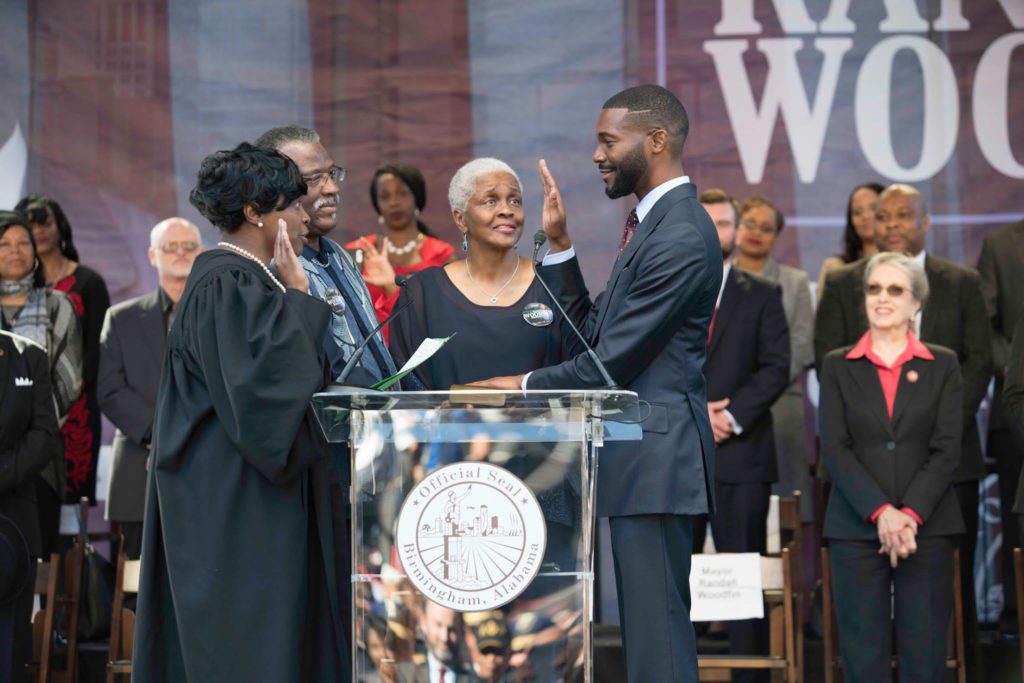
It was a picture-perfect day on Tuesday as Randall Woodfin, 36, was sworn into office as the 30th mayor of the City of Birmingham, Ala. by Judge Nakita Blocton making him the city’s youngest mayor in modern history. Woodfin took the oath of office before thousands of onlookers in downtown Birmingham’s Linn Park where there was not a cloud in the sky. With a giant American flag backdrop, Woodfin was flanked by banners which, according to the Birmingham Times., listed the names of all 99 neighborhoods in the city. “I am so honored for this moment. It is hard to put this moment into words as relates to this opportunity to serve my hometown,” Woodfin told the crowd. “I am so proud and so eager to get to work.” He continued, “ this is not my inauguration. This is our inauguration. What stands behind us is not just a building, it’s not just city hall, but it’s a symbol that reflects the voice of the people of all 23 communities and all 99 neighborhoods.” Woodfin’s October victory On Oct. 3, Woodfin handily bested Birmingham’s seven-year incumbent mayor, William Bell, in the city’s contentious runoff mayoral race. Woodfin — a city attorney and member of the Birmingham Board of Education — took home 24,910 votes, 58 percent, over Bell’s 17,353, 41 percent. Woodfin’s team Two weeks ahead of his inauguration, Woodfin announced the six members of his executive leadership team during a press conference at the Birmingham Civil Rights Institute. “I could not be more proud of the team we are putting together to help transform our city,” Woodfin said. “Each of these men and women are true public servants. They reflect my core beliefs in integrity, efficiency and concern for each resident of Birmingham. We look forward to continuing to complete our executive team as well as department heads as we near the administration beginning in two weeks.” His executive team includes: Cedric Sparks: chief of staff. He is a longtime leader of Birmingham’s Division of Youth Services dating back to 2002. He is a graduate of West End High School, the University of Alabama and Miles Law School. Kevin Moore: chief operating officer. He has worked for the city of Birmingham for 22 years, most recently as director of the Birmingham Parks and Recreation Department. He has also served as the director of the Birmingham CrossPlex. Moore is a 1992 graduate of Samford University. Ed Fields: senior advisor and chief strategist. He led Woodfin’s campaign for mayor and has a long history as a local businessman and civic activist. He received his undergraduate degree in business Administration from Alabama State University and his MBA from University of Alabama’s Manderson School of Business. Kelvin Datcher: director of intergovernmental affairs. He previously served as director of investor relations at REV Birmingham. He is a graduate of Gettysburg College and previously worked at Southern Poverty Law Center, Alabama State University and for the Birmingham City Council. He has been active in economic development initiatives for the City of Birmingham. Nicole King: city attorney. She began her legal career with the city of Birmingham Law Department in 2006. A native of Birmingham and graduate of Ramsay High School, King is also a University of Alabama and Texas Southern University Law School graduate. She has successfully handled cases before the Alabama Supreme Court, Alabama Court of Civil Appeals and the U.S. Court of Appeals for the 11th Circuit. Sylvia Bowen: executive administrator. She has worked as the Birmingham City Council District 8 chief of staff and served as executive assistant to the dean of academic affairs and as an instructor at Lawson State Community College. She is a graduate of Tuskegee University and holds an MBA from Johnson and Wales University. Watch Woodfin’s inauguration ceremony below:
Steve Bannon to campaign with Roy Moore next week

Former White House chief strategist and current Breitbart News chief Steve Bannon says he’s heading back to the Heart of Dixie next week to campaign for U.S. Senate hopeful Roy Moore. Bannon will join Moore at a rally in Fairhope, Ala., Tuesday, Dec. 5, just one week before Moore will face-off against Democrat Doug Jones in the Dec. 12 special election for Attorney General Jeff Sessions‘ former seat. “I look forward to standing with Judge Moore and all of the Alabama deplorables in the fight to elect him to the United States Senate and send shockwaves to the political and media elites,” Bannon told CNN, Bannon’s decision to visit the Yellowhammer State comes in the wake of Monday’s White House announcement that President Donald Trump will not travel to Alabama and campaign for Moore, in light of the allegations against him. Moore has been under fire since The Washington Post published an explosive report on Nov. 9 with the accounts of four women who claim he sexually pursued them when he was in his 30s and they were in their teens. Since that time, a total of nine women have levied accusations against Moore. The news has caused rapid fallout from dozens within the Republican Party who have called on him to withdraw his name from next month’s special election if the allegations are true. Following the first allegations, Bannon said, “Until I see additional evidence on Judge Moore, I’m standing with him.”
Steve Flowers: Jim Martin, father of the modern Republican Party in Alabama
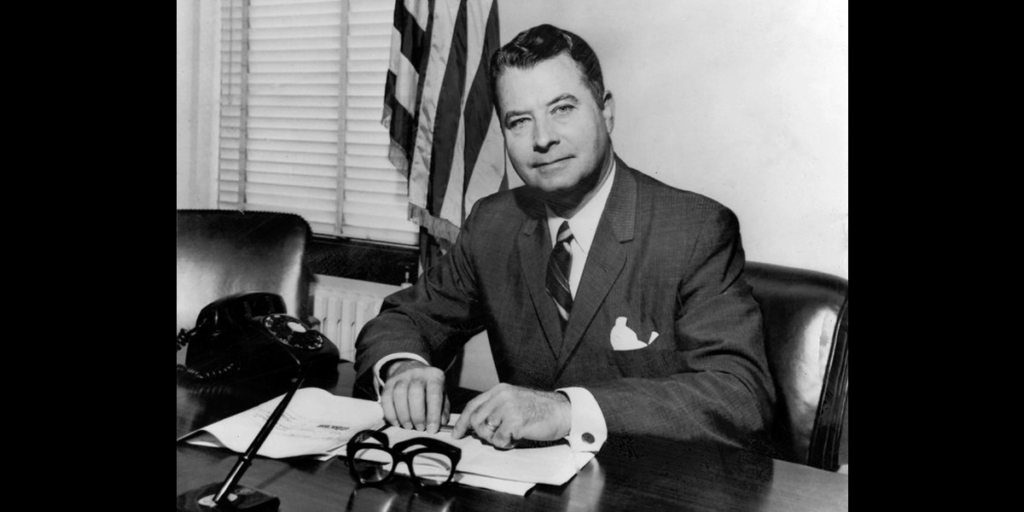
Jim Martin passed away recently in Gadsden at 99 years old. His beloved wife of 70 years, Pat, was by his side. He was a true Christian gentleman. Jim was one of the Fathers of the modern Republican Party in the South. In 1962, John Kennedy was President. Camelot was in full bloom. The Congress was controlled by Democrats only because the South was solidly Democratic. The southern bloc of senators and congressmen were all Democrats. Because of their enormous seniority, they controlled both houses of Congress. The issue of Civil Rights was a tempest set to blow off the Capitol dome. Kennedy was under intense pressure to pass major Civil Rights legislation. However, he was up against a stonewall to get it passed the powerful bloc of southern senators. Race was the only issue in the South, especially in Alabama. George Wallace was riding the race issue to the Governor’s office for his first term. The white southern voter was determined to stand firm against integration and was poised to cast their vote for the most ardent segregationists on the ballot. Our Congressional delegation was Democratic, all eight Congressmen and both Senators. Our tandem of John Sparkman and Lister Hill had a combined 40-years of service. Lister Hill had gone to the U.S. Senate in 1938. He had served four six-year terms and had become a national celebrity in his 24 years in the Senate. He was up for election to his fifth six-year term. It was expected to be a coronation. He was reserved, aristocratic, and almost felt as if he was above campaigning. Hill was also soft on the race issue. He was a progressive who refused race-bait. Out of nowhere a handsome, articulate, young Gadsden businessman, Jim Martin, appeared on the scene. Martin was 42, a decorated World War II officer who fought with Patton’s 3rd Army in Europe. He entered as a private and became an integral part of Patton’s team, rising to the rank of Major. After the war he went to work for Amoco Oil and married a Miss Alabama – Pat McDaniel from Clanton. They then settled in Gadsden and he bought an oil distributorship and became successful in business. He was a business Republican and became active in the State Chamber of Commerce. When the State Chamber Board went to Washington to visit the Congressional delegation, they were treated rudely by our Democratic delegates who were still voting their progressive New Deal, pro union philosophy. Martin left Washington and decided that Alabama at least needed a two party system and that he would be the sacrificial lamb to take on the venerable Lister Hill as the Republican nominee for the U.S. Senate. Martin got the nomination in a convention and the David vs. Goliath race was on. By late summer the Big City newspapers could feel that Martin had some momentum. He was being perceived as the conservative and Hill as the liberal. Every Alabama courthouse was Democratic, all sheriffs, Probate Judges, and statewide elected officials. It was hard to imagine that the tradition of voting Democratic would change, but the winds of segregation were strong. When the votes were counted in November of 1962, Martin had pulled off the biggest upset in the nation. NBC’s team of Huntley and Brinkley reported the phenomenon on the nightly news. Republican President, Eisenhower, called Martin to congratulate him. However, things were happening in rural North Alabama. Martin had won by 6,000 votes but three days later, mysterious boxes appeared with just enough votes to give Hill the belated victory. The entire country and most Alabamians knew that Jim Martin had been counted out. Jim Martin would have been the first Republican Senator from the South in a century. Some people speculate that he would have been the vice-presidential candidate with Nixon in 1968. Regardless, he was the John the Baptist of the Southern Republican sweep of 1964, and father of the modern Republican Party in Alabama. That 1962 Senate race was a precursor of what was to come two years later. Jim Martin was one-of-five Republicans swept into Congress in the 1964 Goldwater landslide. He probably would have won the U.S. Senate seat of John Sparkman. However, he chose to run for governor against Lurleen Wallace. In 1987 Martin became Commissioner of the Alabama Department of Conservation and Natural Resources. As commissioner, Martin helped create the Forever Wild land preservation program. Jim Martin has a special place in Alabama political history. See you next week. ••• Steve Flowers is Alabama’s leading political columnist. His weekly column appears in over 60 Alabama newspapers. He served 16 years in the state legislature. Steve may be reached at www.steveflowers.us.
