
Alabama home sales total 4,334 units during November, up 9 percent from last year
Sales Alabama home sales totaling 4,334 units during November were an increase of 9 percent from the same month a year ago. Two more resources to review: Quarterly Report and Annual Report. Forecast November sales were 13.7 percent or 523 units above the Alabama Center for Real Estate‘s (ACRE) monthly forecast. ACRE’s 2017 sales forecast through November projected 49,528 closed transactions, while the actual sales were 53,177 units. Supply The statewide housing inventory during November was 24,990, a decrease of 9.4 percent from November 2016 and 40.6 percent below the November peak in 2007 (42,039 units). There were 5.1 months of housing supply in November (6 months is considered equilibrium), which represents a drop of 6.2 percent from November 2016 (6.5 months). November inventory decreased from October by 1 percent. This direction is consistent with historical data that indicate November inventory on average (2012-16) decreases from October by 1.7 percent. Demand November residential sales rose 5.8 percent from October. Historical data indicate that November sales on average (2012-16) decrease from October by 1.7 percent. The average days on the market until a listing sold was 126 days, down 2.9 percent from last year. According to the National Association of Realtors November Existing Home Sales Report, November home sales were 0.4 percent higher than home sales during the same month in 2016. See how Alabama compares with the U.S. residential market by clicking here. Pricing The November median sales price increased 2.2 percent from the same period last year to $176,222. During November, 36 percent of Alabama markets experienced price gains from November 2016. This indicator can fluctuate from month to month because of sampling size of data and seasonal buying patterns. Seeking balance The metro markets in Alabama representing 70 percent of all sales continued to trend toward greater seller bargaining power with 4.3 months of supply. Outside the metro markets, Alabama’s mid-sized markets are reporting 5.2 months of supply, while rural areas are reporting 6.6 months of supply. There have been significant improvements from inventory peaks experienced during the recession. The supply of quality inventory in the past has affected sales, according to some boots-on-the-ground professionals. Industry perspective “The economy and real estate markets continue to show they are resilient. Regardless of the economic metric — GDP, monthly jobs or home prices — the dashboard registers an ‘all-systems-go’ economy,” said KC Conway, director of research and corporate engagement at the Alabama Center for Real Estate. “GDP started the year off with its best Q1 reading in several years and followed it up with above 3 percent readings for Q2 and Q3. (This year) will be the first year since the financial crisis that the economy registered an annual GDP greater than 2 percent. It was just plus 1.6 percent for 2016. “Job growth is healthy as well. The first week of December the market received solid monthly jobs reports from both ADP (which measures private industry job formation) and the BLS (the government’s monthly jobs report produced by the Bureau of Labor Statistics). ADP reported a healthy new 190,000 private-sector jobs for November and a monthly average of 210,000 jobs over the prior 12 months. The BLS reported November jobs at a higher-than-expected level of 228,000 jobs – and its year-to-date monthly average is 174,000. Unemployment remains low at 4.1 percent, and inflation was just reported on December 13th at 1.7 percent for the “core rate” (which excludes the more volatile food and energy components) and 2.2 percent overall annualized due to higher energy prices. “The Federal Reserve is taking note of the expanding economy and followed up its prior two rate hikes earlier in 2017 with a 0.25 percent rate increase at its December 13th meeting. Housing conditions remain conducive to growth in new supply and more transaction activity. Single-family home inventories are below demand levels across the nation, Southeast and most Alabama markets. The national rate of appreciation is running above 6 percent on the heels of 5-plus percent in 2016. This is leading builders and lenders to be more receptive to adding inventory. New housing starts and permits will likely end 2017 at or above the 1.3 million units level, split 30 percent multifamily and 70 percent single-family. The outlook heading into 2018 is the best we have seen in a decade.” Click here to generate more graphs from the Alabama November Housing Report, including Total Sales, Average Sales Price, Days on the Market, Total Inventory and Months of Supply. The Alabama Residential Monthly Report is developed in conjunction with the Alabama Association of Realtors and its local associations. Republished with permission from the Alabama NewsCenter.
Daniel Sutter: Republicans and college
Republicans’ and Democrats’ attitudes toward higher education are seemingly diverging. Increasingly critical Republican attitudes will likely, in time, have policy consequences. An annual Pew Center survey found in 2015 that 54 percent of Republicans thought that higher education’s impact on the country was positive, versus 37 percent negative. This year these numbers flipped to 58 negative – 36 positive, with 65 percent negative among conservative Republicans. Democrats this year were at 72 percent positive, 19 percent negative. Republicans and Democrats further disagree on the value of college degrees. A recent Wall Street Journal poll found that Democrats agreed, 52 to 43 percent, that a four-year degree is worth the cost. By contrast, Republicans disagreed, 53 to 43 percent. Republican attitudes may already be affecting policy. The U.S. House recently proposed taxing the largest university endowments, treating graduate student tuition waivers as taxable income, and denying tax deductions for athletics seat licenses. The final tax bill is more favorable to universities, but the proposals represent a warning shot. Republicans’ antagonism toward my industry makes sense: they are mad at the preponderance of liberals among college professors, and at the liberal policy initiatives from universities. The domination of faculty positions by liberals and Democrats has been documented by numerous methods. The causes and consequences of this imbalance, however, are less clear. It is unclear, for example, if conservatives are simply less likely to want to be professors or face discrimination because of their views. We know from testimonials that conservatives sometimes face verbal abuse, and yet many liberal professors respect (although they might challenge) conservative students’ views. Whether biased readings or attempts at indoctrination change students’ views is uncertain. A liberal world view inevitably affects professors’ research. This is not an indictment, or excuse to ignore research you don’t agree with, but rather an observation on the research process. Social science research requires premises about the nature of human society. Here’s one concrete example. Economists typically judge economic performance against the satisfaction of market demand – do consumers get what they want? Yet other social scientists believe that continual advertising and our consumer culture manufacture these demands. Whether demand should be treated seriously affects our research. Can anything be done about the liberal dominance of college faculties, if it is indeed a problem? Donors and alumni can always attempt to place conditions on gifts, which administrators may or may not accept. As a matter of policy, the University of Colorado brings a conservative professor to campus each year to organize lectures and other activities to provide balance. The Iowa legislature considered a bill mandating using voter registration in faculty hiring. If the sociology department, for instance, had too many registered Democrats, they could only hire registered Republicans. I doubt that this would accomplish much, as some liberal sociologists would surely register as Republicans to secure set-aside positions. Instead of “affirmative action for conservatives,” perhaps we should embrace of a range of intentionally ideological curricula. Economist John Merrifield argues that the primary goal of K-12 education reform should be a diverse menu of options for parents and students. I agree, but why not extend this diversity to programs or even universities embodying conservative and liberal values and approaches? For example, scholars bitterly debate whether the core curriculum should cover the Great Books or “Western Canon.” Regardless of who is correct, many conservatives regard the Canon as fundamental. Some schools, mostly private colleges, still teach the Great Books. Alabama’s fourteen public four-year universities already offer a wide range of programs; the University of Montevallo, for example, is a public liberal arts college. Why not have one university dedicated to a conservative educational experience, and another dedicated to a liberal curriculum? While neither might provide balance within their programs, they would increase the range of options available at in-state tuition rates, while truthful disclosure should prevent enrollment by unsuspecting students. President Trump has attacked the liberal media bias and fake news. The recent House tax proposals, I think, provide warning that higher education may soon face similar attacks. Perhaps embracing and ensuring a range of ideological options will more effectively defuse the growing discontent. ••• Daniel Sutter is the Charles G. Koch Professor of Economics with the Manuel H. Johnson Center for Political Economy at Troy University and host of Econversations on TrojanVision. The opinions expressed in this column are the author’s and do not necessarily reflect the views of Troy University.
Steve Marshall appoints new director of Alabama Dept. of Forensic Sciences
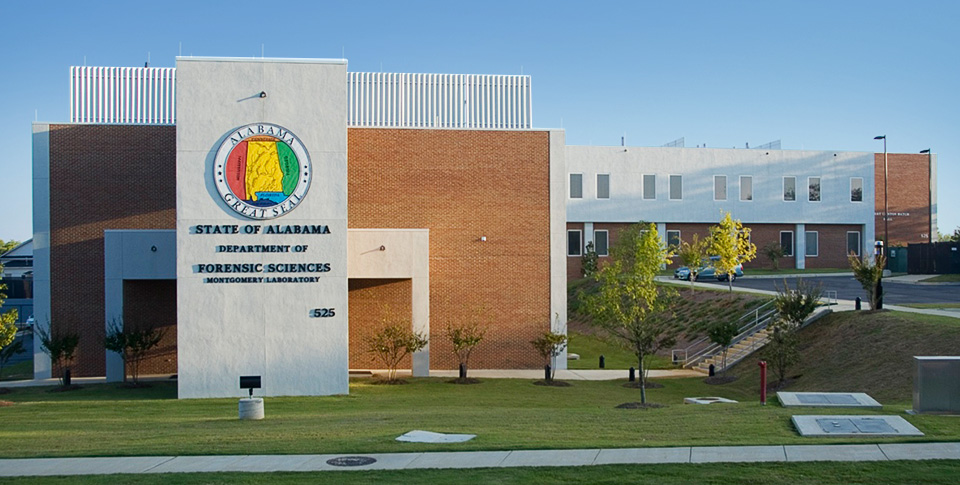
Attorney General Steve Marshall announced on Wednesday the appointment of Angelo Della Manna, of Hoover, Ala., to become director of the Alabama Department of Forensic Sciences (ADFS). Among his official duties, the ADFS director oversees the State’s forensic sciences program, directs the work of agency investigative, scientific and medical personnel at the central office location as well as field offices and labs throughout the state, and is responsible for the overall comprehensive and technical training program for all agency staff. “It is a pleasure to announce the appointment of Angelo Della Manna as director of the Alabama Department of Forensic Sciences,” said Marshall. “Angelo brings to the position considerable experience and leadership as both a veteran of the Alabama Department of Forensic Sciences and a nationally recognized authority in the field of forensic science. His extensive background in the Department of Forensic Sciences will ensure that the vital laboratory and death investigation services provided to state and local law enforcement will continue to be of the highest caliber.” Under state law, the Attorney General appoints the director of the ADFS. He was assisted in his appointment by a screening committee, which is subject to final approval by the State Personnel Board and Governor Kay Ivey. Della Manna expressed appreciation at being selected and looked forward to guiding the state forensics professions in their mission. “I am both humbled and excited to be selected by General Marshall as the next leader of one of the premier forensic science agencies in this country,” said Della Manna. “My staff of forensic science professionals and I will remain focused on the critical role we have in the justice system as the only internationally accredited provider of forensic science services in Alabama, as we collectively strive to help make Alabama safer, each and every day.” Della Manna began his service with the ADFS in 1993 where he worked on over 2,000 complex forensic cases ranging from burglary to capital murder, built a national leading forensic DNA program, assisted the Department in achieving International Laboratory Accreditation for the first time in its history, and secured and managed over $25 million in federal grant awards to-date. He was elected to serve on the FBI’s five-person Executive Board for DNA Analysis methods where he helped draft and implement new Standards for the Forensic DNA community. He also served as vice chair of the Biology/DNA Scientific Area Committee of the National Institute of Standards and Technology (NIST) in developing new scientific standards in forensics. Della Manna holds a bachelor of science degree in chemistry from the University of Toronto and a master of science in forensic science from the University of Alabama at Birmingham. Della Manna replaces Director Michael Sparks who is retiring effective December 31, 2017. His appointment is effective Jan. 1, 2018,
Maya Blume-Cantrell is an Alabama artist whose ideas are at play in the clay
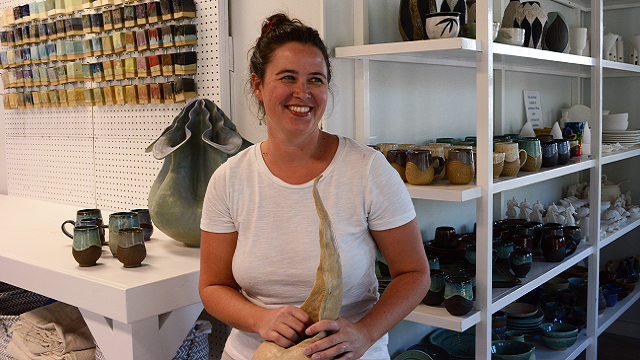
At the Coastal Arts Center of Orange Beach, you might notice a gallery/studio space with functional pottery like bowls, mugs and plates, as well as sculptures. The studio belongs to Maya Blume-Cantrell, an artist producing both types of pottery and teaching classes on her favorite subject. “The functional pieces are made using a potter’s wheel, so everything starts with the symmetry and the circle. They are then thrown and carved while shaping the bottom and adding handles if they are going to be mugs,” Blume-Cantrell said. “The sculptural work is coil-built, which is basically rolling out long cylinders or snakes of clay about the size of my finger and adding them one layer at a time. With the coils, your form can be much more organic; you aren’t constricted by the circle.” Blume-Cantrell began working with clay when she was in college. She was infatuated with how amorphous it was. She wasn’t restricted by the shape of wood or metal. She also loved the dichotomy of making soft organic shapes and hard geometric shapes out of the same medium. “What I found intriguing about clay was the ability to make anything within your imagination. Almost all of my work is sold through the gallery here at the Coastal Arts Center. My sculptural work is featured in a couple of other galleries regionally. I have some work in Franklin, Tennessee, at Gallery 202; also in Robertson Gallery in Mobile,” Blume-Cantrell said. A resident artist at the Coastal Arts Center, Blume-Cantrell enjoys the visual and performing arts center in the Gulf Coast region of the state. All the artists there strive to enrich the lives of residents and visitors through interactive exposure to local art. “At the Coastal Arts, we teach classes on the wheel, as well as hand-building. We teach children’s and adult classes. Anything within your imagination that you want to make, we help you create it,” Blume-Cantrell said. Both Blume-Cantrell and her husband, Nick Cantrell, are artists. She considers it a privilege to live and work together. “My husband and I are very fortunate in that we have both reached a time in our lives where we can both be creative and make a living through our artwork. It’s very rewarding for someone to identify with a piece that I make, that they can find something that speaks to them in that piece,” Blume-Cantrell said. Some of Blume-Cantrell’s work has been sent to exotic places, in addition to selling all over the South. “I did some mugs for the captain of a ship that is based out of the Mediterranean. They started in Malta, came down through the Caribbean, raced up to Bermuda through the northeast Atlantic coast and they’re going to be cruising back. And yes, they made it through the Bermuda Triangle, but they would blame that on the rum,” Blume-Cantrell said with a laugh. Republished with permission from the Alabama NewsCenter.
Steve Flowers: The 2017 political year was Moore exciting than expected
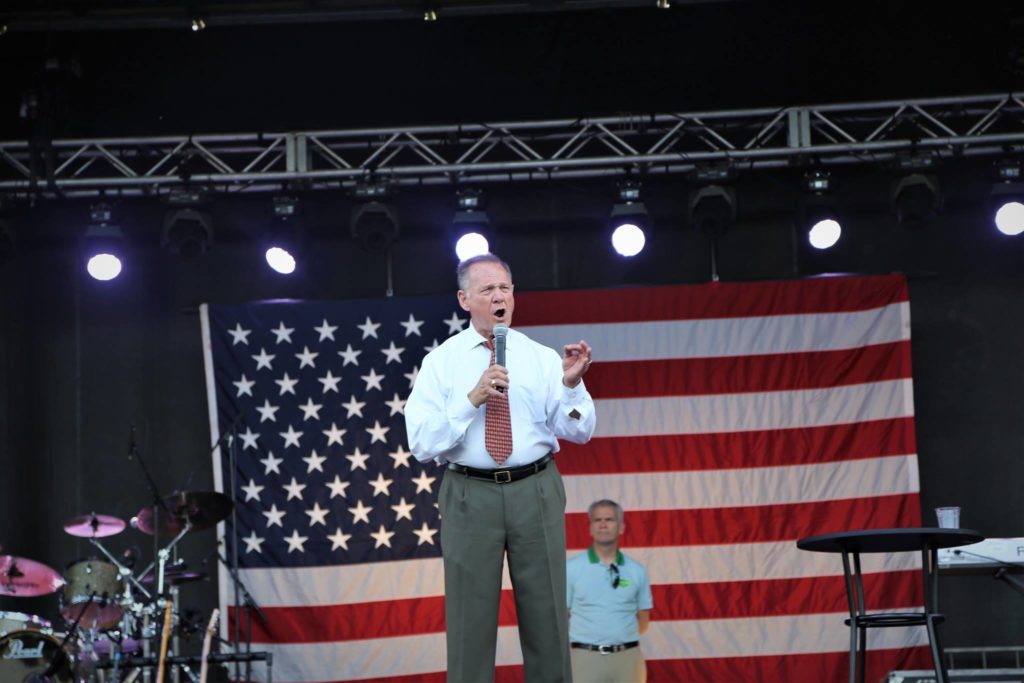
Well, folks, we have had a more exciting and fun filled political year than we expected. Usually, most of the fun is reserved for even numbered years when presidential or gubernatorial elections are held. However, it’s been a good ride. Obviously, the Special Election for the remaining three years of Jeff Sessions’ senate term monopolized the year. Although you will have to remember, that election was preceded by two events that set up the senate race. Donald Trump selected Jeff Sessions to be Attorney General. Sessions had been our junior senator for 20 years. He was elected to his fourth 6-year term in 2014. Therefore, the seat we just voted on comes up again in 2020. Believe me there are probably a dozen viable Republican thoroughbreds who have already decided they are interested and are chomping at the bit to run. However, most of them have statewide or congressional reelection plans to get out of the way in next year’s 2018 elections. Remember good ole Governor Robert Bentley? It may seem like a long time ago but Bentley was our governor this time last year. His romantic obsession with his personal advisor was about to drive him from his office. However, he had a golden opportunity to appoint Jeff Sessions’ replacement until an election could be held. He appointed Attorney General Luther Strange. Well ole Bentley leaves office with two years left in his term and in steps Kay Ivey, who has been in the obscure office of Lt. Governor for six-years. She takes the reigns of state government and the first thing she does is throw Luther under the bus and change the election from 2018 to this year. If Luther had been given a year for people to forget the appointment by Bentley and been able to run when every other race was on the ballot in 2018, and spend $15 million from the Washington establishment PACs, he would have won the seat for 6-years and the rest of his life. Senator Richard Shelby would have been happy with his new colleague and Jeff Sessions would have been pleased with his successor. Our Ten Commandments Judge Roy Moore was poised and ready to go to the senate. The Judicial Inquiry Commission had removed him from the bench for being against gay marriage. The decision for Moore was easy. He had nothing else to do. It was like putting Brer Rabbit in the briar patch. The first poll and the last poll revealed the book on Moore. It was written. He had a hardcore 30-percent of the vote in Alabama made up of right wing, hardcore, evangelical Alabama folks. This 30-percent would vote for him come Hell or high water; and they did. However, that same polling also revealed that there remains 70-percent that will not vote for him under any circumstance. The reason he lost was that a good portion of that 70-percent showed up to vote. Surprisingly, the belief by many was that this 70-percent would not vote. His 30-percent was going to vote and they did. That’s why he won the primary, his 30-percent are more ardent religious and quite frankly older. They vote. On the other hand, a good many of the Roy Moore detractors are younger and darker. African American voters, young and old, turned out in massive, inexplicably amazing unprecedented numbers and voted against Roy Moore and Donald Trump. It was a tidal wave that was enormous and it sent Roy Moore to a watery grave. As a good many of the state’s newspapers headlines declared, “No Moore.” This race classically underlines and illustrates the undeniable political truism that more people vote against someone than vote for someone. Merry Christmas and see you next week. ••• Steve Flowers is Alabama’s leading political columnist. His weekly column appears in over 60 Alabama newspapers. He served 16 years in the state legislature. Steve may be reached at www.steveflowers.us.
US Senate passes historic tax reform legislation

The U.S. Senate passed the most historic rewrite of the nation’s tax laws in more than three decades Tuesday night by a 51-48 vote. The product of years of discussion, weeks of committee consideration and hours of floor debate, H.R. 1, the Tax Cuts and Jobs Act, will lower individual, small business, and corporate tax rates, double the standard deduction, repeal the Obamacare individual mandate, simplify the tax code, and dramatically increase the child tax credit. The Senate-passed report will receive a final vote in the House Wednesday morning before being sent to the White House for President Donald Trump’s signature. Alabama’s senior U.S. Sen. Richard Shelby voted in favor of the legislation, saying its passage will help put money back in the pockets of the middle-class Americans who have earned it. “The Senate today passed historic legislation to deliver pro-growth, middle-class tax relief to the American people. This bill not only lowers individual and corporate tax rates, lightening the burden on small businesses, but it works to revitalize our economy – impacting current and future generations to come. Across the nation, this legislation will help create jobs, increase paychecks, and make the tax code simpler and fairer,” said Shelby. “I am proud that we are able to work together to fulfill our commitment to deliver real tax reform and put money back in the pockets of the middle-class Americans who have earned it. This is a once-in-a-generation opportunity to change Americans’ lives for the better.” Alabama’s outgoing U.S. Sen. Luther Strange also voted in favor of the bill. “Tax relief is not pie in the sky. Today, it becomes reality for the American families working hard to make ends meet,” said Strange. “It becomes reality for the small businesses that serve as cornerstones of our communities. It becomes reality for job creators who know the power of American industry. Getting tax relief accomplished is the reason I came to Washington, and on behalf of Alabama, I was proud to cast my vote tonight.”
