
Alabama’s first openly gay lawmaker Patricia Todd to lead LGBTQ coalition
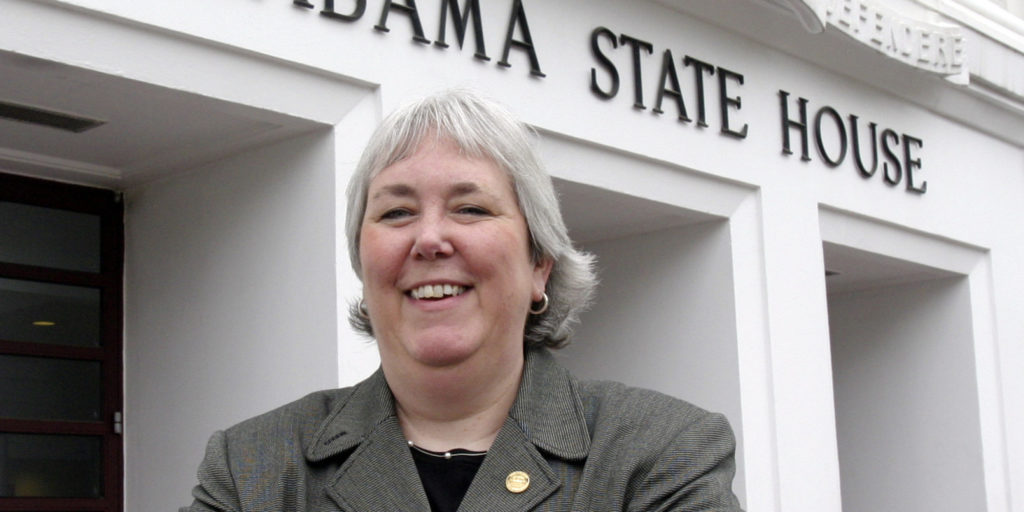
One Orlando Alliance, central Florida’s largest coalition of LGBTQ advocacy groups, on Tuesday named Birmingham-Democrat state Rep. Patricia Todd executive director. Todd, Alabama’s first openly gay lawmaker will lead the LGBTQ coalition in Orlando, Fla., in an effort to bring together LGBTQ+ organizations and work to transform Central Florida into an accepting and unified community for all. Eighteen organizations formed the alliance in June 2016 following the Pulse nightclub shooting in Orlando to offer short-term crisis counseling, emergency care packages, and money to victims and their families. Since then, the alliance has grown to more than forty groups with a long-term vision to support and empower LGBTQ residents in central Florida. Todd has over three decades of experience advocating for justice and equality. Born and raised in Kentucky, Todd served two years in Washington, D.C. with the National Organization for Women before moving to Alabama. She went on to serve as Executive Director for AIDS Alabama, the statewide HIV/AIDS organization, and State Director for the Human Rights Campaign. In 2006, she garnered national attention when she became the first openly gay elected official to serve in the Alabama House of Representatives. She was re-elected in 2010 without opposition. After serving 12 years, she did not seek re-election. Her farewell speech to the House received a standing ovation. “Patricia has been training for this role her whole life. She’s a natural fit and we’re delighted she’ll be joining the coalition in this important work,” remarked Jennifer Foster, Chair of the Board of Directors and one of the original co-conveners of the Alliance. Todd said of her new position, “I am honored to be selected as the Executive Director for One Orlando Alliance. I look forward to working alongside Alliance members to create a more inclusive Central Florida community.” “The work of One Orlando Alliance serves as a national model for how to pull community together in the wake of unimaginable tragedy,” Todd added. “I’m humbled to help tell that story of the origin and even more excited about our shared vision for a stronger, more unified future. Together, the Alliance will ensure that justice and equality are rights of all who call Central Florida home.” The selection of Todd followed an extensive nation-wide search that began in August, 2017. She will begin her new role on June 1.
University of Alabama researcher awarded USDA grant to improve flavor quality in foods
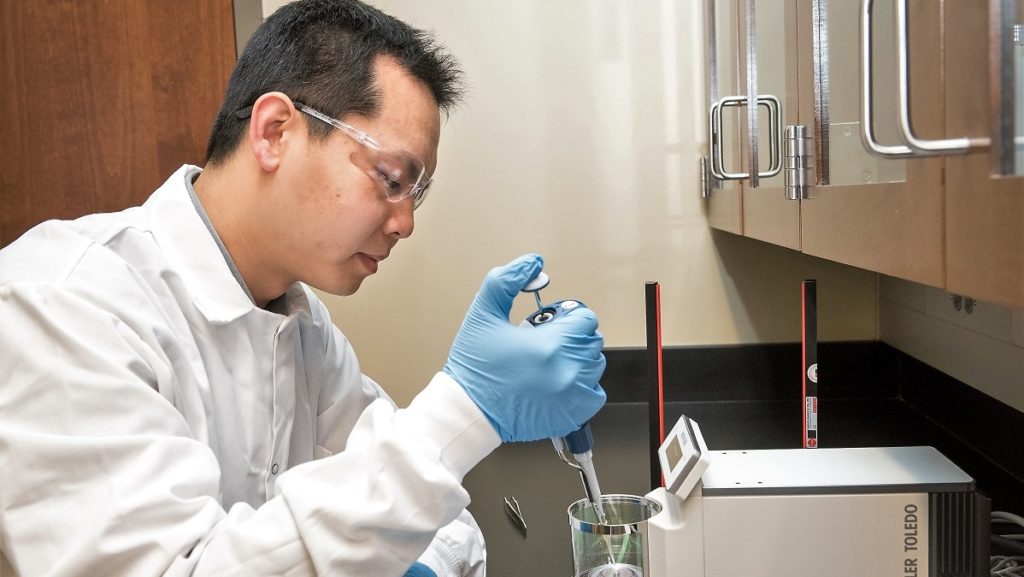
Dr. Lingyan Kong of the University of Alabama was recently awarded a $425,000 grant from the United States Department of Agriculture to research and improve flavor use efficiency and stability in foods using supramolecular starch-flavor structures. Flavor, the sensory impression of food, is determined primarily by the chemical senses of smell and taste. Flavor stability and release behavior are significant quality and acceptability factors for food, but they are difficult to control. A common example used to describe the short-lived nature of flavor is how some chewing gum products provide a blast of flavor that lasts only several seconds or minutes. To find innovative solutions to the challenges of food flavor use, Kong is developing a composition, known as supramolecular starch-guest inclusion complexation, to modulate flavor encapsulation and release as novel food ingredients. “In food formulation, flavor compounds are often the most expensive ingredients,” said Kong, a UA assistant professor in the department of human nutrition and hospitality management. “But, these compounds are volatile and they can become unstable when exposed to heat or light, and their release from foods is difficult to control.” The subject of supramolecular starch-guest inclusion complexation and its preparation have been studied in the past, but Kong is one of the first researchers to explore its practical applications. Through his research, Kong has invented a cost-efficient method to produce the supramolecular structures, and he recently started the process of having his composition and method patented. “Starch is an important agriculture commodity that is relatively inexpensive,” said Kong. “During this process, starch molecules wrap around flavor compounds to form inclusion complexes that can improve flavor’s dispersibility and stability, ultimately controlling its release.” Aside from improving and sustaining flavor release, Kong believes his method can help mask unpleasant tastes and odors in foods, as well as medications. “Everyone has experienced certain ingredients in foods and medications that have an unpleasant taste or malodor,” said Kong. “The structure I created may have the ability to mask those undesirable senses by hiding those tastants and malodor compounds in starch, preventing them from being detected by the taste buds on our tongue or the olfactory receptors in our nose.” According to Kong, the USDA-funded project will last three years. While the majority of Kong’s work will be done at UA, he will collaborate with Penn State University, where he earned his doctorate in food science. During the final stages of the project, Penn State will provide sensory analysis of the food formulations produced. “Scientifically, we are working to understand how molecules assemble in the supramolecular structures and what controls their disassembling so we can start to manipulate flavor release,” said Kong. “Once we have a better understanding of the structures and properties, we can start to add the starch-based flavor ingredients to food, nutrition and pharmaceutical applications.” Republished with the permission of the Alabama Newscenter.
Steve Flowers: Court of Appeals races on ballot this year

Last week we made you aware that five of the nine seats on our State Supreme Court are up for election this year. In addition, our Court of Civil Appeals and Criminal Appeals have several members up for election. The folks who sit on these courts essentially have zero name identification.Even when polling is done soon after Alabamians have voted for them, Alabama voters still cannot identify them. These courts do just what their name implies. They hear appeals from civil and criminal cases from around the state and are a barrier or gatekeeper between the circuit or trial courts around the state. They deflect a lot of cases from getting to the Supreme Court. Most states have these appellate courts. They are similar and derived from the federal appellate courts. Alabama is in the minority of states that elect our judges. All of our judges in Alabama are elected, not only the Supreme and Appellate Court jurists, but also our local Circuit and District Judges. Judges in most states are appointed – usually by the governor. The crafters of our 1901 Constitution gave the people the right to vote on judges, which was one of the deference’s from having a powerful governor. There are nine seats on the State Supreme Court and five seats each on the Court of Civil and Criminal Appeals. All 19 of our state court seats are held by Republicans, which is reflective of our state’s political leanings. As would be suspected with all Republicans, they tend to be conservative. Our Court of Civil Appeals leans pro-business, and our Court of Criminal Appeals tends to favor prosecutors over defendants. However, our current Court of Criminal Appeals has a very glaring exception due to the obvious inexplicable length in their handing down an opinion on the conviction of former Speaker, Mike Hubbard. In almost all cases heard by the Court of Criminal Appeals, they render an opinion upholding a conviction by a local jury. The only exception is when there is an egregious overt error in jury instructions or overt documented prejudice by a Circuit Judge. Folks, I watched and followed the Mike Hubbard case. Judge Walker, a highly respected and veteran experienced Lee County Circuit Judge did a meticulous job in that trial. A 12 person jury convicted Mike Hubbard of Ethics Law violations. There was no error in protocol or one shred of evidence that was not presented. It was a lengthy trial. Hubbard had his day in court. A jury of his Lee County peers found him guilty. Judge Walker, in order to avoid error, read the instructions to the jury to assure that proper language was unmistakable. As I travel the state on Speaking engagements and Talk shows, invariably the first question asked by Rotarians or callers is, “Why hasn’t Mike Hubbard gone to jail?.” They ask a pertinent question. They suspect foul play or political deference may be at play. It would appear that that might be the case. Hubbard was convicted almost two years ago. The Court of Criminal Appeals usually rules on an intricate murder trial in less than a year. Yet, Hubbard remains free on Appeal. The average Alabamian is perplexed by the delay. I suspect politics is at play in this case. It may revolve around campaign contributions to judicial candidates. The members of the State Court of Criminal Appeals are Liles Burke, Mary Windom, Beth Kellum, Sam Welch and Mike Joiner. There are several newcomers in the June Primary. The list includes running for three open seats; Richard Minor, Donna Beaulieu, Bill Cole, Rich Anderson and veteran Fayette County District Attorney, Chris McCool. We also have some races on the Court of Civil Appeals next month. The business community is obviously more interested in this Civil Appeals Court than Criminal.In place 1, Baldwin County Circuit Judge Michelle Thomasson may have an edge over Pat Thetford of Birmingham and Christy Edwards of Montgomery. Incumbent Judge Terri Willingham Thomas is being challenged by Chad Hanson for Place 2. There are a lot of judicial races on our June 5 ballot on both the state and local level. See you next week. ••• Steve Flowers is Alabama’s leading political columnist. His weekly column appears in over 60 Alabama newspapers. He served 16 years in the State Legislature. Steve may be reached at www.steveflowers.us.
