
Martha Roby: A season of Thanksgiving and rebuilding
![[Photo Credit: Pixabay.com]](https://altoday.com/wp-content/uploads/2018/11/cornucopia-1789664_1920-1024x683.jpg)
Thanksgiving is a uniquely special holiday because it provides us an entire day each year to pause as a country and give thanks to God for the countless ways He has blessed us. The stress and craziness of everyday life often make it easy to lose sight of just how much we have to be thankful for, so as we all have the opportunity to gather with loved ones this Thanksgiving, I hope we all take time to count our numerous blessings. While we have a lot to be thankful for in our state and country right now, there are also people in our district and throughout the Southeast who are in the midst of a very challenging recovery period in the wake of Hurricane Michael. When this horrific storm made landfall just over a month ago, areas of Alabama, Florida, and Georgia were completely ravaged. Hundreds of people lost everything, and more than 30 people were killed. Needless to say, this Thanksgiving will be a very emotional time for many people in our country. Here in our district, the agriculture community faces the most significant devastation. While the full scale of damages is still being assessed at this time, Hurricane Michael dealt a terrible blow to our cotton, timber, and peanut farmers. In the aftermath of the storm, I have traveled to the Wiregrass several times to be with our farmers and to see firsthand what they are experiencing. In fact, I recently had the opportunity to visit a farm in Houston County with U.S. Department of Agriculture (USDA) Secretary Sonny Perdue and Alabama Department of Agriculture and Industries Commissioner John McMillan to assess damage and discuss recovery efforts with some local farmers. I appreciate the local leaders and hardworking farmers who took the time to sit down with Secretary Perdue, Commissioner McMillan, and me. Secretary Perdue is a friend to Alabama, and I’m deeply grateful that he made this visit happen and participated in this important dialogue with Alabama farmers. I will work alongside Secretary Perdue and my colleagues in Congress to provide the proper resources and assistance to our farmers. My job is to be on the front line fighting for Alabama, and we are making the push to get this done quickly and correctly. We must get this right, and we must ensure that Alabama’s farmers are included in all recovery efforts. Throughout my time in Congress, I have made it a priority to fight for our farmers of all commodities. Their work to provide the food and fiber we depend on is vitally important. I will continue to advocate for them, especially during this time of uncertainty as we work to put the pieces back together for these hardworking men and women who have suffered tremendous loss to their livelihoods. During this season of Thanksgiving as you’re gathered with family and friends, I hope you will join me in prayerfully remembering our neighbors in the Wiregrass and throughout the Southeast. While the challenge of rebuilding won’t be easy, I am confident that we will get through it together. In the spirit of the holiday, I want to take this opportunity to tell you that I am thankful for the responsibility to serve our state and country in the United States Congress. It is a true honor to be in a position to make a difference on behalf of Alabama’s Second District, so thank you for allowing me to serve you. From my family to yours, Happy Thanksgiving. ••• Martha Roby represents Alabama’s Second Congressional District. She lives in Montgomery, Alabama, with her husband Riley and their two children.
Nancy Pelosi has ‘candid’ talk with potential rival for speaker
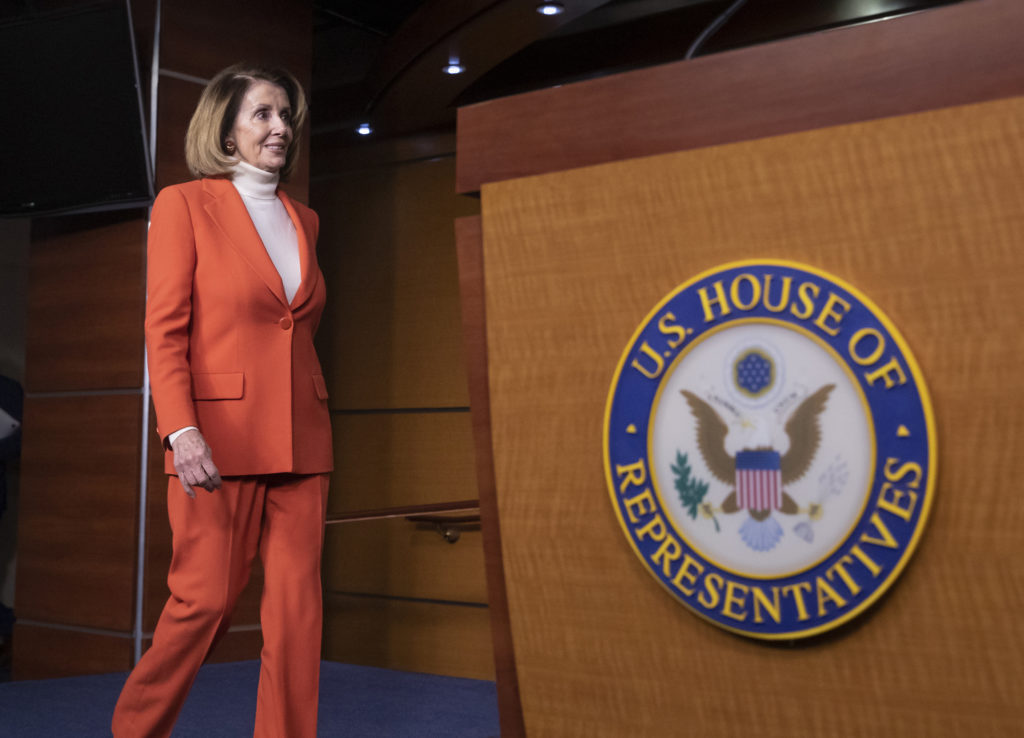
Nancy Pelosi met privately Friday with her top potential rival for House speaker, Rep. Marcia Fudge, as the Democratic leader works to gather support and fend off a challenge from a small but persistent group determined to stop her from reclaiming the gavel. Fudge said the two had “a very open and frank discussion,” including about “the feeling in the caucus of people who are feeling left out and left behind” and the need for a transition to new leadership. “We talked about some succession planning,” Fudge told reporters. “She did not share them with me. But I think it is something our caucus is interested in knowing.” The Democratic leader and the Ohio Democratic congresswoman met in Pelosi’s stately office, steps from the House floor, for about 45 minutes as lawmakers left town for the Thanksgiving recess without a resolution to the leadership struggle. “We had a candid and respectful conversation,” Pelosi said. Fudge said she shared with Pelosi “the growing support that I have and why I’m considering a bid to run for speaker.” Democrats are expected to take an internal caucus vote when they return after Thanksgiving and Fudge said she would decide by then if she is running. “To her credit, she wanted to know what my concerns were. We discussed them,” Fudge said. “What she asked me was, basically, how we could get to a point where I’m supportive.” If it was up to most of the Democratic Party, Pelosi would be the obvious choice to become speaker of the House in the new Congress, when Democrats have the majority. But within the ranks there’s a small but persistent group pushing to topple her return as the first woman with the gavel. Some say it’s time to give younger lawmakers a chance to rise. Pelosi, 78, made history when she became the first female speaker of the House in 2007. She assumed the post after Democrats took control of the House in midterm elections during former President George W. Bush‘s second term. She appears be winning the outside game for a return to the speakership, amassing endorsements from a who’s who of the nation’s Democrats: former Vice President Al Gore and former Secretary of State John Kerry. Inside the Capitol she has support from influential lawmakers, Rep. John Lewis, D-Ga., the civil rights leader, and Rep. Adam Schiff of California, who’s in line to chair the Intelligence Committee, among others. Most recently Pelosi got the nod from MoveOn.org as a coalition of liberals sound the alarm against an overthrow being orchestrated by mostly centrist Democrats who want to prevent the San Franciscan from being the face of the party. It noted her work passing the Affordable Care Act and tweeted: “Were it not for her skilled and effective leadership, the ACA would not be law today. Dems must reject attempts to defeat her and move caucus to the right.” The Congressional Progressive Caucus also met Thursday with Pelosi and emerged pleased with her commitment to boost their ranks on key committees and provide funding for lower-level leadership offices that set policy and communications for the caucus. The group has not yet endorsed anyone, but Rep. Pramila Jayapal, D-Wash., a co-chair of the caucus, said Democrats need a leader who can hit the ground running “to deliver real results.” The show of strength is a reflection on Pelosi’s 15-year tenure as party leader but also her place in history as the first woman to hold — and potentially return — to the speaker’s office after an election that ushered in a record number of women candidates. It’s not lost on supporters that a group made up of mostly men is leading the effort to oust her. On the list of 17 names who’ve signed onto a letter against her, just three are women. Pelosi’s opponents started rallying Thursday behind Fudge’s possible bid for the job, even though her potential campaign is splitting votes in the powerful Black Caucus. Fudge, recently re-elected to a 7th term, is an ally of Ohio Democratic Rep. Tim Ryan, who mounted an unsuccessful campaign against Pelosi two years ago and is a leader of the current effort to topple her. “The country needs to come together, our caucus needs to come together,” Ryan said. “We need to heal and Marcia Fudge is one of the people who could make that happen.” Pelosi has fended off challenges before, but this one — fueled by newcomers calling for change and frustrated incumbents who feel shut out of leadership after her many years at the helm — poses perhaps the biggest threat yet. With a narrow Democratic majority, now at about 230 seats, she does not have much cushion to secure the 218 votes needed on the floor if all Republicans vote against her, as expected. Some House races remain undecided and the Democratic majority could grow slightly. There is a chance the math could shift in Pelosi’s favor if lawmakers are absent or simply vote “present,” meaning she would need fewer than 218 votes for an absolute majority. The full chamber will elect the next speaker Jan. 3. Pelosi has said she has “overwhelming support” to become the next speaker. Republished with permission from the Associated Press.
Secretary of State’s office recovers over $100,000 in campaign finance fines

Alabamians, like most Americans, want transparency when it comes to politics. Part of that means being able to see who’s funding political candidates. Which is exactly why political candidates and Political Action Committees (PACs) are required to file campaign finance reports. But sometimes those reports aren’t filed on time, or at all. Which is why the state legislature passed act 2015-495 in 2015 that allows the Alabama Secretary of State’s office to issue fines when Principle Campaign Committees (PCCs) or Political Action Committees (PACs) don’t file their monthly, weekly, or daily campaign finance reports on time. The act went into effect with the start of the 2018 Election Cycle and since that time Secretary of State John Merrill‘s office has issued 1,166 penalties or warnings for a total amount of $197,657.84. Thus far, $102,249.05 has been paid. The money not yet paid has either been waived by the Alabama Ethics Commission or the office is still waiting to collect the funds from the committee. According to the Secretary of State’s office, “Penalties are issued to any committee that does not file their campaign finance report by midnight on the date the report is due. Most reports are due by 12:00 p.m. on the 2nd of each month. Committees are required to report all contributions and expenditures incurred by their campaign during the previous month.” Accordingly, penalty amounts increase as the number of late reports increases from the candidate. Additionally, the first report a candidate files late, but within 48 hours of the date the report is due, the committee is given a warning that does not count against them or require a fine be paid. Further, the code specifically states that warnings are not violations of the law. In addition to the warning process, committees have the ability to appeal their penalty to the Alabama Ethics Commission. Of the 1,166 penalties and warnings, 166 have been overturned. Fines paid by committees to the Secretary of State’s office is deposited directly into the state general fund.
John Merrill says don’t count write-in votes for Alabama state or federal offices
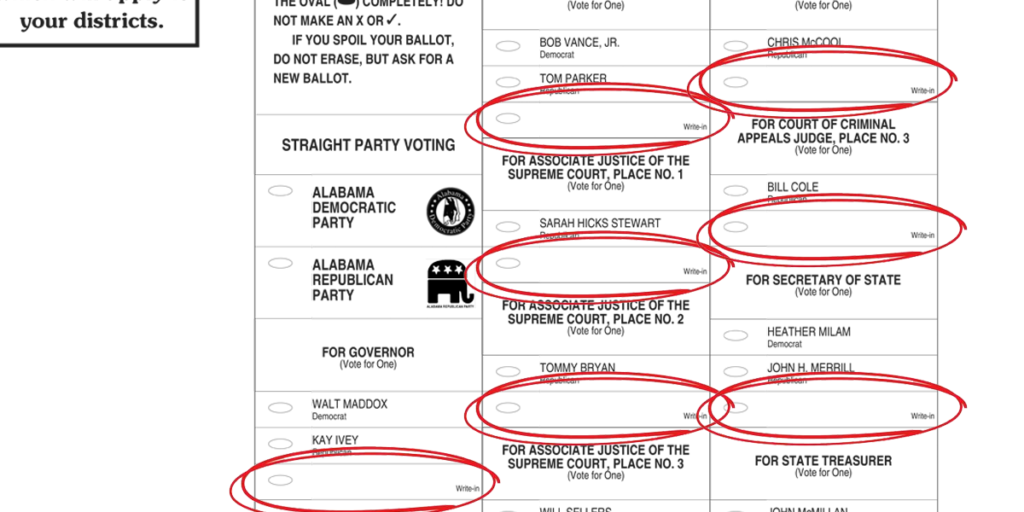
Alabama voters who are unhappy with the choices at the polls often choose to write-in candidates instead of casting their vote for someone they can’t get behind. But that doesn’t necessarily mean their vote will ever be counted. At least not in a public way that they might otherwise expect. Such is the case in the 2018 midterm elections. Alabama Secretary of State John Merrill‘s office on Tuesday announced there were not enough write-in votes cast to merit counting them by name — as they won’t change the final outcome. According to Alabama law, 17-6-28, write-in votes don’t need to be counted unless they may impact results. State law requires the Secretary of State’s Office to review county vote totals and compare those totals to the number of write-in votes cast in each statewide race involving a Federal or State office. Following the completion of that review, the Secretary of State’s Office is tasked with determining whether the total number of write in votes is less than the difference in votes between the candidates receiving the greatest number of votes for that office. “Merrill and his team have completed a review of the offices and it has been determined that no county is required by law to count and report write-in votes as there were not enough votes cast,” according to a news release from the Secretary of State’s office. But that doesn’t mean the write-in votes aren’t “counted.” The total number of write-in votes are recorded, but since the number is inconsequential to the outcome of the race, election officials aren’t required to tally specific votes for each individual write-in. “All write in votes are counted and acknowledged and recorded, and documented. They just don’t have to be delineated for the public to see because they did not affect the outcome of the race. All votes counted for those individuals whose names were written in,” Merrill explained on Alabama Today’s Facebook page. Hypothetical scenario To better understand how the write-in vote counting process works, imagine that in a given county there were 100 ballots cast total in one particular race. Suppose Candidate A received 53 votes, Candidate B received 35 votes, and a Candidate 3, a third-party candidate, received 10 votes. That means there were just two write-in votes in the race. Given that two votes would not be enough to change the outcome of the election, the names of those votes would not be recorded. All 100 votes, and their break-down — Candidate A: 53 votes, Candidate B: 35 votes: Candidate C: 10 votes, Write-ins: 2 votes — will be documented. Final vote totals County election officials must still make this determination for any county offices not included in the Secretary of State’s review. Final vote totals as certified by the County Canvassing Board are due to the Secretary of State’s Office by Friday, November 16. *This story has been updated to further clarify the write-in vote counting process.
Uniontown gets a $23.4 million wastewater solution from the USDA
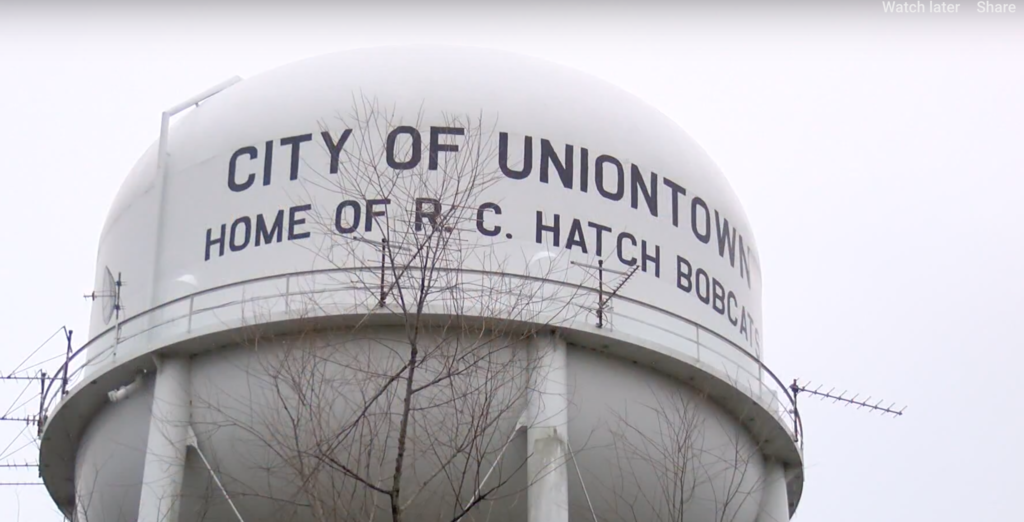
The U.S. Department of Agriculture (USDA) announced a $23.4 million grant to address an ongoing wastewater treatment crisis in Uniontown, Ala. USDA will work with the municipality to create an outside board which will oversee the development of a new wastewater system for Uniontown residents. Alabama 7th District U.S. Rep. Terri Sewell calls the grant “a huge victory” for Uniontown. “Today’s grant announcement is a huge victory for Uniontown that will have a real-life impact for thousands of Alabamians living in the rural Black Belt,” said Sewell. “No American family should have to live without access to safe wastewater treatment in the 21st Century. I have met with families in rural Alabama who struggle with the health and economic challenges created by failing wastewater systems. Every day, their stories inspire my fight in Congress for stronger investments in our wastewater infrastructure. USDA’s assistance in Uniontown is an important step forward, but the wastewater crisis facing Alabama’s rural Black Belt is not over. We must continue fighting for Uniontown, Lowndes County, and all of our state’s residents who have to live with inadequate basic resources.” For over a decade, failing wastewater infrastructure has created enormous health and economic challenges for communities in rural Alabama. Since 2016, the issue has received national and international attention, with the release of a United Nations-sponsored report this year highlighting the failure of wastewater infrastructure in Alabama’s rural Black Belt. Alabama’s senior U.S. Sen. Richard Shelby helped lead the efforts to secure the funding. Along with Sewell, he was joined by U.S. Sen. Doug Jones, Alabama 4th District U.S. Rep. Robert Aderholt and USDA State Rural Development Director Chris Beeker. “Water and wastewater systems across the country are aging, overburdened, and in need of replacement,” said Shelby. “Failure to invest in these water projects has devastating economic and public health consequences. The dire situation in Uniontown is a prime example of a number of communities across Alabama in need of upgrades and repairs. I am proud to have led the efforts to create momentum for this project, and I would like to thank USDA for providing this critical funding. I remain committed to fighting for these greatly needed resources to combat our state’s growing infrastructure needs.” The USDA grant This $23,437,500 USDA Rural Development grant for Uniontown will enable a major infrastructure redesign and rehabilitation. The project will include construction of an interconnection between the city of Uniontown and the city of Demopolis which will pump wastewater to Demopolis for treatment. Once this collection system is operational, the treatment of wastewater through the city of Uniontown’s existing lagoon and spray field system will be eradicated. The lagoons and spray field serving the city of Uniontown will be decommissioned and reclaimed, which will eliminate wastewater overflow and assist the city to better comply with environmental regulatory requirements. Approximately 2,810 customers in the city of Uniontown and the surrounding area are served by this wastewater system.
Supporters, opponents address proposed new beach bridge in Baldwin County

Transportation officials in Alabama have gotten plenty of opinions, pro and con, to consider on a proposed bridge to improve access to the state’s beaches. The department of transportation heard from 28 people in Gulf Shores on two proposals for a road and bridge project that’s expected to cost between $56 million and $61 million, news outlets reported. City leaders in Gulf Shores and Orange Beach also testified in favor of the project, saying it would help evacuate the beaches during hurricanes. “You cannot get on or off the island during any kind of catastrophic event,” said Orange Beach City Councilman Jerry Johnson. Gulf Shores public works director Mark Ackerman pointed out one of the existing bridges was closed for more than a day because of a barge collision in 2014. Thursday’s hearing comes just weeks after Hurricane Michael slammed ashore on the nearby Florida’s Panhandle as a Category 4 storm killing 45 people. The Alabama DOT is accepting public comments for the rest of the month. It plans to decide on a plan early next year. “We want to improve community connectivity, said Vincent Calametti, Southwest Region Engineer for the transportation department. Supporters say a new bridge would improve congestion that clogs roads heading to the beach during peak travel months. More than 6 million people visit the state’s beaches each year. Opponents say it’s a waste of money and should not be a top priority for transportation funds. They say the project might not get tourists to and from the beaches any faster, calling it a “Bridge2Nowhere.” Other opponents say the Mobile area has more important needs, including the widening of U.S. 98. Some residents living near the proposed bridge site are worried about noise and the appearance in the neighborhood. Republished with permission from the Associated Press.
Florida: Hand recount begins for tight US Senate race
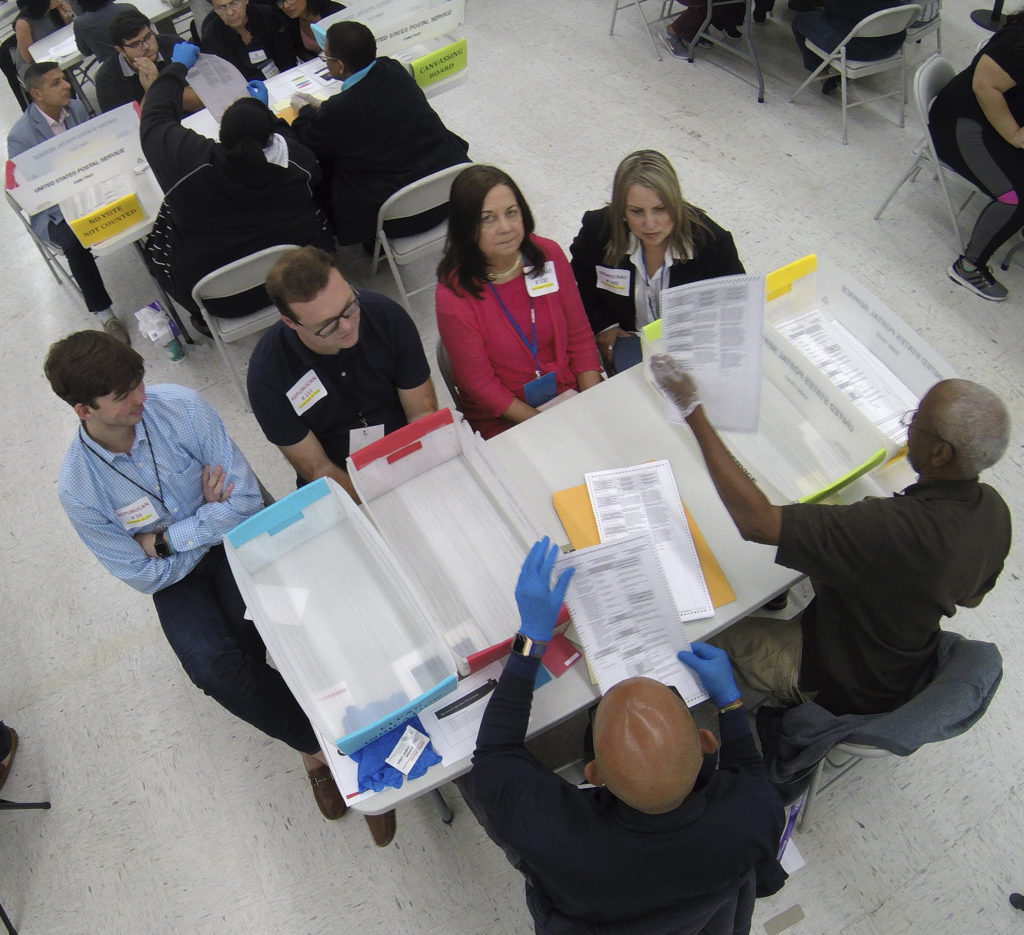
A hand recount began Friday in Florida’s acrimonious U.S. Senate contest after an initial review by ballot-counting machines showed Republican Gov. Rick Scott and Democratic Sen. Bill Nelson separated by fewer than 13,000 votes out of more than 8 million cast. Under state law, a hand review is required when the victory margin is 0.25 percentage points or less. A state website’s unofficial results show Scott ahead of Nelson by 0.15 percentage points. A hand recount in the Senate race does not review all votes that were cast. It will involve only that fraction of ballots in which voters cast either two votes for one race, which is called an overvote, or appeared to choose no candidate, which is an undervote. The idea is to figure out a voter’s intent. At a warehouse in Broward County — which has had numerous problems throughout the election — dozens of volunteers sitting at folding tables cheered loudly when they were told they had finished the recount Friday morning for the Senate race and could go home for the day. Results were not immediately announced. The margin in the governor’s race between Republican Ron DeSantis and Democrat Andrew Gillum was 0.41 percent. That means the contest for governor appeared all but over Thursday, with a machine recount showing DeSantis with a large enough advantage over Gillum to avoid a hand recount in that race. Gillum, who conceded on Election Night only to retract his concession later, said in a statement that “it is not over until every legally casted vote is counted.” The overall recount has been fraught with problems. One large Democratic stronghold in South Florida was unable to finish its machine recount by the Thursday deadline due to machines breaking down. A federal judge rejected a request to extend the recount deadline. “We gave a heroic effort,” said Palm Beach Supervisor of Elections Susan Bucher. If the county had three or four more hours, it would have made the deadline to recount ballots in the Senate race, she said. Meanwhile, election officials in another urban county in the Tampa Bay area decided against turning in the results of their machine recount, which came up with 846 fewer votes than originally counted. And news outlets in South Florida reported that Broward County finished its machine recount but missed the deadline by a few minutes. Scott called on Nelson to end the recount battle. It’s time for Nelson “to respect the will of the voters and graciously bring this process to an end rather than proceed with yet another count of the votes — which will yield the same result and bring more embarrassment to the state that we both love and have served,” the governor’s statement said. The margin between Scott and Nelson had not changed much in the last few days, conceded Marc Elias, an attorney working for Nelson’s campaign. But he said he expects it to shrink due to the hand recount and the ruling on signatures. Six election-related lawsuits are pending in federal court in Tallahassee, and at least one in state court. The situation drew the ire of U.S. District Judge Mark Walker, who slammed the state for repeatedly failing to anticipate election problems. He also said the state law on recounts appears to violate the U.S. Supreme Court ruling that decided the presidency in 2000. “We have been the laughingstock of the world, election after election, and we chose not to fix this,” Walker said at a hearing Thursday. Late Thursday, Walker rejected a challenge by Nelson and Democrats to the rules of the hand recount in the Senate race. During the hand recount, elections officials look at just the ballots that weren’t recorded by voting machines. Walker found the state’s rules were reasonable and constitutional. Walker also ordered that voters be given until 5 p.m. Saturday to show a valid identification and fix their ballots if they haven’t been counted due to mismatched signatures. Republicans challenged this order and were turned down by an appeals court. State officials testified that nearly 4,000 mailed-in ballots were set aside because local officials decided the signatures on the envelopes did not match the signatures on file. If those voters can prove their identity, their votes will now be counted and included in final official returns due from each county by noon Sunday. Walker was asked by Democrats to require local officials to provide a list of people whose ballots were rejected. But the judge refused the request as “inappropriate.” Republished with permission from the Associated Press.
Doug Jones introduces bipartisan bill to help keep Alabama’s deer population healthy

On Thursday U.S. Sen. Doug Jones took a step to tackle one of the largest challenges facing hunters throughout the country — Chronic Wasting Disease (CWD). Jones introduced a bill in Congress to help to increase wildlife managers’ ability to keep wildlife healthy. The bill authorizes a special resource study to determine how CWD spreads and could be prevented in deer and elk. CWD can affect both wild and domestic herds of deer and elk in 25 states. However, state recommendations for preventing the spread of the disease vary. The bill would give state wildlife agencies and wildlife experts information to conduct targeted research on how the disease is transmitted, determine which areas are most at risk, and develop consistent advice for hunters to prevent further spread. CWD nears Alabama CWD is a deadly neurological illness, similar to mad cow disease, is putting the deer, moose and elk populations at risk. The disease is infectious, communicable, and always fatal. This fall, the disease was discovered in the wild in two deer in east Mississippi for the first time. As of now, the disease has not been detected in any Alabama deer. Alabama state wildlife officials have committed to pay extra attention to deer in Franklin, Lamar and Marion counties — all within a 50-mile radius of where the infected deers were found. Jones’ bill “As an avid outdoorsman and hunter, I am deeply troubled by the spread of Chronic Wasting Disease,” said Jones. “This disease is threatening to impact the wildlife population in Alabama just as it has in a number of other states throughout the country. That’s why it is so vital for the Senate to pass legislation that will ultimately give state and local wildlife officials the tools they need to contain the spread of CWD.” The “Chronic Wasting Disease Transmission in Cervidae Study Act” addresses the needs identified by state wildlife agencies. The bill requires the USDA secretary to enter into an arrangement with the National Academies of Sciences to review current data and best management practices (BMPs) from the CWD Herd Certification Program and state agencies regarding: Pathways and mechanisms for CWD transmission Areas at risk and geographical patterns of CWD transmission Gaps in current scientific knowledge regarding transmission to prioritize research to address gaps Maine-Republican U.S. Sen. Susan Collins, Texas-Republican U.S. Sen. John Cornyn , Wyoming-Republican U.S. Sen. Mike Enzi, Wisconsin-Republican U.S. Sen. Ron Johnson, South Dakota-Republican John Thune, West Virginia-Democrat Joe Manchin, and Mississippi-Republican Roger Wicker all cosponsored the legislation.
