
Democrats focus on voting rights ahead of 2020 primary
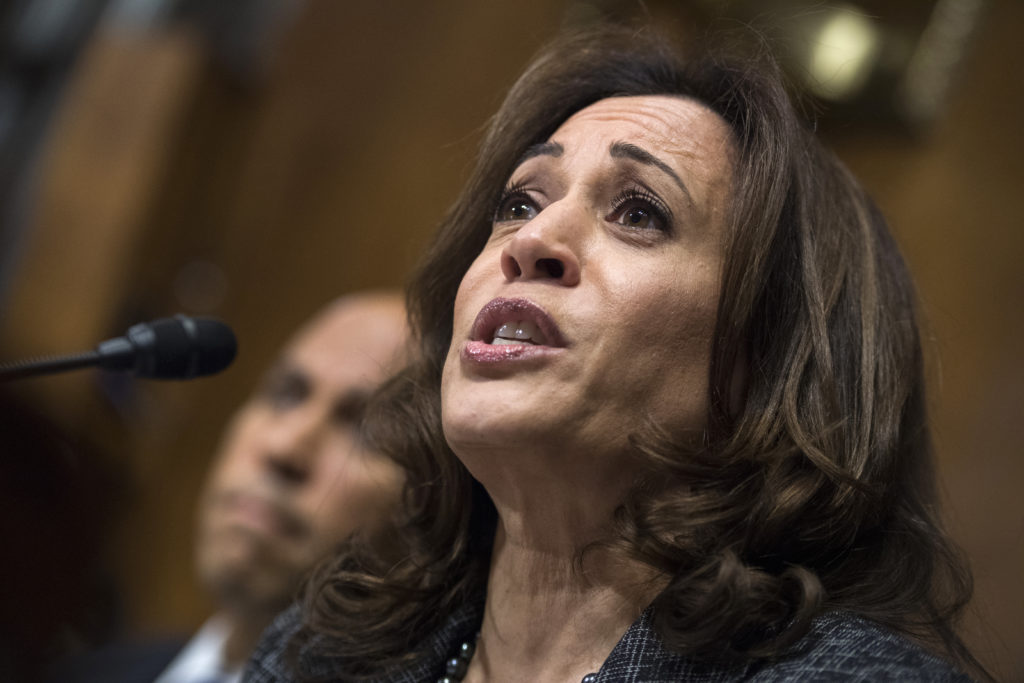
Democrats are trying to turn their most painful losses this year into a rallying cry they hope will electrify the 2020 presidential campaign: Every vote matters. Multiple potential contenders for the Democratic presidential nomination are elevating the issue of voting rights as they prepare to launch campaigns. They’re vowing to oppose Republican-backed efforts to require identification to vote, reinstate protections eliminated by a 2013 Supreme Court ruling and frequently highlight the necessity of counting every vote. The aim is to tap into the anger and frustration among Democrats who argue that Republicans win some elections by making it harder for their constituents, particularly minorities, to vote. That sentiment has long existed among Democrats but intensified after the party lost closely watched races for governor in Georgia and Florida last month. Both contests featured heated racial rhetoric and charges of voter suppression. The party’s suspicion of Republicans has also grown as a congressional race in North Carolina remains mired in allegations of absentee ballot fraud and GOP lawmakers in Wisconsin and Michigan seek to weaken the power of incoming Democratic governors. Democrats ultimately hope to turn the issue of voting rights into an argument that’s just as persuasive to voters in 2020 as health care proved to be in 2018. And there’s already competition among potential presidential contenders to build a reputation as the most aggressive in advocating for the right to vote. “This is not a new issue, and it is quite frankly the dark history of our country, which is specific populations being restricted from meaningful access to the right to vote,” Sen. Kamala Harris of California told The Associated Press. “There’s no question that 2018 highlighted an issue that has maybe seemed to be dormant for some time, but it’s very much alive and it should be the subject of dinner table conversations everywhere and it should be of real concern to everyone because, look, when people lose confidence in our democracy, when Americans lose confidence in our democracy, it will impair our strength. It will cause us to be weaker,” she said. Aides to Harris said that voting rights would be among her top priorities, and that she would likely frame it less as a civil rights issue and as more of a broader Democratic rallying point. She has argued that the entire Democratic agenda is weakened when Republicans restrict ballot access for unions, minorities and other groups. New Jersey Sen. Cory Booker, who is weighing his own presidential bid, has framed the issue of voting rights in the context of a traditional civil rights issue. During an October trip to Des Moines, Iowa, Booker sparked cheering standing ovations as he quoted from Martin Luther King Jr.‘s speech from the 1965 voting rights march on Montgomery, Alabama. “How long will it take? I’m going to tell you, not long now,” Booker proclaimed, turning the moment into a call-and-response. “Because it’s not long until November.” Harris, Booker and Sen. Amy Klobuchar of Minnesota are among the potential presidential candidates who will hold onto seats on the Senate Judiciary Committee heading into 2020, giving them an important post from which to address voting rights. That’s leaving some activists pleased that the issue appears to be moving into the mainstream of Democratic politics. “This is the first time where I feel like there has been a broad conversation because the examples were so egregious,” said Adrianne Shropshire, the executive director of BlackPAC, which works to mobilize black voters. “It was literally in every community that I went to, in every church that I stopped by, in every neighborhood when I was knocking on doors — that was almost one of the first things that people were talking about because everyone felt like their community was under assault.” Still, some caution that the focus on voting rights isn’t a successful strategy to win a crucial election and could instead backfire on Democrats who are trying to appeal to broader swaths of voters. Peter Guzman, a Republican who is the president of the Latin Chamber of Commerce in Nevada, said that while he feels every candidate — Democrat and Republican — should talk about voting rights, he didn’t see it as a singularly important issue to center a campaign on. “I think the conversation should be encouraging everybody to vote, and if anybody feels like that’s being suppressed, they certainly should call the authorities and make it known that they’re not able to vote,” Guzman said in an interview. He added that he could see potential backlash for a candidate who campaigns on it. “I’m not quite sure everybody in the country believes the problem is that significant,” he said. “Here in Nevada, I believe that we have some of the best, safest voting in the United States,” he added. “I think we’re a model for the rest of the nation. I do not believe that there’s voter suppression. Whenever I hear voter fraud, I believe those are buzzwords for other things.” That’s not stopping Democrats for now. At a post-election gathering on Capitol Hill of the National Action Network, the civil rights organization founded by the Rev. Al Sharpton, multiple senators who appear to be moving toward jumping into the 2020 presidential race eagerly discussed the issue. “When it comes to elections, there should be no hesitation: Every vote matters, period,” said Sen. Elizabeth Warren of Massachusetts. “If you can’t get more Americans to vote for you than the other guy or gal, then you lose. It’s that simple. Politicians are supposed to compete over how many voters they can persuade to come vote for them, not how many American citizens they can disqualify, discourage or demoralize.” Klobuchar, who could stake out a more moderate position among Democrats should she choose to seek the White House, told the gathering, “I think No. 1 on the agenda has got to be our economy.” “And then,” she continued, “you can’t have a fair economy for everyone if you don’t have fair voting rights.”
Compromise Farm Bill passes Senate with support of Richard Shelby, Doug Jones
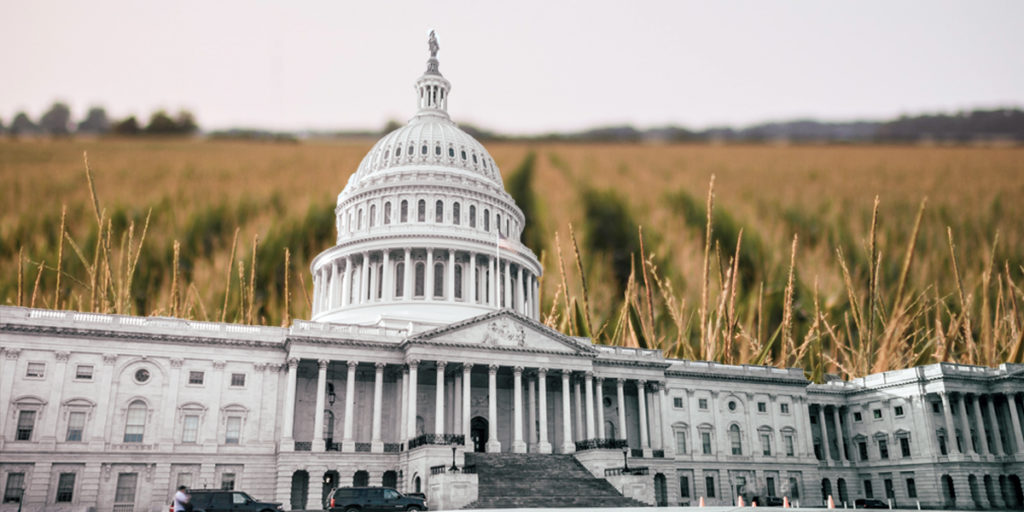
The compromise Farm Bill sailed to passage in the U.S. Senate on Tuesday by a bipartisan vote of 87 to 13, with the support of both Alabama U.S. Sen. Richard Shelby and Doug Jones, less than 24 hours after it being released to the public. The final bill reflects a hard-fought bipartisan, bicameral agreement on a five-year farm bill to strengthen the diversity of American agriculture and support the 16 million jobs that power the food and farm economy. “This bipartisan legislation provides much-needed predictability that will significantly benefit our state’s farmers and the entire agriculture industry,” said Shelby. “I look forward to the lasting positive impact this bill with have on rural areas throughout Alabama and the nation.” “This is a Farm Bill for rural Alabama and rural America,” said Jones. “I’m proud that the final legislation ensures that our farmers have the support and resources they need to continue to do their important work. It also addresses several urgent issues for our state, particularly the need for expanded rural health care and broadband access. Since I arrived in the Senate in January, I’ve worked closely with my colleagues on both sides of the aisle, as well as farmers from across Alabama, to advocate for a strong Farm Bill for all of our rural communities. This bill reflects the priorities we share for a brighter and more secure future for Alabama.” Agriculture is Alabama’s top revenue producing industry, generating an annual impact of over $70 billion. With over nine million acres of farmland and more than 48,500 farms, the state is a national leader in food production and a global competitor in the poultry, catfish, timber, cotton, and livestock industries. The bill now moves to the House for final consideration. 2018 Farm Bill Overview* The Agriculture Improvement Act of 2018, also known as the 2018 Farm Bill, strengthens the diversity of American agriculture, supporting the 16 million jobs at the root of our farm and food economy. The impact of the Farm Bill reaches both on and off the farm by growing opportunities for our farmers, protecting our land and water, strengthening small towns and rural communities, and supporting families working hard to make ends meet. Strengthening the diversity of American agriculture Protects crop insurance and expands coverage to new crops including fruits, vegetables, hops, and barley. The bill also improves crop insurance access for veterans, beginning farmers, and fruit and vegetable growers, and more than doubles the disaster assistance coverage options for crops that are not eligible for insurance. Improves risk management options for commodity crop farmers and dramatically expands the coverage for dairy farmers. Building on the $1.1 billion added to support dairy farmers in the Bipartisan Budget Act of 2018, the bill provides improved coverage options at more affordable rates and refunds up to $58 million in premiums paid under the former program. Expands export opportunities by securing an additional nearly $500 million in permanent funding over the next decade to help farmers find new global markets for their goods. Strengthens investments in agricultural research to support groundbreaking science that makes farmers more efficient, resilient, and sustainable, and invests $185 million in public-private research through the innovative Foundation for Food and Agriculture Research, which will generate nearly $4 billion in returns to the agricultural economy. Grows local food economies by securing $500 million in permanent funding, more than doubling past investments for farmers markets, local food systems, and value-added production as a part of the new Local Agriculture Market Program. Helps socially disadvantaged, veteran, and new and beginning farmers by combining initiatives to create $435 million in permanent funding – tripling the current investment – to educate the next generation of farmers and reach more minority farmers as a part of the new Farming Opportunities Training and Outreach Program. Helps military veterans with careers in agriculture by making risk management tools more affordable, improving access to land and capital, and prioritizing training for veterans. Establishes historic new support for urban agriculture in the farm bill for the first time by creating a new office at the U.S. Department of Agriculture to advocate for urban farms. It also includes provisions to make it easier for urban farmers to start their farms, grow their businesses, and manage their risk. Grows the organic sector by providing $395 million in permanent funding, which almost quadruples investment for organic research. The bill also offers cost-share assistance to help farmers transition into organics and strengthens trade enforcement. Provides support for specialty crop growers by continuing $2.4 billion in permanent investments in research, pest management, and promotion of fruits and vegetables and providing $125 million to conduct five years of critical citrus disease research. Legalizes hemp as an agricultural commodity, expanding the diversity of American agriculture and opening up new market opportunities for farmers. Safeguards livestock and poultry from disease outbreaks through strong investments in detection, response, and recovery, including the creation of a national vaccine bank. Offers $40 million in new scholarship opportunities at land grant universities for students attending historically black 1890’s colleges and universities and authorizes scholarships for tribal students pursuing careers in agriculture. New tools to conserve and restore our land, water, and forests Maintains funding in the conservation title, maintains unique working lands programs, and grows overall funding for conservation by leveraging private dollars. Invests in regional conservation partnerships by tripling mandatory funding, which will leverage nearly $3 billion in new private investment in locally-led conservation over the next decade, while also streamlining requirements for farmers and local partners leading the projects. Improves soil health and water quality by encouraging farmers to plant cover crops, providing incentives in conservation programs, driving climate-smart practices through a new soil health pilot to sequester carbon, and prioritizing the protection of drinking water by dedicating at least 10 percent of all conservation dollars to these projects. Secures opportunities for outdoor recreation by adding 3 million new acres to the Conservation Reserve Program, expanding Voluntary Public Access to allow more recreation on private lands, and designating 20,000 acres of national forest wilderness. Promotes clean energy and efficiency upgrades by including $500 million to help rural
Donald Trump bickers with Dem leaders, threatens gov’t shutdown
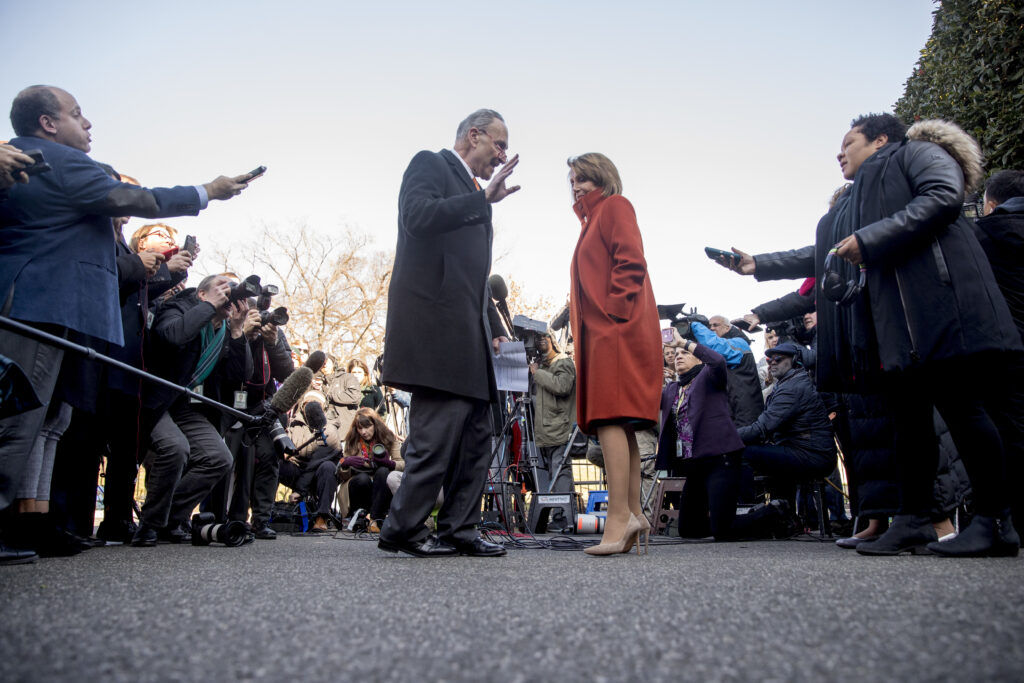
Bickering in public with Democratic leaders, President Donald Trump threatened repeatedly on Tuesday to shut down the government if Congress doesn’t provide the money he says is needed to build a wall at the Mexican border. Trump’s comments came as he opened a contentious meeting with Democratic Senate and House leaders Chuck Schumer and Nancy Pelosi, with a partial shutdown looming on Dec. 21 when funding for some agencies will expire. The president and Pelosi tangled over whether the House or the Senate was holding up his proposal. Trump and Schumer jabbed at each other over the import of the midterm elections — and who will be blamed if a shutdown occurs. “If we don’t get what we want, one way or the other, whether it’s through you, through military, through anything you want to call, I will shut down the government,” Trump ultimately declared. “I will take the mantle. I will be the one to shut it down.” The televised discussion was Trump’s first encounter with the newly empowered Democrats since their midterm victories in the House. It offered a remarkable public preview of how divided government might work — or break down — over the next two years as the 2020 presidential election nears. Pelosi later called the confrontation with Trump “wild” and boasted that she and Schumer goaded the president to “fully own that the shutdown was his.” “It’s like a manhood thing for him,” Pelosi told Democratic lawmakers back at the Capitol. “As if manhood could ever be associated with him. This wall thing.” Pelosi’s comments were described by an aide who was in the room but was not authorized to speak publicly. Schumer, meanwhile, told reporters that “this Trump shutdown, this temper tantrum that he seems to throw, will not get him his wall and will hurt a lot of people.” Senate Majority Leader Mitch McConnell said he hasn’t given up hope that a shutdown can be averted. The Kentucky Republican said “magic” sometimes happens in Congress ahead of Christmas, when lawmakers are eager to leave Washington. “I’d like to see a smooth ending here,” McConnell said at the Capitol. Republican House Speaker Paul Ryan acknowledged Tuesday that the GOP-led House has yet to pass legislation that includes the $5 billion in border wall funds that Trump has been requesting. Ryan likely lacks sufficient votes from Republicans who will lose their majority at the end of the month. Trump is seeking far more for his long-stalled border wall than the $1.6 billion the Senate has agreed to for border security, including physical barriers and technology along the U.S. southern border. The Oval Office meeting between Trump, Vice President Mike Pence and the Democrats began civilly, with Trump noting progress for bipartisan criminal justice legislation in the Senate. But the session quickly unraveled as he mentioned his promised wall along the U.S.-Mexico border. Said Trump with a smile: “And then we have the easy one, the wall. That will be the easiest of all, what do you think Chuck?” Schumer shot back sternly: “It’s called funding the government.” When Pelosi said Trump did not have sufficient support for the wall in the House, Trump interjected: “Nancy, I do.” Pelosi later said: “This has spiraled downwards.” After Pelosi and Schumer noted Democratic success in the midterm elections, the president asked whether Republicans had won the Senate in the November election. “When the president brags he has won North Dakota and Indiana, he’s in real trouble,” retorted Schumer with a smile. Pence, a former House member, sat silently as Trump and the two Democrats bickered. Pence later called the meeting a “good discussion.” Asked to describe the atmosphere in the private meeting that followed the public quarrel, Pence said, “candid.” Pelosi and Schumer have urged Trump to support a measure that includes a half-dozen government funding bills largely agreed upon by lawmakers, along with a separate measure that funds the Department of Homeland Security at current levels through Sept. 30. The homeland bill includes about $1.3 billion for fencing and other security measures at the border. If Trump rejects that, Democrats are urging a continuing resolution that would fund all the remaining appropriations bills at current levels through Sept. 30. “We gave the president two options that would keep the government open,” Pelosi and Schumer said in a statement after the meeting. “It’s his choice to accept one of those options or shut the government down.” Pelosi, who is seeking to become House speaker when the new Congress convenes in January, said she and many other Democrats consider the wall “immoral, ineffective and expensive.” She noted that Trump promised during the 2016 campaign that Mexico would pay for the wall, an idea Mexico has repeatedly rejected. If Democrats refuse to support the wall, the military will build the remaining sections, Trump said. “The wall will get built,” he insisted. Rep. Bennie Thompson, D-Miss., the incoming House Homeland Security chairman, said using the military to build the wall “just doesn’t make any sense. I can think of a lot more important things we can do with the military then build a fence.” McConnell said circumstances were “beginning to resemble a movie we’ve seen before,” noting that Democrats forced a brief shutdown in January in a dispute over immigration policies. “It didn’t work out very well,” he said. “The reality is that the president’s request is entirely reasonable.” Schumer and other Democrats supported a 2006 law that authorized hundreds of miles of fencing along the southern border, McConnell said, urging Democrats to again back physical barriers — by whatever name — along the border. Republished with permission from the Associated Press.
Doug Jones introduces bipartisan legislation to put an end to predatory, ‘live’ loans

If you’ve ever received a check in the mail that looks authentic from your bank or another financial institution, but you aren’t sure why you received it — it is most likely a “live” check, which is actually a high-interest loan. Not knowing where the check comes from stops some consumers from doing anything with it. But many others assume it’s a legitimate check, cash it, and unwittingly enter into an unwanted financial agreement with the lender. In the eyes of the law, cashing the check is the same things as opening a loan. U.S. Sen. Doug Jones has taken notice of this predatory practice and has introduced bipartisan legislation to try and stop it. On Monday, Jones along with his colleagues, Sen. Tom Cotton (R-Ark.), and Sen. Jeff Merkley (D-Ore.) introduced a bill that would halt the predatory practice of mailing high-interest loans to consumers in the form of “live” checks. The Unsolicited Loan Act of 2018 would prohibit this practice and ensure that consumers access loans only when they proactively apply for them. This legislation mirrors the decades old prohibition on the mailing of live credit cards. “As working Americans look to make ends meet, lenders will often target cash-strapped families with these mailings. It is unconscionable that someone would take advantage of another person’s dire financial situation to make a quick buck for themselves. We need to end this predatory lending tactic and pass this legislation to protect consumers and their pocketbooks,” said Jones. It has been long recognized by Congress that consumer loans should require an application by a customer. In fact, Congress banned the mailing of unsolicited live credit cards nearly 50 years ago. In modern lending, a formal loan application can often take just minutes. The bill does not prohibit the direct marketing or mailing of a loan application, but rather provides common-sense consumer protections without limiting access to credit for consumers who willingly apply and seek lending products.This legislation would provide common-sense consumer protections without limiting access to credit for consumers who willingly apply and seek lending products. “People should understand clearly when they are taking on debt. But because ‘live’ checks mailed directly to consumers don’t require an application or any previous relationship with the consumer, many individuals don’t realize that these checks are actually high-interest loans until it’s too late. Just like Congress ended the practice of mailing ‘live’ credit cards nearly 50 years ago, Congress should pass our bill now to stop this underhanded practice,” explained Cotton. The bill would also ensure that companies cannot shift from the mailing of live checks to other forms of transfer, such as a gift card or an “e-check.” In addition, it would ensure that customers are not liable for debt incurred from an illegal, unsolicited live check loan. “When you receive a check in the mail, it’s natural to assume that depositing it will help—not hurt—your bottom line,” added Merkley. “But these checks don’t pad consumers’ pocketbooks; instead, they send them into a vortex of debt. The practice of mailing high-interest loans disguised as checks is unconscionable and clearly predatory. Today, we’re sending a bipartisan message that this unacceptable practice must end.” The National Consumer Law Center has endorsed this legislation on behalf of its low-income clients.
Greg Reed: Now, a Medicaid program built around families and communities

The elections of November 6th are over, and now, in Washington and in Montgomery legislators again take up the task of governing. As the leader of Alabama’s twenty-seven Republican state senators, my focus is on working with other lawmakers and Governor Kay Ivey to make state government more efficient and to keep job growth strong. Reforming the state’s Medicaid program is one of the toughest challenges we face in the coming year. Medicaid, the federally-mandated health insurance program for pregnant women, children, low-income adults, the elderly, and the disabled, is by far the largest line item in the state’s General Fund — Medicaid by itself accounts for 37 percent of all non-education state spending and its budget for the current year is $755 million. For context, state prisons consume 23 percent and the Alabama Law Enforcement Agency (state troopers) uses 2.5 percent of non-education spending. The aging of America’s population as the Baby Boomers retire puts enormous stress on government-run health insurance programs like Medicaid. About 10,000 Boomers retire every day, and the U.S. Census Bureau predicts that by 2035, the number of adults aged 65 and older in America will outstrip the number of children under the age of 18. In Alabama, the population of folks aged 65 and older is expected to grow by 25 percent between now and 2025. This coming demographic tidal wave threatens to swamp a number of government programs, including Medicaid. For the past five years, I have worked with Medicaid Commissioner Stephanie Azar to craft a new health care model that better serves the growing number of senior citizens in Alabama who are in Medicaid’s long-term care. Thankfully, this year Alabama received approval from the Centers for Medicare and Medicaid Services in Washington to move ahead with the Integrated Care Network (ICN). This reform will offer senior citizens on Medicaid additional health care choices and is projected to save, over the long run, tens of millions of taxpayer dollars. Here is how the ICN will work: in October of this year, the state Medicaid agency partnered with an Alabama health care provider that will now serve the medical needs of the 23,000 senior citizens who are receiving Medicaid’s long-term care services, 70% of whom are in nursing homes. By partnering with an expert health care provider based in Alabama, Medicaid can offer its long-term patients better care — and thus allow more Medicaid recipients to stay longer in the comfort of their own home. Medicaid recipients can still opt for a nursing home, and no benefits are changed under this new system. But by partnering with a health care provider that is an expert in managed care, Medicaid can bend the cost curve down, offer improved health care, and give more of Alabama’s senior citizens an opportunity to stay a little longer in their homes and communities. For my wife and me, one of the greatest privileges in life is spending time with our parents — and as the years have passed, we, like so many Alabama families, have discussed the future and begun to plan for the day when our parents will need additional help. As a legislator, I think often about how the policies that I vote on will affect the lives of my friends and neighbors. The Integrated Care Network is just getting started, but I am optimistic that this reform will improve the quality of life for many families in Alabama and put Medicaid on a sounder financial footing. ••• Jasper-Republican, State Sen. Greg Reed is the Alabama Senate Majority Leader and represents Senate District 5, which is comprised of all or parts of Winston, Walker, Tuscaloosa, Jefferson, and Fayette counties.
Donald Trump says military to build border wall if Democrats refuse

President Donald Trump sought Tuesday to pressure Democratic congressional leaders into supporting his demand for billions of dollars to build his promised wall along the U.S.-Mexico border, threatening to have the military build it “if Democrats do not give us the votes to secure our Country.” Trump tweeted the threat hours before Senate Democratic Leader Chuck Schumer and House Democratic Leader Nancy Pelosi were to meet with Trump at the White House in an effort to avert a possible partial government shutdown on Dec. 21, when funding for some agencies is scheduled to expire. In a series of tweets Tuesday, Trump said immigration and border patrol agents and thousands of active-duty service members he sent to the border have done a “FANTASTIC” job. But he said “A Great Wall would be, however, a far easier & less expensive solution.” Trump said he looked forward to meeting with Schumer and Pelosi, but claimed they don’t want border security for “strictly political reasons.” “If the Democrats do not give us the votes to secure our Country, the Military will build the remaining sections of the Wall. They know how important it is!” Trump said. Schumer and Pelosi said Monday that Republicans have the power to keep the government open since they control Congress and the White House. “Our country cannot afford a Trump Shutdown,” they said in a statement, adding that Trump “knows full well that his wall proposal does not have the votes to pass the House and Senate and should not be an obstacle to a bipartisan agreement.” Republican congressional leaders have repeatedly said it’s up to Trump to cut a deal with Democrats, an acknowledgment of their inability to produce spending bills with Republican votes alone. That gives Democrats some momentum heading into the closed-door talks, which also could veer into Trump’s request for emergency funding for deadly wildfires in California and a Republican-sponsored bill to extend expiring tax breaks and delay some health care taxes. Before lawmakers adjourn for the year they also may consider a bipartisan criminal justice reform bill, a bill to protect special counsel Robert Mueller and a plan to overhaul the system for handling sexual harassment complaints on Capitol Hill. By far, the biggest unresolved issue is the border wall. Trump wants the next funding package to include at least $5 billion for it, an idea Democrats have flatly rejected. Pelosi and Schumer have urged Trump to support a bill that includes a half-dozen government funding bills largely agreed upon by lawmakers, along with a separate measure that funds the Department of Homeland Security at current levels through Sept. 30. The homeland bill includes about $1.3 billion for fencing and other security measures at the border. If Trump rejects that, Democrats will likely urge a continuing resolution that funds all the remaining appropriations bills at current levels through Sept. 30, an aide said. The aide was not authorized to discuss strategy by name and requested anonymity. Trump said Friday that Congress should provide all the money he wants for the wall and called illegal immigration a “threat to the well-being of every American community.” At an appearance in Kansas City, Missouri, Trump accused Democrats of playing a political game and said he ultimately would win. “I actually think the politics of what they’re doing is very bad for them,” Trump said of Democrats. “We’re going to very soon find out. Maybe I’m not right. But usually I’m right.” Pelosi, who is seeking to become House speaker when the new Congress convenes in January, said she and many other Democrats consider the wall “immoral, ineffective and expensive” and noted that Trump promised during the 2016 campaign that Mexico would pay for the wall, an idea Mexico has repeatedly rejected. Protecting borders “is a responsibility we honor, but we do so by honoring our values as well,” Pelosi said last week. Schumer said Democrats want to work with Trump to avert a shutdown, but said money for border security should not include the concrete wall Trump has envisioned. Instead, the money should be used for fencing and technology that experts say is appropriate, Schumer said. “We do not want to let a Trump temper tantrum govern our policies or cause the shutdown of a government, which everyone on both sides of the aisle knows is the wrong idea,” Schumer said. If Trump “wants to shut down the government over Christmas over the wall, that’s his decision,” he said. Vermont Sen. Patrick Leahy, the top Democrat on the Senate Appropriations Committee, said Trump is the only obstacle between fully funding the government and a shutdown. “Time and again, President Trump has used the government of the American people as a bargaining chip for his fabricated solution to his manufactured crisis,” Leahy said Monday in a Senate speech. Trump “wants to score a made-for-reality-TV moment and he doesn’t care how many hardworking Americans will suffer for it,” Leahy said. “This is not about border security. This is about politics, pure and simple.” House Majority Whip Steve Scalise, R-La., said Democrats were the ones playing politics. If there’s a better way to secure the border than the $5 billion plan Trump has laid out, Democrats “need to come with an alternative,” Scalise said Monday on Fox News Channel. “They can’t come and say they want to shut the government down for no reason because they don’t want border security. They’ll lose that argument with the American people.” Republished with permission from the Associated Press.
Alabama Power honored for diversity efforts at Birmingham Equal Opportunity Dinner
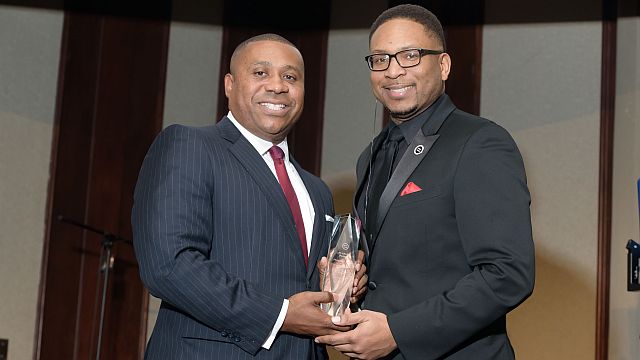
The Birmingham Urban League honored corporate citizens and community leaders Saturday, Dec. 8 at its Equal Opportunity Dinner. According to its organizers, the annual gala recognizes efforts that help in advancing equal opportunity for all. Alabama Power received the President’s Award for contributions to the community and its consistent support of the organization and diversity. Birmingham Division Vice President Jonathan Porter accepted the award on behalf of the company. “Alabama Power is proud of the continued partnership with organizations such as the Birmingham Urban League to help propel our community forward,” said Porter. The dinner was also held to commemorate the Birmingham Urban League‘s 50 years of service to the community. U.S. Sen. Doug Jones and U.S. Rep. Terri Sewell were the event co-chairs. National Urban League president Marc Morial was the keynote speaker for the evening. Morial recognized Birmingham’s first African-American mayor, Richard Arrington, saying the nation should appreciate Birmingham. Former Mayor William Bell was also honored for his leadership and his work in revitalizing the City of Birmingham. Mayor Bell shared a light moment with the audience, saying that even after completing his term serving the city, his wife still encourages him to “get out and go be great.” Other organizations such as Alpha Kappa Alpha Sorority, United Way of Central Alabama and Peacemakers was honored as well. More than 200 guests were treated to comedy and entertainment at the dinner. Republished with permission from the Alabama NewsCenter.
Rauf Bolden: Local government blocking solar development in Orange Beach?

History shows us an innovative mind, creating a glimpse of what is possible in the future, founding the basis of solar technology, salting the earth with monikers like climate change is real, prompting reactions ranging from exasperation to outright dismay. “In 1839, Alexandre Edmond Becquerel discovered that certain materials produced small amounts of electric current when exposed to light,” according to a report in Course Hero. Fast-forward to 2018, and we find ourselves with thriving solar industries, producing everything from panels for your roof to driveway lights, being both efficient and affordable. Alternative energy enthusiasts in the western part of the United States have dedicated their lives to using solar power in their homes, and passing on this knowledge to their friends, and their communities, but not in Orange Beach. “As a solar power proponent for the last thirty five years on land and sea, I am baffled by the reluctance of people to avail themselves of the opportunity to engage something as dependable as the sunrise each day. Even my fellow Electricians and Instrument Technicians have lost hard earned money every day they put off this common sense means of saving for their own futures. The simplest grid tie systems I have developed in California and Utah have long since paid for themselves in utility savings, as well as through the Federal Tax Credits and rebates that are available for the asking. The cost of panels per watt has dropped to 1/3 of the prices in 2001, and though sales of panels have been surging, it appears from my Western States observation point that it is The Utility Companies [sic] that are buying them up,” said Rick Gustavson in an email from St. George, Utah, having built two solar homes with his wife Jean. The dilemma for solar homeowners in Orange Beach is unfettered regulation, because our local-electrical supplier Baldwin EMC (Electricity Membership Cooperative) is an electricity re-seller, making them beholding to their upstream vendor. According to documentation obtained in an email from Greg Gipson, Manager of Business Development, Energy Services, and Advanced Metering at Baldwin EMC, the electrical provider requires liability insurance and upgrade-payment guarantees from EMC’s solar customers. This procedure insulates their suppliers from financial exposure by pushing additional expenses for solar connectivity down onto the solar homeowner (EMC’s “Members Guide to Interconnected Distributed Resource”, pg. 8-9). The City of Orange Beach also has specific building codes about installing solar panels on your roof. ”Probably a Miscellaneous Application (from the Building Department) with wind rating info on [the] panels,” said Howard Stuart, Plans Examiner at Community Development in an email. Then there is insurance. Depending on the underwriter, they may or may not require re-certification, ensuring your roof is up to city standards. “Currently [our] carrier does not require a new certificate if you install solar panels in [the] roof. The credit for fortified gold would not be removed. However, for any reason other than insurance purposes, you would need to consult with IBHS [Insurance Institute for Business and Home Safety],” said Cindy Vines, Account Executive, South Shore Insurance Agency, in Daphne, Alabama in an email. Minimizing buyer’s remorse from complicated permitting and regulations is offset by tax credits, rebates and solar reliability, strengthening financial arguments for using alternative energy in your home. “The federal solar tax credit, also known as the investment tax credit (ITC), allows you to deduct 30 percent of the cost of installing a solar energy system from your federal taxes,” according to Energy Sage. Although Orange Beach does not provide tax incentives for solar a full-tax credit is available from the Federal Government. “To receive the full tax credit, you must have federal income tax liability that’s at least equal to the value of the tax credit. This credit may be carried over to future tax years,” according to Tesla Solar Roofs. Building a solar-powered home in Orange Beach is burdened with man-in-the-middle profit margins, encumbering the project with provider-imposed regulations; possibly arguing the added trouble is not worth the effort. Do not think Baldwin EMC is overly bureaucratic, demanding so much extra cash from solar-energy homebuilders. Their primary-power supplier is the real puppeteer, hamstringing potential-solar customers. “The Member (read: EMC customer) may be compensated for the power [on solar projects] that flows onto the distribution system,” according to EMC’s “Members Guide to Interconnected Distribution”, pg. 7, being conspicuously vague as to how much credit is given for each watt of solar generated, and the City of Orange Beach looks on as if at a passing summer cloud. Our city leaders made a definitive choice about climate change. Instead of insisting the new school (2017) run on solar, as an example to the rest of the state, the Council decided to pay $4 million for ball fields, and $4 million for a performing-arts center, powered in the traditional way, perhaps by coal-fired power plants. It is an opportunity lost, demonstrating the unintended consequence of uninformed decisions, affecting generations to come. ••• Rauf Bolden is retired IT Director at the City of Orange Beach, working as an IT & Web Consultant on the Beach Road. He can be reached at: publisher@velvetillusion.com.
