
Opinion: Cutting opioid supplies in our community with non-narcotic alternatives

If you’re a patient who’s had a surgery and dealing with acute post-surgical pain, why choose an opioid-based pain reliever when there are equally effective, FDA-approved, opioid-free alternatives? That’s the question medical professionals, addiction specialists, youth advocates, and others are asking. Unfortunately, due to a flaw in the way parts of the health care system are paid for, particularly in Medicare: Patients and providers are steered towards using opioids. It’s disappointing to realize that something as simple as outdated Medicare reimbursement rules can push narcotics on patients. The hard reality is these rules, which effectively incentivize the use of opioids for post-surgical pain relief, are contributing to the deadly oversupply of opioids in our communities. In 2016 alone, more than 340 Alabamians died of opioid overdose. This is a crisis impacting all facets of society – patient, providers, families, students, and businesses alike. However, there is reason for hope in that many affected families are not letting despair undermine their resolve to combat the problem, using every means possible. That’s the impetus behind The Will Bright Foundation, named for Will, who died of overdose at age 25. As important as it is to support treatment for those with existing substance abuse disorders, we also need to focus on getting ahead of this crisis. Prevention is a powerful tool to get ahead of the crisis and protect people from being exposed to potential risks early-on. Reducing exposure to opioids in the first place is an important place for us to start. Every opioid exposure increases addiction risk. In 2015, there were over 141 opioid prescriptions written for every 100 people in Alabama—enough to give each resident a bottle of painkillers and then some. Opioids can be medically necessary, but post-surgical prescribing could be reduced if non-opioid therapies were more widely used. Physicians and other medical professionals want to turn to these safer medications, but they face significant barriers. Medicare policy is a big one. Surgeries are currently compensated by Medicare with a lump sum, which must cover any post-operative pain medicines. Non-narcotic painkillers cost modestly more than opioids, up to $300. At a time when hospitals, especially those in rural areas, are struggling for survival, they cannot independently absorb that cost increase for hundreds of operations each year. How Medicare reimburses makes a difference, because 44 million older and disabled Americans—15 percent of the population—rely on Medicare for their health coverage. The end result: opioids are prescribed for nine in ten surgical patients, even though many safer drugs exist. For patients undergoing multiple procedures, repeated post-operative treatment with opioids poses serious risk. And for those with a history of addiction, a dose of codeine can be enough to spark a relapse. It’s no wonder older people are exhibiting a sharp increase in opioid use disorders. They are not seeking a high from these drugs, but they are being repeatedly and dangerously exposed to them through routine medical treatment. Complicating the issue, the vast majority of patients don’t finish their painkiller supply. Without proper disposal, the drugs linger in medicine cabinets, where they are accessible by family members, guests, and thieves. Literally billions of legally prescribed pain pills have found their way onto the streets. These drugs are flooding our college campuses and our high schools. Young people report that prescription painkillers are easier to obtain than alcohol. But every “experiment” with a narcotic is hazardous. Suddenly, a good student takes a painkiller recreationally—or is treated for a legitimate medical issue after a few non-medicinal exposures—and they just can’t stop. This is far too dangerous a trap to set for people at such a vulnerable age. Fortunately, Alabama’s U.S. Senator Doug Jones is out in front on this issue. Along with Republican Sen. Bill Cassidy of Louisiana, Senator Jones has asked the federal government to change Medicare rules to separately reimburse for non-opioid pain medicines used after surgery. This will tip the balance toward safer, non-opioid medicines and help keep opioids out of our communities. Reduce exposure, reduce supply, and we can reduce addiction. ••• Katie Beckham, PA-C, MSPAS, Alabama Society of Physician Assistants Lisa and Bill Bright, founders of the Will Bright Foundation Gerald Fraas, president and co-founder of Students for Opioid Solutions Dr. Paul Rider, M.D., University of South Alabama Medical Center
Jim Zeigler’s annual report reveals minimal losses of state property

An annual audit of Alabama’s state property revealed the state had minimal losses in 2018, just .0864% of total state assets. State Auditor Jim Zeigler’s staff conducted a property inventory of 45 agencies in the 2018 fiscal year, which ended Sept. 30. According to Zeigler’s annual report, 35 agencies scored perfect audits, with all items of state property accounted for. 10 agencies had losses of 206 items valued at depreciated cost of $376,322.76. Zeigler’s office is tasked with providing accountability to the taxpayers of Alabama by maintaining accurate records of all personal property valued at $500 and above by conducting property and equipment audits for all 176 agencies statewide with 238,557 total assets. Typical items are state vehicles, computers and furniture. “The new safeguards we are putting into place are paying off with less loss of state property. Accountability works and re-pays for its costs many times over.” Zeigler said. Zeigler was elected to a second term as State Auditor Nov. 6. This is his final term, as he is term-limited.
Alabama education officials create plan for schools to monitor juvenile sex offenders

Alabama education officials plan to create a model policy so that all public school systems are ready to monitor student sex offenders in two years. State Superintendent Eric Mackey says that each local education authority can use it as their own policy by the 2020-2021 school year. Alabama’s mandatory attendance law means that local boards of education must ensure that children younger than 16 in their districts are enrolled in some form of schooling — whether public, private, parochial schools or home-schooled, The Montgomery Advertiser reported . Mackey said that low-level sex offenders can return to the public school system once they are adjudicated. The policy is aimed at making sure those students are supervised and that other students are not harmed. The new policy is required by Annalyn’s Law, which was passed earlier this year, the Montgomery newspaper reported. Annalyn’s Law is named after a child victim who was abused by a juvenile in Alabama. As of January, there were 1,305 juvenile sex offenders on the Alabama Law Enforcement Agency sex offender registry. Juvenile sex offenders must submit an application to all school property and school-functions, according to a draft of the model policy. They must also meet with school personnel to create and implement an individualized safety plan. Also, schools will continue to share information and monitor the student through school enrollment changes and school personnel changes, the newspaper reported. Officials will offer training to school personnel on how to take appropriate action when an increase or escalation of certain behaviors is noticed. Members of the advisory committee developing the policy include the state’s Law Enforcement Agency, the Alabama Department of Education, Department of Human Resources, the Governor’s Office, the Alabama Coalition Against Rape, the Attorney General’s Office and the Southern Poverty Law Center. Republished with permission from the Associated Press.
GOP waits on Donald Trump as clock ticks toward partial shutdown

The fight over President Donald Trump‘s $5 billion wall funds deepened Monday, threatening a partial government shutdown in a standoff that has become increasingly common in Washington. It wasn’t always like this, with Congress and the White House at a crisis over government funding. The House and Senate used to pass annual appropriation bills, and the president signed them into law. But in recent years the shutdown scenario has become so routine that it raises the question: Have shutdowns as a negotiating tool lost their punch? Monday brought few signs of progress. A partial shutdown that could occur at midnight Friday risks disrupting government operations and leaving hundreds of thousands of federal employees furloughed or working without pay over the holiday season. Costs would be likely in the billions of dollars. Trump was meeting with his team and getting regular updates, said White House spokeswoman Sarah Huckabee Sanders. Trump was also tweeting Monday to keep up the pressure. Exiting a Senate Republican leadership meeting late Monday, Sen. John Thune of South Dakota said, “It looks like it probably is going to have to build for a few days here before there’s a solution.” The president is insisting on $5 billion for the wall along the southern border with Mexico, but he does not have the votes from the Republican-led Congress to support it. Democrats are offering to continue funding at current levels, $1.3 billion, not for the wall but for fencing and other border security. It’s unclear how many House Republicans, with just a few weeks left in the majority before relinquishing power to House Democrats, will even show up mid-week for possible votes. Speaker Paul Ryan’s office had no update. Many Republicans say it’s up to Trump and Democrats to cut a deal. Senate Majority Leader Mitch McConnell and Trump talk most days, but the senator’s spokesman would not confirm if they spoke Monday about a plan. McConnell opened the chamber hoping for a “bipartisan collaborative spirit” that would enable Congress to finish its work. “We need to make a substantial investment in the integrity of our border,” McConnell said. “And we need to close out the year’s appropriation process.” Meanwhile more than 800,000 government workers are preparing for the uncertainty ahead. The dispute could affect nine of 15 Cabinet-level departments and dozens of agencies, including the departments of Homeland Security, Transportation, Interior, Agriculture, State and Justice, as well as national parks and forests. About half the workers would be forced to continue working without immediate pay. Others would be sent home. Congress often approves their pay retroactively, even if they were ordered to stay home. “Our members are asking how they are supposed to pay for rent, food, and gas if they are required to work without a paycheck,” said a statement from J. David Cox, Sr., president of the American Federation of Government Employees, the large federal worker union. “The holiday season makes these inquiries especially heart-wrenching.” Many agencies, including the Pentagon and the departments of Veterans Affairs and Health and Human Services, are already funded for the year and will continue to operate as usual, regardless of whether Congress and the president reach agreement this week. Congress already approved funding this year for about 75 percent of the government’s discretionary account for the budget year that began Oct. 1. The U.S. Postal Service, busy delivering packages for the holiday season, wouldn’t be affected by any government shutdown because it’s an independent agency. Trump said last week he would be “proud” to have a shutdown to get Congress to approve a $5 billion down payment to fulfill his campaign promise to build a border wall. During his 2016 presidential campaign, Trump promised that Mexico would pay for the wall. Mexico has refused. Democratic leaders Chuck Schumer and Nancy Pelosi, in a meeting last week at the White House, suggested keeping funding at its current level, $1.3 billion, for improved fencing. Trump had neither accepted nor rejected the Democrats’ offer, telling them he would take a look. Schumer said Monday he had yet to hear from Trump. Speaking on the Senate floor, Schumer warned that “going along with the Trump shutdown is a futile act” because House Democrats would quickly approve government funding in January. “President Trump still doesn’t have a plan to keep the government open,” Schumer said Monday. “No treat or temper tantrum will get the president his wall.” One option for lawmakers would be to provide stopgap funding for a few weeks, until the new Congress convenes Jan. 3, when Pelosi is poised to become House speaker. Wyoming Sen. John Barrasso, who is in line to become the No. 3 Republican in the Senate, suggested a stopgap bill could be one way to resolve the issue or a longer-term bill that includes money for border security. GOP leaders, though, were frustrated as the clock ticked away. Leaving the weekly leadership meeting, Sen. Roy Blunt, R-Mo., said any planning was a “very closely held thing. That’s why we should never let this happen. We should pass the bills the way we’re supposed to pass them.” Republished with permission from the Associated Press.
Rauf Bolden: How to run for Mayor and Council in Orange Beach
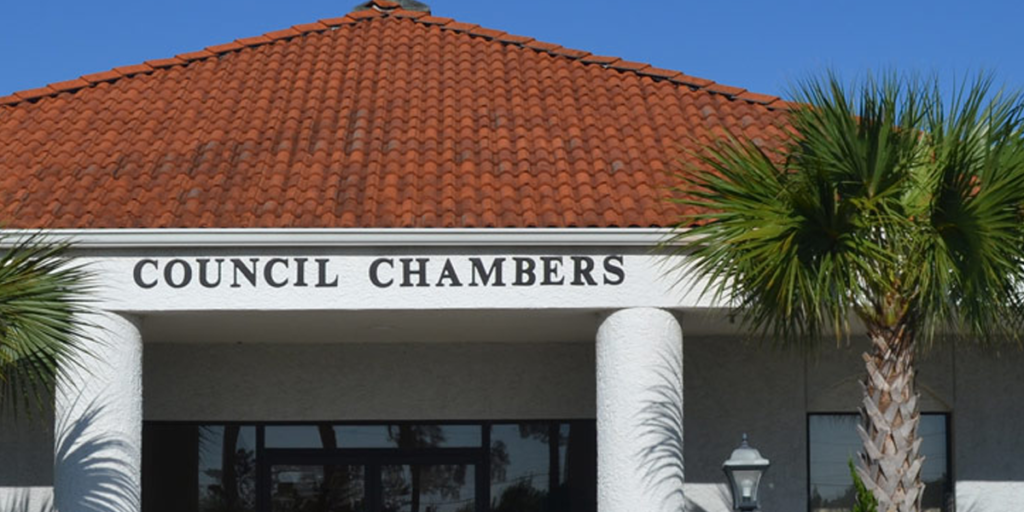
Getting elected Mayor or to the City Council in 2020 is simple. Campaign on a platform to eliminate the 4-mil property tax, giving residents a real return for putting up with the traffic, and propose we pay for the tax cut with sin taxes on tobacco products, alcohol, and sugary drinks, offsetting the money lost on the tax cut. This oversimplification sounds easy, but it’s not. Orange Beach has competent council members, being skilled politicians, representing their community on an at-large basis, not districts. Jeff Silvers and Joni Blalock have served the longest since 2004; Jerry Johnson and Jeff Boyd have served since 2012; Annette Mitchell was appointed to serve out the term of the late Al Bradley, being elected to her first term in 2016. Mayor Tony Kennon started out as a Councilman, being first elected on August 24, 2004, but resigned on June 7, 2005. Three years later, on August 26, 2008 he was elected Mayor, presently serving his third consecutive term, ending in 2020. To qualify for the ballot you have to meet a few minimum requirements. The candidate “must be 18 years old; must be a resident of the city for 90 days prior to the election [rent or own]; must be a US citizen for one day; and must be a registered voter,” according to the Alabama Secretary of State’s website. Planning your run for the 2020 election cycle takes time and hard work, beginning in 2019. Start building up a war chest of donor lists, appropriate technology and talented volunteers. How do you go about getting elected to public office? Here are a few pointers. Know your electorate: talk with people across the entire economic spectrum, finding out what matters to them; connect with bellwethers, getting the right people backing you; kick off fundraising by contacting past candidates; build your team, knowing volunteers will do the bulk of the work; design campaign material, concentrating on poster and yard sign design, newsletters, and social media. Raise candidate’s profile, reaching out to voters through common acquaintances. Create a campaign plan for messaging and build a dedicated voter database, tracking communication through websites, social media and telephone calls, according to a report on CallHub, a political website (https://callhub.io/run-local-political-campaign/). Offending one person with your campaign style in a small town may mean offending their entire voting family. Note that council members are sometimes elected with as little as 400 votes. In 2008, Kennon had around 1,200 votes, being elected mayor in a town of 5,000 people. The margin for offending is large, but the margin for winning is small, adding to that, the responsibility for winning is enormous, putting you on-call 24/7 for a low-paying job. “I know when my Dad [Councilman Jerry Davidson] was on council [2000-2004] he spent an enormous amount time in many many more meetings [council planning] than the public meetings held and people took any and all opportunities anytime he was anywhere to discuss their thoughts,” said Kristy Doggett a twenty-year resident in an email. Some people cannot be bothered with public service, saying it is too much trouble, putting up with all the politics for a beggar’s wage: $13,401.18 per year for each council member; $16,557.36 per year for the Mayor Pro-Tem (vice-mayor); and $42,000.00 per year for Mayor. Then there is the question of getting along with Mayor Kennon (if re-elected), having a very unique style of coordinating policy. Potential candidates muse about the fringe benefit of being embarrassed and humiliated in the Council Chambers for disagreeing with him. Baldwin County District Representative Daniel Catlin, who was standing in for Congressman Bradley Byrne at his congressional town hall, watched as Kennon attempted to demean, disgrace and shame Congressman Byrne’s supporters in the Council Chambers. “They [residents] are ignorant by choice,” said Kennon, as evidenced in this video report from Cliff McCollum of Gulf Coast News Today. The video speaks volumes. We need a hefty selection of good candidates in 2020, offering a salary commensurate with the job’s responsibilities, specifically large enough to compensate professionals for managing a $40 million budget. I suggest $160,000 per year for Mayor, and $50,000 per year for each of the five council members, as outlined in my previous op-ed. People in Orange Beach can do better than having their Mayor and City Council stand unopposed for municipal elections because of the low pay. Let’s improve the compensation package for our elected officials, simultaneously attracting a large pool of candidates, showing the world democracy, and competitive elections have a strong tradition in Orange Beach. ••• Rauf Bolden is retired IT Director at the City of Orange Beach, working as an IT & Web Consultant on the Beach Road. He can be reached at: publisher@velvetillusion.com.
