
Planned parenthood president forced out after only 8 months
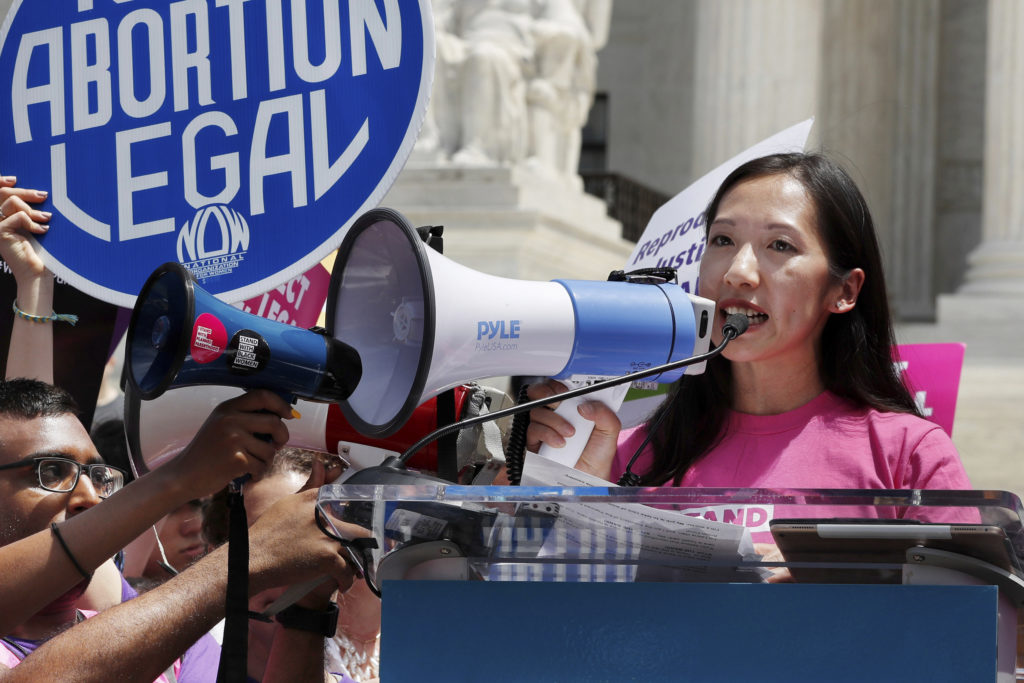
The president of Planned Parenthood, Dr. Leana Wen, was ousted Tuesday after just eight months on the job as the organization faced unprecedented challenges related to its role as the leading abortion provider in the U.S. Wen, in a Twitter post, said she learned that Planned Parenthood’s board “ended my employment at a secret meeting.” She indicated the board wanted more emphasis on political advocacy, while she sought to prioritize Planned Parenthood’s role as a provider of health care services ranging from birth control to cancer screenings. “We were engaged in good faith negotiations about my departure based on philosophical differences over the direction and future of Planned Parenthood,” Wen said. “I am stepping down sooner than I had hoped.” Her departure came as the Trump administration announced it would start enforcing new rules that ban taxpayer-funded family planning clinics referring women for abortions. Planned Parenthood, the largest recipient of those funds, says it will not abide by those rules. Without elaboration, Planned Parenthood announced Wen’s departure via a Twitter post, thanking her for her service and wishing her luck going forward. It also announced that Alexis McGill Johnson, co-director of a research consortium called the Perception Institute, will serve as acting president of Planned Parenthood and its political wing, the Planned Parenthood Action Fund, while a search for new permanent leader is conducted. Wen, a Chinese immigrant who fled her native country when she was a child, took over as Planned Parenthood’s leader in November, succeeding Cecile Richards, who had been president since 2006. Wen had been Baltimore’s health commissioner since 2015. Wen’s tenure coincided with major challenges for the U.S. abortion-rights movement, in which Planned Parenthood has long played a major role. Emboldened by a strengthened conservative presence on the U.S. Supreme Court, several Republican-controlled state legislatures have enacted laws this year aimed at banning most abortions. None of the laws have taken effect, but backers hope they might eventually lead the high court to overturn the 1973 Roe v. Wade ruling that establish a nationwide right to abortion. Meanwhile, the Trump administration has moved to withhold federal family planning funds from clinics, including Planned Parenthood’s, that refer women for abortions. With about 400 clinics, Planned Parenthood is the largest provider in the federal family planning program for low-income women, known as Title X. The program does not pay for abortions, but until now clinics had been able to refer women for the procedure. Planned Parenthood clinics have long been a target for religious and social conservatives because the clinics separately provide abortions. Jacqueline Ayers, Planned Parenthood’s top lobbyist, said its clinics will stop accepting federal money and tap emergency funding as they press Congress and the courts to reverse the administration’s ban. Title X serves about 4 million women annually through independent clinics. Taxpayers provide about $260 million a year in grants to clinics, but that money by law cannot be used to pay for abortions. In a letter to her colleagues at Planned Parenthood, Wen said she had believed its primary mission was to be a health care organization, more so than an advocacy organization. “With the landscape changing dramatically in the last several months and the right to safe, legal abortion care under attack like never before, I understand the shift in the Board’s prioritization,” Wen wrote. By David Crary AP National Writer. Republished with permission of the Associated Press.
Facebook’s currency plan gets hostile reception in Congress
Under sharp criticism from senators, a Facebook executive on Tuesday defended the social network’s ambitious plan to create a digital currency and pledged to work with regulators to achieve a system that protects the privacy of users’ data. “We know we need to take the time to get this right,” David Marcus, the Facebook executive leading the project, told the Senate Banking Committee at a hearing. But that message did little to assure senators. Members of both parties demanded to know why a company with massive market power and a track record of scandals should be trusted with such a far-reaching project, given the potential for fraud, abuse and criminal activity. “Facebook is dangerous,” asserted Sen. Sherrod Brown of Ohio, the committee’s senior Democrat. Like a toddler playing with matches, “Facebook has burned down the house over and over,” he told Marcus. “Do you really think people should trust you with their bank accounts and their money?” Republican Sen. Martha McSally of Arizona said “the core issue here is trust.” Users won’t be able to opt out of providing their personal data when joining the new digital wallet for Libra, McSally said. “Arizonans will be more likely to be scammed” using the currency, she said. The litany of criticism came as Congress began two days of hearings on the currency planned by Facebook, to be called Libra. Meanwhile, a House Judiciary subcommittee extended its bipartisan investigation of the market power of Facebook, Google, Amazon and Apple. On the defensive from bursts of aggressive questioning, Facebook’s Marcus indicated the currency plan is a work in progress. “We will take the time” to ensure the network won’t be open to use by criminals and illicit activity like money laundering and financial fraud. “We hope that we’ll avoid conflicts of interest. We have a lot of work to do,” Marcus said. He said the new venture would be headquartered in Switzerland, not to avoid oversight but because the country is a recognized international financial center. The grilling followed a series of negative comments and warnings about the Libra plan in recent days from President Donald Trump, his treasury secretary and the head of the Federal Reserve. But some senators emphasized the potential positive benefits of Facebook’s plan, meant to bring money transacting at low cost to millions around the globe who don’t have bank accounts. Facebook had its strong defenders of the project, too, on the panel. “To strangle this baby in the crib is wildly premature,” said Sen. Pat Toomey, Republican-Pennsylvania. In that vein, Marcus said Libra “is about developing a safe, secure and low-cost way for people to move money efficiently around the world. We believe that Libra can make real progress toward building a more inclusive financial infrastructure.” The planned digital currency is to be a blend of multiple currencies, so that its value will fluctuate in any given local currency. Because Libra will be backed by a reserve, and because the group of companies managing it will encourage a competitive system of exchanges, the project leaders say, “anyone with Libra has a high degree of assurance they can sell it for local (sovereign) currency based on an exchange rate.” Promising low fees, the new currency system could open online commerce to millions of people around the world who lack access to bank accounts and make it cheaper to send money across borders. But it also raises concerns over the privacy of users’ data and the potential for criminals to use it for money laundering and fraud. To address privacy concerns, Facebook created a nonprofit oversight association, with dozens of partners including PayPal, Uber, Spotify, Visa and MasterCard, to govern Libra. As one among many in the association, Facebook says it won’t have any special rights or privileges. It also created a “digital wallet” subsidiary, Calibra, to work on the technology, separately from its main social media business. While Facebook owns and controls Calibra, it won’t see financial data from it, the company says. Senators demanded to know exactly what that separation will entail. “Facebook isn’t a company; it’s a country,” said Sen. John Kennedy, Republican-Louisiana. Kennedy and other conservative senators took the occasion to air long-standing grievances against Facebook, Twitter and Google for a perceived bias against conservative views. Facebook’s currency proposal has also faced heavy skepticism from the Trump administration. Trump tweeted last week that the new currency, Libra, “will have little standing or dependability.” Both Treasury Secretary Steven Mnuchin and Fed Chair Jerome Powell have expressed serious concerns recently that Libra could be used for illicit activity. The Treasury Department has “very serious concerns that Libra could be misused by money launderers and terrorist financers,” Mnuchin told reporters at the White House on Monday. “This is indeed a national security issue.” Also Tuesday, across the Capitol in the House, the chairman of a Judiciary Committee panel investigating the market power of big tech companies said Congress and antitrust regulators wrongly allowed them to regulate themselves. That enabled companies like Facebook, Google, Amazon and Apple to operate out of control, dominating the internet and choking off online innovation, Rep. David Cicilline, Democrat-Rhode Island, said at the start of a hearing. “The internet has become increasingly concentrated, less open, and growingly hostile to innovation and entrepreneurship,” he said. As concerns have mounted over data privacy and market dominance of Big Tech, an increasing number of lawmakers from both parties are calling for tighter regulation of customarily free-wheeling companies or even breaking them up. The Justice Department and the Federal Trade Commission are pursuing antitrust investigations of the four major companies. Executives of the companies, testifying at the Judiciary hearing, pushed back against lawmakers’ accusations that they operate as monopolies, laying out ways in which they say they compete fairly yet vigorously against rivals in the marketplace. And Google executive Karan Bhatia, at a Senate Judiciary subcommittee hearing on online bias, insisted that the company’s search engine does not filter on the basis of political views. “We surface the
Condemn Donald Trumps tweets? Here’s a round-up of what the Alabama delegation thought about it

Did Donald Trump go too far in his tweet to 4 women in the democrat house caucus? Here’s how Alabama’s delegation reacted to a House Resolution 489 filed to condemn his message as racist. ….and viciously telling the people of the United States, the greatest and most powerful Nation on earth, how our government is to be run. Why don’t they go back and help fix the totally broken and crime infested places from which they came. Then come back and show us how…. — Donald J. Trump (@realDonaldTrump) July 14, 2019 Bradley Byrne, District 1: “Today’s vote is a transparent and ineffective attempt to distract from the open warfare inside the Democratic Party. The long histories of anti-Semitic and un-American comments from the so called “Socialist Squad” deserve universal condemnation, and Democrats’ overnight transition from a circular firing squad to a circle of support is the height of hypocrisy. “Since ‘the Squad’ thinks America is such a terrible place, I’ve offered to fly them to the socialist paradise of Venezuela. In the meantime, we should stop wasting time on show votes like this and finally take action to secure the border and solve the immigration crisis.” Martha Roby, District 2: “As elected officials, we owe it to this country and our political discourse to combat unseemly speech consistently and fairly, but Democratic leadership in the House has demonstrated they are only willing to call out members of the opposing party by name while sparing their own from the finger-pointing. While I do not condone the President’s recent comments, I will vote against H. Res. 489 because I refuse to participate in this blatant political gamesmanship. Regardless of party affiliation, we must all treat one another with respect and civility in order to effectively do the important work of the American people.” Mo Brooks, District 5: “President Trump hammered various Socialist Democrats for their support for evil Socialism; repugnant, non-stop invective and hatred shown for the foundational principles which have made America the greatest nation in world history; open disdain and dislike of Israel; and religious prejudice against the Jewish people. “Socialist Democrats have no legitimate defense of Socialism, hatred for America’s foundational principles, open disdain and dislike of Israel, and religious prejudice against the Jewish people so, instead, they do what Socialist Democrats candidate schools train them to do:[1] divert public attention by hollering racism despite the facts being crystal clear that President Trump was motivated by a lot of things, but none of them had anything at all to do with race or skin pigmentation. “I will proudly vote against H.Res. 489 because it falsely injects race as a motivation without any supporting proof whatsoever. Just as a person’s skin pigmentation should not be wrongly used as a sword against him, a person’s skin pigmentation should also not be wrongly used as a shield that deflects from proper political discourse. Socialist Democrats are wrong, sinister and insidious to interject race as a motivation for President Trump’s tweets when those very same tweets show on their face a variety of motivations that have nothing to do with race or skin pigmentation. “The Socialist Democrats’ imputing false, racial motive to President Trump without supporting evidence and in the face of overwhelming evidence to the contrary is malicious and vile conduct that insidiously divides America on racial grounds while undermining the credibility of legitimate racist claims made in American society. Revolting and malevolent conduct that promotes racial division for political gain must be condemned and opposed. With my vote, I do both.” Gary Palmer, District 6: “President Trump’s comments on Twitter were ill-timed and insensitive, but not racist, as the Socialist Democrats have hypocritically claimed,” Palmer said. “The hypocrisy is glaringly apparent when you consider that Representative Alexandria Ocasio-Cortez recently tweeted, ‘This administration has established concentration camps on the southern border of the United States for immigrants,’ and that Representative Ilhan Omar recently tweeted that support for Israel was ‘all about the Benjamins.’ “The Founders envisioned the House floor as a place where the people’s business is conducted. It was not designed for hypocritical, political grandstanding. The House could conduct no other business if we responded to every unbecoming comment of elected officials on social media. “Instead of wasting time on comments made on a Twitter account, we should be focused on addressing the issues that are of greatest concern to Americans, including the crisis at our southern border. This is what we have been elected to do. We have not been elected as the social media police.” Terri Sewell, District 7: “The President’s continued attacks on four Congresswomen of color who he said should go back where they came from are offensive and overtly racist. These Congresswomen are U.S. citizens who have sworn an oath to defend the Constitution and improve our nation. Right now, that means they are speaking out against Trump Administration policies that keep innocent children in cages and continue to tear families apart. To suggest their voices do not belong based on the color of their skin is below the dignity of the presidency. “I know I was elected to improve the everyday lives of those living in Alabama’s 7th Congressional District. The President should be working with Members of Congress to solve the challenges our country is facing, not engaging in attacks on Members’ personal character that stand in the way of progress. The President should get off of Twitter and start working to raise wages, improve and expand health care access and lower the price of prescription drugs. None of us can afford to go backward. We should all be working to move this nation forward.”
Fundraising heats up in the congressional race to replace Bradley Byrne
Totals can be deceiving. If you looked at just the overview of fundraising available on the FEC website in the open race to replace Congressman Bradley Byrne for Alabama’s first congressional district you’d think that Jerry Carl is blowing away the competition. But you’d be wrong. He’s ahead in total cash on hand but not in fundraising. A look at his reports show that while Carl is leading the field with cash on hand it’s due to two factors: First, is he had a headstart in raising money and secondly he has loaned himself a substantial amount, $305,000 to be exact. The fundraising leader of this race is currently Bill Hightower but before we assume that he can turn money into votes and run away with this race we have to look at his history. In his failed attempt to primary Governor Kay Ivey in 2018 he came in a distant fourth place garnering just 5% of the vote even though he spent $1,068,507. That’s not a promising vote to dollar turnaround for donors and potential donors. Summing up the most recent filings on the FEC site: Senator Bill Hightower raised $386,238 (though his numbers aren’t fully processed you can view the raw data here), State Representative Chris Pringle raised $215,611 and Carl raised $108,026 in the same time period. Wes Lambert raised $48,129 but spent an astounding portion of that leaving himself with just $2,000 cash on hand. Carl’s first report due in May showed that he raised $187,592. Here are the tables currently available from the FEC website.
Donald Trump calls on GOP to oppose House resolution condemnation of tweets

President Donald Trump called on fellow Republicans Tuesday to stick with him, “not show weakness” and oppose a House resolution condemning his tweets urging four Democratic congresswomen of color to return to their countries. His comments, he insisted, “were NOT Racist.” Trump renewed his rain of insults against the four lawmakers — American citizens all — as his GOP allies in Congress mostly leapt to his defense. Following his cue, they tried refocusing the battle by accusing the four progressive freshmen and their party of pushing the country toward socialism. “I will vote against this resolution,” House Minority Leader Kevin McCarthy of California told reporters, calling the measure “all politics.” No. 3 House GOP leader Liz Cheney of Wyoming said the four Democrats “are wrong when they attempt to impose the fraud of socialism on the American people.” The House resolution would condemn “President Donald Trump’s racist comments that have legitimized and increased fear and hatred of new Americans and people of color.”The four-page measure traces the country’s history of welcoming immigrants from colonial times and includes an entire page of quotes from Republican President Ronald Reagan.Reagan said in 1989, during his final days in office, that if the U.S. shut its door to new arrivals, “our leadership in the world would soon be lost.” Democrats were hoping the resolution would put Republican lawmakers on the spot and would win some GOP votes. Top Republicans were urging their GOP colleagues to stand against the language, and it was unclear if any would defect. “The so-called vote to be taken is a Democrat con game. Republicans should not show ‘weakness’ and fall into their trap,” Trump tweeted. “I don’t have a Racist bone in my body!” he wrote. He also reprised a taunt he initially made on Monday, tweeting, “If you hate our Country, or if you are not happy here, you can leave!” The lawmakers strongly oppose Trump’s policies and have voiced support for his impeachment. His barrage came amid a continued backlash to his weekend tweets that the progressive women “go back” to their “broken and crime-infested” countries. The tweets, widely denounced as racist, were directed at Reps. Ilhan Omar of Minnesota, Alexandria Ocasio-Cortez of New York, Ayanna Pressley of Massachusetts and Rashida Tlaib of Michigan. Ocasio-Cortez returned the fire Tuesday, tweeting, “You’re right, Mr. President – you don’t have a racist bone in your body. You have a racist mind in your head and a racist heart in your chest.” McCarthy said Monday that Trump was not a racist. But he said he disagreed that the four lawmakers should leave the U.S., telling reporters, “They’re Americans. Nobody believes somebody should leave the country. They have a right to give their opinion.” The episode served notice that Trump is willing to again rely on incendiary rhetoric on issues of race and immigration to preserve his political base in the leadup to the 2020 election. At the Capitol, there was near unanimous condemnation from Democrats and a rumble of discontent from a subset of Republicans, but notably not from the party’s congressional leaders. In response, Trump tweeted anew Tuesday about the four congresswomen: “Why isn’t the House voting to rebuke the filthy and hate laced things they have said? Because they are the Radical Left, and the Democrats are afraid to take them on. Sad!” His words, which evoked the trope of telling black people to go back to Africa, may have helped narrow the divides among House Democratic, who have been riven by internal debate over how best to oppose his policies. At a closed-door meeting Tuesday of House Democrats, Speaker Nancy Pelosi, D-Calif., said, “We are offended by what he said about our sisters,” according to a congressional aide who attended the meeting and described the remarks on condition of anonymity.Trump allies said he was also having some success in making the progressive lawmakers the face of their party. The Republican president questioned whether Democrats should “want to wrap” themselves around this group of four people as he recited a list of the quartet’s most controversial statements. “Nancy Pelosi tried to push them away, but now they are forever wedded to the Democrat Party,” he wrote Tuesday, adding: “See you in 2020!” Trump, who won the presidency in 2016 in part by energizing disaffected voters with inflammatory racial rhetoric, made clear he has no intention of backing away from that strategy in 2020. “The Dems were trying to distance themselves from the four ‘progressives,’ but now they are forced to embrace them,” he tweeted Monday afternoon. “That means they are endorsing Socialism, hate of Israel and the USA! Not good for the Democrats!” Trump has faced few consequences for such attacks in the past. They typically earn him cycles of wall-to-wall media attention and little blowback from his party. He is wagering that his most steadfast supporters will be energized by the controversy as much, or if not more so, than the opposition. The president has told aides that he was giving voice to what many of his supporters believe — that they are tired of people, including immigrants, disrespecting their country, according to three Republicans close to the White House who were not authorized to speak publicly about private conversations. In an Associated Press-NORC Center for Public Affairs Research poll from February 2017, half of Americans said the mixing of culture and values from around the world is an important part of America’s identity as a nation. About a third said the same of a culture established by early European immigrants. But partisans in that poll were divided over these aspects of America’s identity. About two-thirds of Democrats but only about a third of Republicans thought the mixing of world cultures was important to the country’s identity. By comparison, nearly half of Republicans but just about a quarter of Democrats saw the culture of early European immigrants as important to the nation. Republished with permission of the Associated Press.
Coal ash disposal plans pit environmental groups against one another

Coal ash: To move it or not to move it? That is the question that even environmentalists can’t agree on as Alabama Power announces its plan for handling existing coal ash in the state. In April 2015, the Environmental Protection Agency finalized a national rule governing how coal ash is managed and stored. The Obama-era rule provides two options for closing basins: either manage coal ash by storing it in place (closed-in-place) or excavate and move the coal ash to a new location. The EPA rule, which has been preserved by the Trump Administration, recognizes that both storing in place and removing and transporting coal ash options are viable options that provide environmental benefits. When faced with the decision of securing ash in its five ponds, Alabama Power considered both options. Ultimately, the company decided to move forward with plans to secure its coal ash using guidance from the closed-in-place standard approved in 2015 but to go further than the required guidelines. As Alabama Power spokesman Michael Sznajderman told Al.com, “the new plans show the company is going “above and beyond” what is required by state and federal coal ash rules, in some cases using redundant dike systems and subterranean retaining walls that extend 30 feet below the ground to prevent contaminants in the ash from reaching rivers or groundwater.” Even so, this solution drew condemnation from Keith Johnston, managing attorney for the Southern Environmental Law Center’s Birmingham office who in the same article told Al.com, “Alabama Power refuses to do what other utilities are doing in Virginia, South Carolina, North Carolina, Tennessee and Georgia (including Georgia Power): excavating and removing these contaminants to modern, dry-lined landfills away from our waters.” A look at what utilities are doing in the aforementioned states, however, shows that Johnston is not comparing apples to apples. As EPA has acknowledged, each coal ash site is unique, meaning utilities in different states are dealing with a number of mitigating factors. Those include different environmental and political circumstances that influence how they are responding to pond closures. Rather than the one-size-fits-all solution that Johnston, Mobile Baykeepers, and others are suggesting, Alabama Power’s proposal cites location-specific plans for each of its ponds. Those are outlined here for public postings. Meanwhile, demonstrating the “damned if you do and damned if you don’t” decision-making process that power companies face in an age of never-ending environmental backlash, environmental activists in Central Florida have rallied to end a state-of-the-art storage deal involving coal ash from Puerto Rico. Florida activists criticized the same closed-by-removal option being advocated by critics in Alabama, citing the risk of transportation and local storage. Coal ash from Plant Barry north of Mobile, for example, would be transported across the Mobile Bay watershed to some other location, were the removal of coal ash to occur. “If Puerto Rico is generating coal ash, it shouldn’t be taken and dumped in someone else’s backyard,” Osvaldo Rosario, a doctorate professor in chemistry at the University of Puerto Rico with a specialization in EPA Environmental Chemistry and more than 35 years of research experience, told a local news outlet. Rosario, who also serves as a consultant to the Federal Food and Drug Administration. “It’s something I’ve always criticized.” Luis Martinez, a director for the Natural Resources Defense Council’s clean energy and climate program, who speaking to Mother Jones about ash being transported from Puerto Rico to Florida was more direct in stating the problem facing those attempting to close ash ponds saying, “Nobody wants [coal ash] in their backyard. That’s a very human reaction.” Paul Griffin, Executive Director of Energy Fairness, a not-for-profit that has testified regularly on energy issues on behalf of power customers and which has supported the closed-in-place approach to coal ash storage addressed critics of the plan saying, “On one hand you have Alabama Power’s proposal to responsibly store coal ash, which goes above and beyond rules written by the Obama Administration to ensure safety for the public and the environment. On the other hand, the vision of Mobile Baykeeper is to spend years digging up coal ash and transporting it through south Alabama communities to some undisclosed place, costing power customers more money and offering zero net environmental benefits.” Griffin went on to say, “Any level-headed person can see that is a terrible bargain not just for power customers, but for the environment too. With coal ash storage a topic of increasingly heated political debate, one thing seems clear. Decisions about which option is best for the environment and for power customers should be based on the best available science, not rhetoric.”
