
ALDOT takes steps to improve transparency after severe public backlash over Mobile tolling plans but still misses mark says critics

41,445 that’s the number (as of the time this story went live) of individuals who have joined the Facebook group to “Block the Mobile Bay Toll.” Public opinion is often split on large infrastructure projects but in this case, according to media reports and Facebook activity, it seems resoundingly consistent: The residents who would use the route do not want and cannot afford the coming toll road. For months, as public opposition has grown stronger and more vocal ALDOT has only doubled down on their talking points that the toll is the only solution and that it’s all but a done deal. The biggest opponent of the bridge has been State Auditor Jim Ziegler who created the opposition Facebook page and has rallied troops to write and call Governor Kay Ivey and show up at a town hall sponsored by Congressman Bradley Byrne who later came out against the toll. I remain 100% opposed to the I-10 bridge tolls. $90 a month is an unacceptable burden to put on hard-working South Alabama families. I’m going to keep fighting against these tolls, just as I’ve done since 2014. Join my fight to STOP THE TOLLS! Add your name to our petition: — Bradley Byrne (@BradleyByrne) July 17, 2019 Today however ALDOT somewhat changed course and released what they called a “Myth Busters” fact sheet. The sheet first reported on by Al.Com is posted in full below. Though they have yet to post it to the project’s webpage the fact sheet is one of the first acknowledgments by ALDOT that they are facing formidable opponents who are disrupting their plans and that they can not turn a blind eye to the growing voices. Zeigler had this to say about today’s, “ALDOT’s Myth Busters propaganda sidestepped the vital issue – the toll’s cost to local motorists who travel I-10 and to small businesses that rely on I-10 daily. Look at a family whose budget is barely in balance. They live on one side of the Bay and work on the other. By adding $1,080 toll per car to their yearly budget, you will put those families in financial ruin. ALDOT did not address the problem of leasing out a portion of an Interstate that belongs to the people. ALDOT did not address the problem of giving a 55-year lease to the toll operator. ALDOT did not address the problem of the toll rates being set by the toll company and changeable for 55 years. ALDOT is fixated on charging a toll. They are for the toll, the whole toll, and nothing but the toll. ALDOT basically said: ‘It’s my way or no highway.” The fact sheet reads: In this first edition of Myth Busters, we address some of the issues we are hearing the most. Concern: There shouldn’t be a toll.Without a toll the project won’t happen. If the project doesn’t happen, drivers will sit in congestion more regularly – and will be more likely to be late to work, pick up the kids, class, and appointments. Not building the project also means the cost of the project will grow due to rising construction costs – so we will be in a worse situation down the road. Due to a nationwide shortage in funding for major transportation infrastructure projects, the state and federal government do not have sufficient funding to deliver the project through its traditional funding model which typically has an 80/20 split between federal investment and state investment. The federal infrastructure legislation proposed under the current administration is heavily dependent upon tolling to deliver infrastructure projects around the United States. With a toll, those who use the alignment pay for it. A free route will be maintained for those who do not want to pay a toll; the free route includes the Causeway, Bankhead Tunnel and the Cochrane-Africatown USA Bridge. Concern: Tolling is double-taxing.A toll is a user fee, not a tax. If a driver does not use the facility, he or she does not pay for it. Drivers only pay a toll when they choose to drive on a toll road because it provides a higher level of convenience, reliability, or safety. Toll customers also pay their share of local, state, and federal taxes through the purchase of fuel. Money generated through gas taxes help fund non-tolled roads that are open to everyone. Concern: The gas tax should pay for this project.The gas tax won’t be in full effect until October 2021. Then, it is estimated to bring in around $320 million annually for statewide projects. If the state set aside $100 million of those annual funds and earmarked them for the Mobile River Bridge and Bayway project, it would take 21 years before we could break ground. Given inflation, the cost of the project would increase significantly. Moreover, there is currently a multi-billion dollar backlog of existing road and bridge needs that will consume and even exceed the new state revenue from the Rebuild Alabama Act. Concern: You refused federal funding.With the exception of the INFRA Grant award announced on July 25, 2019, ALDOT has never been offered federal funding for this project. With reference to the GOMESA funding, those funds are for projects and activities for the purposes of coastal protection, including conservation, coastal restoration, hurricane protection, and infrastructure directly affected by coastal wetland losses. Those funds are not for building roads and ALDOT has no control over how those funds are allocated and distributed. Even if it was determined that this project was an eligible use for GOMESA funds, it would take away from the many local uses in Mobile and Baldwin Counties that are steeped in years of precedents. If the total annual amount of GOMESA funds was committed to the Mobile River Bridge and Bayway Project to pay debt service, it would mean no other eligible and needed local projects could be funded. Furthermore, even if the total annual amount of GOMESA funds was committed to the Mobile bridge project, the funds would not be sufficient to
Tea Party activist Becky Gerritson vs. Baron Coleman: An absurd fight against his First Amendment rights

Becky Gerritson is known by many for either her activism in the Tea Party movement or her unsuccessful run for congress against Martha Roby. Gerritson was one of the first tea party leaders I met when I moved to Alabama in 2013. She spoke at the launch of the Alabama Chapter for 60 Plus Association at my request. We’ve spoken at multiple events and rallies together since then. Up until now, I’ve known her to date to be a principled champion of small government and constitutional conservatism. One of the original tea party leaders Gerritson and her husband founded the Wetumpka Tea Party in 2009. She received national press following her emotional testimony to congress in her successful fight against the Internal Revenue Service. The IRS was proven to have targeted conservative groups including the Wetumpka Tea Party for delays in obtaining their tax-exempt status and her speech at the congressional oversight hearing was empowering to activists everywhere. Earlier this year it was announced that Gerritson had been hired as the new Executive Director of the Eagle Forum of Alabama. Baron Coleman is a licensed attorney, political consultant and the co-host of the award-winning daily radio show News and Views. I’ve been a guest on his show around a dozen times. We don’t agree on everything. He uses language that’s a little harsher than I would but heck it’s his show and he’s consistent in his opinions. If he thinks you’re a sell-out for industry be it a one-time vote or a career choice he’s going to say you’re a “whore for them”. One of his favorite lines is to call individuals a “Globalist corporatist whore.” It’s kinda his schtick that and pointing out that “errrbody” listens to his show. He’s called me liberal and questioned my conservative values more than once; anyone who knows me, has read my editorials or has listened to me speak publicly would find that laughable. That’s the thing though, the show both is informative and entertaining. Baron doesn’t just tell it as it is, he tells it as he sees it. It is in fact not just news, it’s his views. So where do these two peoples worlds collide in a world that suddenly pits conservative against conservative? In a Facebook public post on his personal page, Baron Coleman wrote this: Seeing the post and subsequent Facebook updates on the subject from him I reached out to him to see who and what this was all about. My first response to learning it was Gerritson going after Coleman’s law license and livelihood was disbelief or dismay. Attempts to silence critics is a tool of the Left these days. This is not what I’d expect or anyone would expect from a conservative firebrand. Don’t like what someone has to say silence them at all costs. Harass those around them and pursue efforts to get them fired, treat them like lepers, black ball and ostracize them: The ways of Facebook, Twitter, keyboard activists from their mother’s basements. This is not something constitutional conservatives do. I’ve said more than once, I support political speech and first amendment rights for all. In the face of the government or others attempting to stop or limit the free speech of someone speaking out against or protesting something I love or value, I’d join the side of those that others are trying to silence. For when we let our opponents be silenced we might are opening the door for our own voices to be silenced. The constitution is for everyone; our soldiers don’t go to the front line for those who agree with them on issues and speech. They go to fight and protect all. First Amendment rights aren’t just guaranteed for speech deemed by the masses as non-offensive. So then I had to believe that whatever Coleman said was really stinking bad, right? I mean to envoke such a strong anti-free speech reaction from a tea party rockstar and a well respected national organization and their state chapter? The back story is this: Gerritson, in her official role with the Eagle Forum, testified against the medical marijuana bill. Coleman, a supporter of the bill noted on-air in at least two different segments that he couldn’t believe Becky was going against the bill. He criticized her for spouting what he called “Big pharma” talking points and as is his style, he said she was acting as a shill and “Big pharma whore.” Don’t get me wrong, I won’t try to convince you the idea that calling someone an industry “whore” is something I’d encourage but, and yes, there’s a but coming, it is a figure of speech that Coleman has every right to use. Yes, our constitution protects speech that not everyone likes. That’s the beautiful part of our nation and its founding documents. If you’re listening to the radio and the host says or plays something you don’t like, turn the channel. Becky has spent the better part of the last decade in the thick of fighting for smaller government and constitutional protections. She is a public figure by definition and by choice. She chooses to step up to the microphone time and time again. This only sets up circumstances that from time to time will lead to others having opinions about her or as in this case her opinions. This is politics and it’s not for the faint of heart or the thin-skinned. Would I like it if someone called me an industry whore? I don’t have to treat that as a hypothetical because it’s happened more than once, more than twice, probably dozens of times and that’s just the times I know of. It’s a known job hazard working for 501(C)(4) groups whose donor lists are, rightfully so, not public record. Those opposing your views feel like you’re a shill or industry whore for those they’re against. If I went after the livelihood of everyone who publicly said something offensive about me or made assumptions about the donors of the groups
Bradley Byrne: In border battle, agents face a growing crisis

Lately we’ve heard a non-stop narrative from the national news media and left-wing Democrats about the horrific conditions at our border. The never-ending insults directed towards our border patrol agents and law enforcement has outraged many of us who appreciate their invaluable service to us. Last week, I traveled to our southern border near El Paso, Texas to talk with them directly and get a firsthand look at the conditions they face. Early Monday morning I arrived at a border location called Monument III on the Border of Sunland Mark, New Mexico and Cuidad Juarez, Mexico. Customs and Border Protection (CBP) agents and military personnel offered me an intensive behind-the-scenes look at their operations. A shift in migration patterns in the last five years has led to many more border crossings in numbers that overwhelm our personnel and infrastructure. Just a few months ago, CBP agents had 2,000 illegal border crossings in downtown El Paso in a 24-hour period. Most of these migrants, in a scheme that is rampant across our border, cross with their wrists out, waiting to be arrested so they can file an asylum claim. After processing, migrants are released. Few show up for court dates, and most asylum claims are rejected or found to be fraudulent. Without question, most of these migrants experienced a long, arduous journey. Border areas are owned by various cartels, and as one agent explained, “nobody gets here without paying something.” Coyotes and cartels collaborate to extort migrants. Horrific physical and sexual abuse is widespread. The wall sections here have made patrolling the area easier. At Monument III, the physical barriers were constructed in 2007 after the Secure Fence Act of 2006 was passed on a bipartisan basis (back when most Democrats supported a wall). Fortunately, the Department of Defense is currently providing camera surveillance so more CBP agents are freed to make arrests. But personnel remain stretched thin. Oftentimes a single agent must arrest and detain dozens of migrants alone. I was told of three CBP agents making 400 apprehensions at one time. My next stop was a tour of Bridge of the Americas (BOTA) Port of Entry (POE) with CBP OFO (Office of Field Opportunities). BOTA is a cargo, pedestrian, and vehicular POE that sees an astounding 24,000 pedestrians and 30,000 vehicles daily. CBP agents at BOTA told me they find a shocking amount of drugs including fentanyl, oxycodone, heroin, meth, and marijuana. Due to the growing strain on resources, the National Guard has been here on a voluntary basis since October 2018 providing valuable clerical work and technology support. From here we traveled to the El Paso Paso del Norte (PDN) Point of Entry, a pedestrian POE. Recently most of the migrants here have been Mexican, coming to the United States for work. But many have dangerous motives. Just days before, agents found 14 pounds of cocaine packed in a vehicle’s quarter panels. The increased traffic makes it extremely difficult to adequately screen all the crossers. Sadly, this lack of resources was a constant theme during my visit. Without exception, the border agents, law enforcement and military personnel along the border were transparent and professional. The slanderous characterizations of these brave men and women from the Socialist Squad and their media allies is shameful. We can be proud of the work our border agents do, but they made clear the scope of the crisis we face. The numbers of people crossing our border are staggering. We need additional resources, including technology, barriers and more border agents out on patrol. And we must change our asylum laws to eliminate the loopholes fueling this migration boom. Another critical agency is Immigration and Customs Enforcement (ICE). I’ll discuss my visit to an ICE detention center next week.
Freshmen house democrats raise more money than gop opponents
The Republican pathway for recapturing House control in next year’s election charges straight through the districts of the most vulnerable Democratic incumbents, especially freshmen. Judging from early but formidable cash advantages those lawmakers have amassed, ousting them won’t be easy. Each of the 62 freshmen House Democrats has raised more money than their top opponent. The same is true for all 31 Democrats from districts President Donald Trump had won in 2016 and for all 39 Democrats who snatched Republican-held seats last November. In nearly all cases it’s not even close. While there’s overlap among the categories, most of these Democrats’ war chests are multiples of what their leading challengers have garnered. That’s testament to the historic ability of both parties’ incumbents to attract contributions and Democrats’ strategy of aggressively collecting money quickly to seize on the anti-Trump enthusiasm that fueled their House takeover last year . “The more you can raise early on, the more you’re going to be able to solidify your seat and show that it’s not worth investments on behalf of Republicans” by GOP donors, said freshman Rep. Katie Hill, Democrat-California. Hill has raised $1.3 million so far this year, more than triple the combined contributions reported by her four would-be Republican challengers. She was elected last year in a Southern California district Republicans had held since 1993. Democrats control the House 235-197, with one independent and two vacancies. Republicans will need 218 seats for a majority. Democrats’ money advantages reflect reports filed with the Federal Election Commission covering the first half of 2019, so plenty can change by Election Day. Many serious challengers haven’t commenced their campaigns yet or have only recently started raising money, and many Republicans will eventually overtake their Democratic rivals. In addition, by November 2020 many GOP candidates will be bolstered by the Republican Party’s allied super PACs, political action committees that can spend unlimited funds. The Congressional Leadership Fund, the GOP super PAC that helps House candidates, unleashed $159 million in 2018 races, well above the $96 million by Democrats’ House Majority Fund. “We haven’t seen anything yet. Wait till the super PACs start dropping their bombs later in the cycle,” warned former New York Rep. Steve Israel, who once led the Democratic Congressional Campaign Committee, or DCCC, House Democrats’ election organization. Republicans downplay the early money discrepancies but concede the numbers merit attention. “It’s a wake-up call to every Republican that you’ve got to be out there doing the work, making sure we beat the trend of money coming in” to Democrats, said Rep. Rodney Davis, Republican-Illonios. Davis is a top Democratic target who was re-elected by less than 1 percentage point last November and faces a 2020 rematch against the well-financed Betsy Londrigan. Even so, warning signs for the GOP are scattered around the country. Democratic freshman Rep. Joe Cunningham, who squeaked into office in South Carolina’s Trump-leaning Lowcountry coastal district, has raised nearly $1.3 million. That’s more than quadruple his best-funded GOP opponent and double the top three Republicans’ contributions combined. Also outstripping their top money-raising GOP challengers are five freshmen from districts Trump carried by a comfortable 10 percentage points or more: Reps. Jared Golden of Maine, Kendra Horn of Oklahoma, Xochitl Torres Small of New Mexico and Anthony Brindisi and Max Rose of New York. Freshman Rep. Tom Malinowski, Democrat-New Jersey, who defeated a GOP incumbent in November, has doubled the fundraising of Tom Kean Jr., a prized GOP recruit and son of a popular former governor by the same name. Sixteen freshmen Democrats ousted Republicans last year by a narrow 4 percentage points or less, and all but two of them have raised at least twice as much as their nearest GOP rival: Reps. Gil Cisneros of Southern California and Oklahoma’s Horn. Underscoring Democrats’ efforts to shore up vulnerable incumbents, 26 of the 62 Democratic freshmen have already raised $1 million or more. They’re led by the nearly $2 million accumulated by the party’s highest-profile newcomer, progressive Rep. Alexandria Ocasio-Cortez , who has a safe New York City seat but seems likely to use some money to help others. Also exceeding $1 million in receipts are 13 of the 31 Democrats who captured Trump-won districts, and 23 of the 39 Democrats who grabbed GOP seats. One of those flush Democrats is freshman Rep. Josh Harder of California’s Central Valley. He’s raised more than $1.6 million, tripling his best-financed GOP challenger, Ted Howze, a large-animal veterinarian who ran unsuccessfully last year. “We don’t have to raise as much as him, but just enough to get our message out,” said Howze. He said he could need up to $6 million for his campaign. Harder spent more than $8 million to win in 2018. The DCCC should further shore up Democrats. It disbursed $297 million helping candidates for 2018, exceeding the $201 million spent by its counterpart, the National Republican Congressional Committee. It’s ahead in this year’s money race as well. In some areas, Republicans are already exhibiting fundraising chops. Don Sedgwick, mayor of Laguna Hills, California, has raised an impressive $621,000, but that’s a fraction of the $1.4 million collected by his intended target, freshman Democratic Rep. Katie Porter. Republican Young Kim, whom Cisneros narrowly defeated in 2018, is not far behind the $579,000 Cisneros has raised. And while freshman Rep. Lucy McBath, Democrat-Georgia, has raised nearly $1.2 million, the top four GOP contenders have raised $1.5 million combined. That suggests plenty of money may be available for the eventual Republican nominee. By Alan Fram Associated Press. Republished with permission of the Associated Press.
Doubts emerge about Donald Trump pick for U.S. intelligence chief
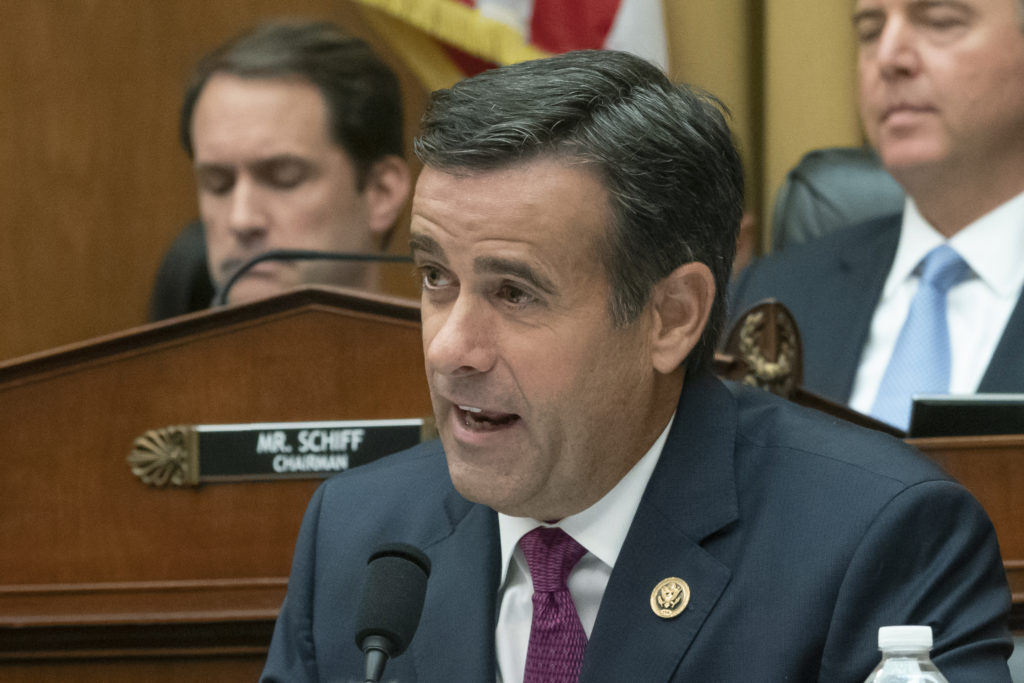
President Donald Trump’s pick for national intelligence director has been mayor of a small Texas city, a federal prosecutor and a member of Congress. But questions were already emerging Monday about whether those qualifications are adequate for the position as the nation confronts threats that include foreign election interference, North Korea’s nuclear ambitions and the risk of war with Iran. Republican Rep. John Ratcliffe is also known as a Trump loyalist, which makes his lack of relevant experience even more striking at a time when current and former government officials expect Russia to look to interfere in the 2020 presidential election just as it did in unprecedented fashion when Trump first ran. “Ratcliffe comes to the job with the least national security experience and the most partisan political experience of any previous director of national intelligence,” said Michael Morell, a former acting CIA director who now hosts the “Intelligence Matters” podcast. The director of national intelligence has oversight of the nation’s 17 intelligence agencies, a significant job touching all corners of national security policymaking. If confirmed, Ratcliffe would be the principal intelligence adviser to Trump, who has appeared determined to surround himself with vocal protectors and defenders even in national security positions that haven’t historically been perceived as overtly partisan. It is unclear what specific experience Ratcliffe will bring in helping thwart foreign government efforts to interfere in American politics. Also unknown is whether skepticism he has voiced in Congress about special counsel Robert Mueller’s investigation into ties between Russia and the Trump campaign will affect his preparation for, or response to, any foreign influence or cyberattacks on campaigns. Ratcliffe, who was among the most aggressive Republican questioners of Mueller at public hearings last week, would replace outgoing director Dan Coats at a time of broader reshuffling within the national security leadership structure. “It’s a moment when Donald Trump can deepen his personal stranglehold over the intelligence function and knock out any voices of dissent to his particular worldview,” said Democratic Rep. Jamie Raskin of Maryland. “That’s a scary thing for the country.” The selection comes months after Trump empowered another ally, Attorney General William Barr, to disclose still-secret intelligence collected by other agencies as part of the Russia investigation. Ratcliffe has made clear his skepticism of that investigation and his belief that Trump was treated improperly by investigators, saying in a talk show appearance Sunday that it was time to move on from discussion of impeachment. Coats, who will step down next month, repeatedly clashed with Trump. He was publicly steadfast about his conviction that Russia had interfered in the election even in the face of the president’s ambivalence. He appeared to scoff when told in an interview that Trump had invited Russian President Vladimir Putin to Washington. And in his resignation letter, he cited as an accomplishment the appointment of an election security executive “to support the whole-of-government effort to address threats against our election.” Tensions with Trump notwithstanding, Coats did bring to the job decades of Washington experience, including lengthy stints as an Indiana congressman and U.S. ambassador to Germany. His predecessor in the Obama administration, James Clapper, spent decades in the military and in intelligence, including as director of the Defense Intelligence Agency.Ratcliffe does not have equivalent credentials, though his supporters are likely to point to his experience as a prosecutor as well as his recent membership on the House Intelligence Committee, which he joined in January. Ratcliffe was first elected to Congress in 2014, and his experience as top federal prosecutor in east Texas gave him instant clout when Republicans ran the Judiciary panel. He was one of the main questioners when Republicans hauled in Justice Department officials to question them about whether they were biased against Trump in the early days of the FBI’s Russia probe. It’s unclear whether concerns about his credentials will trip up the confirmation process. Confirmation takes a simple 51-vote majority, under new rules in the Senate, but that leaves slim room for error with Republicans holding a 53-seat majority. Sen. Richard Burr, the Republican chairman of the Senate Intelligence Committee, said Monday that he would move swiftly to push the nomination through his panel. “I don’t have any concerns,” he told reporters. Several Republicans on the intelligence panel said they didn’t know Ratcliffe and would wait to meet with him. “I’m open on this,” said Missouri Sen. Roy Blunt. Maine Sen. Susan Collins, a critical swing vote for the GOP who sits on the panel, said the job is very important to her because she co-wrote the legislation that created it 15 years ago. She said she had never heard of Ratcliffe before last week, so she couldn’t comment on his qualifications, but she said she cares deeply “about having an independent, well-qualified individual in that post.” Republican Sen. John Cornyn, another member of the committee, said that his Texas colleague is a “tremendous human being” and that he is “confident he can rise to the challenge.” Democrats were immediately critical. The committee’s top Democrat, Sen. Mark Warner of Virginia, said Ratcliffe’s questioning at the Mueller hearings “raises huge questions in my mind” about his ability to be independent. Even before Mueller testified, Trump had his eye on Ratcliffe, who had already established himself as an outspoken defender of the president and raised Trump-backed questions about the conduct of the intelligence community in the Russia probe. But two officials said his aggressive questioning of the former special counsel cemented the president’s view that he was the right person for the job. Last Wednesday, he told Mueller that while he accepted that Russia’s interference was “sweeping and systematic,” he was also concerned about how much intelligence came from an ex-British spy who received Democratic funding to investigate Trump and whose research helped form the basis of a secret surveillance warrant to monitor the communications of a former Trump campaign aide. He pointedly accused Mueller of departing from the special counsel’s own rules by writing “180 pages about decisions that
Dan Coats will leave his job as national intelligence director
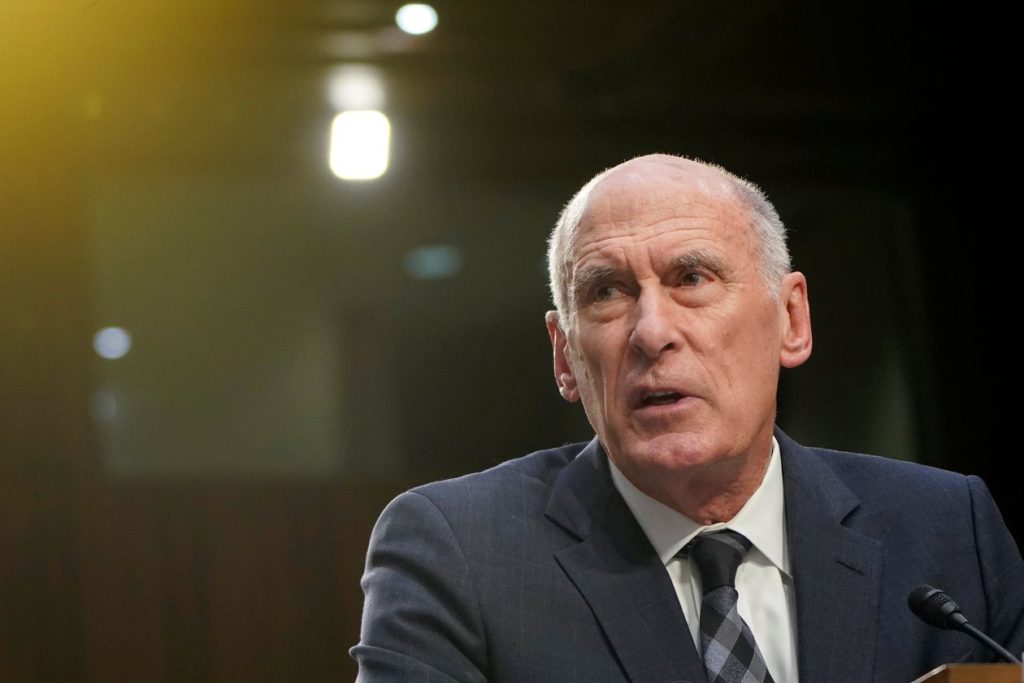
Dan Coats, director of national intelligence, will leave his job next month, President Trump announced, after a turbulent two years in which Coats and the president were often at odds over Russian interference in the 2016 election. Trump announced Coats’ departure as Aug. 15 in a tweet on Sunday that thanked Coats for his service. He said he will nominate Rep. John Ratcliffe, Republican-Texas, to the post and that he will name an acting official in the coming days. Ratcliffe is a frequent Trump defender who fiercely questioned former special counsel Robert Mueller during a House Judiciary Committee hearing last week. Coats often appeared out of step with Trump and disclosed to prosecutors how he was urged by the Republican president to publicly deny any link between Russia and the Trump campaign. The frayed relationship reflected broader divisions between the president and the government’s intelligence agencies. Coats’ public, and sometimes personal, disagreements with Trump over policy and intelligence included Russian election interference and North Korean nuclear capabilities. Trump had long been skeptical of the nation’s intelligence agencies, which provoked his ire by concluding that Russia interfered in the 2016 presidential election with the goal of getting him elected. In a letter of resignation released Sunday night, Coats said serving as the nation’s top intelligence official has been a “distinct privilege” but that it was time for him to “move on” to the next chapter of his life. He cited his work to strengthen the intelligence community’s effort to prevent harm to the U.S. from adversaries and to reform the security clearance process. A former Republican senator from Indiana, Coats was appointed director of national intelligence in March 2017, becoming the fifth person to hold the post since it was created in the wake of the Sept. 11, 2001, attacks to oversee and coordinate the nation’s 17 intelligence agencies. Coats had been among the last of the seasoned foreign policy hands brought to surround the president after his 2016 victory, of whom the president steadily grew tired as he gained more personal confidence in Oval Office, officials said. That roster included Defense Secretary Jim Mattis and Secretary of State Rex Tillerson, and later national security adviser H.R. McMaster. Coats developed a reputation inside the administration for sober presentations to the president of intelligence conclusions that occasionally contradicted Trump’s policy aims.His departure had been rumored for months, and intelligence officials had been expecting him to leave before the 2020 presidential campaign season reached its peak. Sen. Mark Warner of Virginia, the ranking Democrat on the Senate’s intelligence committee, tweeted Sunday: “The mission of the intelligence community is to speak truth to power. As DNI, Dan Coats stayed true to that mission.” Senate Majority Leader Mitch McConnell said he was sorry to see Coats leave and praised him, saying he had been reassured knowing that such a man as his former Senate colleague who “took such a deliberate, thoughtful, and unbiased approach was at the helm of our intelligence community.” Trump’s announcement that Coats would be leaving came days after Mueller’s public testimony on his two-year investigation into Russian election interference and potential obstruction of justice by Trump, which officials said both emboldened and infuriated the president. Coats had been among the least visible of the president’s senior administration officials but, in his limited public appearances, repeatedly seemed at odds with the administration, including about Russia. For instance, he revealed to Mueller’s investigators how Trump, angry over investigations into links between his campaign and Russia, tried unsuccessfully in March 2017 to get him to make a public statement refuting any connection. “Coats responded that the Office of the Director of National Intelligence (ODNI) has nothing to do with investigations and it was not his role to make a public statement on the Russia investigation,” Mueller’s report said. Trump later called Coats to complain about the investigation and how it was affecting the government’s foreign policy. Coats told prosecutors he responded that the best thing to do was to let the investigation take its course. In February, he publicly cast doubt on the prospects of persuading North Korea to end its nuclear weapons program despite the diplomatic efforts of the administration, which has touted its outreach to the isolated country as one of its most important foreign policy achievements. Coats, in testimony to Congress as part of annual national intelligence assessment, said North Korea would be “unlikely” to give up its nuclear weapons or its ability to produce them because “its leaders ultimately view nuclear weapons as critical to regime survival.”Trump publicly bristled at the testimony of Coats, the head of the CIA and other officials who contradicted his own positions on Iran, Afghanistan and the Islamic State group as well as North Korea. The intelligence officials were “passive and naive,” he said in a tweet.Last July, Coats and the president appeared at odds following Trump’s widely panned news conference in Helsinki alongside Russian President Vladimir Putin. Trump said he saw no reason to believe Russia had interfered in the 2016 election, drawing bipartisan criticism and a rebuttal from his intelligence chief. “We have been clear in our assessments of Russian meddling in the 2016 election and their ongoing, pervasive efforts to undermine our democracy, and we will continue to provide unvarnished and objective intelligence in support of our national security,” Coats said.The president later said he misspoke in Helsinki. That same month, Coats appeared to scoff when told in an interview that Trump had invited Putin to Washington. “Say that again,” Coats said, cupping his hand over his ear on live television. He took a deep breath and continued: “OK. That’s going to be special.” He later said his comments at the Aspen Security Forum in Colorado were “in no way meant to be disrespectful or criticize the actions of the president.” In December, Coats said he was “deeply saddened” when Mattis resigned in protest of Trump’s foreign policy, including the decision to withdraw American troops from Syria. Coats called Mattis a
John Giles: Qualifications? Meeting a payroll

Governor Guy Hunt once told me, “John, before anyone runs for office or becomes a journalist, they would be well-served to have met a payroll first. What a profound statement and I agree 100 percent. If you have kept up with my resume, I worked for the Hunt administration in economic development during the late 80’s early 90’s. I worked primarily in the area of Small Business and later with all exiting business and industries. My father was a small business entrepreneur and that mantle passed down to his family. My father taught all of us what it meant to meet a payroll. We all fully understood and appreciated what Governor Hunt was saying. For those who have not had that opportunity, let me share with you what has to happen before you can write a payroll check. First, you have to have a product or service. Then, you have to get in the market place and find your niche among a field of competition. You have to convince the buyer you are qualified to deliver, best in the business and your price has to generally meet your competitors. After getting the order, now you have to deliver as promised, satisfy the customer, invoice and then collect. In addition, one must price the invoice with an adequate margin to meet your overhead, expenses, maintain raw materials and finished inventory, carry accounts receivables, payroll and payroll taxes, and then guess who is last to get paid. Entrepreneurs are often over glamourized, they really work to keep their team employed and in most cases, the last one to get paid. I can tell you from personal experience, on more than one occasion; we had to put our paycheck in the drawer, while paying employees and other obligations first. Entrepreneurs often go to bed and wake up in a sweat, frequently can’t sleep from the financial, physical and emotion load of carrying a business. This same owner is often faced with a tsunami of problems that seem to be insurmountable, and somehow finds a narrow path of escape from total disaster and business failure. At the end of the day, this small business person is responsible for the engine of our economy, and creates 75 percent of all of our new jobs. Prayer, vision, work ethic, tenacity, grit, tough, mission oriented, making one dollar do the work of three dollars, negotiating skills and not having can’t or quit in your vocabulary are the traits that embody a small business entrepreneur. Most people cannot handle this kind of sustained pressure. For an elected official who never met a payroll, it puts them at a great disadvantage in solving problems and getting projects completed. Often, without the skills to find solutions or make very tough decisions, a non- business background officeholder quickly find themselves outside of their expertise. All too often they are tempted with very weak solutions throwing taxpayer money at problems, like raising taxes, toll roads or legalizing gambling, all of which are very regressive ideas. Another example, let’s build bigger prisons rather than fight recidivism. Being successful in business also requires a high level of common sense, which is generally not the order of the day in government solutions. Rarely does a journalist have a small business background, which means they have never met a payroll. Most come from academia where research projects are theory based and not applied real time research. Journalist by most polling data, generally vote Democrat and typically lean leftward in rationale and on issues. As I have written before, journalism and editorial opinion departments have merged, which is unfortunate. In my experience over the years, if you have an elected official offer an idea as a solution like, raising taxes, passing gambling, open borders, free healthcare and college, adding illegal immigrants to the entitlement rolls and allowing them to vote and the like, generally journalist are drooling all over these ideas as if they are a stroke of brilliance. One recent example, Obama’s economic development plan was summed up in two words: Green Jobs. The media treated this notion as astounding. Common sense knew at the outset, this was a flawed concept. Wind energy, solar, and electric cars are not cost effective, so the market potential for these ideas are in the deficit before you wake up in the morning. Government subsidized plants promoting these concepts catastrophically failed on a flawed theory, not applied science. Let’s discuss academia for a minute. I have often proposed that we need corporate business minds running academia, not academics, particularly as College and University Presidents along with Superintendents of Education. You can hire academics to run your educational programs. Education is like any other enterprise, you are in the people business so they have to be led, have budgets, need long term strategic plans with measurable outcomes and who better to address this kind of leadership than a business professional. If you do not have a PhD. behind your name, you can forget about being a university president. Motivating people, being goal oriented, raising funds, selling programs to the public, leadership, making tough decisions and so much more are second nature for a business person. Academics in this environment are at a great disadvantage, because of not having the hard core problem solving skills earned from recession injected experiences, there is just no comparison. As a side note, lawyers often find their way into public office. There are two kinds of lawyers, strict constructionist constitutional originalist (Conservative) and those that believe the constitution is a living, breathing every evolving and changing document (Liberal). Ambulance chasing plaintiff trial lawyers (Liberal) generally are those if elected or appointed as judges practice judicial activism. We do not need these types in any public office. On the other hand, strict constructionists (Conservative) generally make great judges and compliment the business minds in the legislative process, keeping ideas constitutionally driven. Business people have to finish the project or service to get paid; non-business minds are
