
Congress’ fight over election security bills explained by AP
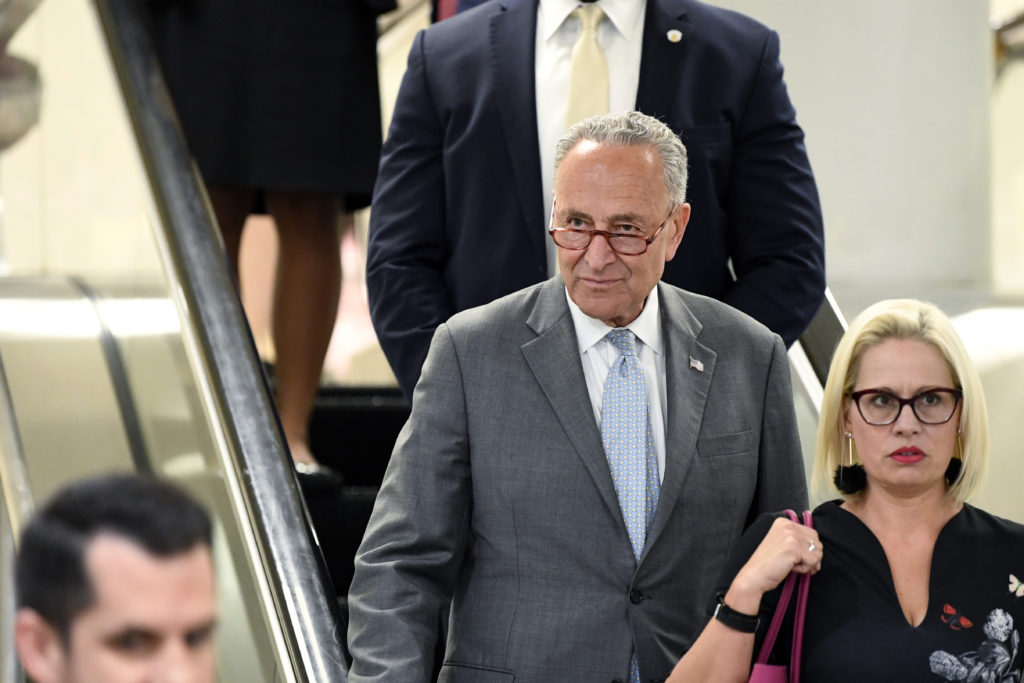
While House Democrats are haggling over whether to consider impeachment of President Donald Trump, Senate Democrats are focusing on a different angle in former special counsel Robert Mueller’s report — securing future elections from foreign interference. Democrats have tried to pass several election security bills in recent weeks only to have them blocked by Republicans, who say they are partisan or unnecessary. The federal government has stepped up its efforts to secure elections since Russians intervened in the 2016 presidential election, but Democrats say much more is needed, given ongoing threats from Russia and other countries. Senate Majority Leader Mitch McConnell has seethed in response to criticism over the issue, including some Democrats’ new moniker for him: “Moscow Mitch.” In an angry floor speech on Monday, he noted that Congress has already passed some bills on the subject, including ones that give money to the states to try to fix security problems. McConnell also left the door open to additional action, saying “I’m sure all of us will be open to discussing further steps.” Senate Minority Leader Chuck Schumer predicted that Democrats’ “relentless pushing” will work. “We’re forcing his hand,” Schumer said. The top Democrat on the Senate intelligence committee, Virginia Sen. Mark Warner, said Thursday that he’s “much more optimistic than even 10 days ago” that the Senate will ultimately pass something on election security. Warner said he believes that in his home state, at least, the issue “has broken through” with voters more than other aspects of Mueller’s probe. But action will have to wait until at least September, with senators having scattered from Washington for the summer recess. A look at various election security bills in the Senate: REPORT FOREIGN INTERFERENCE Legislation introduced by Warner would require campaigns to report to federal authorities if they have any contacts with foreign officials who are attempting to interfere in a presidential election. Mueller’s report, issued in April, details a meeting between a Russian lawyer and members of the Trump campaign before which dirt on Democrat Hillary Clinton had been promised. There’s no evidence that such material was provided at the meeting, and Mueller concluded that he wasn’t able to establish a conspiracy between Trump’s campaign and Russia. But Democrats say more safeguards are needed to ensure future campaigns don’t receive foreign help. Republicans blocked Warner’s bill on the floor last month, but at least one in their ranks has signed on — Maine Sen. Susan Collins, a key swing vote on the intelligence panel.“Russia’s efforts to interfere in our elections remain relentless,” Collins tweeted July 30. “I’m proud to join Sen. @MarkWarner in cosponsoring the bipartisan FIRE Act to require presidential candidates to immediately call the FBI if they are contacted by a foreign power attempting to target our elections.” Democratic Sen. Richard Blumenthal of Connecticut has a similar bill that has also been blocked by Republicans. SECURE STATE ELECTION SYSTEMS Minnesota Sen. Amy Klobuchar, a Democratic candidate for president, has introduced legislation to require states to use paper ballots, which would make election systems less vulnerable to hacking. It would also provide additional grants for states to make improvements, among other measures. Homeland Security officials notified election officials in 21 states in 2017 that their systems had been targeted by Russia. Authorities have since said they believe all states were targeted to varying degrees. The federal government has ramped up its efforts to help states prevent such intrusions, and both sides say the relationship has greatly improved.Republicans blocked passage of Klobuchar’s bill on the Senate floor in June. GOP critics of the bill say they fear creating too many new federal rules for states when they are already working with the government to make improvements. Some Republicans supported similar legislation in the last Congress, including Oklahoma Sen. James Lankford and Missouri Sen. Roy Blunt. Lankford has said he’s still working with Klobuchar’s office on details of the legislation, but Blunt says he doesn’t think it’s needed, for now. The House passed similar legislation to help states, but Republicans blocked that on the Senate floor as well. SENATE CYBERSECURITY Democratic Sen. Ron Wyden of Oregon and Republican Sen. Tom Cotton of Arkansas have sponsored a bill to protect personal electronic devices and accounts of senators and Senate staff from cyber threats. It would allow Senate officials to provide voluntary assistance to the senators. That bipartisan legislation, which was also blocked on the Senate floor last month, came after former Sen. Claire McCaskill, Democrat-Missouri, said last year that Russian hackers had tried unsuccessfully to infiltrate her Senate computer network in 2017. The senators said they proposed the legislation after Senate officials said they couldn’t use public funds to protect non-government devices and accounts. RUSSIAN SANCTIONS Another bipartisan election security measure from Sens. Marco Rubio, Republican-Florida, and Chris Van Hollen, Democrat-Maryland, would slap new sanctions on Russia if it tries to interfere in U.S. elections. Rubio and Van Hollen pushed the legislation last session and reintroduced it this year, but it hasn’t yet moved. McConnell hasn’t signaled opposition to the bill, but some lawmakers in the House and Senate have raised concerns it casts too wide a net and could cause problems for allied nations that do business with Russia. MORE REGULATION OF ONLINE CAMPAIGN ADS Legislation first introduced in 2017 by Warner and Klobuchar would extend some political ad rules that now apply to TV, radio and print to the internet. That bill has bipartisan support as well, with Senate Judiciary Committee Chairman Lindsey Graham as a cosponsor. The senators wrote the legislation in response to Russia’s broad social media disinformation campaign on Facebook and other sites. It would require social media companies to keep public files on election ads and meet some of the same disclaimer requirements as political broadcast and print advertising. The social media companies say they have started to take those steps voluntarily, but the bill’s supporters say they should be required by law. MAKING IT A CRIME FOR FOREIGN NATIONS TO INTERFERE In arguing
AP fact check: The democratic debates and Donald Trump counterpunch
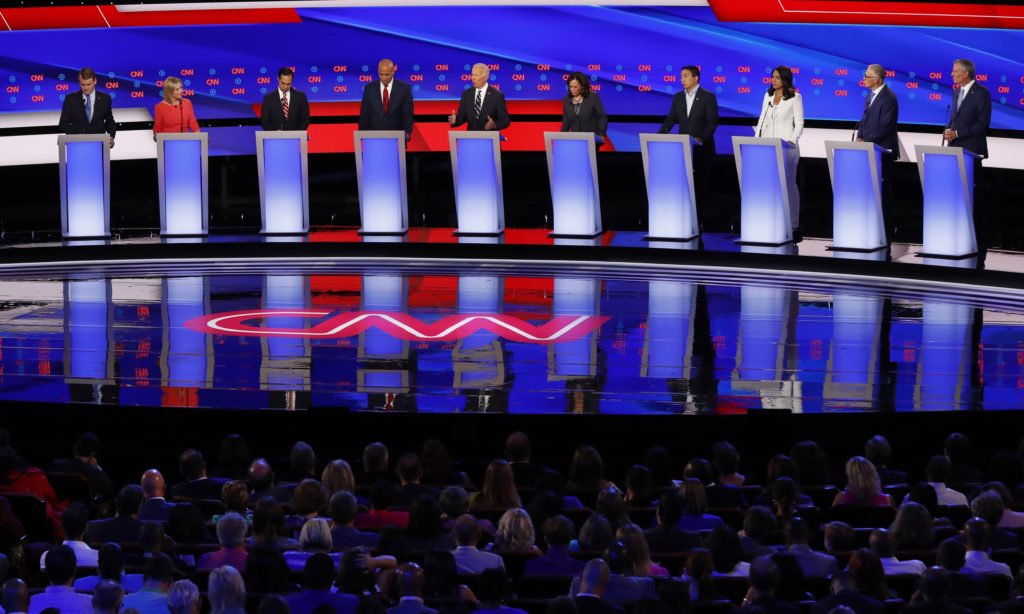
In his typically boastful rally this past week, Donald Trump placed himself too high in the pantheon of presidents when it comes to getting his judicial picks on federal courts. He’s been having a good run on that front but he’s not where he said he is — ranking right under George Washington, no less. Much of the week was filled with the cacophony of Democratic presidential candidates having their say on the debate stage. Their pronouncements did not always fit with the facts. They skewed reality on climate science, immigration policy, the auto industry and more. A review: JUDGES TRUMP, on his record of filling federal judicial appointments: “There’s only one person … who percentage-wise has done better than me with judges.” — Cincinnati rally Thursday.THE FACTS: No, at least four have done better. Trump is properly ceding first place to George Washington, who had a judiciary entirely made up of his choices simply because he was the first president. But he’s not acknowledging that at least three modern presidents had a better record than Trump of getting their judicial choices on the courts. Russell Wheeler, a visiting fellow at the Brookings Institution and former deputy director of the Federal Judicial Center, has been keeping track. He found that Trump’s confirmed judges make up 17% of total federal judgeships. At this point in their presidencies, John Kennedy had filled 30% of the federal judiciary, Bill Clinton had filled 20% and Nixon had filled 25%. CLIMATE BETO O’ROURKE, former U.S. representative from Texas, on global warming: “I listen to scientists on this and they’re very clear: We don’t have more than 10 years to get this right. And we won’t meet that challenge with half-steps, half-measures or only half the country.” — Democratic debate Tuesday. PETE BUTTIGIEG, mayor of South Bend, Indiana: “Science tells us we have 12 years before we reach the horizon of our catastrophe when it comes to our climate.” — Democratic debate Tuesday. ANDREW YANG, entrepreneur: “This is going to be a tough truth, but we are too late. We are 10 years too late.” — Democratic debate Wednesday. THE FACTS: These statements are out of step with science. Climate scientists don’t agree on an approximate time frame, let alone an exact number of years, for how much time we have left to stave off the deadliest extremes of climate change. Nor do they think it’s too late already. A report by the U.N. Intergovernmental Panel on Climate Change, drawn from the work of hundreds of scientists, uses 2030 as a prominent benchmark because signatories to the Paris climate change agreement have pledged emission cuts by then. But it’s not a last-chance, hard deadline for action, as O’Rourke, Buttigieg and others have interpreted it.“The hotter it gets, the worse it gets, but there is no cliff edge,” James Skea, co-chairman of the report, told The Associated Press. Climate scientists certainly see the necessity for broad and immediate action to address global warming, but they do not agree that 2030 is a “point of no return,” as Buttigieg put it. “This has been a persistent source of confusion,” agreed Kristie L. Ebi, director of the Center for Health and the Global Environment at the University of Washington in Seattle. “The report never said we only have 12 years left.” IMMIGRATION Kamal Harris, senator from California: “We’ve got a person who has put babies in cages and separated children from their parents.” — Democratic debate Wednesday.MICHAEL BENNET, senator from Colorado, in a message directed at Trump: “Kids belong in classrooms not cages.” — Democratic debate Wednesday. TRUMP: “The cages for kids were built by the Obama Administration in 2014. He had the policy of child separation. I ended it even as I realized that more families would then come to the Border!” — tweet Wednesday. THE FACTS: There’s deception on both sides here. Family separations as a matter of routine came about because of Trump’s “zero tolerance” enforcement policy. President Barack Obama had no such policy and Trump’s repeated attempts to pin one on him flies in the face of reality. Trump only ended — or suspended — what Trump had started, and that was after a judge ordered that the practice be sharply curtailed and as an international uproar grew. Moreover, the American Civil Liberties Union now says in a legal challenge that more than 900 children were separated from their parents at the border in the year after the judge’s order. The Obama administration also separated migrant children from families when a child’s safety appeared at risk with the adults or in other limited circumstances. But the ACLU says children have been removed after the judge’s order for minor transgressions by the adults, like traffic offenses, or for unfounded suspicions of wrongdoing. Trump, though, is correct in noting that the “cages” — chain-link enclosures inside border facilities where migrants have been temporarily housed, separated by sex and age — were built and used by the Obama administration. Democrats routinely ignore that fact when they assail Trump for what they call the cruelty of putting “babies in cages.” The Trump administration has been using the same facilities as the Obama administration. Joe Biden, former vice president, on Obama’s approach to people who came to the U.S. illegally as children: “The president came along and he’s the guy that came up with the idea, first time ever, of dealing with the Dreamers. He put that in the law.” — Democratic debate Wednesday. THE FACTS: He’s wrong that Obama achieved a law protecting those young immigrants. He notably failed on that front. Instead he circumvented Congress and used his executive authority to extend temporary protection, letting them stay in the country if they met certain conditions. The Deferred Action for Childhood Arrivals program, as its name implies, merely defers deportations. Trump, also with executive action, tried to end the program but the effort has been tied up in courts, so the protection continues for now. Cory Booker, senator
Alabama implements new vaping regulations
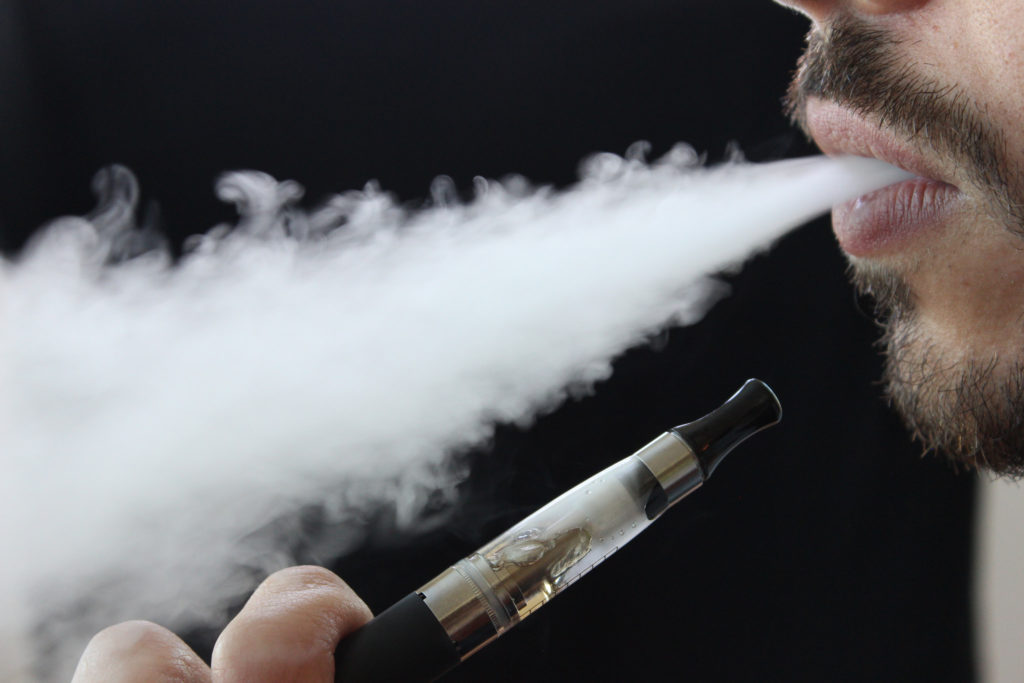
Tobacco shops in Alabama are no longer being able to advertise vaping as a healthy alternative to smoking. A wide-ranging law regulating vaping that passed the legislature earlier this year went into effect Thursday. It also prohibits opening vape shops within 1,000 feet of a school, church or childcare facility and limits advertising on billboards to include only three vaping flavors. That includes tobacco, mint and menthol. Critics say fruit-flavored vaping liquids attract younger users. One of the law’s sponsors, Democrat Rep. Barbara Drummond, told WBRC-TV she was shocked to see a 12-year-old in her Sunday school class with a vape, which she initially thought was a flash drive. Republished with permission of the Associated Press.
