
Governor’s panel tours aging, understaffed prison

State officials toured a state prison that the corrections commissioner say illustrates the state’s problem with aging facilities. It also shows the state’s ongoing problems with understaffing. The Governor’s Study Group on Criminal Justice Policy on Tuesday toured Holman Correctional Facility in Atmore. The maximum-security inmate houses more than 1,000 inmates in facilities originally designed for about 500. Corrections Commissioner Jeff Dunn says the 50-year-old prison was built under a “warehousing” model of corrections, and lacks spaces for rehabilitation programs. Gov. Kay Ivey’s administration is exploring a plan to build three new mega-prisons and close most facilities. Holman Warden Cynthia Stewart says the prison has about one-third of the corrections officers it is authorized to have. An inmate hung a “Help” sign in a window as reporters approached. Republished with the permission of the Associated Press.
Adam J. MacLeod: Alabama’s marriage compromise follows the law and history

For just over a month now, Alabama officials have not issued marriage licenses. They instead record certificates memorializing marital contracts, signed by married couples and notarized. The law authorizing this change is a sensible and principled compromise. Indeed, it might be a model for other states. It accommodates both the opinion of the U.S. Supreme Court, expressed in its 2015 Obergefell v. Hodges ruling, that natural marriage can no longer be privileged in law and the rights of state officials who cannot in good conscience affirm a conception of marriage that they understand to be false. Alabama probate judges have long had different legal obligations than Kim Davis, the county clerk in Kentucky who stopped issuing marriage licenses after Obergefell. In August, the United States Court of Appeals for the Sixth Circuit ruled that Davis infringed the rights of same-sex couples. Kentucky law requires a clerk to issue licenses. And the Supreme Court’s ruling in Obergefell requires that, if states license natural marriages then they must also issue licenses to same-sex couples. Davis argued that she was not flouting Obergefell. She did not discriminate; she did not issue licenses to anyone. In the words of the Fourteenth Amendment to the U.S. Constitution, she did not deny anyone “equal protection” of the laws of Kentucky. But the Court of Appeals ruled that her refusal to issue licenses violated a right that was “clearly established” in Obergefell and grounded in the Due Process Clause of the Fourteenth Amendment. The idea that the Due Process Clause requires states to issue marriage licenses is implausible. So, the sensible interpretation of the Davis ruling is that, because Kentucky law requires clerks to issue marriage licenses, Davis shirked her duty by refusing. That reasoning has no bearing on Alabama law. Even before Alabama abolished marriage licenses, its laws authorized but did not require county officials to issue a license. The alternative—that the Due Process Clause requires marriage licenses—would be ludicrous. The Fourteenth Amendment was ratified in 1868. States did not begin issuing marriage licenses until the early 1900s. Union soldiers did not fight and die in the Civil War to obtain permission from the state to get married. Nor would it have occurred to anyone who voted to ratify the Fourteenth Amendment that “liberty” means seeking government permission to do what God and nature commend. When states did begin licensing marriages, they did so in part for reasons that violate the Fourteenth Amendment. Some states created marriage license schemes and other vital records in order to improve public health data. But many did so to prevent inter-marriage between the races (known as “miscegenation”) and to facilitate forced sterilization and other eugenics programs. Proponents of marriage licensing laws were candid about these goals. The influential eugenicist Harry Hamilton Laughlin explained in a 1922 report to the Chicago Municipal Court: “[A]mong the most eugenical of [limitations on marriage] are those relating to certain types of miscegenation and those denying marriage to the insane, feebleminded and other constitutional degenerates or defectives.”Marriage licenses empower states to control marriage. Laughlin explained that marriage records are also important to enable eugenicists to identify “individuals personally defective,” who suffer “hereditary degeneracy,” so that they can be denied admission to marriage. “The location of such degeneracy is a difficult task,” he conceded, “but is necessary as a foundation for the intelligent purging of the race.” Laughlin’s frank disclosure of the racist, social-Darwinian motivations behind marriage licensing laws might startle those who have never studied the history of legal concepts (a group that today includes most lawyers, unfortunately). But some judges and elite lawyers today seem to share his assumption that judges and other government officials have power to define what marriage is and to grant permission to marry. Laughlin was candid about the implications of this assumption. The power to define marriage and to grant permission to marry is the power to prohibit real marriages between man and woman, which are capable of producing children whom the government deems undesirable. Laughlin looked forward to the day when governments would not only prevent marriages between different races and by “defectives” but would also “limit marriage to persons who can demonstrate the possession in their family trees of socially valuable mental, physical and temperamental qualities.” Advances in scientific knowledge would, he hoped, eventually bring about “the limitation of marriage to persons of demonstrated natural worth.” This is not to suggest that those who today advocate a statist conception of marriage do so because they are closet eugenicists. It is to expose the folly of the idea that marriage exists because of state law or the opinions of federal judges. Marriage pre-existed the first state statutes and the creation of federal courts by several thousand years. And the Constitution does not require states to attempt to re-engineer marriage for the purposes of dogmatic elites. Adam J. MacLeod is a Professorial Fellow of the Alabama Policy Institute and Professor of Law at Faulkner University, Jones School of Law.
William Parker and Wardine Alexander to lead Birmingham Council next 2-years

Councilor William Parker (District 4) and Councilor Wardine Alexander (District 7) were elected as the new president and pro tempore of the Birmingham City Council today at the council’s regular meeting. According to the bio on his city website, Parker describes himself as a “Talladega College graduate has deep political roots. He worked as a legislative assistant to former U.S. Representative Earl Hilliard, D-Birmingham, before being elected to the State Legislature. During his tenure, he served a large portion of Council District 4. The Birmingham City Council appointed Council President Pro Tempore William Parker to fill his late mother’s term on November 26, 2013. Council President Maxine Herring Parker passed away on November 12, 2013. Council President Pro Tempore William Parker has vowed to continue her work.” Alexander’s bio notes, “She was appointed to the Birmingham City Council on October 30, 2018 to represent District 7. Her top priorities for the district centers around sustainable programs that will improve public safety, economic opportunity, and the ultimate enhancement of the quality of life for all residents along with effective workforce development and community revitalization programs. She believes that with improved collaboration among the residents, major community/business stakeholders, the Council, and the Mayor, effective change can be brought to District 7 and the City.” AL.Com reported that “District 8 Councilor Steven Hoyt nominated District 1 Councilor Clinton Woods for president. District 2 Councilor Hunter Williams nominated Parker. District 3 Councilor Valerie Abbott and Hoyt initially abstained from the vote, but then changed their votes to support Parker. The remaining councilors, except for Woods, then changed their votes to support Parker as well. Alexander was nominated for pro tem by Williams. Hoyt then nominated District 9 Councilor John Hilliard. Alexander won with five votes. Councilors Hoyt, Hilliard, Smitherman and Woods voted for Hilliard.” The council president and pro tempore serve 2-year terms.
Donald Trump likens House impeachment inquiry to ‘a lynching’

President Donald Trump enraged Democrats on Tuesday by comparing their impeachment inquiry to a lynching, assigning the horrors of a deadly and racist chapter in U.S. history to a process laid out in the Constitution. “That is one word no president ought to apply to himself,” said Democratic Rep. James Clyburn of South Carolina, the highest-ranking African American in Congress. “That is a word that we ought to be very, very careful about using” he said. Rep. Bobby Rush, Democrat-Illinois, called on Trump to delete the tweet. “Do you know how many people who look like me have been lynched, since the inception of this country, by people who look like you. Delete this tweet,” wrote Rush, who is also black. Sen. Doug Jones, Democrat-Alabama, tweeted to Trump: “No sir! No, @realDonaldTrump: this is NOT a lynching, and shame on you for invoking such a horrific act that was used as a weapon to terrorize and murder African Americans.” Republicans legislators largely tried to put the focus on what they said was the unfair way in which Democrats are conducting the impeachment inquirySen. Lindsey Graham, Republican-South Carolina, said Trump’s description was “pretty well accurate.” He called the impeachment effort a “sham” and a “joke” because the president does not know the identity of his accuser, and the process is playing out in private. Lynchings, or hangings, were used mostly by whites against black men in the South, beginning in the late 19th century amid rising racial tensions. By comparing his possible impeachment to a lynching, Trump also likened Democrats to a lynch mob. Under pressure over impeachment, blowback over his Syria policy and other issues, the Republican president tweeted Tuesday: “So some day, if a Democrat becomes President and the Republicans win the House, even by a tiny margin, they can impeach the President, without due process or fairness or any legal rights. “All Republicans must remember what they are witnessing here — a lynching. But we will WIN!” Trump has a habit of trying to portray himself as the victim. His tweet came a day after he lashed out at critics of his decision — since rescinded — to schedule a major international economic summit for 2020 at one of his Florida golf properties. During remarks Monday, he lamented people who invoke the “phony emoluments clause.” The clause is in the Constitution and bans presidents from receiving gifts or payments from foreign governments, without the consent of Congress. Impeachment and its process are also in the Constitution. A whistleblower’s complaint that Trump was attempting to use his office for personal political gain during a July 25 phone conversation with Ukraine’s president led House Speaker Nancy Pelosi to open the impeachment inquiry. Trump insists he did nothing wrong. He has characterized the conversation with Ukrainian President Volodymyr Zelenskiy as “perfect” and argues that sore-loser Democrats are still trying to overturn the 2016 election that put him in the White House and keep him from winning a second term next year. Lynchings were fueled by anger toward blacks across the South, where many whites blamed their financial problems on newly freed slaves living around them, the NAACP n By Darlene Superville Associated Press Notes. Follow Darlene Superville on Twitter: https://www.twitter.com/dsupervilleap Republished with the permission of the Associated Press.
Birmingham City Council passes 100-block ‘health district’ smoking ban

An Alabama city council has approved an ordinance prohibiting smoking in a 100-block zone around schools and health facilities. Al.Com reports Birmingham City Council unanimously approved the rule last week. It’ll go into effect on Dec. 1. The ordinance says the no-smoking zone will be called the “health district” and will cover the University of Alabama at Birmingham, Children’s Hospital and Veteran’s Administration Medical Center. The council banned smoking in most places in 2012 and gave violators a fine. Council President Valerie Abbott says she’s worried about enforcing the ordinance but Health Officer and CEO of the Jefferson County Department of Health Mark Wilson says a few “gentle reminders” will be enough. The ordinance doesn’t include vaping; Wilson says he hopes the council will amend the ordinance in the future. Republished with the permission of the Associated Press.
National democrats says Oct 5 bylaws ‘binding’ on Alabama party
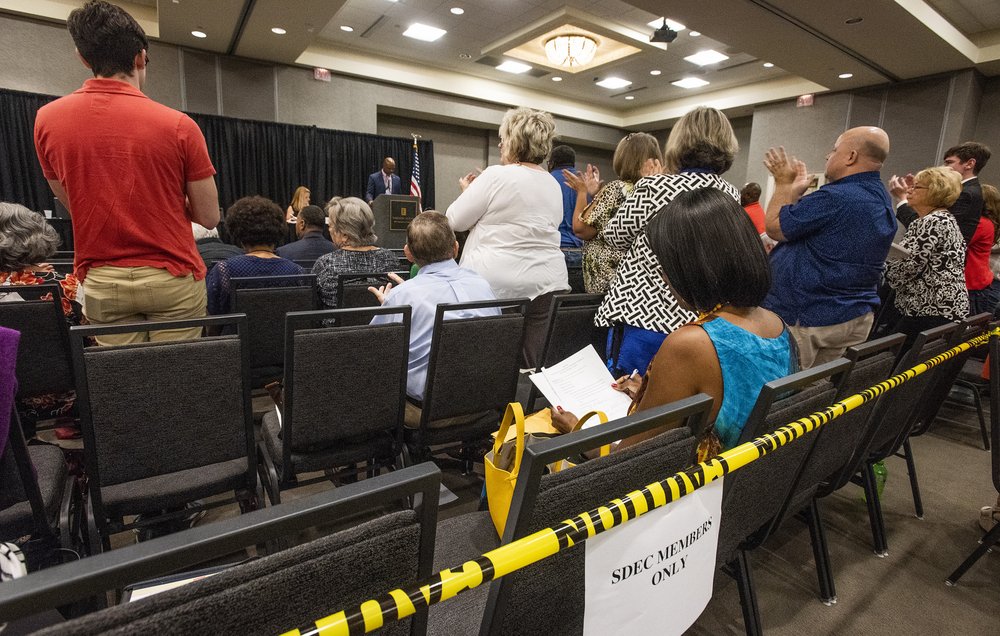
The chairman of the Democratic National Committee said state Democrats should follow their recently adopted bylaws and urged the state party chair to get on board with them. DNC Chair Tom Perez delivered the message in a letter Saturday to Alabama Democratic Party Chair Nancy Worley. Perez told Worley that a set of bylaws adopted Oct. 5 by a group of state committee members was properly called and is “binding on the party.” Worley has contended the Oct. 5 meeting was illegitimate. The rebuke from Perez is the latest twist in the ongoing power struggle that has split the party’s governing board into two factions — a reform group whose actions have been blessed by the DNC and committee members aligned with Worley and Joe Reed, the party’s vice-chair of minority affairs. Worley held a separate meeting on Oct. 12 in which different bylaws were adopted. Perez said the actions at the Oct. 12 meeting were not cleared by the DNC. The dueling meetings came after the DNC directed the Alabama party to hold new elections for chair and vice-chair and update bylaws to provide for the representation of more minorities in the party and not just African Americans. The Oct. 5 bylaws set up diversity caucuses to nominate Hispanics, LGBTQ individuals, young voters, and others to the governing board known as the State Democratic Executive Committee. Perez asked Worley to encourage all Democrats to attend a Nov. 2 meeting that will use the Oct. 5 bylaws to fill vacant positions and hold elections for chair and vice-chair. Perez said then the “State Party can turn attention to increasing the number of Democrats in Alabama” and to “fully and effectively conduct Party affairs in connection with the critical 2020 elections.” Worley said Monday that she has not seen the letter which was copied to several other Democrats. But she criticized the directives by national party officials and said the changes would “cut back minority representation for Blacks” in the party. “Democrats can win elections in the South, but the DNC can’t dictate the model to win here,” Worley wrote in a text message. DNC officials have warned the state party that failure to comply with orders on bylaws and leadership could cost them seats at the 2020 party convention in Milwaukee. Republished with the permission of the Associated Press.
