
Next Trump-Biden debates uncertain, though Oct. 22 is likely

The campaign’s final debates between President Donald Trump and Democrat Joe Biden were thrown into uncertainty Thursday as the rival camps offered dueling proposals for the remaining faceoffs that have been upended by the president’s coronavirus infection. The chair of the nonpartisan Commission on Presidential Debates told The Associated Press that the final debate, scheduled for Oct. 22, was still slated to go on with both candidates present as planned. But next Thursday’s debate seemed to be gone, after the Trump team objected to the commission’s format change. The whipsaw day began with an announcement from the commission that the town hall-style affair set for Oct. 15 in Miami would be held virtually. The commission cited health concerns following Trump’s infection as the reason for the change. Trump, who is eager to return to the campaign trail despite uncertainty about his health, said he wouldn’t participate if the debate wasn’t in person. Biden’s campaign then suggested the event be delayed a week until Oct. 22, which is when the third and final debate was already scheduled. Next, Trump countered again, agreeing to a debate on Oct. 22 — but only if face to face — and asking that a third contest be added on Oct. 29, just before the election. But Biden’s advisers rejected squaring off that late in the campaign. After the release late Thursday of a letter from Trump doctor Navy Cmdr. Sean Conley that the president had “completed his course of therapy” and could resume campaigning this weekend, the Trump campaign called on the commission to hold next week’s debate in person as originally scheduled. “There is therefore no medical reason why the Commission on Presidential Debates should shift the debate to a virtual setting, postpone it, or otherwise alter it in any way,” said Trump campaign manager Bill Stepien. But commission chair Frank Fahrenkopf said late Thursday that the decision to hold the debate virtually, guided by its medical advisers at the Cleveland Clinic, was not going to be reversed. The commission said it made the announcement in order to “protect the health and safety of all involved,” including the everyday citizens invited to ask questions of the candidates. The debate commission, which has the unenviable task of finding common ground between the competing campaigns, already came under scrutiny after the first debate between Trump and Biden deteriorated, with the president frequently interrupting his opponent and the moderator unable to take control. The Oct. 22 debate in Nashville, Tennessee, is scheduled to feature a format similar to the first. Biden’s campaign has suggested that it be modified to the “town meeting” format, though the Trump campaign has not weighed in. Founded after the 1984 presidential election, the commission has organized every general election debate since 1988 — and typically selects the dates, moderators, formats and locations without input from the candidates. Biden moved quickly to make sure he would still appear in front of a television audience next week. Instead of debating Trump on Thursday, he will take part in a town hall sponsored by ABC News. As he campaigned in Arizona, Biden said he would indeed attend the Oct. 22 debate. “We agreed to three debates back in the summer,” Biden said. “I’m showing up. I’ll be there. And if, in fact, he shows up, fine. If he doesn’t, fine.” For Trump, who is recovering from COVID-19 at the White House after spending three days in the hospital, the health-induced changes are an unwelcome disruption to his effort to shift focus away from a virus that has killed more than 210,000 Americans this year. In an interview with Fox Business anchor Maria Bartiromo shortly after the commission’s announcement, Trump insisted he was in “great shape” and called the idea of a virtual debate a “joke.” “I’m not going to do a virtual debate,” he declared. Stepien said Trump would stage a rally rather than debate next Thursday, though it’s not yet clear if he will be well enough to do that. With less than four weeks until Election Day and with millions of voters casting early ballots, pressure is building on Trump to turn around a campaign that is trailing Biden in polls nationally and in most battlegrounds, where the margin is narrower. A debate before an audience of tens of millions of television viewers could provide that reset. But another debate could also expose Trump to political risks. GOP strategists say the party’s support began eroding after his seething performance against Biden last week when he didn’t clearly denounce a white supremacist group. Trump’s apparent unwillingness to change his style to win back voters he needs — particularly women — was on display again Thursday during his Fox Business interview when he referred to Democratic vice presidential nominee Kamala Harris as a “monster.” Campaigning with Harris in Arizona, Biden called Trump’s characterization of the first Black woman on a major party’s presidential ticket “despicable” and added that it was “so beneath the office of the presidency.” This would not be the first time Trump has skipped a debate. During the 2016 Republican primary, he boycotted the last debate before Iowa’s first-in-the nation caucuses, holding a fundraiser for veterans instead — a move he later speculated may have contributed to his loss in the state. Trump fell ill with the virus on Oct. 1, just 48 hours after sharing a stage with Biden in person during the first presidential debate in Cleveland. While the two candidates remained a dozen feet apart, Trump’s infection sparked health concerns for Biden and sent him to undergo multiple COVID-19 tests before returning to the campaign trail. His campaign announced Thursday that Biden had undergone his fifth such test and was found to be negative. Trump was still contagious with the virus when he was discharged from Walter Reed National Military Medical Center on Monday, but his doctor said Thursday he had “completed his course of therapy” and could resume campaigning this weekend. According to the Centers for Disease Control and Prevention, those with mild to
13 charged in plots against Michigan governor, police
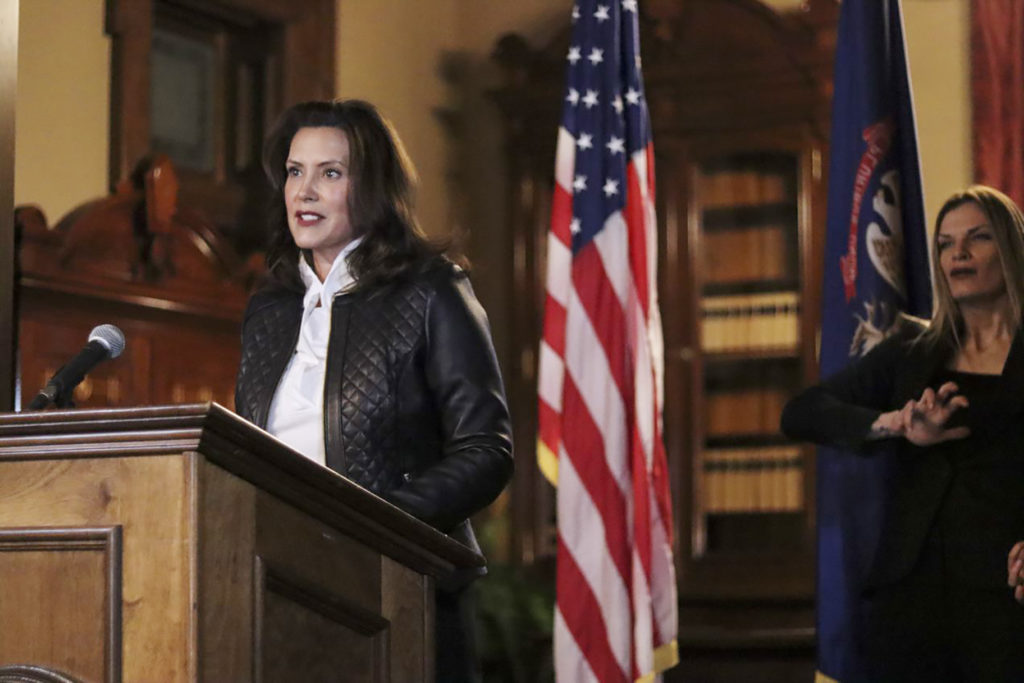
Agents foiled a stunning plot to kidnap Michigan Democratic Gov. Gretchen Whitmer, authorities said Thursday in announcing charges in an alleged scheme that involved months of planning and even rehearsals to snatch her from her vacation home. Six men were charged in federal court with conspiring to kidnap the governor before the Nov. 3 elections in reaction to what they viewed as her “uncontrolled power,” according to a federal complaint. Separately, seven others linked to a paramilitary group called the Wolverine Watchmen were charged in state court for allegedly seeking to storm the Michigan Capitol and seek a “civil war.” The two groups trained together and planned “various acts of violence,” according to the state police. Surveillance for the kidnapping plot took place in August and September, according to an FBI affidavit, and four of the men had planned to meet Wednesday to “make a payment on explosives and exchange tactical gear.” The FBI quoted one of the men as saying Whitmer “has no checks and balances at all. She has uncontrolled power right now. All good things must come to an end.” Authorities said the plots were stopped with the work of undercover agents and informants. The men were arrested Wednesday night. The six charged in federal court face up to life in prison if convicted. The state terrorism charges the other seven men face carry a possible 20-year sentence. Andrew Birge, the U.S. attorney in western Michigan, called the men “violent extremists.” They discussed detonating explosive devices — including under a highway bridge — to divert police from the area near Whitmer’s vacation home and Fox bought a Taser for use in the kidnapping, Birge said. “All of us in Michigan can disagree about politics, but those disagreements should never, ever amount to violence. Violence has been prevented today,” Detroit U.S. Attorney Matthew Schneider told reporters. A few hours later, Whitmer pinned some blame on President Donald Trump, noting that he did not condemn white supremacists in last week’s debate with Joe Biden and instead told a far-right group to “stand back and stand by.” “Hate groups heard the president’s words not as a rebuke but as a rallying cry, as a call to action,” Whitmer said. The White House called Whitmer’s remarks “outlandish.” Whitmer, who was considered as Biden’s running mate and is nearly halfway through a four-year term, has been widely praised for her response to the coronavirus but also sharply criticized by Republican lawmakers and people in conservative areas of the state. The Capitol has been the site of many rallies, including ones with gun-toting protesters calling for her ouster. Whitmer put major restrictions on personal movement and the economy, although many of those limits have been lifted since spring. The governor has exchanged barbs with Trump on social media, with the president declaring in April, “LIBERATE MICHIGAN!” There is no indication in the criminal complaint that the men were inspired by Trump. Authorities also have not publicly said whether the men were angry about Whitmer’s coronavirus orders. The criminal complaint identified the six accused in the plot against Whitmer as Adam Fox, Ty Garbin, Kaleb Franks, Daniel Harris, Brandon Caserta, all of Michigan, and Barry Croft of Delaware. All but Croft appeared Thursday in federal court in Grand Rapids. They asked for court-appointed lawyers and were returned to jail to await detention hearings Tuesday. Fox, who was described as one of the leaders, was living in the basement of a vacuum shop in Grand Rapids. The owner said Fox was opposed to wearing a mask during the pandemic and kept firearms and ammunition at the store. “He was anti-police, anti-government,” Brian Titus told WOOD-TV. “He was afraid if he didn’t stand up for the Second Amendment and his rights that the country is going to go communism and socialism.” The government said the plot against Whitmer appeared to have roots in a June gathering in Dublin, Ohio, attended by more than a dozen people from several states, including Croft and Fox. “The group talked about creating a society that followed the U.S. Bill of Rights and where they could be self-sufficient,” the FBI affidavit said. “They discussed different ways of achieving this goal from peaceful endeavors to violent actions. … Several members talked about murdering ‘tyrants’ or ‘taking’ a sitting governor.” The seven men charged in state court are accused of identifying the homes of law enforcement officers and making violent threats “intended to instigate a civil war,” Attorney General Dana Nessel said. They were identified as Paul Bellar, 21, of Milford; Shawn Fix, 38, of Belleville; Eric Molitor, 36, of Cadillac; Michael Null, 38, of Plainwell; William Null, 38, of Shelbyville; Pete Musico, 42, and Joseph Morrison, 26, who live together in Munith. According to the affidavit, Musico and Morrison are founding members of the Wolverine Watchmen, which authorities described as “an anti-government, anti-law enforcement militia group.” At least three of the 13 defendants were among some armed demonstrators who entered the Senate gallery on April 30 following a larger protest outside the Capitol against Whitmer’s stay-at-home order, said Nessel spokeswoman Kelly Rossman-McKinney. At the time, a senator said the men shouted down at senators who were meeting amid debate over extending the governor’s emergency declaration. The identities of the three men were not immediately available. The Watchmen have met periodically for firearms and tactical training in remote areas “to prepare for the ‘boogaloo,’ a term referencing a violent uprising against the government or impending politically motivated civil war,” state police Det. Sgt. Michael Fink wrote in an affidavit. Some boogaloo promoters insist they are not genuinely advocating for violence. But the boogaloo has been linked to a recent string of domestic terrorism plots, including the arrests of three Nevada men accused of conspiring to incite violence during protests in Las Vegas. Boogaloo supporters have shown up at protests against COVID-19 lockdown orders and racial injustice, carrying rifles and wearing tactical gear over Hawaiian shirts. Michigan became known for anti-government paramilitary activity in the
Coronavirus found in deceased cat in Opelika
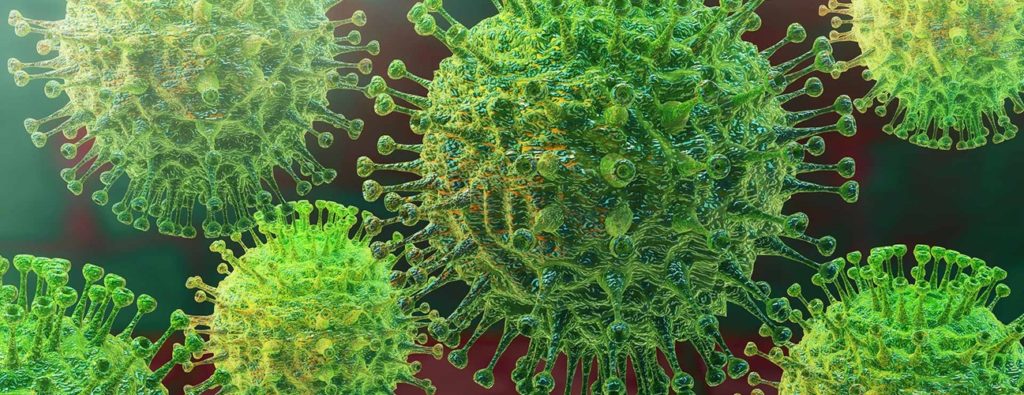
State health and agriculture officials are investigating after the coronavirus was found in a dead cat, officials said Thursday. The Alabama Department of Public Health said testing confirmed that a deceased cat in Opelika tested positive for SARS-CoV-2, the strain of the virus that causes COVID-19. Veterinary pathologists don’t believe the virus was the primary cause of the cat’s death because it had signs of a bacterial infection. Cases of SARS-CoV-2 in animals are thought to be very rare, and have primarily occurred 5 to 10 days following exposure to a positive human, state health officials said. The department said less than 10 animal deaths in the United States are thought to have been associated with the COVID-19 pandemic. Dr. Dee W. Jones, state public health veterinarian, said there seems to be no evidence suggesting that companion animals are responsible for infecting people. Republished with the permission of the Associated Press.
