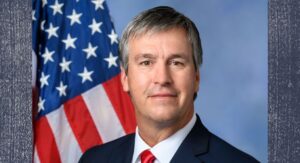
Eula Battle, First Lady of Huntsville passed away at 65
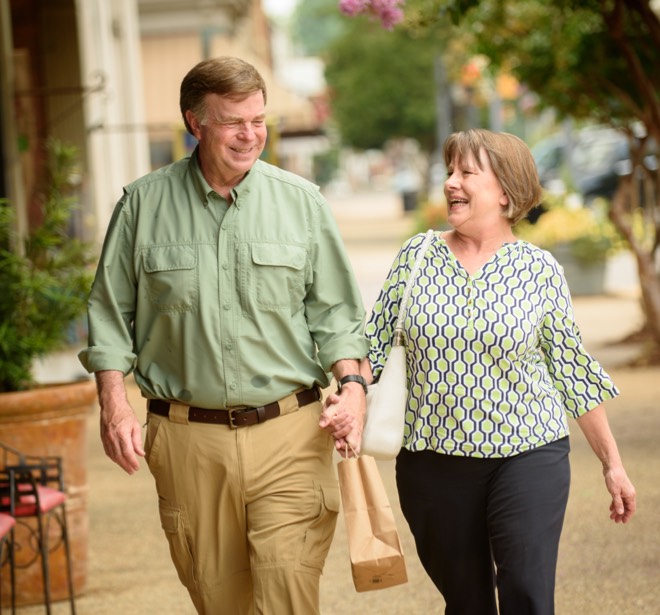
Mayor Tommy Battle’s office announced the death of his wife, Eula Battle. The First Lady of Huntsville passed away at 65 following a battle with cancer.
Bradley Byrne: FEMA’s Hurricane Sally response
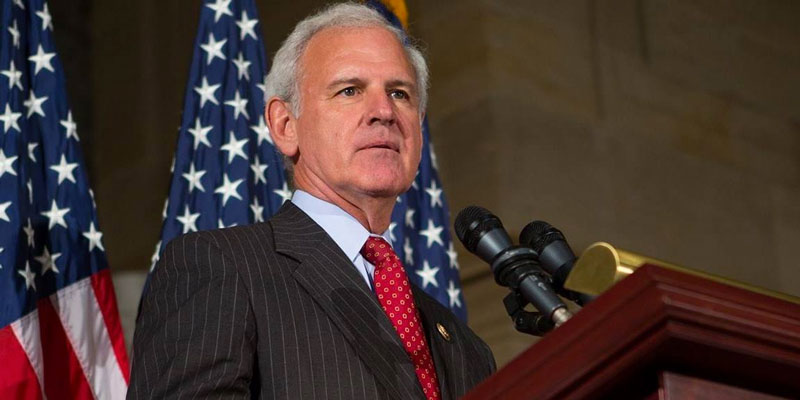
Most people in Alabama have heard of FEMA, the Federal Emergency Management Administration. Its name is a little misleading because emergencies by their nature aren’t so much managed as responded to, often after the fact. You can’t manage a tornado or an earthquake, for example, but you can and should respond to it. Hurricanes are facts of life down here and nearly every part of our state, not just the coast, have been affected in some way by at least one. We can prepare for hurricanes and guard against the worst consequences and that starts with each of us as individuals, family members, and citizens doing our part to be prepared to protect and take care of ourselves, family members, and neighbors. Alabamians are actually pretty good at doing that. But, there is also a role for governments at all levels. Local governments actually play the most important public role because they are closest to the people of their areas and have the first responders already employed and trained to take care of the needs of local residents during the period running up to, during, and in the immediate aftermath of the storm. State governments manage the preparations before the storm and provide the support local governments need afterward to do their jobs. The federal government supports the state and local efforts, which typically means providing the lion’s share of the money needed, anywhere from 75% to 90% of the costs. So there’s not one emergency management agency involved in responding to hurricanes but three, corresponding to each level of government. The day before Hurricane Sally hit, I was individually briefed by the Director of the National Hurricane Center Ken Graham, FEMA Administrator Pete Gaynor, and Coast Guard officials. That same day I went to the White House and made sure we had a good line of communication in case we needed help, which looked likely at the time. I have to say, the White House was immediately responsive and has continued to be so. How has FEMA handled the federal response to Hurricane Sally? When the state of Alabama requested a pre-storm disaster declaration, which triggers federal financial support for preparations and response during the storm, FEMA and the White House gave the okay in just a few hours. On that day before when I spoke with the White House, I asked them to send FEMA Administrator Gaynor to my district as soon as possible once the storm cleared to see the damage and meet with local officials. He came three days after the storm and spent several hours touring the damage with me and meeting with local leaders. When the state of Alabama requested a post-storm declaration, triggering federal financial support for public and individual assistance, FEMA and the White House responded affirmatively in less than 48 hours – record time. Public assistance is federal financial support for the costs to state and local governments as a result of a storm. This includes water bottles and meals ready to eat for locally requested points of distribution, debris removal and cleanup costs (think of the large tandem trucks picking up debris piled up on the right of way), as well as the costs to repair damage to public buildings and infrastructure like roads and bridges, and in the case of Sally damage to the Port of Mobile. Individual assistance, as the label states, goes to individuals affected by the storm. Private assistance won’t pay something you have insurance for, but it does pay for a variety of losses, particularly having to do with an individual’s home. So far 60,000 Alabamans have applied for individual assistance and already FEMA has approved $42 million. If you haven’t applied for individual assistance there’s still time for you to do so online at DisasterAssistance.gov, or if you need help in applying call FEMA’s Helpline at 1-800-621-3362. If you have applied for individual assistance and have been denied, appeal the decision because frequently the denial is simply because the applicant didn’t include all the needed information. Many people were flooded by Sally and over 3,000 of them have made claims to the National Flood Insurance Program. Over $16 million has already been paid out on those claims. The Small Business Administration has approved over a thousand home loans to people with storm losses, totaling over $40 million, and many more loan applications are still pending. So, how has FEMA performed in responding to Hurricane Sally? So far, pretty darn well. I want to thank FEMA Administrator Gaynor for coming down here so quickly after the storm and for FEMA’s quick and positive responses to all our requests. And I want to thank President Trump for his concern and quick response to Alabama’s requests for disaster declarations. Hurricane Sally was a brutal experience for us in Alabama, but FEMA’s response shows that government can do good things, helping people and communities when they really need it. Congressman Bradley Byrne currently represents Alabama’s 1st congressional district.
Justice Dept. files landmark antitrust case against Google
The Justice Department on Tuesday sued Google for abusing its dominance in online search and advertising — the government’s most significant attempt to protect competition since its groundbreaking case against Microsoft more than 20 years ago. And it could just be an opening salvo. Other major tech companies including Apple, Amazon, and Facebook are under investigation at both the Justice Department and the Federal Trade Commission. “Google is the gateway to the internet and a search advertising behemoth,” U.S. Deputy Attorney General Jeff Rosen told reporters. “It has maintained its monopoly power through exclusionary practices that are harmful to competition.” Lawmakers and consumer advocates have long accused Google of abusing its dominance in online search and advertising. The case filed in federal court in Washington, D.C., alleges that Google uses billions of dollars collected from advertisers to pay phone manufacturers to ensure Google is the default search engine on browsers. That stifles competition and innovation from smaller upstart rivals to Google and harms consumers by reducing the quality of search and limiting privacy protections and alternative search options, the government alleges. Critics contend that multibillion-dollar fines and mandated changes in Google’s practices imposed by European regulators in recent years weren’t severe enough and Google needs to be broken up to change its conduct. The Justice Department didn’t lay out specific remedies along those lines, although it asked the court to order structural relief “as needed to remedy any anticompetitive harm.” That opens the door to possible fundamental changes such as a spinoff of the company’s Chrome browser. Google vowed to defend itself and responded immediately via tweet: “Today’s lawsuit by the Department of Justice is deeply flawed. People use Google because they choose to — not because they’re forced to or because they can’t find alternatives.” Eleven states, all with Republican attorneys general, joined the federal government in the lawsuit. But several other states demurred. The attorneys general of New York, Colorado, Iowa, Nebraska, North Carolina, Tennessee, and Utah released a statement Monday saying they have not concluded their investigation into Google and would want to consolidate their case with the DOJ’s if they decided to file. “It’s a bipartisan statement,” said spokesman Fabien Levy of the New York State attorney general’s office. “There’s things that still need to be fleshed out, basically” President Donald Trump’s administration has long had Google in its sights. One of Trump’s top economic advisers said two years ago that the White House was considering whether Google searches should be subject to government regulation. Trump has often criticized Google, recycling unfounded claims by conservatives that the search giant is biased against conservatives and suppresses their viewpoints. Rosen told reporters that allegations of anti-conservative bias are “a totally separate set of concerns” from the issue of competition. Sally Hubbard, an antitrust expert who runs enforcement strategy at the Open Markets Institute, said it was a welcome surprise to see the Justice Department’s openness to the possibility of structurally breaking up Google, and not just imposing conditions on its behavior as has happened in Europe. “Traditionally, Republicans are hesitant to speak of breakups,” she said. “Personally, I’ll be very disappointed if I see a settlement. Google has shown it won’t adhere to any behavioral conditions.” The argument for reining in Google has gathered force as the company stretched far beyond its 1998 roots as a search engine governed by the motto “Don’t Be Evil.” It’s since grown into a diversified goliath with online tentacles that scoop up personal data from billions of people via services ranging from search, video, and maps to smartphone software. That data helps feed the advertising machine that has turned Google into a behemoth. The company owns the leading web browser in Chrome, the world’s largest smartphone operating system in Android, the top video site in YouTube, and the most popular digital mapping system. Some critics have singled out YouTube and Android as among Google businesses that should be considered for divestiture. Google, whose corporate parent Alphabet Inc. has a market value just over $1 trillion, controls about 90% of global web searches. Barring a settlement, a trial would likely begin late next year or in 2022. The company, based in Mountain View, California, argues that although its businesses are large, they are useful and beneficial to consumers. It maintains that its services face ample competition and have unleashed innovations that help people manage their lives. Most of Google’s services are offered for free in exchange for personal information that helps it sell its ads. In a Tuesday presentation with a handful of reporters, Google argued that its services have helped hold down the prices of smartphones and that consumers can easily switch away from services like Google Search even if it’s the default option on smartphones and in some internet browsers. A recent report from a House Judiciary subcommittee concluded that Google has monopoly power in the market for search. It said the company established its position in several markets through acquisition, snapping up successful technologies that other businesses had developed — buying an estimated 260 companies in 20 years. The Democratic congressman who led that investigation called Tuesday’s action “long overdue.” “It is critical that the Justice Department’s lawsuit focuses on Google’s monopolization of search and search advertising, while also targeting the anticompetitive business practices Google is using to leverage this monopoly into other areas, such as maps, browsers, video, and voice assistants,” Rep. David Cicilline of Rhode Island said in a statement. Columbia Law professor Tim Wu called the suit almost a carbon copy of the government’s 1998 lawsuit against Microsoft. He said via email that the U.S. government has a decent chance of winning. “However, the likely remedies — i.e., knock it off, no more making Google the default — are not particularly likely to transform the broader tech ecosystem.” Other advocates, however, said the Justice Department’s timing — it’s only two weeks to Election Day — smacked of politics. The government’s “narrow focus and alienation of the bipartisan state attorneys
Senate to work through weekend to push Amy Coney Barrett onto court
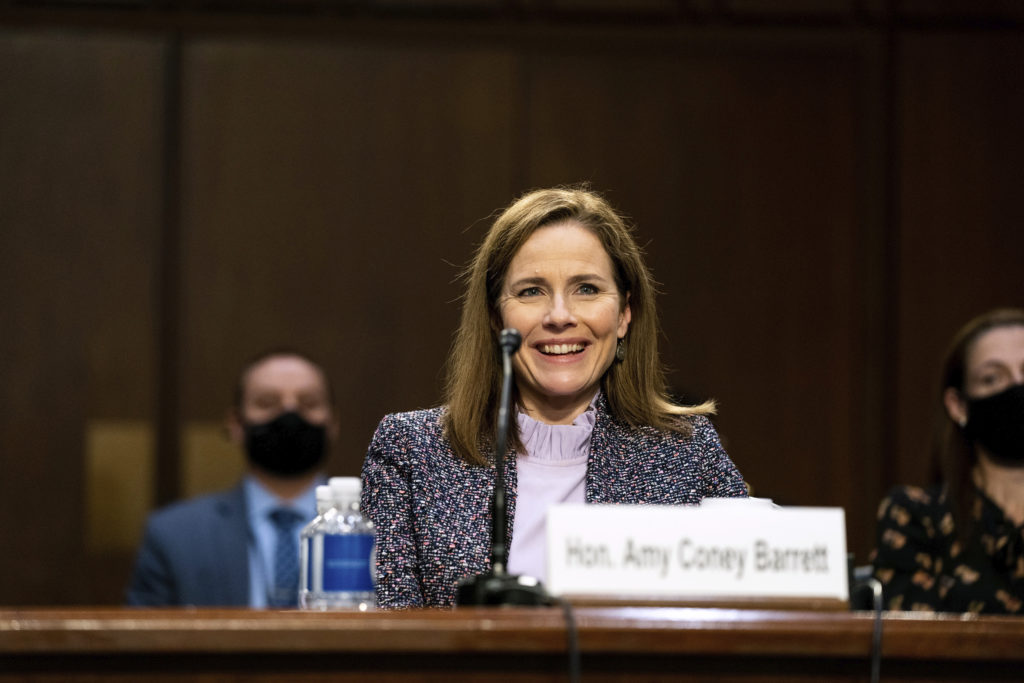
Wasting no time, the Senate is on track to confirm Judge Amy Coney Barrett to the Supreme Court by next Monday, charging toward a rare weekend session as Republicans push past procedural steps to install President Donald Trump’s pick before Election Day. Senate Majority Leader Mitch McConnell said he will begin the process as soon as the Senate Judiciary Committee wraps up its work Thursday. With a 53-47 Republican majority, and just two GOP senators opposed, Trump’s nominee is on a glide path to confirmation that will seal a conservative hold on the court for years to come. McConnell said Monday that Barrett demonstrated over several days of public hearings the “sheer intellectual horsepower that the American people deserve to have on the Supreme Court.” Without the votes to stop Barrett’s ascent, Democrats have few options left. They are searching for two more GOP senators to break ranks and halt confirmation, but that seems unlikely. Never before as a court nominee been voted on so close to a presidential election. Senate Democratic leader Chuck Schumer decried what he called the “farcical” process to “jam” through Trump’s choice, even as the coronavirus outbreak sidelined GOP senators. “The Republican majority is running the most hypocritical, most partisan and least legitimate process in the history of Supreme Court confirmations,” he said during speech as the Senate opened. The Senate Judiciary Committee is set to meet Thursday to vote on recommending Barrett’s nomination to the full Senate. By Friday, procedural votes are expected, continuing over the weekend as Republicans push through the steps for a final vote to confirm Barrett as soon as Monday. The 48-year-old appellate court judge from Indiana delivered few specific answers during several days of public testimony as senators probed her previously outspoken views against abortion, the Affordable Care Act, and other issues before the court. She declined to say whether she would recuse herself from cases involving the election between Trump and Democrat Joe Biden. Trump has said he wants the judge seated in time to hear any potential disputes from the Nov. 3 election. He also has said he’s looking for a judge who would rule against the Obama-era health care law, which is headed to the court in a case justices are expected to hear Nov. 10. If confirmed, Barrett would be Trump’s third justice on the court. She would fill the vacancy from the late Ruth Bader Ginsberg, the liberal icon, locking in a 6-3 conservative majority on the high court. Republished with the permission of the Associated Press.
Republicans see bright spot in voter registration push
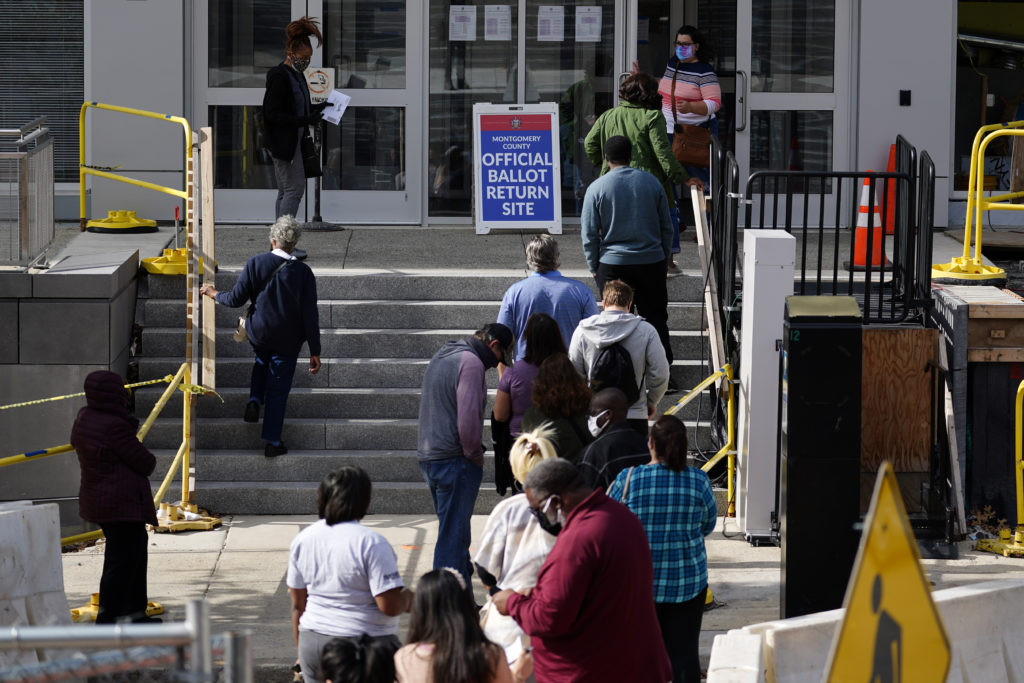
The Republican Party has cut into Democrats’ advantage in voter registration tallies across some critical presidential battleground states, a fact they point to as evidence of steady — and overlooked — enthusiasm for President Donald Trump and his party. Even though Trump trails in national polls and struggles with fundraising with just weeks before Election Day, Republicans see their progress signing up voters in Florida, Pennsylvania, Arizona, and other states as a rare bright spot. Democrats appear to have been set back by their decision to curb in-person voter registration drives during much of the pandemic. And in something of a reversal, Republicans are crowing about their success bringing in new voters who could ramp up turnout and deliver the White House to their candidate. “The best thing for voter registration is enthusiasm for a candidate and the infrastructure,” said Nick Trainor, director of battleground strategy for Trump’s re-election campaign. “The lack of enthusiasm for Joe Biden, coupled with the lack of structure is the reason they’re not doing what they did in the past.” In Florida, Republicans netted 146,644 voters over Democrats since the pandemic hit in March, leaving Democrats with their smallest overall lead in party registrations since the state began tracking them in 1972. In Pennsylvania, which Trump won with 44,000 votes in 2016, the GOP added 103,171 more voters since November than Democrats did. Even in Arizona, where Democrats have steadily been chipping away at the GOP’s advantage among registered voters due to a growing number of young Latinos voters, Republicans added 30,000 more voters than Democrats since mid-August. Democrats argue that Republican gains are partly illusory: Some of the GOP registrants are former Democratic voters who have been voting for Republicans but have not updated their registration until now. They also note young voters, who lean heavily Democratic, increasingly register as unaffiliated with either party, which helps pad the GOP’s advantage on paper but it might not help on Election Day, David Bergstein, a spokesman for the Democratic National Committee, said Republicans were “cherry-picking” voter registration statistics. Still, he noted: “Democrats are taking nothing for granted and pulling out all the stops to reach every voter we need.” Voters can still sign up to vote in a handful of states, and several, including the key battlegrounds of Michigan, Minnesota, and Wisconsin, allow voters to sign up to vote on Election Day. Still, the numbers reflect a broader reality: The coronavirus pandemic hobbled voter registration since it broke out in March, shutting down hubs of voter registration such as street festivals, college campuses, and departments of motor vehicles. Even as society has opened back up since March, registrations are 38% lower than they were during a comparable stretch in 2016, according to a report from the Brennan Center for Justice. Experts note that a registration drop-off of that size disproportionately hurts young, urban, and minority voters — voters that tend to lean Democratic. “Most definitely, the pandemic has impacted Democratic voter registration numbers, especially among core constituencies,” said Jonathan Robinson of the Democratic data firm Catalist. Democrats were starting ahead of Republicans. They’ve had success registering new voters through much of the Trump administration. Their gains after Trump’s election helped lead to their success flipping the House of Representatives in an election with record young voter participation rates — a sign, they argue, that their pre-pandemic work will pay off in November. Since the outbreak, things have been harder for Democrats and the wide array of nonprofit groups that work to sign up new voters. These organizations have been hesitant to resume face-to-face interactions. The Biden campaign only resumed some this month while Republicans have not been as shy — they began going back into the field this summer. “They ceded the playing field,” Trainor said of Democrats. In Arizona, online registration efforts don’t have the same impact as in-person ones, said Alejandra Gomez, co-executive director of the Latino organizing groups Living United for Change in Arizona and the Arizona Center for Empowerment. “While we were seeing an increased number in online participation, it’s still not the same as face-to-face work and being able to have a conversation with a person,” Gomez said. Still, Democrats feel good about their position in the state. Data analyst Sam Almy said that, of the 66,000 voters added to the rolls since August who don’t register with either party, half are 35 or younger, a key Democratic demographic. In Pennsylvania. Republicans have been steadily gaining on Democrats since Trump’s election. Democrats in the state acknowledge the president has a striking appeal to many longtime members of their party who may be switching to the GOP. “Donald Trump is a singularly, unique personality,” said John Fetterman, the state’s Democratic lieutenant governor. Fetterman noted that despite the attrition in registration numbers, Democrats won the state’s Senate and gubernatorial races in 2018. “I’m not really concerned by the voting registration difference,” Fetterman said. In Nevada, where Democrats routinely out-register Republicans in the run-up to elections, the GOP has bested Democrats for at least five months since the pandemic hit. In North Carolina, where a competitive Senate race could determine which party controls the upper chamber, Republican registration has leapt by 51,381 over Democratic since mid-March. In Florida, Democrat Hillary Clinton lost the state when her party’s registration advantage was more than 320,000 in 2016. It’s now about half of that. But Democrats note that there’s been an even larger increase in new voters who decline to register with either party. Steve Schale, a veteran Florida Democratic strategist who’s complained publicly about his party’s failure to keep up with the GOP in registrations, said during a call with reporters Monday that those unaffiliated voters are overwhelmingly young and people of color. “That’s probably a pretty good sign,” said Schale, who also runs a group supporting Biden. Republished with the permission of the Associated Press.
Group offers churches $6-a-ballot to help people vote early
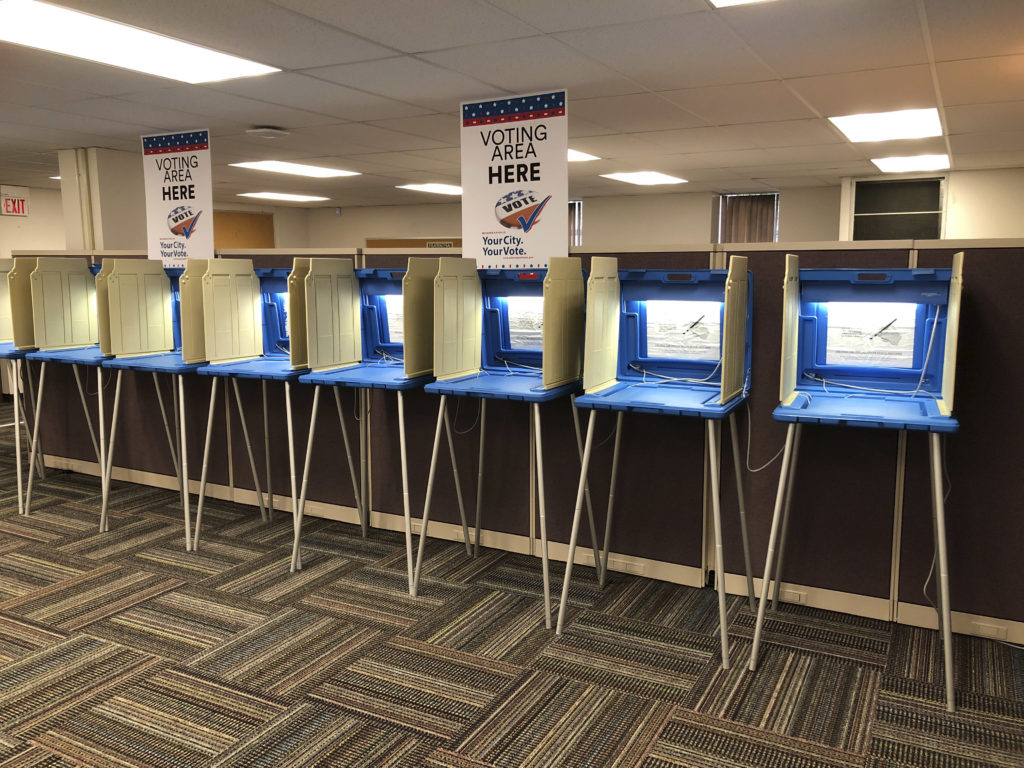
A group’s offer to pay churches $6 for every person they help to vote early this year does not violate any law although it might not be the “best practice” for getting out votes, Alabama’s elections chief said Monday. The “New South Souls to the Polls Initiative” is paying churches a $6 contribution “for each documented early vote” to cover the expenses for outreach and transportation to help people vote early by absentee ballot, according to a letter mailed to pastors by Hank Sanders, a former longtime Democratic state senator from Selma who is organizing the effort. It’s unclear how many churches were offered the funds. Sanders said the $6 is intended to compensate groups for transportation, outreach, and time to help people vote early and is not tied to how a person will vote. “It says specifically no person can be paid to vote. This is not about paying anybody to vote. It’s about trying to encourage people,” Sanders said in a phone interview. The New South Coalition is a predominately Black political group that is dedicated to the “progressive ideals of freedom, justice, and democracy.” Sanders said the effort is being run by the New South Alliance LLC, an entity dedicated to get-out-the-vote efforts. Absentee ballot requests have skyrocketed since the state office loosened rules because of the COVID-19 pandemic. People lined up Saturday in Birmingham and Montgomery to cast absentee ballots via in-person voting after local election officials offered Saturday balloting. A national Republican group backing Republican Tommy Tuberville in his bid to unseat incumbent Sen. Doug Jones criticized the $6 as a “cash for votes” scheme. Alabama Secretary of State John Merrill, a Republican, said he reviewed the situation and determined there is nothing nefarious as long as the $6 is not tied to voting a particular way. “It’s not illegal. It’s certainly not a best practice,” Merrill said in a telephone interview. “It does not say you are going to give it to someone to vote a particular way or vote for a particular party or to vote for, or against, a particular initiative, and so there is nothing there that is illegal.” The National Republican Senatorial Committee called it a “desperate and shady cash-for-votes scheme” and noted that a related organization, the New South Alliance, has endorsed Jones and Jones’ campaign has given money to the New South Alliance LLC. “Jones knows his radical message doesn’t resonate with Alabamians and has turned to dishonest campaign tactics to pay for votes,” National Republican Senatorial Committee spokesperson Paige Lindgren said in a news release. Sanders said the effort is in, “no kind of way tied to Doug Jones.” “It’s a shame that so many people don’t want other folks to vote,” Sanders. A spokeswoman for the Jones campaign said they “appreciate Secretary Merrill’s quick attention to this concern.” “While this practice is legal, the campaign does not condone it and strongly discourages it,” Jones campaign spokeswoman Lizzie Grams said. Republished with the permission of the Associated Press.
Kay Ivey: An inspirational pick
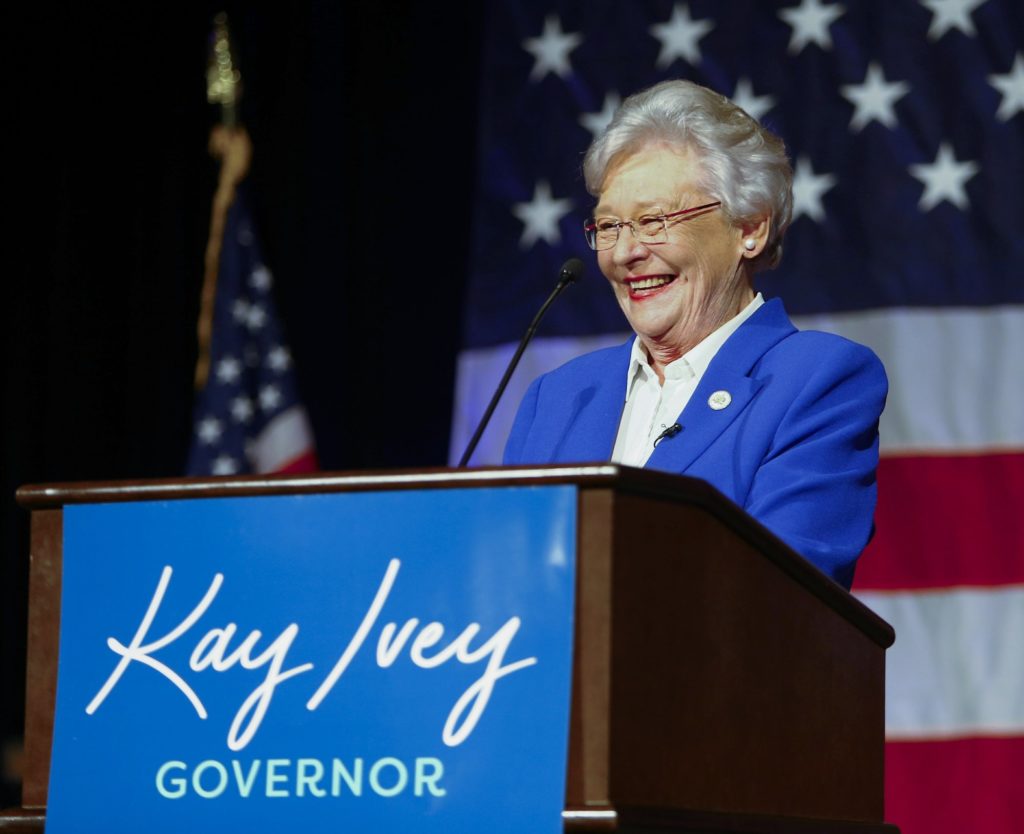
A century ago, the Suffragettes finally succeeded in winning the right to vote for women. They would be thrilled to see the nomination of a woman so uniquely qualified to serve on the U.S. Supreme Court as Judge Amy Coney Barrett, were they alive today. It’s easy to imagine them storming the streets of America and urging that Judge Barrett be confirmed, and by a wide margin. After all, the four female justices nominated before her were confirmed with lopsided votes by the U.S. Senate: 99-0 for Justice Sandra Day O’Connor, 68-31 for Justice Sonia Sotomayor, 63-37 for Justice Elena Kagan and 96-3 for the late Justice Ruth Bader Ginsburg. Sadly, it speaks to the times in which we are living that Judge Barrett’s vote by the Senate will most likely come down to a tight vote, with nearly every Democrat opposing her nomination. As governors who are either the first or second females to be elected in our respective states, we are rightfully proud to see diversity expand among the highest levels of government. Notably, however, our support for Judge Barrett hinges not on her being a female, but rather her superior intellect, unflappable composure and impeccable integrity, all which combine to make her eminently qualified in every way. Regretfully, we know – as do many others – that the climb for women into the upper echelon of American leadership has always been a bit steeper. After all, when was the last time a man’s haircut, the color of his tie or suit, or the number of children in his family were scrutinized as part of the public discourse? It is bittersweet that Judge Barrett followed her father’s advice that she could do anything her male counterparts could do, only better, and yet, sadly, millions of women appear to oppose her nomination simply because she interprets the law as-written, rather than siding with them on every issue. Is this the new standard for qualification? Many progressives, it seems, claim to believe in the power of women, but only for women who think and talk like they do. We applaud President Donald Trump for choosing Judge Amy Coney Barrett for service on our nation’s highest court; she may well be one of the most qualified, extraordinary picks during the past century, and we urge the United States Senate to confirm her nomination in short order. We especially like the direct answers Judge Barrett provided to two of the Senate Judiciary Committee members who questioned her last week. When Sen. Chris Coons, D-Delaware, suggested that Judge Barrett would vote in the same manner as the late Justice Antonin Scalia, a conservative for whom she had clerked earlier in her career, she calmly responded, “I assure you I have my own mind.” And when the Committee’s ranking Democrat, Sen. Dianne Feinstein, D-California, asked her whether she believed that Medicare was unconstitutional, she cited the “Ginsburg Rule,” so named for the late justice she will be following, of providing “no hints, no previews, no forecasts.” Perhaps one of the most powerful witnesses to speak in support of Judge Barrett was her former law student at Notre Dame, Laura Wolk. Ms. Wolk is totally blind, but before pursuing the “impossible dream” of becoming the first blind law clerk at the Supreme Court last year, she was struggling with her classwork as a first-year law student, fearful of failing. Laura recalled, “Judge Barrett leaned forward and looked at me intently. ‘Laura,’ she said, with the same measured conviction that we have seen displayed throughout her entire nomination process, ‘this is no longer your problem. It’s my problem.’” Ms. Wolk went on to say that Judge Barrett helped her see a pathway to success. She said the Judge will “serve this country with distinction not only because of her intellectual prowess, but also because of her compassionate heart and her years of treating others as equals deserving of complete respect.” When Judge Barrett raises her right hand to take the oath to “administer justice without respect to persons” and to “support and defend the Constitution of the United States,” it will be a win-win for every female – young and old alike during the past 100 years – who has dreamed of seeing women advance to the top positions of our government. Moreover, it will be a signal to every little girl – and boy – that the most qualified individual will get the job. Governors Kay Ivey of Alabama, Kristi Noem of South Dakota and Kim Reynolds of Iowa authored this column.