
Gulf storm damage causes polling place moves, power outages

Elections officials in the Deep South spent election eve tending to lingering damage from Hurricane Zeta and other storms that damaged buildings or left polling places without power ahead of Tuesday’s election. Storm damage caused polling places to be moved in Louisiana, and power companies and election officials scrambled to restore power, or make sure generators were available, at polling places in Louisiana, Alabama, Georgia, and Mississippi. Election officials expressed confidence that the sites would be operational Tuesday. Thousands of voters in southwest Louisiana will be casting ballots in different locations Tuesday because Hurricane Laura wrecked their traditional polling sites in late August, and they have not yet been repaired. Across the state in the New Orleans area and in other southeastern parishes, several dozen voting locations will be running on generator power because outages caused by Hurricane Zeta last week have not been fixed. “No polling location will be without power on Election Day,” Louisiana Secretary of State Kyle Ardoin, the state’s chief elections officer, said in a statement. By far, the greater disruption in Louisiana was caused by Laura in southwestern Calcasieu and Cameron parishes, where Ardoin’s office provided charts showing locations for 95 polling precincts have shifted because of the destruction of the Category 4 storm. In rural Cameron Parish, most voters will be casting ballots at either a local fire station or a neighborhood market. Calcasieu Parish has created several consolidated voting sites, with most voters in Lake Charles casting their ballots at two mega-polling locations, the Burton Coliseum entertainment arena or the Lake Charles Civic Center. Elections officials have cautioned that the megasites may require longer waits for voters than usual. Some polling sites in southeastern Louisiana will be operating on generators to keep machines and lights running because of outages caused by Hurricane Zeta, which made landfall in the state as a Category 2 storm. The number of voting sites that will require generators “gets lower and lower as each hour passes” and power is restored, said Tyler Brey, a spokesman for Ardoin’s office. New Orleans Democratic Mayor LaToya Cantrell criticized the Republican-led secretary of state’s office Sunday for “failing to fulfill its duty” in providing the generators needed for polling sites, risking disenfranchisement of voters. But Brey said every polling location will have adequate power. He said the generators for voting sites were provided largely by Entergy, but also some by the state as well. Ardoin accused Cantrell of “trying to score cheap political points” with her criticism. Louisiana Gov. John Bel Edwards, a Democrat, had asked utility companies to prioritize restoration to voting locations even before Zeta struck. Across Louisiana, Mississippi, Alabama, and Georgia, more than 148,000 electrical customers had outages Monday because of recent storms, according to the utility tracking website poweroutage.us. In Alabama, Zeta caused damage along a line stretching from the southwestern to northeastern counties of the state. Multiple Alabama voting places remained without power Monday, but generators will be provided to any that still lack service on Election Day, said Secretary of State John Merrill. He declined to say how many were without power, saying the number was rapidly reducing. Merrill said all 1,980 polling locations will have power on Tuesday, either through regular service or by generator. A spokesman for Alabama Power said the company has assessed polling locations provided by election officials and is working to ensure that all polling locations in its service territory have power before the polls open Tuesday. Officials in some of the hardest-hit counties spent the final day before the election trying to determine just how many places might lack electricity or have storm damage. In Talladega County, which has 26 polling sites, chief probate clerk Lawana Patterson said emergency management officials had told her “everything is in working condition.” “I’m not saying everything is perfect, but I’m working on it,” she said. Dallas County Probate Judge Jimmy Nunn said all but one of the county’s 29 voting places had power back on, and state emergency management officials were connecting a generator at the rural Beloit Community Center, where normal service had not been restored. “They’ll have lights and everything, so people won’t even know they’re out,” Nunn said. In neighboring Mississippi, seven counties still had power outages in homes or businesses. Electricity has been restored to all polling places in four of those counties — Hancock, Harrison, Jackson, and Stone. In Mississippi’s George, Greene and Perry counties, a small number of precincts were without power Monday, but generators were available in all three if they are needed Tuesday. Perry County Circuit Clerk Christy Pittman Mayo said “one little bitty precinct” might have to use a generator. In Georgia, two or three polling places remained without power Monday, said Gabriel Sterling, statewide voting system implementation manager. Republished with the permission of the Associated Press.
Bradley Byrne: After the election: One nation under God
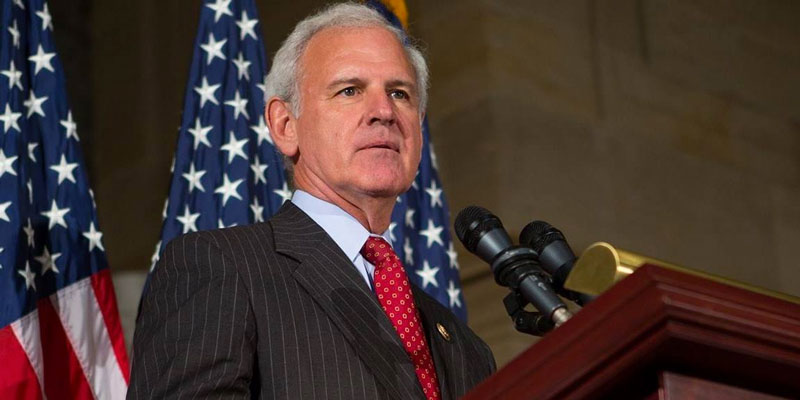
I’ll never forget sitting in the US House Chamber in January of 2017, watching the counting of the Electoral College votes from the 2016 presidential election. Under the Twelfth Amendment to the Constitution, the sitting Vice President opens and counts the votes as submitted and certified by the electors chosen from each state, and the Vice President must do so “in the presence of the Senate and the House of Representatives.” Because Inauguration Day was still several days away, the sitting Vice President was Joe Biden, and as a member of the House, I was entitled to be there. Procedurally, any Representative or Senator can object to any state’s electoral college votes, but at least one member from the other house must agree with the objection before it can be considered. Alabama was the first state up, and Jim McGovern, a very liberal Democrat member from Massachusetts who served on the Rules Committee with me, stood up and objected because the Russians supposedly interfered with our vote for Donald Trump. He also made a blatantly false allegation that our state violated the Voting Rights Act and suppressed thousands of votes. No Senator agreed with him, and Vice President Biden ruled the objections out of order, which kept me from having to argue against McGovern’s silly and frankly slanderous objections. The count went on, and as every Trump state’s votes came up, a Democrat House member would stand up and object, but because no senator agreed with the objections, Biden would rule them out of order. Finally, after several of these, Biden leaned into the microphone and said firmly to his fellow Democrats, “it’s over.” Though they hated the result, he was saying, the Constitution calls for the person with the most electoral votes to be President. And that person was Donald Trump, not Hillary Clinton. This has been an extraordinary year, with the pandemic, a record economic downturn and recovery, riots and violence, and an unprecedented number of hurricanes. It will be an extraordinary election, too, as record numbers of people have already voted in many states, but their votes can’t be counted until election day, and many of those states’ election processes require days to count all those votes. There will also be challenges to the counting of some, perhaps many, ballots because they weren’t filled in or submitted properly. So, we aren’t likely to know the result on Election Day. We didn’t know the result of the 2000 election until December, weeks after the election, and that took an extraordinary decision by the Supreme Court to resolve it in favor of George W. Bush. The Twelfth Amendment was passed and ratified because the 1800 presidential election resulted in an electoral college tie between Thomas Jefferson and his supposed running mate Aaron Burr. That threw the election into the House of Representatives which took 36 ballots to finally make Jefferson the president, three months after the election. In both cases, the nation moved on and accomplished great things. Though this year’s election isn’t likely to be over as quickly as we are used to, all of us should be patient and trust in our Constitution and the institutions which have served us so well for over 230 years. There will be plenty of eyes on the process, and nothing inappropriate is going to go unnoticed. Our intelligence and law enforcement communities have been closely monitoring foreign actors and will continue to do so after the election. Be careful of the information you receive during and after the election because we know there’s a lot of truly fake “news” out there, designed to divide us as a nation. And when we have a result, if your candidate doesn’t win, let’s not have a replay of 2016 when Democrats refused to accept the result, who wouldn’t let it be “over” and shamefully called themselves the “resistance,” a slap in the face of the Constitution and our tradition of peaceful transfer of power. We’ve wasted too much time in Washington over the Mueller report and a failed impeachment effort, attempting to reverse the 2016 election. And we’ve had too much violence this year – we don’t need more due to the election. If your candidate loses, the appropriate response is to be the loyal opposition – loyal to our nation and its Constitution but opposed to the policies of the victorious party. Remember, in American politics, today’s loser is often tomorrow’s winner. Our greatest enemy isn’t a foreign nation but our internal division, driven by a hyper-partisan news media and entertainment industry ready to exploit every fault line in our country and craven before the far worse fault lines of countries where that industry makes a lot of money. Let’s ignore the media and entertainment industry and return to what we learned in school about the traditional values which make us great. As a unified nation there is nothing we can’t do, no problem or issue we can’t solve. We are one nation under God. Let’s keep it that way. Congressman Bradley Byrne currently represents Alabama’s 1st congressional district.
Martha Roby: COVID-19 will not shake our democracy
Election Day is here, and it’s safe to say that this year’s election looks quite different than those of the past. As we continue to navigate the ongoing Coronavirus (COVID-19) pandemic, several protocols have been put in place nationwide to create cautious and healthy environments for in-person voting. A record-breaking number of Americans have already voted or plan to vote in the 2020 General Election, with over 75 million individuals having cast their ballots. An estimated 4.9 million people live in the state of Alabama. In the 2020 March Primary Election, there was a total of 3,576,107 Alabamians registered to vote. Of those registered to vote, approximately 1,176,315 individuals – or 33 percent – actually exercised their right to vote in this year’s primary. On Thursday, the Alabama Secretary of State’s office announced that more than 259,200 Alabamians had voted by absentee, and Secretary of State John Merrill stated that 316,130 ballots had been requested. While the final statewide voter turnout will not be known until after Tuesday’s election, it is vital we each take the time to exercise our right to vote as afforded to us by the U.S. Constitution. If you plan to vote in-person, please be sure to follow all local and statewide COVID-19 guidelines. Your participation is especially crucial as the number of daily new Coronavirus cases across the state are on the rise. For COVID-19 voting resources and information, visit sos.alabama.gov/covid-19-voting-resources. The United States was founded on a strong set of principles that have shaped our nation and guided the American people for nearly 250 years. We will not allow a health pandemic to shake our democracy. We have been given the right to freely and openly express our beliefs and opinions, participate in civil public discourse, and vote to elect the individuals who lead our nation. If you have not already, I encourage you to exercise your right to vote and participate in the democratic process. Martha Roby represents Alabama’s Second Congressional District. She lives in Montgomery, Alabama, with her husband Riley and their two children.
Email Insights: API’s Guide to the November 2020 Constitutional Amendments
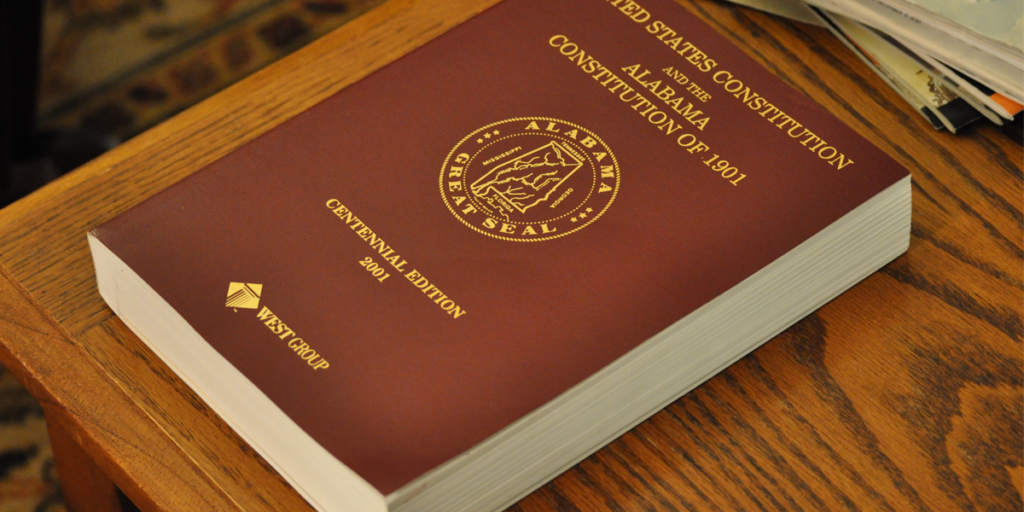
In a recent email, Alabama Policy Institute released a guide to the Constitutional Amendments that will be on the ballot for Alabama. According to its website, “API is a non-profit, non-partisan educational and research organization committed to free markets, limited government, and strong families. API reaches its goal of sound public policy through research, advocacy, and public education efforts.” In the guide, each of the proposed amendments is described and explained so that voters can make an informed decision. Here is the email below: In less than three weeks, Alabamians will go to the polls and vote in one of the most contentious presidential elections in recent history. What is lesser known is that Alabamians will also be voting on six statewide amendments to the Alabama Constitution. These amendments address the right to vote, the state’s judiciary system, “stand your ground” provisions in some counties, and more. The purpose of this Guide is to explain these six amendments in plain language so that voters may be well informed when they go to the polls on November 3rd, or when they mail in their absentee ballot. We recommend, in addition to reading this guide, printing off a sample ballot and filling out your selections beforehand and bringing it with you to the polls.
Former Alabama judge pleads guilty to theft, abuse of power
An Alabama judge who resigned earlier this year while under indictment has pleaded guilty to three felony charges of theft and abuse of power. Doug Patterson’s plea Friday negates his trial that had been scheduled in about two weeks. Instead, he faces up to 40 years in prison at sentencing on Dec. 8. “Patterson’s actions as an attorney and as a judge tarnished and debased the judicial system,” Attorney General Steve Marshall said in a statement. “His conviction sends a clear message that public officials who abuse their position, harm vulnerable parties, and flagrantly disregard Alabama law will be held accountable for their crimes.” Efforts to reach Patterson for comment Friday were unsuccessful and defense attorney Dan Totten didn’t return a call for comment, al.com reported. The plea agreement requires Patterson to repay nearly $73,000 that was stolen from a juvenile court fund and two of his former legal clients, Then-Gov. Robert Bentley appointed Patterson as a district judge in March 2016. A native of Athens, Patterson was elected to a full term in 2017. He was removed from the bench in August 2019 after an investigation began. In a letter to Limestone County presiding Judge Robert Baker, Patterson confessed to “unethical, criminal and reprehensible” conduct. Still, he pleaded not guilty to the charges and continued to draw a $10,800-per-month salary until he resigned in July. Republished with the permission of the Associated Press.
Bruised and haunted, US holds tight as 2020 campaigns close

Just over her mask, Patra Okelo’s eyes brimmed with tears when she recalled the instant that a truth about America dawned and her innocence burned away. One moment on Aug. 11, 2017, she thought the tiki torches blazing in the distance at the University of Virginia were “the most beautiful thing I’d ever seen, lighting up the darkness.” Later, on television, she could see the fire more clearly. Hundreds of white supremacists carried those torches, sparking 24 hours of fury and death that transformed Charlottesville into an enduring battle cry of the 2020 presidential election. “My heart broke that night,” Okelo, now 29, said on Saturday, as President Donald Trump and Democrat Joe Biden blitzed across the country to make the closing arguments of their bitter contest to lead the divided nation. Presidential elections are traditionally moments when Americans get a high-definition look in the mirror. But by the final, frenetic sprint of the 2020 race, the world had long peered into the country’s darkest corners and seen a battered and haunted image staring back. The presidency and control of the Senate are in the balance, but for many, there was something even more urgent. Survival was the immediate goal, both as human beings and as a country whose very name seems aspirational at a time of such division and angst. The list of threats is long and personal: Coronavirus has killed more than 230,000 people in the U.S., and infections are surging in almost every state. The economy and with it families are suffering from uncertainty. The legacy of slavery ripped through society yet again this year after the police killing of George Floyd in Minneapolis sparked nationwide protests and crackdowns by law enforcement. Okelo can draw a line from the August night in 2017 when she first saw the torches to the last hours of the 2020 election. She voted for Biden. On Aug. 12, 2017, in the hours after the torchlight parade, James Alex Fields Jr. plowed his car into a group of protesters on 4th Street and killed activist Heather Heyer. That intersection is now decorated with purple flowers and messages in chalk. Okelo says she has avoided the area ever since. Trump blamed “both sides” for that conflagration. Earlier this year, he boarded up the White House and used federal forces to protect it from the protests over Floyd’s death. And when asked, he has most often refused to condemn white supremacy. Okelo, who is Black, heard when Biden launched his campaign for president with the words, “Charlottesville, Va.” “My younger brother is in danger,” Okelo said she has come to realize. “So I waited in line today, and I voted as I did.” But the connection between 2017 and now also is marked by contrasts. A year ago, Americans were riveted by the House impeachment proceedings against Trump for his appeals for political help from Ukraine. The Senate acquitted him at the beginning of 2020, followed by Trump’s victory lap and House Speaker Nancy Pelosi’s show-topping rip of his State of the Union speech. A campaign that started with more than two dozen Democrats competing for the right to challenge Trump ended with Biden the party’s nominee, and one of his rivals, California Sen. Kamala Harris, as his running mate, the first Black or Indian woman to seek the vice presidency. It seems like a distant, more innocent time. When Harris announced her own presidential bid nearly two years ago, she did it before nearly 20,000 people attending an outdoor event in her home city of Oakland, California. Campaigning in the West in the race’s final week, Harris spoke in Las Vegas to a socially distanced crowd of people sitting on blankets spaced 6 feet apart. White circles around chairs denote appropriate social distancing. As for the sound of the 2020 race, car horns have replaced the roar of Democratic crowds. “Honk if you’re fired up! Honk if you’re ready to go!” former President Barack Obama has said in the final swing. On the Republican side, Trump remained energized by large, mostly unmasked crowds in defiance of the advice from his administration’s top public health officials. The president was making a final blur of 10 rallies across battleground states, arguing falsely that the coronavirus was on the wane and falling back on familiar anthems about Hillary Clinton, his vanquished 2016 rival, and building a border wall between the U.S. and Mexico. “Tuesday is our big deal as a country!” Trump said on Sunday, as he braved flurries and a stiff wind chill in Michigan. The president is aiming to run up support in the whiter, more rural parts of the state with warnings that a Biden win could be disastrous for the economy. Down in the polls and at a cash disadvantage, Trump expressed confidence and said of Biden at one point, “I don’t think he knows he’s losing.” In contrast, Biden’s campaign rallies through Michigan, Georgia and Pennsylvania were strictly distanced and often drive-in affairs where mask-wearing is required. At an Atlanta-area event on Sunday, a Biden staffer stepped to the podium and enforced the rules just before Harris spoke. “Y’all need to go back to your cars,” the aide said. “We are not a Trump rally.” Also defining this campaign at its ragged end is a hovering uncertainty and anxiety. Trump has refused to commit to a peaceful transfer of power if he loses to Biden, and his exhortation to supporters to “stand back and stand by” the polls to make sure the vote is legit sounded to some like a call to intimidate voters and elections officials. Images and reports, such as a get-out-the-vote rally in North Carolina on Saturday that ended with law enforcement pepper spraying the crowd, kept the country on edge. State police said participants were blocking the roadway and had no authorization to be there. In Texas, Trump supporters in cars and trucks swarmed around a Biden campaign bus at high speed on a highway. The
Biden works to push Black turnout in campaign’s final days
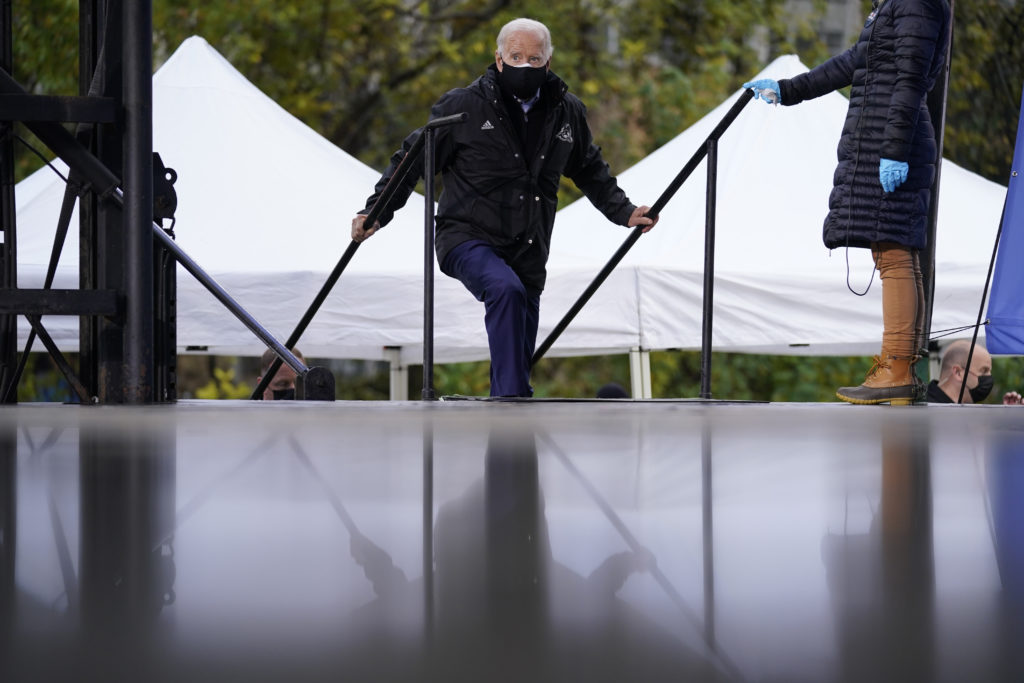
Joe Biden was spending the final days of the presidential campaign appealing to Black supporters to vote in-person during a pandemic that has disproportionally affected their communities, betting that a strong turnout will boost his chances in states that could decide the election. Biden was in Philadelphia on Sunday, the largest city in what is emerging as the most hotly contested battleground in the closing 48 hours of the campaign. He participated in a “souls to the polls” event that is part of a nationwide effort to organize Black churchgoers to vote. “Every single day we’re seeing race-based disparities in every aspect of this virus,” Biden said at the drive-in event, shouting to be heard over the blaring car horns. He declared that Trump’s handling of COVID-19 was “almost criminal” and that the pandemic was a “mass casualty event in the Black community.” His running mate, Sen. Kamala Harris, was in Georgia, a longtime Republican stronghold that Democrats believe could flip if Black voters show up in force. The first Black woman on a major party’s presidential ticket, she encouraged a racially diverse crowd in a rapidly growing Atlanta suburb to “honor the ancestors” by voting, invoking the memory of the late civil rights legend, longtime Rep. John Lewis. She later campaigned in Goldsboro and Fayetteville, North Carolina, two cities with a large share of Black voters. But even as 93 million Americans have cast ballots and election officials prepare to count, President Donald Trump was already threatening litigation to stop the tabulation of ballots arriving after Election Day. As soon as polls closed in battlegrounds such as Pennsylvania, Trump said, “we’re going in with our lawyers.” It was unclear precisely what Trump meant. There is already an appeal pending at the Supreme Court over the counting of absentee ballots in Pennsylvania that are received in the mail in the three days after the election. The state’s top court ordered the extension and the Supreme Court refused to block it, though conservative justices expressed interest in taking up the propriety of the three added days after the election. Those ballots are being kept separate in case the litigation goes forward. The issue could assume enormous importance if the late-arriving ballots could tip the outcome. Biden is focusing on turning out Black voters in the final stretch in part to avoid a narrow outcome that could prompt Trump to seek an advantage in the courts. It’s a challenging dynamic because Democrats have spent months pushing their supporters to vote by mail. But their energy has shifted to urge Black supporters who have long preferred to vote in person or distrust voting by mail to get out on Tuesday. A Biden path toward victory must include Black majority cities, including Philadelphia and Detroit, which will be crucial in determining the outcome in Pennsylvania and Michigan. Those are states where both candidates have spent a significant amount of time in the final days of the 2020 election. “The historical but also cultural reality for our community is that Election Day represents a collective political act and it’s a continuation of our struggle for full citizenship in this country,” said Adrianne Shropshire, the executive director of BlackPAC. “Black voters are showing up in ways that they did not in 2016 and we can take heart in that.” In Detroit, officials are projecting a 50% voter turnout, which would be higher than 2016, yet lower than 2008 and 2012 when Obama’s candidacy drew record voter participation. Grassroots organizers in the Philadelphia area have spent months engaging potential voters, many of whom they expect will be casting ballots for the first time on Election Day. “Most Black voters in Philly have been skeptical of mail-in voting,” said Joe Hill, a veteran Democratic operative-turned-lobbyist from the city. “A lot of us have gotten our ballots already,” Hill said, but added, “Election Day has always been everything in Philadelphia.” Healthcare Pennsylvania, a local union chapter of the Service Employees International Union, is working to increase turnout by at least 10,000 in west Philadelphia and spent the weekend knocking on more than 600 doors. West Philadelphia has a majority Black population and has experienced firsthand the convergence of the pandemic’s disproportionate impact on Black Americans and protests in recent days against police brutality, mirroring what’s occurred nationwide. Biden has also drawn a sharp contrast to Trump through a summer of unrest over the police killings of Breonna Taylor in Kentucky and George Floyd in Minneapolis. Their deaths sparked the largest protest movement since the civil rights era. Biden responded by acknowledging the systemic racism that pervades American life, while Trump emphasized his support of police and pivoted to a “law and order” message that resonated with his base but did little to broaden his appeal. Four years ago, Trump made his pitch to voters of color by bellowing “What have you got to lose?” in supporting the Republican candidate and aides have pointed to pre-pandemic economic gains by people of color. He only won 8% of the Black vote, but in a development that has haunted Democrats for four years, Clinton’s margin fell 7 percentage points from Obama’s in 2012, according to Pew Research Center. There’s little chance that Trump will win all that many more Black voters this year, though his campaign believes it has made inroads with young Black men. The president’s primary strategy has been to erode Biden’s support with a barrage of negative advertisements. One replays Biden’s eyebrow-raising “you ain’t Black” comment, in which the former vice president questioned how African Americans could support Trump. Another uses the Democrat’s own past words in support of the 1994 crime bill against him. The bill, which Biden helped write, led to stiffer prison sentences that disproportionately incarcerated Black men. Trump, in a tweet Sunday, claimed that Biden called young Black man “superpredators” — which he did not do, though he used the term “predators” in a 1993 floor speech to describe criminals. Biden, who has a
