
GOP’s Tommy Tuberville defeats US Sen. Doug Jones, flips Alabama seat
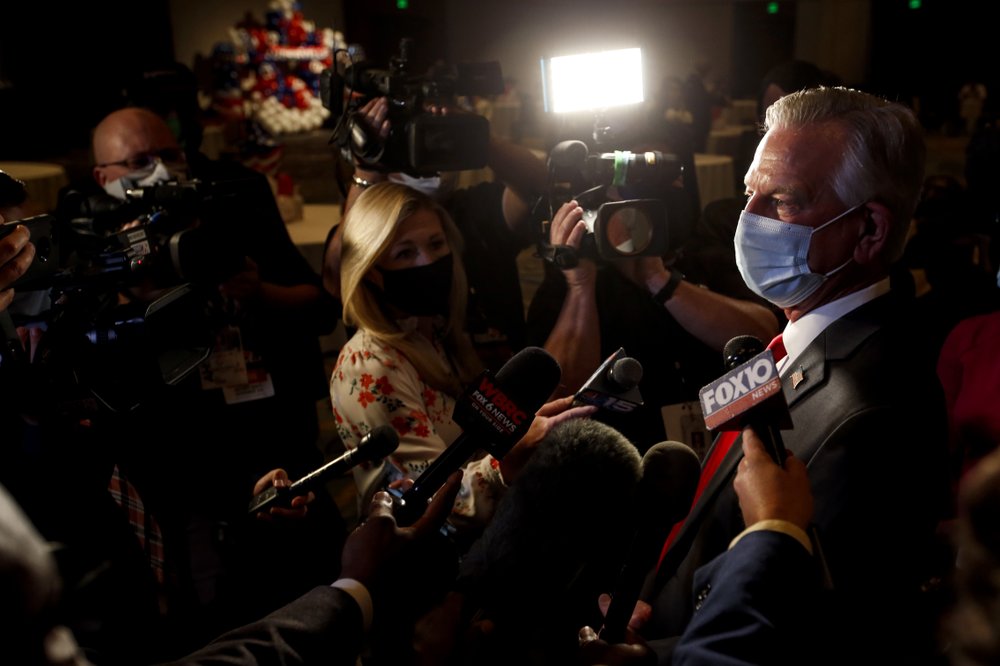
Former college football coach Tommy Tuberville has recaptured a U.S. Senate seat for Republicans by defeating Sen. Doug Jones in Alabama. Jones has been widely been considered the Senate’s most endangered Democrat. Republicans had made taking back the once reliably conservative seat a priority in 2020. Tuberville, who has never held public office and last coached four years ago, aligned himself closely with President Donald Trump and declared in the primary campaign: “God sent us Donald Trump.” “Alabama, welcome back to the Republican U.S. Senate,” Tuberville shouted after taking the stage to loud cheers at his election night party in downtown Montgomery. He said his victory shows that the seat can’t be bought by donors from other states. Tuberville took a congratulatory call from Vice President Mike Pence on stage after his victory was declared. “Thank you for delivering a great victory for President Donald Trump and thank you for sending a great new senator to the United States Senate,” Pence told the crowd after Tuberville put him on speakerphone. Jones had won the seat during a 2017 special election in which GOP Senate candidate Roy Moore was publicly accused of sexual misconduct involving young women decades ago. The GOP hammered Jones over his vote to convict Trump in the Senate impeachment trial earlier this year. Judy Harrison, a retired educator in Montgomery who described herself as “very conservative,” said she voted for Tuberville. “He’s a fine Christian man, I do know that,” said Harrison, 80. “And I know that he will work hard and do the best that he can. And I think his values are similar to mine.” However, Glenn Crowell, a 63-year-old retired restaurateur and Republican, voted for Jones. “I would have voted for Tuberville, but I couldn’t find out some stuff about him because he didn’t give any interviews and didn’t debate or anything like that,” said Crowell, who is Black. “So I know him for a football coach, but I don’t know him for his political views.” Three years ago, Jones became the first Alabama Democrat elected to the U.S. Senate in a quarter-century. His victory, blasted as a fluke by some, was aided by scandal after Republican nominee Roy Moore, already a controversial figure in the state, faced allegations of sexual misconduct from decades earlier. Jones won the special election to fill the seat that belonged to former U.S. Sen. Jeff Sessions. He resigned to become Trump’s first attorney general, a position he was later forced to resign after Trump became unhappy from Sessions’ decision to recuse himself from the Russia investigation. Tuberville, armed with outsider appeal and fame from his time as Auburn University’s football coach, won the GOP primary over Sessions, who tried to win back his old seat but was wounded by his falling out with Trump. Trump won Alabama with 62% of the vote in 2016 and endorsed Tuberville over Sessions in the 2020 Republican primary runoff. In trying to recapture the seat for the GOP, Tuberville and Republicans pointed to some of Jones’ votes to argue his views were out of step with Alabama’s conservative voters. In addition to seizing on Jones’ vote in Trump’s impeachment trial, Republicans also criticized Jones’ support of abortion rights. Alabama voters in 2018 approved a constitutional amendment saying it’s state policy to recognize the rights of “unborn children.” Jones, a former U.S. attorney best known for prosecuting two Ku Klux Klansmen responsible for Birmingham’s infamous 1963 church bombing, positioned himself as a moderate who supported gun rights and would cross party lines when it benefited the state. On the campaign trail, he referred to Tuberville as “Coach Clueless” because of his verbal fumbles on policy questions and past financial dealings. Republished with the permission of the Associated Press.
Long lines, enthusiasm but no major problems as US votes
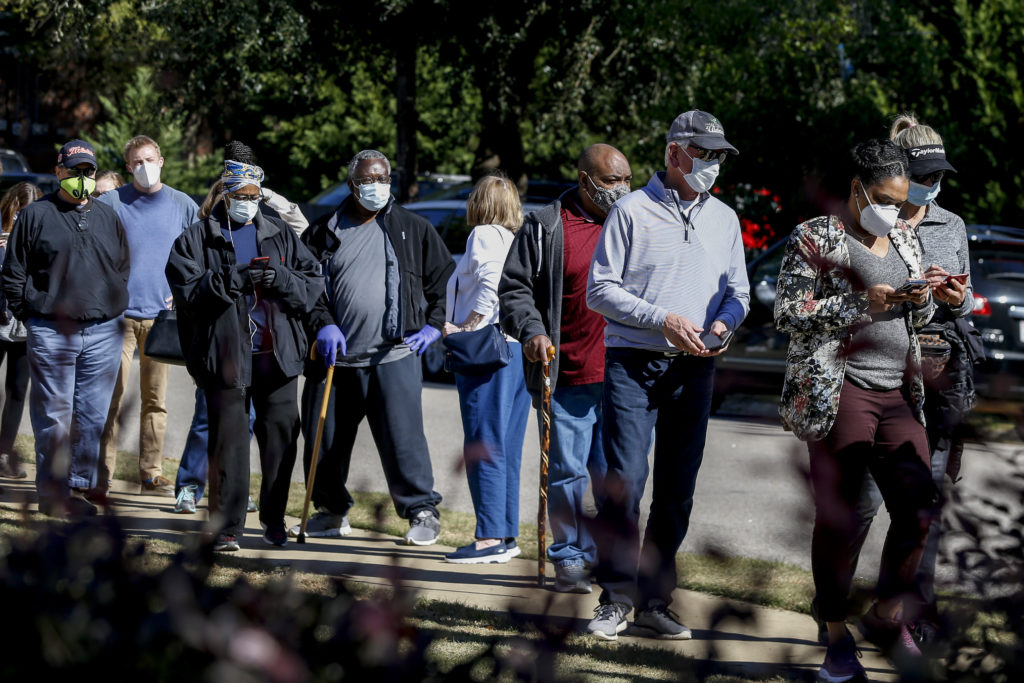
Voters marked the end of a fraught U.S. election season at the polls Tuesday, casting the last of what will likely be a record number of ballots in the midst of a global pandemic that upended long-established election procedures, prompted an unprecedented surge in mail ballots and triggered hundreds of lawsuits. No major problems were reported, and fears of large-scale voter intimidation or harassment had not materialized by midday. Officials have already warned that counting ballots could take days due to an avalanche of mail votes that take more time to process and could result in another round of court battles. President Donald Trump has already threatened legal action to prevent the counting of ballots that arrive after Election Day, which some states allow. Meanwhile, a federal judge ordered postal workers in some major cities to sweep processing facilities for any remaining ballots before the end of the day. Minor problems occur every election, and Tuesday was no different. There were long lines and sporadic reports of polling places opening late, along with equipment issues in counties in Ohio, Texas and Georgia. This was all expected given voter enthusiasm, the decentralized nature of U.S. elections and last-minute voting changes brought on by the pandemic. There were also reports, as there are every election, of efforts to discourage people from voting that surfaced in robocalls in Michigan and Iowa. The FBI was investigating. “We have not seen anything significant where it comes to voter intimidation or harassment. We are seeing enthusiastic partisan supporters in some places, but we are not seeing the kind of concerns that we may have had in the run-up to today,” said Suzanne Almeida, interim executive director of Common Cause Pennsylvania. At least 101.9 million people had already voted before Election Day, about 73 percent of the nearly 139 million who cast ballots in 2016, according to data collected by The Associated Press. Given that a few states, including Texas, had already exceeded their total 2016 vote count, experts were predicting record turnout this year. Those yet to vote headed to polling places despite another spike in COVID-19 cases that has hit much of the country. Among them were voters who may have wanted to vote by mail but waited too long to request a ballot or those who didn’t receive their ballots in time. Kaal Ferguson, 26, planned to vote by mail but was concerned he hadn’t left enough time to send his ballot back. So he voted in person in Atlanta, despite worries he could be exposed to COVID-19 by fellow voters. “Obviously everybody has their right to vote,” he said. “But it’s kind of scary knowing that there’s not a place just for them to vote if they’d had it, so you could easily be exposed.” Others were likely persuaded by the president’s rhetoric attacking mail voting or simply preferred to vote in person after reports surfaced over the summer of mail delivery delays following a series of policy changes implemented by the U.S. Postal Service’s new leader, Postmaster General Louis DeJoy, a major GOP donor. “I don’t want to see no mailman. I like to stand here, see my own people, wait in the line and do my civil duty,” said James “Sekou” Jenkins, a 68 year-old retired carpenter and mechanic who waited about 15 minutes before polls opened in West Philadelphia and voted for Democrat Joe Biden about an hour later. On Tuesday afternoon, a federal judge in Washington D.C. ordered U.S. Postal Service inspectors to sweep 27 mail processing facilities for lingering mail-in ballots and send out those votes immediately. The order, which includes centers in central Pennsylvania, Philadelphia, Detroit, Atlanta, south Florida and parts of Wisconsin, followed concerns the agency wouldn’t be able to deliver ballots on time. Postal data has shown service in some battleground areas severely lagging. “The slowdown and compromising of the U.S. Postal Service was a concern,” said Rebecca Kraft, a 41-year-old Milwaukee resident who voted in person. “So I said ‘All right, if I’m feeling healthy, I am going to go do it at the polls just to make sure.’” Federal authorities were monitoring voting and any threats to the election from an operations center just outside Washington D.C. Officials there said no major problems had been detected. “We’re not out of the woods yet,” said Christopher Krebs, the director of the U.S. Cybersecurity and Infrastructure Security Agency. “Today, in some sense, is half-time. There may be other events or activities or efforts to interfere and undermine confidence in the election. So I’d ask all Americans to be patient, to treat all sensational and unverified claims with skepticism, and remember technology sometimes fails and breaks.” In the months leading up to Election Day, election officials had to deal with a pandemic that has infected more than 9 million Americans and killed more than 230,000, forcing them to make systemic changes largely on the fly and mostly without federal money. Meanwhile, Trump repeatedly sought to undermine the election with unsubstantiated claims of widespread voter fraud. He has particularly targeted the crucial battleground state of Pennsylvania, after the U.S. Supreme Court allowed — at least for now — a three-day extension for receiving and counting absentee ballots. Over the weekend, Trump said that as soon as the polls close there on Tuesday, “We’re going in with our lawyers.” Misinformation about election procedures, concerns about confrontations at the polls and reports of mail slowdowns also clouded the run-up to Election Day. States hammered out plans for protecting against foreign and domestic cyberattacks, countering misinformation and strengthening an election infrastructure tested by massive early voting and pandemic precautions. Election officials across some 10,000 voting jurisdictions scrambled to purchase personal-protective equipment, find larger polling places, replace veteran poll workers who opted to sit out this year’s election due to health concerns and add temporary workers to deal with the avalanche of mail ballots. Most states, even ones with broad mask mandates, stopped short of forcing voters to wear them at the
Republicans try to reclaim Alabama Senate seat from Doug Jones
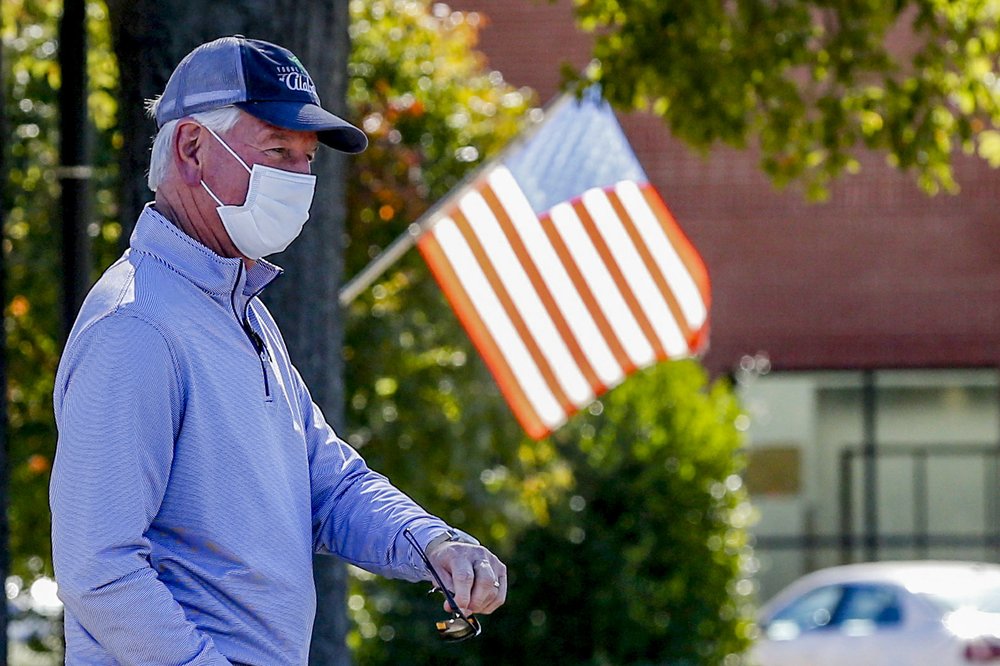
Republicans in Alabama are attempting to reclaim a U.S. Senate seat that the Democrats won three years ago in the reliably red state. Democratic Sen. Doug Jones is being challenged by Republican Tommy Tuberville, who limited his public appearances and refused to debate him. Tuberville is well known in Alabama as Auburn University’s former football coach, and is expected to benefit from straight-ticket voting and President Donald Trump’s endorsement in a state where Trump remains popular among white voters. Voters encountered long lines as the polls opened Tuesday morning. Alabama Secretary of State John Merrill predicted that the state will see record turnout with up to 76% of the state’s 3.7 million eligible casting ballots. The race will test whether Democrats can maintain inroads in the Deep South state. The outcome of the race could also affect control of the U.S. Senate, which Republicans currently control 53-47. Judy Harrison, a retired educator in Montgomery who described herself as “very conservative,” said she voted for Tuberville. “He’s a fine Christian man, I do know that,” said Harrison, 80. “And I know that he will work hard and do the best that he can. And I think his values are similar to mine.” Glenn Crowell, a 63-year-old retired restaurateur and registered Republican, voted for Jones. “I would have voted for Tuberville, but I couldn’t find out some stuff about him because he didn’t give any interviews and didn’t debate or anything like that,” said Crowell, who is Black. “So I know him for a football coach, but I don’t know him for his political views.” The Jones campaign emphasized his record of bipartisanship and support for the Affordable Care Act while questioning Tuberville’s knowledge and readiness for office. Jones, a former U.S. attorney best known for prosecuting Ku Klux Klansmen who bombed a Birmingham church in 1963, became the first Alabama Democrat elected to the Senate in a quarter century by defeating Roy Moore, who was accused of pursuing romantic and sexual relationships with teenage girls when he was in his 30s. During a candidate forum with students at Auburn, Jones was asked whether a Democrat could represent the interests of Alabamians. “I have no idea what they are talking about when someone says that,” he said. “Does it mean I’m not going to represent the farmers like I’ve been doing? Does it mean I’m not going to represent the military like I’ve done for the last two years, and help upgrade our nuclear triad and our military folks?” “Alabama is not monolithic. We are a diverse state. …. The goal is to try to find common ground,” he added. Tuberville ended the comeback hopes of former Attorney General and Alabama U.S. Sen. Jeff Sessions in this summer’s GOP runoff. He’s positioned himself as a political outsider and emphasized his support of Trump and opposition to abortion. “I’m going to stand with President Trump to finish the border wall, cut your taxes, and protect life,” Tuberville said in an ad. His last comment was a reference to his opposition to abortion. Tuberville said Jones was out of sync with Alabama’s conservative voters when he voted to remove Trump during the impeachment trial and refused to confirm Amy Coney Barrett to the U.S. Supreme Court. “Senator Jones has not been a voice for the people of Alabama,” Tuberville said after a campaign stop Sunday, suggesting Jones was more suited to represent California. “I want to go work on their behalf,” he said of Alabama voters. David Mowery, an Alabama-based political consultant, said the path for a Democrat is harder in Alabama than in some other Southern states that are beginning to turn purple. “We’re a Republican state. We don’t have a growing suburban area,” he said. “Those types of issues aren’t roiling our populace, for better or for worse. We don’t have the diversity that a Georgia has, or a North Carolina has.” Wearing a string of GOP buttons and carrying a face mask that read, “Biden will Keep Lock Downs For Years,” Meghann Mustico, a 40-year-old file clerk from Hoover, came to hear Tuberville speak on Sunday. “I know he will better represent Alabama,” Mustico said. “President Trump has been the voice for the unborn, stood up for veterans rights, and I have a feeling he is going to follow his lead.” Marilyn Hobbs, a program administrator for a media company, said she has already cast an absentee ballot for Jones and for former Vice President Joe Biden in the presidential election. She said there is energy among Democrats in this election. “He definitely has a chance,” Hobbs said of Jones. “The same people who voted for him last time, we are going to vote for him again. I do believe women will play a central part in voting for this senator and this president.” Republished with the permission of the Associated Press.
In 2020 finale, Donald Trump combative, Joe Biden on offense
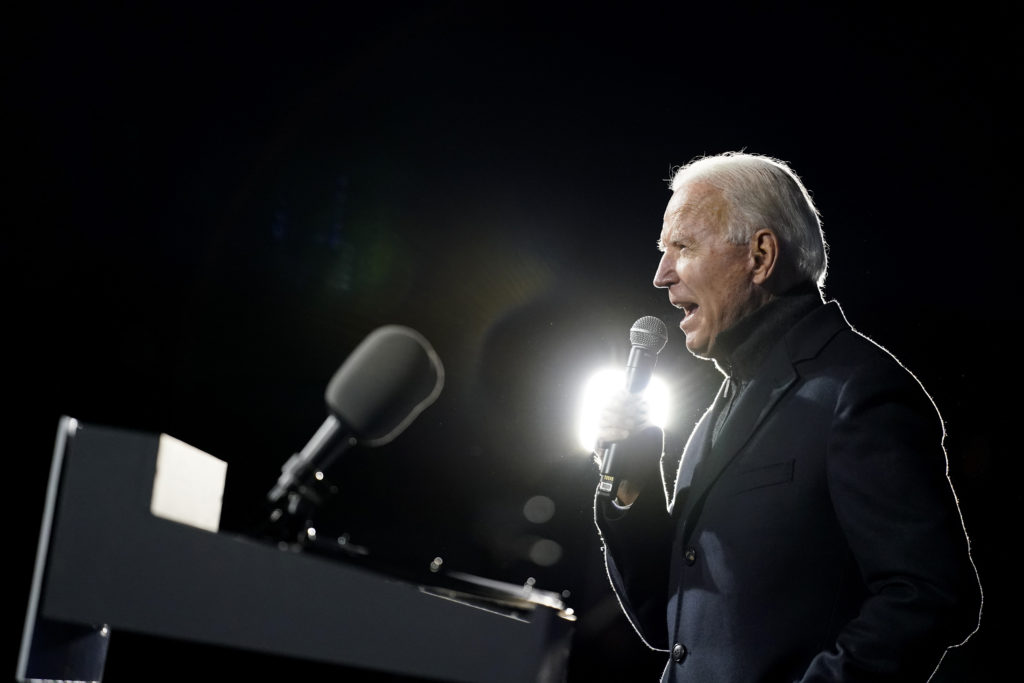
In the closing hours of a campaign shadowed by a once-in-a-century pandemic, President Donald Trump charged across the nation Monday delivering an incendiary but unsupported allegation that the election is rigged, while Democratic challenger Joe Biden pushed to claim states once seen as safely Republican.
Doug Jones calls Tommy Tuberville ‘quitter,’ says health care on ballot
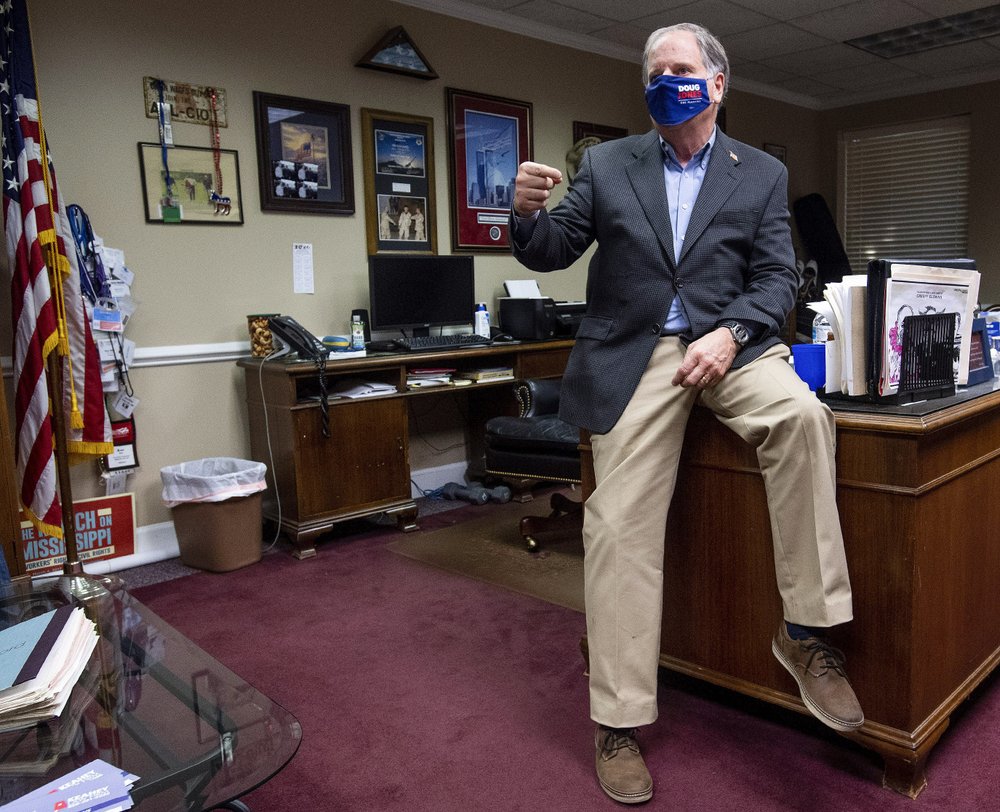
U.S. Sen. Doug Jones of Alabama made a flurry of campaign stops Monday as the Deep South Democrat tries to avoid being swept out of office by Republican Tommy Tuberville and a red wave on Election Day. Jones, who is running for a full term after winning a special election three years ago, made a last-minute push to get voters to the polls as he seeks a coalition of Democrats, independents and Republicans, required to hold on to the seat. During a stop at the AFL-CIO labor union office in Montgomery, Jones brushed aside predictions that he can’t win, noting he had done so once. “We’ve got a tough road tomorrow. Everybody knows this. We’ve got a tough road. We’ve got to get our folks voting,” Jones said. “This is not about me. This has never ever been about me and my family. It’s about you. … It’s all about One Alabama,” the senator said, referencing his campaign slogan. In 2017, Jones was the first Alabama Democrat elected to the U.S. Senate in a quarter-century. He is facing reelection in a state where President Donald Trump won 62% of the vote in 2016. Jones, as he has at other stops, emphasized health care issues, including the fate of the Affordable Care Act, which he says provides health coverage protections for hundreds of thousands of people in the state. “Make no mistake, folks, your health care is on the ballot. … Leave it to Alabama to try to get rid and throw into turmoil the health care of 957,000 Alabamians that have preexisting conditions in this state,” Jones said. Marilyn Hobbs, a program administrator for a media company, said she has already cast an absentee ballot for Jones and for Joe Biden in the presidential election. “He definitely has a chance,” Hobbs said of Jones. “The same people who voted for him last time, we are going to vote for him again. I do believe women will play a central part in voting for this senator and this president.” Jones took parting shots at Tuberville, saying his opponent’s campaign consisted of only, “Drain the swamp, build the wall, no amnesty, I’ve got Donald Trump’s back and let me tell you lies about Doug Jones.” He also lampooned Tuberville as a quitter, noting the Republican had said he might spend part of the day golfing. The Tuberville campaign did not immediately respond to an email seeking comment. Tuberville held a Sunday rally in Gardendale, which he said was his final stop of the race. Tuberville emphasized his support for Trump and said Jones does not represent the conservative voters of the state. “When we win, you are going to get someone like Donald Trump who is going to work for you,” Tuberville said. “I’m not doing this to be on television or be in the newspaper. I’ve done all that.” Tuberville did not announce any campaign stops Monday. He told supporters all that was left to do was go vote and send a message. “I’m probably going to get a haircut. I might even go hit a few golf balls. I may be sore Tuesday night when I get up on the stage at the end of the election. This is the last event I’ll attend. There is not a lot we can do other than go vote,” Tuberville said Sunday. Wearing a string of GOP buttons and carrying a face mask that read, “Biden will Keep Lock Downs For Years,” Meghann Mustico, a 40-year-old file clerk from Hoover, came to hear Tuberville speak on Sunday. “I know he will better represent Alabama,” Mustico said. “President Trump has been the voice for the unborn, stood up for veterans rights, and I have a feeling he is going to follow his lead.” Republished with the permission of the Associated Press.
Judge rejects GOP effort to throw out 127,000 Houston votes
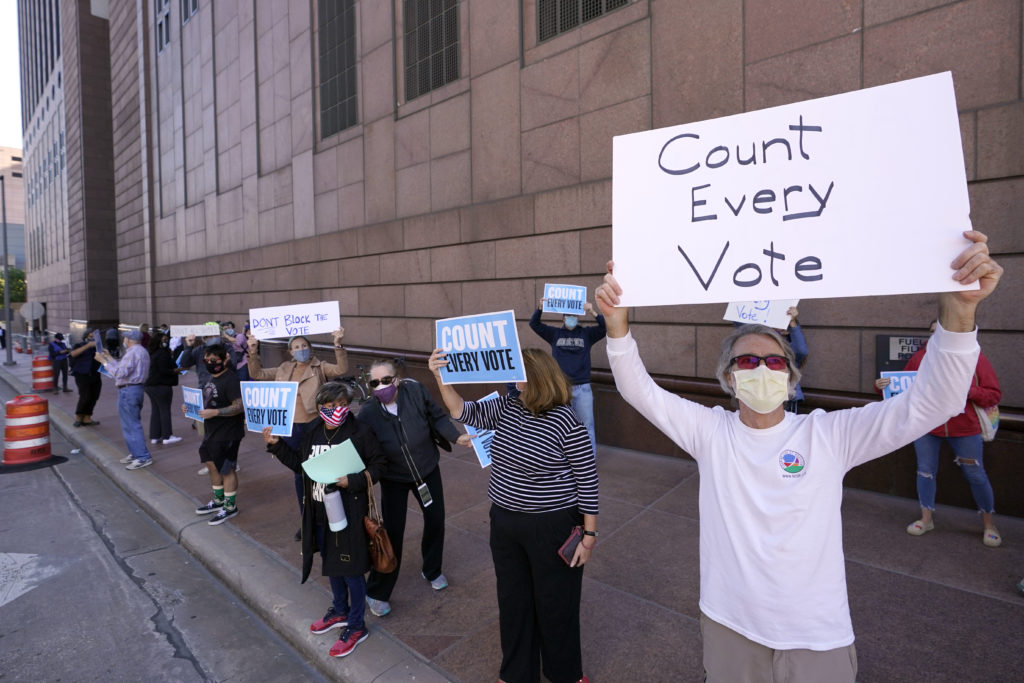
A federal judge on Monday rejected another last-ditch Republican effort to invalidate nearly 127,000 votes in Houston because the ballots were cast at drive-thru polling centers established during the pandemic. The lawsuit was brought by conservative Texas activists who have railed against expanded voting access in Harris County, where a record 1.4 million early votes have already been cast. The county is the nation’s third-most populous and a crucial battleground in Texas, where President Donald Trump and Republicans are bracing for the closest election in decades on Tuesday. U.S. District Judge Andrew Hanen’s decision to hear arguments on the brink of Election Day drew concern from voting rights activists and came after the Texas Supreme Court rejected a nearly identical challenge over the weekend. “We cannot allow participation to be limited simply because there are those who choose to think that they have the ability and the authority to decide who votes,” Democratic Rep. Al Green, of Houston, said outside the courthouse after the ruling. “It’s the Constitution that determines who votes.” Hanen said those who oppose drive-thru centers — who were represented by former Harris County GOP Chairman Jared Woodfill— had no standing to bring a lawsuit. He added that people had already voted and that conservative activists had months to bring a challenge sooner. But Hanen still expressed doubts about whether Texas law allowed anyone to vote from their car, even during a pandemic. “I would not vote in a drive-thru just out of my concern as to whether that’s legal or not,” Hanen said. After Hanen’s ruling, Woodfill accused Harris County officials of using their office to help Democrats win Tuesday. “If Harris County goes against Trump in large enough numbers, then we could lose Texas. And if Trump loses Texas then we lose the national election,” Woodfill said after the ruling. “As far as I’m concerned, this is ground zero.” Late Monday, Woodfill filed an appeal with the 5th U.S. Circuit Court of Appeals, seeking an emergency injunction to invalidate the ballots cast curbside. The appeals court did not rule immediately. Another 20,000 or more voters were expected to use drive-thru polling locations Tuesday, said Harris County Clerk Chris Hollins, the county’s top elections official. Several voters who already used the drive-thru centers rushed to join mounting opposition to the lawsuit, including a Houston attorney whose wife was 35 weeks pregnant when she cast her ballot. She gave birth to twins Friday. “My vote counts,” David Hobbs said. “My wife’s vote counts.” Trump won Texas by nine points in 2016 but polls have shown Democrat Joe Biden still within reach in America’s biggest red state. Democrats also need to flip only nine seats to reclaim a majority in the Texas House for the first time in 20 years, and have aggressively targeted several races in Harris County. Woodfill has been a part of a battery of court challenges over moves to expand voting options during the COVID-19 pandemic. The challenges have not involved Trump’s campaign. Harris County offered 10 drive-thru locations as an option for its nearly 5 million residents amid worries of spreading the coronavirus. Woodfill argued that Texas election law makes no explicit allowances for drive-thru voting and framed it is as an unlawful expansion of curbside voting, which is legal in Texas but limited to people who are unable to enter polling places because of their health. Portions of the hearing were consumed by debate over what exactly qualified as a legal structure for a polling place under Texas law. “You have a fundamental right to vote in a car?” Hanen tersely asked an attorney for the ACLU. Woodfill’s lawsuit noted that all but one of the drive-thru centers were set up “in Democrat areas of the county.” More than 40% of Harris County residents are Latino, and about one in five residents are Black. The lawsuit drew objections even from Republicans, including former Texas House Speaker Joe Straus. Republican Sen. John Cornyn, who is facing the toughest reelection battle of his career Tuesday against Democrat MJ Hegar, also said during a weekend campaign stop that the Texas Supreme Court made the right decision earlier in rejecting an identical challenge. The Texas Supreme Court, which is controlled entirely by Republicans, rejected an identical lawsuit last month and on Sunday refused to invalidate the votes already cast. The state’s highest court did not explain its decision. Hollins had asked Republican Gov. Greg Abbott to affirm that the drive-thru locations are legal but received no response. Texas is one of just five states that did not allow for widespread mail-in voting this year during the coronavirus pandemic, which has killed more than 18,000 people statewide. Abbott instead expanded early voting by one week, and that extra time helped Texas already surpass 2016’s total votes even before Tuesday’s election. More than 9.7 million people have cast early ballots in Texas, where turnout typically ranks among the lowest in the country. Some elections experts predict that total turnout in Texas could surpass 12 million, and Harris County officials have taken more steps than most to expand voting access. The county tripled the number of polling places and last week had eight locations that stayed open for 24 hours. Republished with the permission of the Associated Press.
