
Donald Trump’s silent public outing belies White House in tumult

Donald Trump spent 10 minutes in public Wednesday honoring America’s war veterans — a veneer of normalcy for a White House that’s frozen by a defeated president mulling his options, mostly forgoing the mechanics of governing and blocking his inevitable successor. Trump’s appearance at the annual Veterans Day commemoration at Arlington National Cemetery was his first public outing for official business in more than a week. He’s spent the past few days in private tweeting angry, unsupported claims of voter fraud. The president has made no comments in person since Democrat Joe Biden clinched the 270 electoral votes on Saturday needed to win the presidency. All the while, his aides grow more certain that legal challenges won’t change the outcome of the election, according to seven campaign and White House officials who spoke on the condition of anonymity to discuss the thinking of the president and others in the executive mansion. Before setting off for the solemn commemoration at Arlington, Trump took to Twitter on Wednesday to slam “fake pollsters” and grouse that a Republican city commissioner who defended the vote tabulation in Philadelphia wasn’t a true Republican. He also sought to draw attention to a Pennsylvania poll worker who recanted allegations of voter fraud on Tuesday before reasserting his allegations on Wednesday. Trump later posted a debunked video that had purported to show poll workers collecting ballots too late. “You are looking at BALLOTS! Is this what our Country has come to?” Trump fumed. Although his official schedule has been bare of public events, Trump has made several personnel moves — firing Defense Secretary Mark Esper and installing three staunch loyalists in top defense jobs. His pick as acting defense secretary, Christopher Miller, was among the Pentagon brass that joined him at Arlington. Some supporters pushed back against the notion that Trump is shirking his presidential duties. “The president is out there as much as he’s ever been on Twitter, and the White House team are moving ahead with budget and staffing priorities,” said Dan Eberhart, a prominent Republican donor and Trump backer. He added, “The president is understandably focused on the ballot counting, but at some point soon he needs to turn his attention back to the lame-duck session and putting a capstone on his first four years.” However, few senior staffers have been around the president in recent days, with many either in quarantine after testing positive for COVID-19 or in insolation after a confirmed exposure or simply not wanting to be near the Oval Office, according to White House staffers and campaign officials. Staff working from the White House thinned out after chief of staff Mark Meadows confirmed last week that he had tested positive for the virus. Some staffers still believe the election outcome can change with litigation and recounts. But there is a growing recognition among most that the election is lost and the building will be vacated by Jan. 20. Trump’s moods have vacillated over recent days. At times, he has seethed with anger, fuming that he lost to a candidate he doesn’t respect and believing that the media –- including what he views as typically friendly Fox News — worked against him. In addition to misdoings with mail-in ballots. But aides say he has been calmer than his tweets suggest, showing greater understanding of his predicament and believing that he needs to keep fighting almost as performance, as a show to the 70 million people who voted for him that he is still battling. In recent days, some aides, including his daughter Ivanka Trump, have started to talk to him about an endgame, questioning how much longer he wants to fight. Outside the White House, one prominent former ally turned Trump critic warned that the president was doing potentially irreparable damage to the Republican Party. “The real issue is the grievous harm he is causing to public trust in America’s constitutional system,” former Trump national security adviser John Bolton wrote in a Washington Post op-ed Wednesday. “Trump’s time is running out, even as his rhetoric continues escalating.” But no one in his inner circle — West Wing staff or Cabinet — is forcefully pushing him to stop. Though he has been in the Oval Office late two nights this week, the president has done little in the way of governing and has instead been working the phones. He has called friendly governors — in red states like Arizona, Texas, and Florida — and influential confidants in the conservative media, like Sean Hannity. But he has not been as responsive to Republican lawmakers as before the election. Always an obsessive cable news viewer, he has been watching even more TV than usual in recent weeks, often from his private dining room just off the Oval Office. Trump’s approach to two crucial Senate run-off elections in Georgia remains an open question: He has not yet signaled if he will campaign there, and aides have started to worry that the extended legal battle could sap support for the GOP candidates. Trump has also begun talking about his own future upon leaving office. He has mused about declaring he will run again in 2024, and aides believe that he will at least openly flirt with the idea to enhance his relevance and raise interest in whatever money-making efforts he pursues. While he ponders his options, his involvement in the day-to-day governing of the nation has nearly stopped: According to his schedule, he has not attended an intelligence briefing in weeks, and the White House has done little of late to manage the pandemic that has surged to record highs in many states. The president’s resistance to acknowledging the outcome of the race has stalled the transition process. The head of the General Services Administration, a Trump appointee, has held off on certifying Biden as the winner of the election. The certification — known as ascertainment — would free money for the transition and clear the way for Biden’s team to begin placing transition personnel at federal agencies. White House spokesman Judd Deere said he
Republicans reprise warnings of leftism in Georgia races
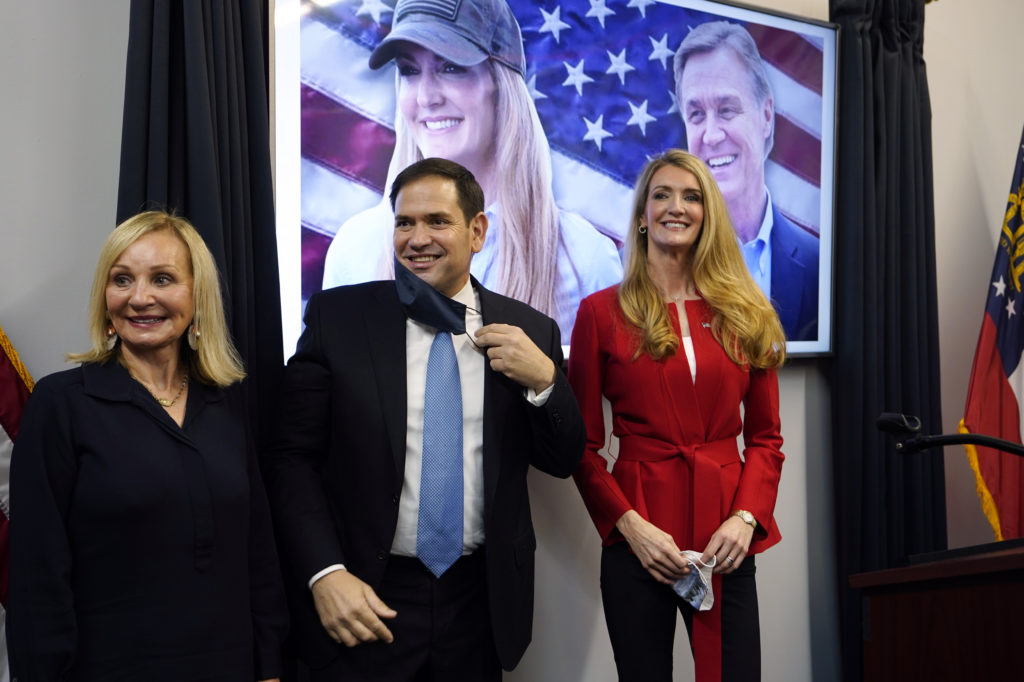
Socialists. Radical extremists. Marxists. Those over-the-top caricatures of Democrats make up Republicans’ opening arguments as they try to protect Georgia’s two U.S. senators who face strong challenges in Jan. 5 runoffs that’ll determine which party controls the chamber at the start of President-elect Joe Biden’s Democratic administration. Florida Sen. Marco Rubio led the charge Wednesday, campaigning in suburban Atlanta alongside Sen. Kelly Loeffler and warning that defeats for her and fellow Georgia Sen. David Perdue would hand over the U.S. government to “radical elements.” Loeffler went so far as to assert, without supporting details, that her Democratic challenger Raphael Warnock has “a Marxist ideology.” Loeffler took no questions after the event that filled the Cobb County Republican Party headquarters with hundreds of enthusiastic voters, many of them not wearing masks as coronavirus cases spike across the country. Warnock’s campaign pushed back, noting the Democrat’s policy preferences fall squarely within the U.S. political mainstream. Terrence Clark, a Warnock aide, said Loeffler is trying to “scare Georgians” while “misrepresenting” Warnock’s candidacy and obscuring her own record. It’s a familiar trope for Republicans to blast Democrats, especially in traditionally GOP-leaning states, as “too liberal” or even “socialist.” But the vehemence to open a two-month runoff blitz underscores the national stakes of Georgia’s unusual twin Senate contests and the sharp focus Republicans are putting on energizing core supporters for a second round of voting. The arguments come as Loeffler, Perdue, and other Georgia Republicans continue suggesting the Nov. 3 election — overseen by a Republican secretary of state — was rife with voting irregularities and tabulation errors, assertions made without evidence but that animate a GOP base still loyal to President Donald Trump even after his national defeat. “Turnout takes care of itself when the presidential race is on the ballot, so it can still boil down to persuasion in the middle,” said Republican consultant Chip Lake, a top adviser on Rep. Doug Collins’ unsuccessful bid against Loeffler. “In a runoff, it’s no longer about persuasion” Lake continued. “It’s about the bases.” Collins, now leading Trump’s recount efforts in Georgia, said the goal is to keep Republicans “fired up because they don’t want to see our country turn to a liberal perspective.” Republicans and Democrats are bracing for an unprecedented national-scale campaign in Georgia, a newfound two-party battleground where record turnout of roughly 5 million split almost evenly. Biden leads Trump by about 14,000 votes, but Secretary of State Brad Raffensperger announced plans Wednesday for an audit with a hand tally of ballots before certifying the results. Perdue, a staunch Trump ally first elected in 2014, led Democrat Jon Ossoff but fell short of the majority Georgia law requires for victory. Loeffler, appointed after Republican Sen. Johnny Isakson announced his retirement last year, trailed Warnock in an all-party primary to finish out the final two years of a six-year term. The Associated Press has called runoffs in both contests but hasn’t called Georgia’s 16 presidential electoral votes. Nationally, Republicans have secured 50 Senate seats to Democrats’ 48. Still, the GOP needs at least one of the Georgia seats to command a majority in January. In a 50-50 Senate, Democrats would have the tie-breaking vote in Vice President-elect Kamala Harris. Rubio and Loeffler warned of dire consequences, even as Rubio implicitly conceded the hyperbole. “To be fair, not all Democrats are socialists,” Rubio said. “But all socialists are Democrats.” Rubio alluded to failed presidential candidate Bernie Sanders, an independent who calls himself a democratic socialist and caucuses with Senate Democrats. Rubio nodded to progressive calls to “defund the police” and Democrats who support policies like “Medicare for All” single-payer health insurance or tuition-free public college nationwide. “All the energy” and “all the money” in the Democratic Party, Rubio insisted, come from such forces. Rubio didn’t mention Biden, who won the nomination and presidency as an establishment figure promising bipartisanship and compromise. Biden often noted as he campaigned that he defeated Sanders and other more liberal candidates for the nomination. “He thinks he’s running against someone else,” Biden quipped at Trump during an Oct. 22 debate when the president sought to label his challenger a socialist. Biden, for example, supports adding a “public option” government health care plan to existing insurance markets, but without ending private insurance. He backs significant public spending on green energy but opposes progressives’ push for quickly phasing out fossil fuels. Warnock and Ossoff have largely aligned behind Biden’s agenda, especially on a public option. Clark, Warnock’s spokesman, noted that Loeffler backs GOP efforts to roll back the 2010 Affordable Care Act that bars insurers from discriminating against customers based on their health history. He also saddled her with the GOP-run Senate’s failure to pass another coronavirus economic aid package as millions of Americans face the loss of jobless benefits, foreclosures, and evictions. Republicans nonetheless are doubling down after GOP Senate incumbents defeated well-financed challengers in more conservative states such as Iowa, Texas, and Montana, while Republican challengers knocked off several House Democrats who’d won moderate districts in 2018. Their bet is that Georgia, long a GOP stronghold before Biden’s performance in the presidential race, follows the same path. Republished with the permission of the Associated Press.
Joe Biden moves forward without help from Donald Trump’s intel team
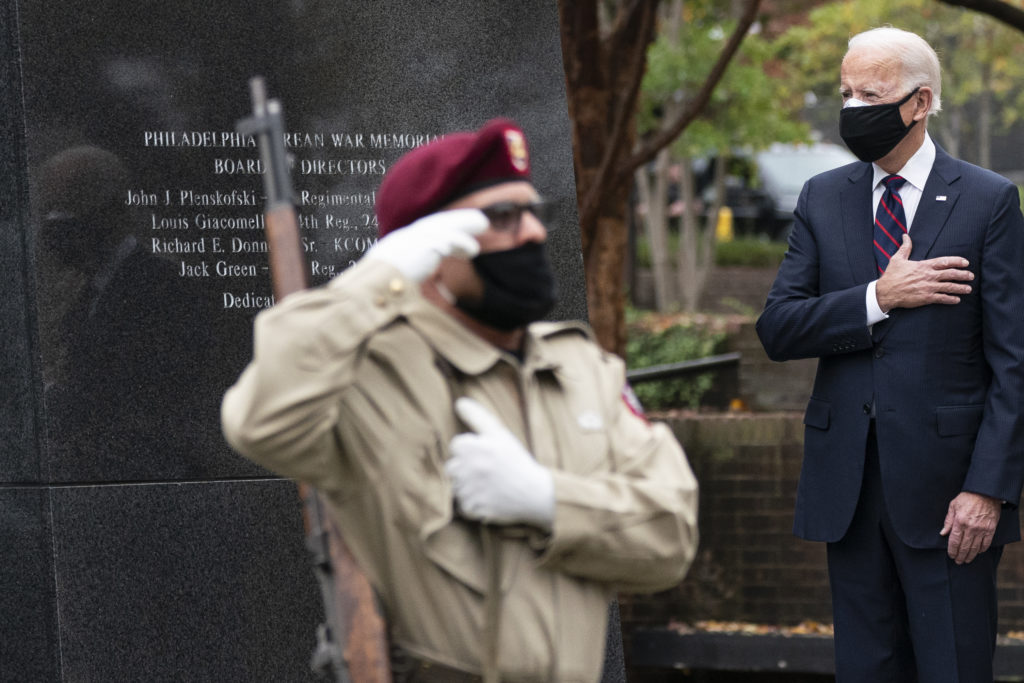
The presidential race was hovering in limbo in 2000 when outgoing President Bill Clinton decided to let then-Gov. George W. Bush read the ultra-secret daily brief of the nation’s most sensitive intelligence. Clinton was a Democrat and his vice president, Al Gore, was running against Republican Bush. Gore had been reading the so-called President’s Daily Brief for eight years; Clinton decided to bring Bush into the fold in case he won and he did. President Donald Trump has not followed Clinton’s lead. As he contests this year’s election results, Trump has not authorized President-elect Joe Biden to lay eyes on the brief. National security and intelligence experts hope Trump changes his mind, citing the need for an incoming president to be fully prepared to confront any national security issues on Day One. “Our adversaries aren’t waiting for the transition to take place,” says former Michigan Republican Rep. Mike Rogers, who was chairman of the House intelligence committee. “Joe Biden should receive the President’s Daily Brief starting today. He needs to know what the latest threats are and begin to plan accordingly. This isn’t about politics; this is about national security.” U.S. adversaries can take advantage of the country during an American presidential transition and key foreign issues will be bearing down on Biden the moment he steps into the Oval Office. Among them: Unless Trump extends or negotiates a new nuclear arms accord with Russia before Inauguration Day, Biden will have only 16 days to act before the expiration of the last remaining treaty reining in the world’s two largest nuclear arsenals. Perhaps U.S. spies have picked up tidbits about the Russians’ redlines in the negotiations, or about weapons it really wants to keep out of the treaty. That’s the type of information that might be in the PDB, a daily summary of high-level, classified information and analysis on national security issues that’s been offered to presidents since 1946. It is coordinated and delivered by the Office of the National Intelligence Director with input from the CIA and other agencies. It is tailored for each president, depending on whether they prefer oral or written briefs or both, short summaries or long reports on paper or electronically. Having access to the PDB also could help Biden craft a possible response to North Korea, which has a history of firing off missiles or conducting nuclear tests shortly before or after new presidents take office. Biden has decades of experience in foreign affairs and national security, but he likely has not been privy to the latest details about how Iran is back to enriching uranium, or the active cyber attack operations of Russia, China and Iran. China’s crackdown on Hong Kong is heating up. And the threat from Islamic extremists, although curbed, still remains. Biden is trying to play down the significance of the delay in getting access to the PDB. “Obviously the PDB would be useful but, it’s not necessary. I’m not the sitting president now,” Biden said Tuesday. He didn’t answer a question about whether he’d tried to reach out to Trump himself on this or any other issue, saying only, “Mr. President, I look forward to speaking with you.” He was also asked about needing access to classified information as soon as possible if Trump doesn’t concede the race. “Look, access to classified information is useful. But I’m not in a position to make any decisions on those issues anyway,” Biden said. “As I said, one president at a time. He will be president until Jan. 20. It would be nice to have it, but it’s not critical.” Biden is familiar with the PDB, having read it during his eight years as vice president. But threats are ever-changing and as Inauguration Day nears, his need for Trump to let him get eyes on the intelligence brief will become more critical. Sen. James Lankford, R-Okla., predicted that the issue of whether Biden will get access to the intelligence brief will be resolved soon. “I’ve already started engaging in this area. … And if that’s not occurring by Friday, I will step in and push and say this needs to occur so that regardless of the outcome of the election, whichever way that it goes, people can be ready for that actual task,” Lankford told KRMG in Tulsa, Oklahoma, on Wednesday. He said Vice President-elect Kamala Harris also should be getting the briefings, which should not be a problem because she already has security clearances as a member of the Senate intelligence committee. While the Bush team had access to the intelligence brief in 2000, an election recount delayed the Bush team’s access to government agencies and resources for more than five weeks. Biden is missing out on all counts: More than a week into his transition, Biden doesn’t have access to the PDB, the agencies or government resources to help him get ready to take charge. “President-elect Joe Biden and his transition team should not suffer a similar delay,” John Podesta, who served as White House chief of staff under Clinton, and Bush’s chief of staff Andrew Card wrote in a joint op-ed published this week in The Washington Post. “We have since learned the serious costs of a delayed transition,” they wrote. “Less than eight months after Bush’s inauguration, two planes flew into the World Trade Center, killing nearly 3,000 Americans.” The 9/11 Commission Report on the Sept. 11, 2001, attacks warns of the danger in slow-walking presidential transition work in general, not just the intelligence piece. The Bush administration didn’t have its deputy Cabinet officers in place until the spring of 2001 and critical subcabinet positions were not confirmed until that summer — if then, the report said. For now, the office of National Intelligence Director John Ratcliffe says it can’t begin talking with the Biden transition team until a federal agency starts the process of transition, which the Trump administration is delaying. The office, which oversees more than a dozen U.S. intelligence agencies, said it must follow
