
Alabama Arise and other organizations urge Kay Ivey to spend CARES Act funds before it’s too late

With less than two months to spend $1 billion in CARES Act Funds, dozens of organizations have written a letter urging Governor Kay Ivey to not let the money go back to the federal government. Alabama was allocated $1.7 billion dollars in COVID-19 relief funding and still has yet to spend the majority of it. The money that isn’t spent by December 31 will be returned to the federal government. One of the 82 organizations that signed the letter to Ivey is Alabama Arise, an organization that advocates for policy that improves the lives of low-income citizens in Alabama. Robyn Hyden, executive director of the organization is hoping that the money will be spent on time and wisely. “We’re now almost to the deadline, and there’s 1 billion in unspent money just sitting on the table,” Hyden commented to Fox10 News. “So we are very concerned that not only are these funds not getting spent quickly enough, but they’re not going in a targeted way to the most vulnerable people in our state.” The advocacy organizations all agreed that there are four main priorities for spending the funds: alleviating hunger; addressing evictions and homelessness; supporting people particularly vulnerable to COVID-19, and child care. Alabama Arise quoted Hyden on Twitter stating, “People are still really struggling, and our economy will not bounce back until every family who’s been hit hard has more opportunity and has more support.” “People are still really struggling, and our economy will not bounce back until every family who’s been hit hard has more opportunity and has more support,” Arise’s @robynhyden tells @FOX10News. #CARESAct funds are critical to fight hunger, homelessness and hardship. #alpolitics https://t.co/z1y1QA1irG — Alabama Arise (@AlabamaArise) November 16, 2020 Gina Maiola, Ivey’s spokeswoman said in a statement, “In consultation with Legislative Leadership, the governor will evaluate the need to shift funds again to potentially address areas that will impact our economy, specifically small businesses. As Governor Ivey has pointed out, $1.7 billion is a hefty chunk of money to spend in six months, but she and the team at Finance will continue working to get this spent and into the hands of Alabamians.” Part of the letter states, “It is important to remember that even before this pandemic devastated the economy, Alabama was the fifth poorest state in the U.S. with 800,000 of our residents living in poverty. These CARES Act funds provide our best hope to ensure the economic downturn does not force these families into long term, catastrophic conditions that will impact generations to come.” A copy of the letter can be seen here.
Paul DeMarco: Alabama must continue to strengthen not weaken state election laws

As the Nation watches the news unfold about allegations of fraud and irregularities in some battleground states, election day in Alabama appeared to generally run smoothly. Yet, while Alabama has better election laws than most of the states embroiled in controversy now, there is still room to improve the current rules on the books. The state’s absentee ballot laws do not allow for the transparency that is needed to ensure there are not deliberate attempts to defraud the system. In addition, we need to make sure the state enforces all of the current laws regarding those absentee ballots. But instead, some Democrats in the state have pushed for more liberal election laws including mail-in ballots with less stringent identification requirements that would make it even harder to verify identity. Those proponents are willing to sacrifice security of the ballot box because they perceive a political benefit to their party with lax rules. Voter Identification is of paramount importance in discouraging fraud and giving confidence to the voters in the integrity and accuracy of our electoral system. Alabama voters should demand that the state’s election laws instill certainty at the ballot box rather than create suspicion. And when the Alabama Legislature is back in session they should listen to those voters. Paul DeMarco is a former member of the Alabama House of Representatives.
Poll workers contract virus, but Election Day link unclear
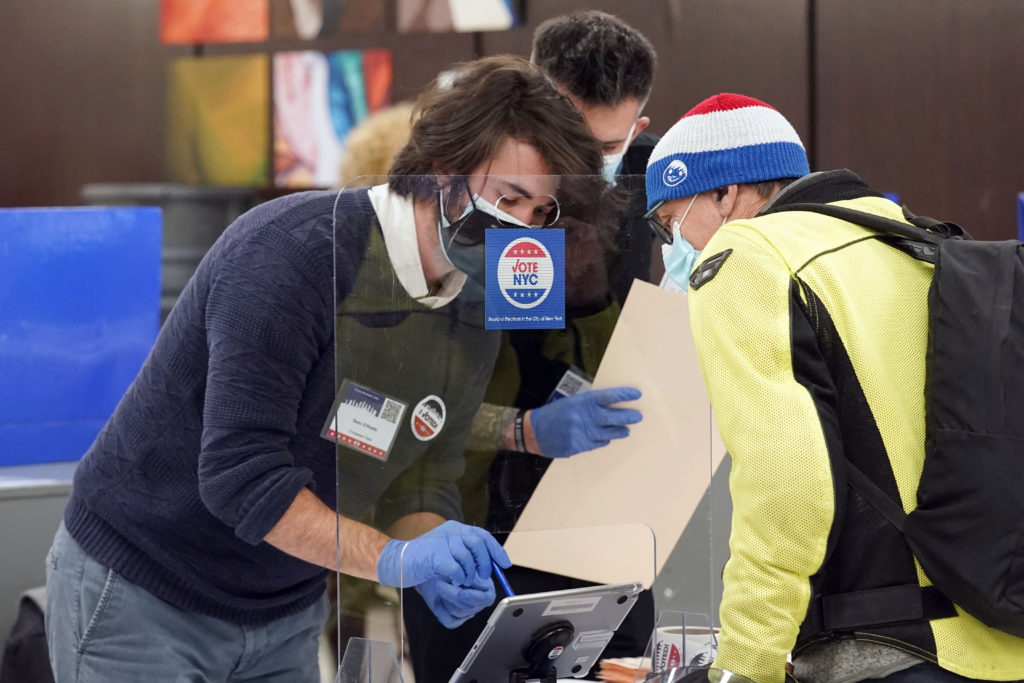
Despite painstaking efforts to keep election sites safe, some poll workers who came in contact with voters on Election Day have tested positive for the coronavirus, including more than two dozen in Missouri and others in New York, Iowa, Indiana, and Virginia. The infections cannot be tied definitively to polling places. Because COVID-19 is spreading rapidly in the U.S., there is no way to determine yet whether in-person voting on Election Day contributed to the surge, public health experts said. Still, the infections among poll workers raise concerns because of how many people passed through voting sites, which implemented social-distancing rules, erected protective barriers, and stocked sanitizer, masks, gloves, and other safety gear. In most places, poll workers were required to wear masks. The cases emerged while election workers continued counting thousands of ballots. As a hand tally of the presidential race began in Georgia, the state’s top election official placed himself under quarantine after his wife tested positive for the coronavirus. In Cedar Rapids, Iowa, which is in a county considered a national virus hot spot, an election official who worked an early voting site later tested positive. “I’m actually surprised that we don’t have more cases,” said Linn County Election Commissioner Joel Miller, who noted that several county workers in his building tested positive in the last week. “It actually seems kind of far-fetched that we didn’t have more, but they might not be reporting it to us.” Election workers in Jackson County, Missouri, which includes Kansas City, seem to be the hardest hit so far, with about 28 staffers testing positive in the past couple of weeks. Tammy Brown, head of the Jackson County Election Board, said her staffers urged voters who felt ill to avoid coming inside, though she suspects not everyone listened. The board dealt with nearly 200,000 voters, including more than 60,000 who cast early ballots. “We, as election officials, all knew we were at risk,” Brown said. “I don’t think this was shocking to any of us.” With transmission rates high in Missouri, health officials are not ready to link the cases to polling places. They say the workers could have become infected anywhere. The county offered drive-thru voting for people with COVID-19 or who were quarantining because of contact with someone who was infected. When part-time workers became ill, full-time election board staff worked the drive-thru line. It’s difficult to trace cases back to polling places because the virus manifests in different ways, and some people never get symptoms. Infections also are spiking as people gather with extended family or friends and return to more crowded public settings. The U.S. on Sunday surpassed 11 million confirmed COVID-19 cases, with the most recent million coming in less than a week, according to Johns Hopkins University. The virus has now killed more than 246,000 people in the United States, and the disease is spreading faster across the country than at any time since the pandemic started. While that spread increases the likelihood poll workers may have contracted the disease elsewhere, there have been calls for their co-workers to quarantine and voters to be tested as a precaution. In New York, more than 1,600 people who voted at a site in the Hudson Valley on Election Day have been advised to get tested after a poll worker tested positive. Officials said colleagues who had sustained contact with the worker will be tested, but they described the risk to voters as minimal because the person wore a mask, kept distance, and followed other safety measures. Similarly, officials in Virginia’s Carroll County said two poll workers in different precincts have tested positive. A health official said that because both were in their infectious periods on Election Day, testing has been offered to workers and voters. Virginia officials statewide had masks, face shields, gloves, hand sanitizer, and other supplies for polling places, and they trained people in safety practices, said Jessica Bowman, deputy commissioner of the Virginia Department of Elections. It could be several weeks before the effect of in-person voting nationwide is known. Polling places that used safety measures could have greatly minimized transmission rates, perhaps making them less risky than going to a restaurant with friends, said M. Kumi Smith, an assistant professor with the epidemiology division at the University of Minnesota. “A super-spreader event is a lot easier to identify when you’re still at an early stage of an epidemic or when there’s a really discrete event that’s really unlike anything else that anyone else is doing,” she said. “But given the real range of activities that are going on here, I would probably be a little bit more skeptical of someone who declares that this is definitively a super-spreading event.” No major reports of safety lapses or risky voting conditions have emerged. States had varying rules for masks. But even in places with mandates, officials balked at requiring face coverings while voting. Instead, they opted for a strong recommendation or offered options such as curbside voting or booths away from others. In Indiana, a poll worker who later tested positive did not show symptoms, practiced social distancing and “wore a mask at all times” on Election Day, said Bartholomew County Clerk Jay Phelps. As a precaution, seven colleagues are quarantining for two weeks. He said election officials spent a lot of time and money making polling places as safe as possible. Poll workers wore masks, and machines, tables, and doorknobs were constantly sanitized. “We worked really hard to make sure that every polling location had protocols in place,” Phelps said. Republished with the permission of the Associated Press.
What mandate? Joe Biden’s agenda faces a divided Congress
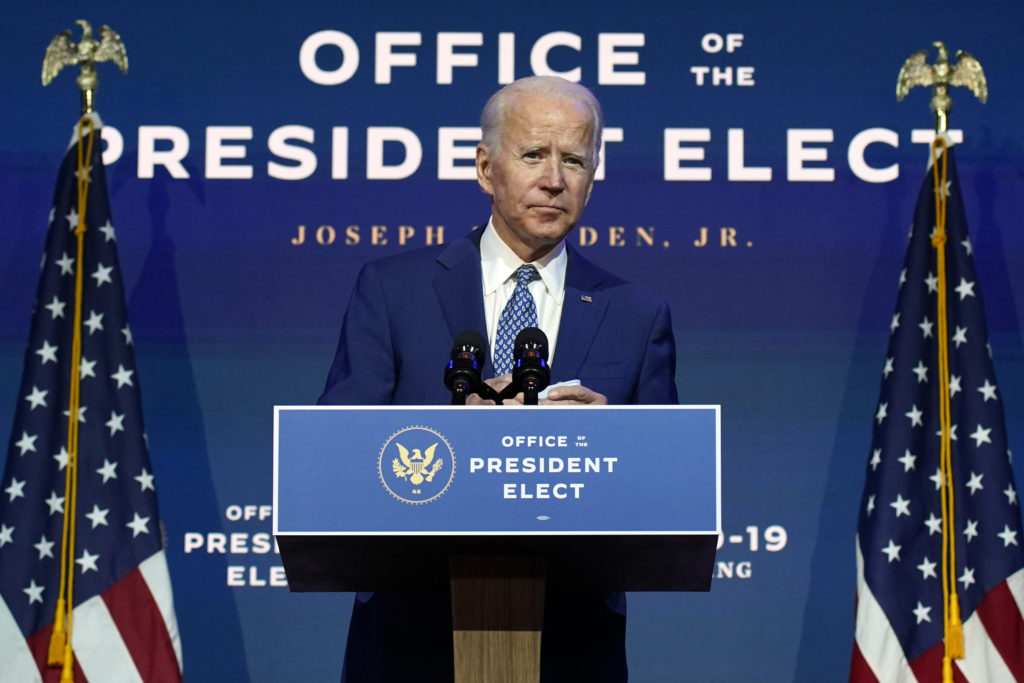
President-elect Joe Biden wants to “restore the soul of America.” First, he’ll need to fix a broken and divided Congress. Biden is rushing headlong into a legislative branch ground down by partisanship, name-calling and, now, a refusal by some to acknowledge his win over President Donald Trump. Democratic allies, struggling to regroup after their own election losses, harbor deep divisions between progressive and moderate voices. Republicans, rather than graciously congratulating the incoming president, are, intentionally or not, delegitimizing Biden’s presidency while catering to Trump’s refusal to accept the election results. At a time when the country needs a functioning government perhaps more than ever to confront the crises of COVID-19, a teetering economy and racial injustice, Washington is being challenged by the president-elect to do better than it has. It’s going to be a hard opening. “The country used to want gridlock because they saw gridlock as a way to protect them. Now the country’s actually hungry for action and progress,” said Jesse Ferguson, a Democratic strategist. “That’s a mandate to flip the switch.” The idea of a Biden mandate, though, is relative, certainly embraced by Democrats who want to push ahead with his agenda. Emboldened Republicans, though, who didn’t lose a single House seat, but in fact expanded their ranks and brushed back many Senate Democratic challengers, see their own mandate to serve as a block on a Biden agenda. California Rep. Kevin McCarthy, the House’s Republican leader, said the election “was a mandate against socialism,” stepping up the relentless GOP attacks, even though Biden is a centrist Democrat. Biden comes to the presidency like few in recent history, with a rare mix of experience but also a potentially divided Congress. Not since President George H.W. Bush has the White House had an executive with such a deep Washington resume. Rarely in modern times has a Democrat started an administration without a full Democratic Congress. While the House is in Democratic hands, the Senate remains undecided, a 50-48 lead for Republicans heading into a Jan. 5 runoff for two seats in Georgia that will determine party control. Asked this past week how he will be able to work with Republicans if they aren’t acknowledging his victory, Biden said, “They will.” What Biden is presenting is a new normal in Washington that he said voters demanded from the election. “If we can decide not to cooperate, then we can decide to cooperate,” he said at his election victory speech. Much has been made of Biden’s relationship with Capitol Hill, where he served as a senator for 36 years, particularly his deal-making as Barack Obama’s vice president with Senate Republican leader Mitch McConnell of Kentucky. Yet McConnell has not revived that approach as he enables Trump to delve into a legal battle rooted in unfounded allegations of voter fraud, even as state officials say the elections ran smoothly and there is no widespread evidence of fraudulent voting. McConnell won his own reelection in Kentucky. Whether McConnell emerges in the new Congress as majority or minority leader with a narrowly divided Senate, the longest serving Republican leader in history will have great leverage over legislation that arrives on Biden’s desk. Biden could seek a repeat of Newt Gingrich’s era when the Republican House speaker served up legislative victories for President Bill Clinton, infuriating Democrats with conservative budget and welfare bills but helping Clinton win a second term. Or Biden could find McConnell rerunning his politically charged GOP blockade of Obama’s agenda. Hopes of overcoming McConnell by ending the Senate filibuster, which would allow bills to advance on a simple majority rather than a 60-vote threshold, are slipping out of reach without Democratic control. “Gingrich insisted the American people wanted it,” said Rick Tyler, a former Gingrich top aide who left the Republican Party in the Trump era. He said McConnell will move on Biden’s agenda when Biden has the nation behind him. “That’s how you do it. Let’s see if Biden can do it,” he said. But it’s not just McConnell. House Speaker Nancy Pelosi, D-Calif., Senate Democratic leader Chuck Schumer of New York and even McCarthy will have oversize roles because of the changed makeup of the new Congress. Biden faces a restive liberal flank, powered by a new generation of high-profile progressives including Rep. Alexandria Ocasio-Cortez, D-N.Y., They helped deliver his victory and may not be so eager to compromise over health care, climate change, income inequality and racial justice issues that have growing popular support. At the same time, while Pelosi and Schumer have long histories with Biden, McCarthy is close to Trump, who is expected to hold a heavy influence on Republicans even after he leaves office. With a slimmer majority in the House, McCarthy’s ability to wrangle votes suddenly matters. “They can, but will they?” said Jim Kessler, a former Schumer aide and executive vice president at the center-left Third Way think tank. “This is a real veteran group of people. They know how to get things done. They know how to stop things from getting done.” An early test for Biden will be the Cabinet nominations, which can be approved by a slim 51 votes in the Senate. Republicans can also block nominees with time-consuming procedural hurdles that could quickly stall the new administration if top positions go unfilled. Democrats did as much to Trump, in some ways as payback after McConnell blocked Obama’s Supreme Court nominee Merrick Garland. “I think there’s a likelihood that Mitch McConnell will Merrick Garland every single Cabinet nominee and will force Joe Biden to negotiate on every single one,” said Sen. Chris Murphy, D-Conn. “Trump is still going to be running the Republican Party. And so, in reality, Joe Biden may have to negotiate every Cabinet pick with Donald Trump.” Republished with the permission of the Associated Press.
New judge for Montgomery’s municipal court
A municipal court vacancy in Alabama’s capital has been filled. Samarria Munnerlyn Dunson was sworn-in Friday to fill the seat in Montgomery, replacing Virgil Ford, WSFA-TV reported. Court Administrator Ken Nixon said Dunson is the fourth judge on the court and will serve a two-year term that is considered part-time. Nixon said the city may pursue having a second full-time judge in the future, but that it’s currently unnecessary due to the pandemic and limited dockets. Republished with the permission of the Associated Press.
