
Personnel update: EDPA names Miller Girvin to lead 60+ member group EDPA as EVP

The Economic Development Partnership of Alabama (EDPA) has hired Miller Girvin to serve as Executive Vice President of Innovation and Entrepreneurship. She will take the position in January 2021. According to their website, the EDPA ” is a private non-profit organization funded by more than 60 Alabama companies, whose mission is to attract and retain world-class talent across a broad spectrum of interests and industries, support and inspire both industry and innovative/emerging companies whether home-grown or transplanted, expand existing businesses, and be the trusted source for data and insights for key economic drivers and stakeholders for Alabama economic development.” Their website lists Alabama Power, Regions Bank, and Verizon as some of the many supporting organizations. Girvin is leaving her role as CEO of the Alabama Capital Network (ACN), a community engagement group she helped found in 2017. The Group’s mission is to support Alabama’s startup ecosystem, and she led ACN efforts to connect startups to capital networks, mentoring from successful entrepreneurs, and access to prospective customers. Her leadership and ability to promote innovation and assistance to Alabama’s entrepreneurial and startup community led Gov. Kay Ivey to name her as one of 15 members of the Alabama Innovation Commission. “My work at ACN has provided me with a unique perspective into our innovation ecosystem,” Girvin stated. “After years of working with entrepreneurs, investors, and policy-makers I have some very clear and targeted ideas on how we can continue to accelerate our entrepreneurial growth. I am excited to join EDPA to support and expand the already successful programs driving innovation in Alabama.” EDPA President Greg Barker said in a statement, “Miller joining EDPA will enable us to continue to elevate our work to support innovators and entrepreneurs throughout the State as we further position Alabama as an innovation hub. Her experience connecting early-stage entrepreneurs and investors for our state will be a vital asset to EDPA and the entire economic development community in Alabama.”
Vatican: OK to get virus vaccines using abortion cell lines
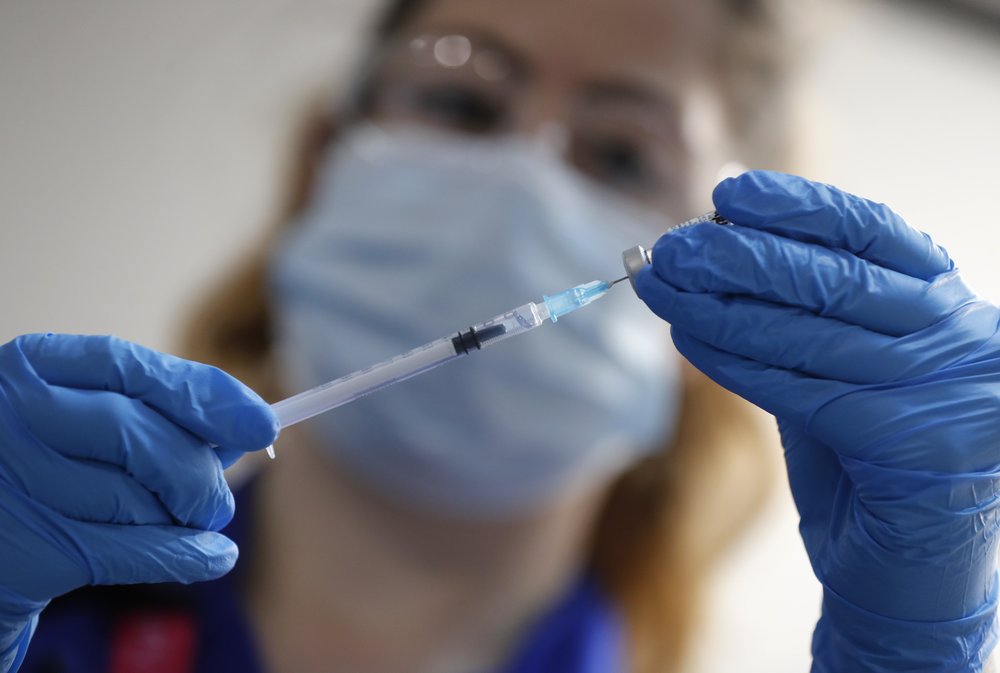
The Vatican on Monday declared that it is “morally acceptable” for Roman Catholics to receive COVID-19 vaccines based on research that used fetal tissue from abortions. The Congregation for the Doctrine of the Faith, the Vatican’s watchdog office for doctrinal orthodoxy, said it had received several requests for “guidance” during recent months. The doctrinal office pointed out that bishops, Catholic groups and experts have offered “diverse and sometimes conflicting pronouncements” on the matter. Drawing on Vatican pronouncements in past years about developing vaccines prepared from cells derived from aborted fetuses, the watchdog office’s statement was examined by Pope Francis, who ordered it to be made public. The Catholic Church’s teaching says that abortion is a grave sin. The Vatican concluded that “it is morally acceptable to receive COVID-19 vaccines that have used cell lines from aborted fetuses” in the research and production process when “ethically irreproachable” vaccines aren’t available to the public. But it stressed that the “licit” uses of such vaccines “does not and should not in any way imply that there is a moral endorsement of the use of cell lines proceeding from aborted fetuses.” The Vatican didn’t name any of the COVID-19 vaccines already being given to people in some countries or authorized to be used soon. In its statement, the Vatican explained that obtaining vaccines that do not pose an ethical dilemma is not always possible. It cited circumstances in countries “where vaccines without ethical problems are not made available to physicians and patients” or where special storage or transport conditions make their distribution more difficult. Much of the Vatican’s pronouncement had echoes in a statement last week by officials of the U.S. Conference of Catholic Bishops. The U.S. conference officials said that “in view of the gravity of the current pandemic and the lack of availability of alternative vaccines,” receiving the vaccines being distributed in the United States is justified “despite their remote connection to morally compromised cell lines.” Getting vaccinated against the coronavirus “ought to be understood as an act of charity toward the other members of our community,” the U.S. bishops conference officials said. Weeks earlier, two U.S. bishops, one in Texas and one in California, had denounced vaccines using cell lines from the tissue of aborted fetuses as immorally produced. One of the bishops said he refused to receive such a vaccine and encouraged rank-and-file Catholics to follow his lead. The Vatican, in reassuring faithful Catholics that getting a COVID-19 vaccine would not violate the church’s moral teaching, noted that while various vaccines might be distributed in a country, “health authorities do not allow citizens to choose the vaccine with which to be inoculated.” In those cases, it is morally acceptable to receive vaccines that have used cell lines from aborted fetuses, the Vatican said. The Vatican said the COVID-19 vaccines that are getting rolled out or are expected to be soon used cell lines “drawn from tissue obtained from two abortions that occurred in the last century.” The Vatican hasn’t said if and when Francis would be vaccinated against the coronavirus, nor which vaccine he might receive, The 84-year-old pontiff has a pilgrimage to Iraq planned for early March, and it’s widely expected that he and the aides accompanying him would get vaccinated ahead of travel abroad. The Roman Catholic church’s doctrinal orthodoxy office said “vaccination is not, as a rule, a moral obligation” and must be voluntary. Still, it said, from an ethical point of view, “the morality of vaccination depends not only on the duty to protect one’s own health but also on the duty to pursue the common good.” Those for reasons of conscience opting not to receive vaccinations produced by cell lines from aborted fetuses, “must do their utmost to avoid,” by appropriate behavior and preventive means, becoming “vehicles” for transmission, the congregation said. Republished with the permission of the Associated Press.
Congress seals agreement on $900 billion COVID relief bill

Top Capitol Hill negotiators sealed a deal Sunday on an almost $1 trillion COVID-19 economic relief package, finally delivering long-overdue help to businesses and individuals and providing money to deliver vaccines to a nation eager for them. The agreement, announced by congressional leaders, would establish a temporary $300 per week supplemental jobless benefit and a $600 direct stimulus payment to most Americans, along with a new round of subsidies for hard-hit businesses and money for schools, health care providers, and renters facing eviction. It came after months of battling and posturing, but the negotiating dynamic changed in Republicans’ favor after the election and as the end of the congressional session neared. President-elect Joe Biden was eager for a deal to deliver long-awaited help to suffering people and a boost to the economy, even though it was less than half the size that Democrats wanted this fall. House leaders informed lawmakers that they would vote on the legislation on Monday, and the Senate was likely to vote on Monday, too. Lawmakers were eager to leave Washington and close out a tumultuous year. “There will be another major rescue package for the American people,” Senate Majority Leader Mitch McConnell, R-Ky., said in announcing the agreement for a relief bill that would total almost $900 billion. “It is packed with targeted policies to help struggling Americans who have already waited too long.” Democrats acknowledged it wasn’t as robust a relief package as they initially sought — or, they say, the country needs. House Speaker Nancy Pelosi vowed more to come once President-elect Joe Biden takes office. “It is a first step,” she said. “We have to do more.” A fight over Federal Reserve emergency powers was resolved Saturday night by the Senate’s top Democrat, Chuck Schumer of New York, and conservative Republican Pat Toomey of Pennsylvania. That breakthrough led to a final round of negotiations Sunday. Still, delays in finalizing the agreement prompted the House to pass a one-day stopgap spending bill to prevent a government shutdown at midnight Sunday. The Senate was likely to pass the measure Sunday night as well. The final agreement would be the largest spending measure yet. It combined $900 billion for COVID-19 relief with a $1.4 trillion government-wide funding plan and lots of other unrelated measures on taxes, health, infrastructure, and education. The government-wide funding would keep the government open through September. Passage neared as coronavirus cases and deaths spiked and evidence piled up that the economy was struggling. The legislation had been held up by months of dysfunction, posturing and bad faith. But talks turned serious in recent days as lawmakers on both sides finally faced the deadline of acting before leaving Washington for Christmas. “This bill is a good bill. Tonight is a good night. But it is not the end of the story, it is not the end of the job,” Schumer told reporters. “Anyone who thinks this bill is enough does not know what’s going on in America.” The $300 per week bonus jobless benefit was one half the supplemental federal unemployment benefit provided under the $1.8 billion CARES Act in March and would be limited to 11 weeks instead of 16 weeks. The direct $600 stimulus payment to most people would also be half the March payment, subject to the same income limits in which an individual’s payment began to phase out after $75,000. The CARES Act was credited with keeping the economy from falling off a cliff amid widespread lockdowns this spring, but Republicans controlling the Senate cited debt concerns in pushing against Democratic demands. Republican politicians, starting with President Donald Trump, focused more on reopening the economy and less on taxpayer-financed steps like supplemental jobless benefits. Progress came after a bipartisan group of pragmatists and moderates devised a $908 billion plan that built a middle ground position that the top four leaders of Congress — the GOP and Democratic leaders of both the House and Senate — used as the basis for their talks. The lawmakers urged leaders on both sides to back off of hard-line positions. “We put our heads down and worked around the clock for nearly a month to produce a bipartisan, bicameral bill to address the emergency needs of our country,” the bipartisan group of about a dozen lawmakers said in a statement. “Our consensus bill was the foundation of this final package.” Republicans were most intent on reviving the Paycheck Protection Program with $284 billion, which would cover a second round of PPP grants to especially hard-hit businesses. Democrats won set-asides for low-income and minority communities. Late-breaking decisions would limit $300 per week bonus jobless benefits — one half the supplemental federal unemployment benefit provided under the CARES Act in March — to 11 weeks instead of 16 weeks as before. The direct $600 stimulus payment to most people would be half the March payment, subject to the same income limits in which an individual’s payment begins to phase out after $75,000. After the announcement, Schumer and Pelosi, D-Calif., announced additional details, including $25 billion in rental assistance, $15 billion for theaters and other live venues, $82 billion for local schools, colleges, and universities, and $10 billion for child care. The governmentwide appropriations bill would fund agencies through next September. That measure was likely to provide a last $1.4 billion installment for Trump’s U.S.-Mexico border wall as a condition of winning his signature. The bill was an engine to carry much of Capitol Hill’s unfinished business, including an almost 400-page water resources bill that targets $10 billion for 46 Army Corps of Engineers flood control, environmental and coastal protection projects. Another addition would extend a batch of soon-to-expire tax breaks, including one for craft brewers, wineries and distillers. It also would carry numerous clean energy provisions, $7 billion to increase access to broadband, $4 billion to help other nations vaccinate their people, $14 billion for cash-starved transit systems, Amtrak and airports. Democrats failed in a months-long battle to deliver direct fiscal relief to states
Donald Trump wants Supreme Court to overturn Pa. election results
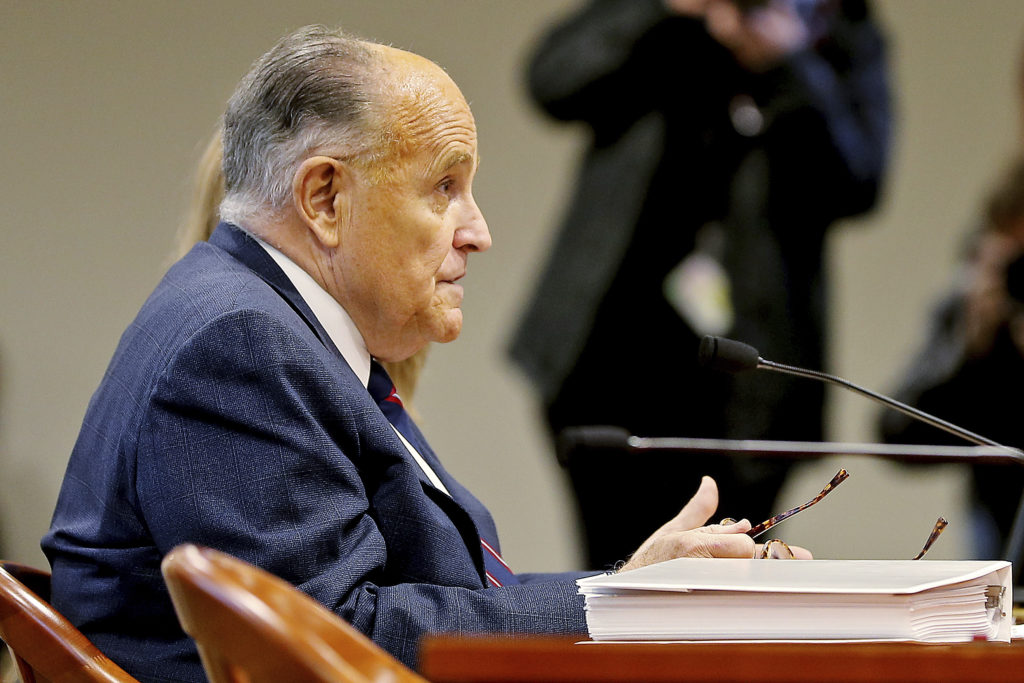
Undeterred by dismissals and admonitions from judges, President Donald Trump’s campaign continued with its unprecedented efforts to overturn the results of the Nov 3. election Sunday, saying it had filed a new petition with the Supreme Court. The petition seeks to reverse a trio of Pennsylvania Supreme Court cases having to do with mail-in ballots and asks the court to reject voters’ will and allow the Pennsylvania General Assembly to pick its own slate of electors. While the prospect of the highest court in the land throwing out the results of a democratic election based on unfounded charges of voter fraud is extraordinary unlikely, it wouldn’t change the outcome. President-elect Joe Biden would still be the winner even without Pennsylvania because of his wide margin of victory in the Electoral College. “The petition seeks all appropriate remedies, including vacating the appointment of electors committed to Joseph Biden and allowing the Pennsylvania General Assembly to select their replacements,” Trump attorney Rudy Giuliani said in a statement. He is asking the court to move swiftly so it can rule before Congress meets on Jan. 6 to tally the vote of the Electoral College, which decisively confirmed Biden’s win with 306 electoral votes to Trump’s 232. But the justices are not scheduled to meet again, even privately, until Jan 8, two days after Congress counts votes. Pennsylvania last month certified Biden as the winner of the state’s 20 Electoral College votes after three weeks of vote counting and a string of failed legal challenges. Trump’s campaign and his allies have now filed roughly 50 lawsuits alleging widespread voting fraud. Almost all have been dismissed or dropped because there is no evidence to support their allegations. Trump has lost before judges of both political parties, including some he appointed. And some of his strongest rebukes have come from conservative Republicans. The Supreme Court has also refused to take up two cases — decisions that Trump has scorned. The new case is at least the fourth involving Pennsylvania that Trump’s campaign or Republican allies have taken to the Supreme Court in a bid to overturn Biden’s victory in the state or at least reverse court decisions involving mail-in balloting. Many more cases were filed in state and federal courts. Roughly 10,000 mail-in ballots that arrived after polls closed but before a state court-ordered deadline remain in limbo, awaiting the highest court’s decision on whether they should be counted. The Trump campaign’s filing Sunday appears to target three decisions of Pennsylvania’s Democratic-majority state Supreme Court. In November, the state’s highest court upheld a Philadelphia judge’s ruling that state law only required election officials to allow partisan observers to be able to see mail-in ballots being processed, not stand close enough to election workers to see the writing on individual envelopes. It also ruled that more than 8,300 mail-in ballots in Philadelphia that had been challenged by the Trump campaign because of minor technical errors — such as a voter’s failure to write their name, address, or date on the outer ballot envelope — should be counted. In October, the court ruled unanimously that counties are prohibited from rejecting mail-in ballots simply because a voter’s signature does not resemble the signature on the person’s voter registration form. The Pennsylvania Republican Party has a pending petition on the state’s mail-in-ballot deadline in which the party specifically says in its appeal that it recognizes the issue will not affect the outcome of the 2020 election. Republished with the permission of the Associated Press.
Groups want water board members who will stop shutoffs

A group of civic organizations is asking Birmingham-area leaders to appoint new board members to the city’s water utility who will stop shutting off water for customers behind on their bills. The organizations are asking for Birmingham Water Works Board members who will resume a moratorium on shutoffs for overdue bills and set up 12-month income-driven repayment plans instead of shorter repayment plans over three to six months. The board resumed water shutoffs in October after an earlier pause because of the coronavirus pandemic. There were more 12,000 overdue accounts owing more than $7 million at that time, WBMA-TV reports, although some customers have since caught up. Rob Burton, executive director of SWEET Alabama, said charity groups can’t afford to cover the overdue bills. The group promotes sustainable use of energy, land, and water. “A lot of our children are taking school virtually and people are working at home so cutting off service to water in our home while our children do not have access to their public spaces and their schools, it’s going to further negatively impact our children,” Burton said. All nine board members’ terms expire at the end of the year, according to the board’s website. The Birmingham City Council appoints four members and Birmingham Mayor Randall Woodfin appoints two members. The Jefferson County Mayor’s Association, the Shelby County Commission, and the Blount County Commission each appoint one member. The utility provides drinking water to more than 600,000 customers in five counties. Burton said a short-term repayment plan can be like paying three water bills in a month for a resident. Burton said the board has not acted despite multiple meetings. In November, the board of directors voted to approve budgets that will not result in an increase in customers’ water rates for 2021. Republished with the permission of the Associated Press.
