
University of Alabama denies report it is under investigation for ties to Wuhan COVID lab
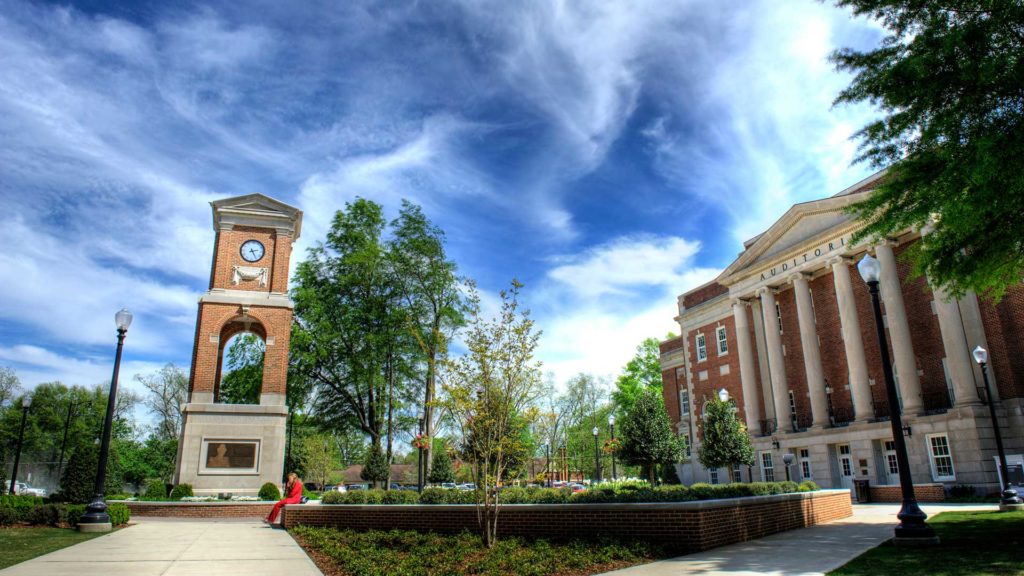
The University of Alabama is denying that it is under federal investigation for possible ties to the Wuhan Institute of Virology (WIV). Annie Mapp from ABC3340 reported on Twitter, “The University of Alabama is under investigation by the federal government for improper ties to China.” #NEW: The University of Alabama is under investigation by the federal government for improper ties to China. More information at the provided link.https://t.co/XH2vTUDjw3 — Annie Mapp (@AnnieMapp_) December 23, 2020 WIV, which is owned by the Chinese government’s Academy of Sciences, includes a maximum biocontainment laboratory that may be closely linked to the origin and/or spread of the Chinese COVID-19 virus. UA President Stuart Bell received the investigation notice from the federal government, asking for “a full report of statutorily defined gifts, contracts, and/or restricted and conditional gifts or contracts from or with a foreign source to the U.S. Department of Education (Department).” The letter stated, “It appears that UA has failed to report an alleged partnership with the Wuhan Institute of Virology (“WIV”), in Wuhan, China.” The university is listed on the Wuhan Institute of Virology website as a “partner”. The University responded to Mapp. She posted a Twitter update stating, “#UPDATE: The University of Alabama sent me the following statement.” #UPDATE: The University of Alabama sent me the following statement @abc3340 pic.twitter.com/pPnLHJznxJ — Annie Mapp (@AnnieMapp_) December 23, 2020 The school is denying any connections to the WIV, and stated that they contacted the institute and asked that UA be removed from their website. The school never received a response to that request.
Donald Trump pardons 15, commutes 5 sentences, including GOP allies
President Donald Trump on Tuesday pardoned 15 people, including a pair of congressional Republicans who were strong and early supporters, a 2016 campaign official ensnared in the Russia probe and former government contractors convicted in a 2007 massacre in Baghdad. Trump’s actions in his final weeks in office show a president who is wielding his executive power to reward loyalists and others who he believes have been wronged by a legal system he sees as biased against him and his allies. Trump issued the pardons — not an unusual act for an outgoing president — even as he refused to publicly acknowledge his election loss to Democrat Joe Biden, who will be sworn in on Jan. 20. Trump is likely to issue more pardons before then. He and his allies have discussed a range of other possibilities, including members of Trump’s family and his personal attorney Rudy Giuliani. Those pardoned on Tuesday included former Republican Reps. Duncan Hunter of California and Chris Collins of New York, two of the earliest GOP lawmakers to back Trump’s 2016 presidential campaign. Trump also commuted the sentences of five other people, including former Rep. Steve Stockman of Texas. Collins, the first member of Congress to endorse Trump to be president, was sentenced to two years and two months in federal prison after admitting he helped his son and others dodge $800,000 in stock market losses when he learned that a drug trial by a small pharmaceutical company had failed. Hunter was sentenced to 11 months in prison after pleading guilty to stealing campaign funds and spending the money on everything from outings with friends to his daughter’s birthday party. White House press secretary Kayleigh McEnany said the pardons for Hunter and Collins were granted after “the request of many members of Congress.” She noted that Hunter served the nation in the U.S. Marines and saw combat in both Iraq and Afghanistan. In the group announced Tuesday night were four former government contractors convicted in a 2007 massacre in Baghdad that left more than a dozen Iraqi civilians dead and caused an international uproar over the use of private security guards in a war zone. Supporters of Nicholas Slatten, Paul Slough, Evan Liberty, and Dustin Heard, the former contractors at Blackwater Worldwide, had lobbied for pardons, arguing that the men had been excessively punished in an investigation and prosecution they said was tainted by problems and withheld exculpatory evidence. All four were serving lengthy prison sentences. The pardons reflected Trump’s apparent willingness to give the benefit of doubt to American service members and contractors when it comes to acts of violence in war zones against civilians. Last November, for instance, he pardoned a former U.S. Army commando who was set to stand trial next year in the killing of a suspected Afghan bomb-maker and a former Army lieutenant convicted of murder for ordering his men to fire upon three Afghans. Trump also announced pardons for two people entangled in special counsel Robert Mueller’s Russia investigation. One was for 2016 campaign adviser George Papadopoulos, who pleaded guilty to lying to the FBI about a conversation in which he learned that Russia had dirt on Trump’s Democratic opponent, Hillary Clinton. The president also pardoned Alex van der Zwaan, a Dutch lawyer who was sentenced to 30 days in prison for lying to investigators during the Mueller probe. Van der Zwaan and Papadopoulos are the third and fourth Russia investigation defendants granted clemency. By pardoning them, Trump once again took aim at Mueller’s inquiry and advanced a broader effort to undo the results of the investigation that yielded criminal charges against a half-dozen associates. The pardons drew criticism from top Democrats. Rep. Adam Schiff, D-Calif., the chairman of the House Permanent Select Committee on Intelligence, said the president was abusing his power. “Trump is doling out pardons, not on the basis of repentance, restitution or the interests of justice, but to reward his friends and political allies, to protect those who lie to cover up him, to shelter those guilty of killing civilians, and to undermine an investigation that uncovered massive wrongdoing,” Schiff said. Last month, Trump pardoned former national security adviser Michael Flynn, who had twice pleaded guilty to lying to the FBI, and months earlier commuted the sentence of another associate, Roger Stone, days before he was to report to prison. Trump has granted about 2% of requested pardons in his single term in office — just 27 before Tuesday’s announcement. By comparison, Barack Obama granted 212 or 6%, and George W. Bush granted about 7%, or 189. George H.W. Bush, another one-term president, granted 10% of requests. Also among those pardoned by Trump was Phil Lyman, a Utah state representative who led an ATV protest through restricted federal lands. Lyman was serving as a Utah county commissioner in 2014 when he led about 50 ATV riders in a canyon home to Native American cliff dwellings that officials closed to motorized traffic. The ride occurred amid a sputtering movement in the West pushing back against federal control of large swaths of land and came in the wake of an armed confrontation Nevada rancher Cliven Bundy had with Bureau of Land Management over grazing fees. Lyman spent 10 days in prison and was ordered to pay nearly $96,000 in restitution. The Trump administration in 2017 lifted a ban on motorized vehicles in parts of the canyon but left restrictions in place through other areas where Lyman led his ride. Two former U.S. Border Patrol agents were also pardoned, Ignacio Ramos and Jose Compean, convicted of shooting and wounding a Mexican drug smuggler near El Paso, Texas, in 2005. Others on the list included a Pittsburgh dentist who pleaded guilty to health care fraud, two women convicted of drug crimes, and Alfred Lee Crum, now 89, who pleaded guilty in 1952 when he was 19 to helping his wife’s uncle illegally distill moonshine. Crum served three years of probation and paid a $250 fine. The White House
COVID-19 claims 3 more Alabama inmates, total deaths top 50
Three more Alabama inmates have died after contracting COVID-19, bringing the system’s total number of inmate deaths from the illness to more than 50, the Department of Corrections said. The deaths of Larry Gene Knight, 72; Dennis Guyton, 73; and Danny Charles Cunningham, 68, who all had other health problems, brought Alabama’s total number of inmate fatalities from the pandemic to 52, and two employees have died, according to department statistics. That ranks fifth in the country, tied with Kentucky, for the number of COVID-19 deaths per 10,000 inmates, according to figures compiled by The Associated Press and the Marshall Project. About 10% of the 10,858 Alabama inmates who have been screened for the new coronavirus have tested positive. The largest concentration of inmates sickened by the new coronavirus is at Bibb Correctional Facility, where 163 prisoners and 48 employees have tested positive. While the virus causes mild or moderate symptoms for most people, it can be deadly for people with serious underlying health problems and the elderly. Republished with the permission of the Associated Press.
U.S. hospitals facing worrisome shortage of nurses, doctors
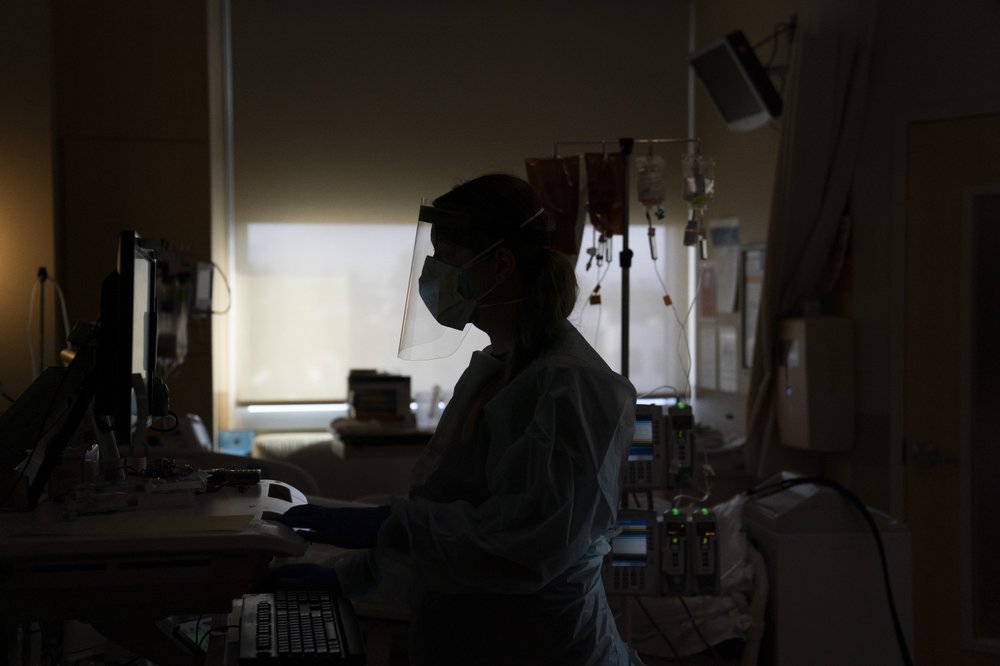
With so many states seeing a flood of coronavirus patients, U.S. hospitals are again worried about finding enough medical workers to meet demand just as infections from the holiday season threaten to add to the burden on American health care. California, which is enduring by far its worst spike in cases and hospitalizations, is reaching out to places like Australia and Taiwan to fill the need for 3,000 temporary medical workers, particularly nurses trained in critical care. “We’re now in a situation where we have surges all across the country, so nobody has many nurses to spare,” said Dr. Janet Coffman, a professor of public policy at the University of California in San Francisco. Hospitals in some states have enlisted retired nurses and students. In Alabama, more than 120 students and faculty members from the University of Alabama at Birmingham’s nursing school began helping with care last week at UAB Hospital. “I know our biggest concern is staff, even more concerned about that than physical beds and physical ICU units,” North Carolina Gov. Roy Cooper said Tuesday. Elected leaders and health officials across the U.S. are asking people to stay home for the holidays while also trying show the public that the COVID-19 vaccines trickling out to health care workers and nursing home residents are safe. A day after getting vaccinated on live television, President-elect Joe Biden said Tuesday that he has full confidence in the vaccine. He also thanked front-line workers, scientists, researchers, and clinical trial participants while urging Americans to avoid large gatherings over the Christmas holidays. Dr. Anthony Fauci, the nation’s top infectious disease expert, received the initial dose of the newest vaccine, produced by Moderna, alongside other federal health leaders who helped oversee its development. Fauci told “Good Morning America” on Tuesday that he expects to start vaccinating the general population in late March or early April and that most Americans will have access to the injections by mid-summer. Also on Tuesday, Dr. Deborah Birx, coordinator of the White House coronavirus response, said she planned to retire, but she is willing to first help Biden’s team as needed. Birx, in an interview with the news site Newsy, did not give a specific timetable on her plans. The medical worker staffing shortages are happening as some states report a record number of deaths. Both Mississippi and West Virginia surpassed their previous highs for virus deaths reported in a single day on Tuesday while Arizona saw its second-highest daily increase during the pandemic. South Carolina Gov. Henry McMaster tested positive for the virus and was to receive outpatient antibody treatment for “mild symptoms,” his office said Tuesday. In Tennessee, which is seeing the nation’s worst new COVID-19 infection surge per capita, the state health commissioner has warned that combining the Thanksgiving surge with another would “completely break our hospitals.” Deaths in Florida’s nursing homes doubled during the Thanksgiving holiday, according to statistics gathered by AARP. The rise drew concern from advocates also worried about gatherings over Christmas and other year-end celebrations. “There is nothing to celebrate. The national average is a catastrophe,” said Dave Bruns, the spokesperson for AARP Florida. Much of California has exhausted its usual ability to staff intensive care beds. All of Southern California and the 12-county San Joaquin Valley to the north have been out of regular ICU capacity for days. An emergency room physician in Los Angeles who helped set up a surge hospital last spring said there are no plans to reopen it. “There would be no way to staff it,” said Dr. Marc Futernick. California hospitals typically turn to staffing agencies during flu season, when they rely on travel nurses to meet patient care needs. But the pool of available travel nurses is drying up as demand for them jumped 44% over the last month, with California, Texas, Florida, New York, and Minnesota requesting the most extra staff, according to San Diego-based health care staffing firm Aya Healthcare. Dr. Mark Ghaly, California’s Health and Human Services secretary, said the state is “lucky to get two-thirds” of its requests for travel nurses fulfilled right now. It’s a sharp contrast from the spring when health care providers from California flew to New York to help their overworked colleagues. Ghaly said entire areas of California may run out of room even in surge capacity units “by the end of the month and early in January.” It’s trying to avoid that by opening makeshift hospitals in places like gymnasiums, tents, and a vacant NBA arena, and sending patients to parts of the state with empty beds. While larger hospital systems can stretch their staff, some smaller or unaffiliated hospitals do not have that ability and are a priority for state staffing assistance particularly with nurses and respiratory therapists, he said. Sara Houze, a traveling cardiac intensive care nurse from Washington, D.C., began a new assignment this week caring for COVID-19 patients on the brink of death in San Bernardino, about 60 miles (97 kilometers) east of Los Angeles. She said her online community of nurses is offering webinars about moral distress because many of them have had to change the way they care for patients. “The patients that aren’t yet intubated, and even the ones intubated, aren’t getting the kind of nursing care that I want to give them because our resources are so limited and time is taxed,” she said. “It’s really disheartening.” Republished with the permission of the Associated Press.
Steve Flowers: Republican majority in the U.S. Senate is more important to Alabama than the presidency
As this 2020 Presidential election year comes to a close, allow me to share some final thoughts on the results with you. As you might expect, with this being the year of one of the worst pandemic viruses in human history, it would have an effect on politics. Surprisingly, given the fact that people were told to not go out and be around others, you had a massive turnout nationwide. In Alabama, the voter turnout was unprecedented and record-breaking, especially among Republican voters. Donald Trump’s popularity in the state drove the turnout. He eclipsed his 62% landslide against Hillary Clinton. He garnered 63% of the amazing vote and provided coattails for Republican Tommy Tuberville and allowed the Coach to annihilate Democrat Doug Jones by a whopping 60 to 40 margin. This year’s vote confirms the fact that a Democrat cannot win a statewide race in the Heart of Dixie. If Democrat Doug Jones can outspend Republican Tuberville $25 million to $7 million, a 4 to 1 advantage, but only manage to get 40% of the vote, that ought to tell you something. Forty percent appears to be the maximum threshold for a well-financed, articulate Democrat in the state. Currently, we have 38 elected statewide officeholders in Alabama and all 38 are Republicans. Therefore, winning the Republican nomination for a statewide office in Alabama is tantamount to election. The nation is divided politically in a deep chasm. Most of rural, middle America in the Heartland of the country is colored Republican red. The East and West coast metropolitan states, primarily New York and California are liberal blue states. If you take out the large runup of votes in California for Democrat Joe Biden, then the race was close to being 50/50 between Trump and Biden. However, the national popular vote is irrelevant as we elect our president under an electoral college system. This election confirmed that there are 10 battleground states where the election is decided. In the other 40 states, the hay is in the barn. Alabama is reliably Republican, and California is solidly Democratic. Therefore, sophisticated, pinpoint campaigning is focused on Florida, Ohio, Michigan, Wisconsin, Pennsylvania, and now the sunbelt states of Arizona, North Carolina, and Georgia. Campaign strategists can even determine the zip codes, neighborhoods, and locales that will determine the outcome in these swing states. It was obvious that Democrats knew all along that the race would boil down to Michigan, Wisconsin, and especially Pennsylvania. Democrats had lost these three states by a razor-thin margin to Trump in 2016 and they were the reason Trump edged Hillary Clinton. The key to victory was turning out the Democratic African American vote in Philadelphia and Detroit. Early voting and especially mail-in voting helped accomplish this mission. Another proven political maxim applied, “Primarily, more people vote against someone than for someone.” More people voted against Donald Trump than voted for Joe Biden. One final thought on presidential politics. The national television networks are unabashedly and unashamedly biased. All of them, and polling may be dead. Very few people, especially Republicans, will trust poll numbers again. One final day poll had Biden beating Trump by 18 points in Wisconsin. He carried the state by less than 1%. More importantly for Alabama is that the Republican party will more than likely keep the majority in the United States Senate. In the Senate, the majority party makes the rules and gets all the committee chairmanships. Our Senior Senator, Richard Shelby, will retain the chairmanship of the Senate Appropriations Committee as well as Chairman of the subcommittee on Defense Appropriations. If you do not think federal defense dollars are important to Alabama, you best think again. No state in the nation benefits more from federal defense dollars than Alabama. Shelby’s prowess at bringing home the bacon to Alabama is legendary. His chairmanship of the Senate Appropriations Committee is probably Alabama’s number one economic engine. Therefore, Tuberville’s defeat of Jones was good for Alabama because it allowed for a Republican pickup over a Democrat and probably insured the Republican majority in the Senate. The current Senate count is 50 Republicans and 48 Democrats. There are two seats in Georgia that will be decided in Special Election runoffs on January 5. The Republicans will be favored to keep these two seats. In closing, for Alabama’s sake economically, it is more important that the U.S. Senate is majority Republican because of Richard Shelby than who won the presidency. See you next week. Steve Flowers is Alabama’s leading political columnist. His weekly column appears in over 60 Alabama newspapers. He served 16 years in the state legislature. Steve may be reached at www.steveflowers.us.
