
Red states on U.S. electoral map lagging on vaccinations
With coronavirus shots now in the arms of nearly half of American adults, the parts of the U.S. that are excelling and those that are struggling with vaccinations are starting to look like the nation’s political map: deeply divided between red and blue states. Out in front is New Hampshire, where 65% of the population age 18 and older has received at least one dose of the vaccine, according to the Centers for Disease Control and Prevention. Following close behind are New Mexico, Connecticut, Maine and Massachusetts at 55% or greater. All have a history of voting Democratic and supported President Joe Biden in the 2020 election. Meanwhile, at the bottom are five states where fewer than 40% have rolled up their sleeves for a shot. Four of them — Mississippi, Alabama, Louisiana and Tennessee — lean Republican and voted for Donald Trump last fall. The fifth is Georgia, which has a Republican governor and supported GOP presidential candidates for nearly three decades before narrowly backing Biden. The emerging pattern: Americans in blue states that lean Democratic appear to be getting vaccinated at more robust rates, while those in red Republican states seem to be more hesitant. “We can draw a conclusion that red states and voters that voted for Trump are going to be more difficult to vaccinate because we have real good survey data to support that,” said Dr. Howard Forman, a professor of public health and management at the Yale School of Medicine. A poll by The Associated Press-NORC Center for Public Affairs Research in late March found that 36% of Republicans said they will probably or definitely not get vaccinated, compared with 12% of Democrats. Similarly, a third of rural Americans said they were leaning against getting shots, while fewer than a fourth of people living in cities and suburbs shared that hesitancy. Forman cautioned that in most U.S. states, which receive vaccine shipments based on population, demand for the shot still exceeds supply. So it’s hard to know how many people are resisting until everyone wanting the shots gets them. But if states soon start seeing significant numbers of unfilled appointments with many people still unvaccinated, he said consequences could be serious. “We could see substantial outbreaks for a long time,” Forman said. “It will determine whether we go back to normal in some cases.” Past AP-NORC polls have shown more Republicans than Democrats say the government has exaggerated the threat posed by the virus. Republicans have also been more opposed to restrictions and mask-wearing. The CDC reports that nearly 121 million American adults — or 47% of the U.S. adult population — have received at least one coronavirus shot. California, the nation’s largest blue state, is slightly ahead of that pace, at 50%. The biggest red state, Texas, lags at less than 44%. How swiftly states are vaccinating doesn’t always correlate with how they vote. Deeply red South Dakota ranks among the most successful states, with 54% of its population getting injections. Among blue states, Nevada lags furthest behind the U.S. at less than 44%, followed by Oregon and Michigan at 45% each. New Hampshire, which leads the nation in adult vaccinations, has a Republican governor and a GOP-controlled Legislature. However, Democrats hold all of its seats in Congress and the state has consistently Democratic in every presidential election since 2008. West Virginia, where Trump carried 66% of the vote last year, became an early success story in the vaccine rollout as the first U.S. state to cover all nursing homes. But while Republican Gov. Jim Justice has remained a vaccine cheerleader, West Virginia now lags the U.S. overall with less than 42% of its population receiving at least one dose. Among those who say they won’t get vaccinated is 58-year-old Martha Brown. Sitting outside her apartment complex in Charleston, West Virginia, Brown said she’s afraid of having a bad reaction after a flu shot last year left her with cold symptoms. “I’m OK without it,” Brown said. “I wear my mask all the time.” Experts said it’s too soon to tell whether pausing shots of the single-dose Johnson & Johnson vaccine will increase reluctance to get vaccinated. Government scientists are investigating reports of unusual blood clots in six women who received the vaccine. If the issue gets resolved quickly and it’s deemed safe to resume Johnson & Johnson shots, there should be little impact on public confidence, said Claire Hannan, executive director of the Association of Immunization Managers. She hopes the response itself assures people “the system is working.” “It’s really important to understand that’s how closely we monitor everyone getting the vaccine” for potential problems, Hannan said. “We have systems in place to connect the dots.” In a suburb outside Chicago, Jennifer Rockwood was getting ready to get her Johnson & Johnson shot Tuesday morning when she heard about the recommended pause. She canceled her appointment after waiting months to get the vaccine. “Did it give me hesitancy? Yes it did,” said Rockwood, 49. “But I was immediately back at my kitchen counter flipping the laptop open again and seeing what I could do to schedule another one.” She booked an appointment to get the Pfizer vaccine Wednesday. Trump has publicly urged Americans to get vaccinated but also received his own injections secretly, disclosing them only after he left office. As president, he spent much of the pandemic minimizing the dangers of the virus, even after being hospitalized with COVID-19. Some Republican governors have likewise kept their own vaccinations quiet. In Florida, where about 44% of the population has gotten at least one shot, it wasn’t disclosed that GOP Gov. Ron DeSantis got the single-dose Johnson& Johnson vaccine until a reporter asked the governor’s spokeswoman days later. Many other U.S. governors have gotten their shots on camera or held news conferences around them in an effort to assure people the vaccines are safe. The Democratic governor of Kentucky, a Trump-voting state, is trying to persuade more people to get jabbed by promising to lift pandemic restrictions when
3rd person arrested in stolen Confederate monument case
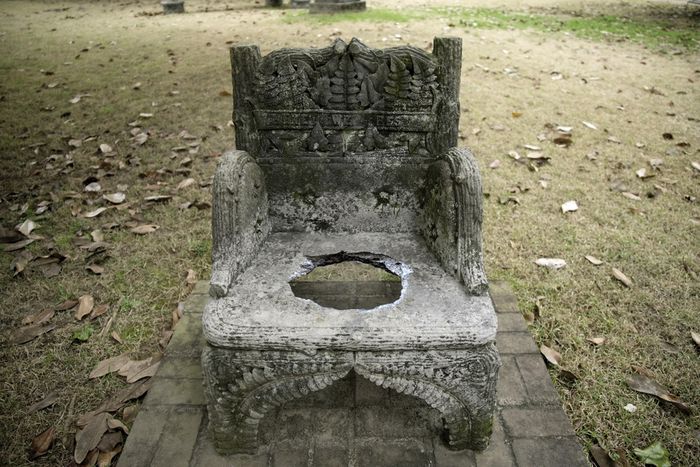
A third person has been arrested in connection with a stolen Confederate monument, New Orleans police said. Stanley Pate turned himself in Friday after being wanted in connection for possession of stolen property, the New Orleans Police Department said. Jason Warnick and Kathryn Diionno were arrested earlier. The chair-shaped monument was recovered in New Orleans after it was taken last month from a cemetery in Selma, Alabama. Someone later sent an email signed “White Lies Matter” claiming responsibility, and then sent fake photos pretending the chair had been turned into a toilet. Lawyers representing Warnick and Diionno said in a statement that the pair are innocent. It is not immediately known if Pate has a lawyer to comment. The monument has since been returned to the United Daughters of the Confederacy. Republished with the permission of the Associated Press.
Proposal in Alabama to up protection for Confederate statues
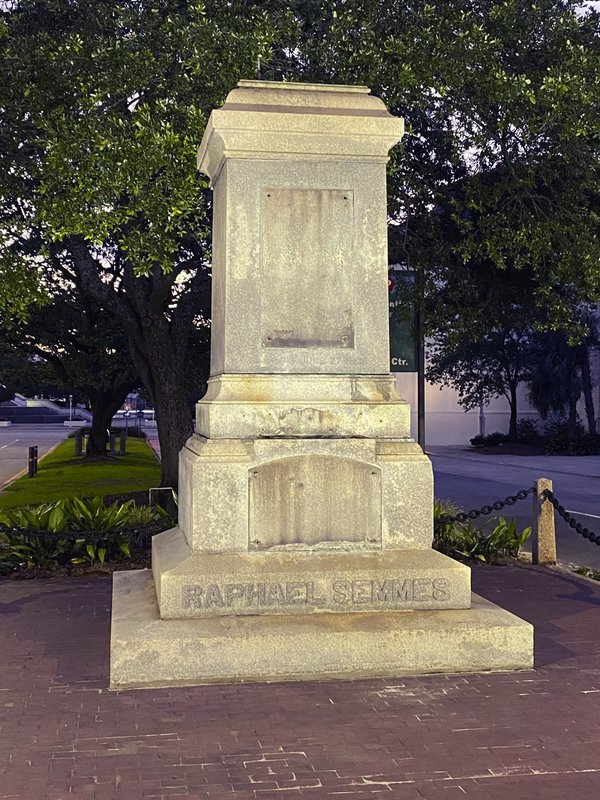
An Alabama lawmaker who disputes that slavery was the cause of the Civil War has proposed fining cities $10,000 a day for taking down Confederate and other longstanding monuments, a bill that drew contentious debate on Wednesday. The House State Government Committee held a public hearing on the bill by Republican Rep. Mike Holmes of Wetumpka that would dramatically increase fines for violating the 2017 Memorial Preservation Act. Current law levies a flat $25,000 fine, which some cities have paid as a cost of removing controversial monuments to other locations. “It’s a deterrent. The citizens of Alabama are upset at the damaging and destroying of these monuments,” Holmes said after the meeting. Holmes said he brought the bill as cities and counties began removing Confederate emblems. The bill drew heated debate as Black lawmakers described why the monuments are viewed as offensive. Some speakers at the public hearing claimed that the Civil War was not about slavery, a notion that is contrary to the widely accepted view that it was the root cause of the conflict. “Some of these monuments are a disgrace to some of us,” said Rep. Rolanda Hollis, a Black Democrat from Birmingham. “People that look like me, they were kidnapped. They were raped. They were beaten and nothing was done about it.” Holmes on Wednesday, and earlier this session, said he did not believe the Civil War was about slavery. Several speakers in favor of the bill repeated that view, which drew a sharp rebuke from some Black lawmakers. “It further shows white supremacy,” Democratic Rep. Juandalynn Givan, D-Birmingham, said of Holmes’ bill. “Why would you fine somebody $10,000 a day? That is ludicrous. But yet you say you are here for the people. And then you don’t know why the freaking war was fought,” Givan said, adding that “maybe they need to get a book and read.” The House Judiciary Committee earlier rejected a bill by Givan that would let cities and counties move the monuments to another location, such as a local park or state agency land, for preservation. The local governments would have to pay for the relocation. Committee Chairman Chris Pringle said it he was not sure when the bill will get a committee vote. Holmes told reporters Wednesday that he did not believe the Civil War was about slavery. “It was a tax thing. Tariffs going in and out of the ports,” Holmes said. Asked about Alabama’s 1861 Articles of Secession that says Alabama wanted to form a new government with other slave states, Holmes replied, “I’ve never seen that. Do you have proof of that?” After being shown the document on the Alabama’s bicentennial website, Holmes said he didn’t read it that way. “It is the desire and purpose of Alabama to meet the slaveholding state of the South who may approve such purpose in order to frame a provisional as well as Permanent Government upon the Principles of the Constitution of the United States,” the document reads. Historian Wayne Flynt, a former Auburn University history professor and the author of more than a dozen books, including co-writing “Alabama: A History of a Deep South State, said that slavery was the “key to the Civil War” but he said white southerners sometimes resisted that because they don’t want to admit their ancestors would fight to maintain slavery. “Coming to terms with history is something that we don’t do well in Alabama. Coming to terms with history admits that slavery was morally wrong, that it was a travesty of Christianity and therefore we could not possibly have done that,” Flynt said. “I’m sorry I’m not still teaching Alabama history because I would enroll them for free in my class,” Flynt quipped. Republished with the permission of the Associated Press.
Senate approves casino and lottery legislation

The Alabama Senate on Tuesday night approved sweeping lottery and casino legislation as lawmakers struck a compromise after years of stalemates on the issue of gambling. Senators voted 23-9 for the proposed constitutional amendment that would establish a state lottery as well as allow nine casino sites in the state. The bill now moves to the Alabama House of Representatives. If approved by lawmakers in both chambers, the proposal would then go before voters. “We have done a monumental job in overcoming something that has been haunting this body for as long as I’ve been here,” Republican Sen. Jim McClendon, the sponsor of the bill, said after the vote. McClendon emphasized Alabama voters will have the final say on the matter. “What we are really okaying is the right for our constituents to come to the voting booth and decide if they like this or not,” McClendon said. If approved he said people “don’t have to drive to Georgia to buy a dadgum lottery ticket.” The bill is similar to a proposal that failed by two votes earlier this session but includes new provisions such as putting the casino licenses up for bid. Casino and sports betting sites would be located in Jefferson County, Mobile County, Macon County, Greene County, Houston County, and either Jackson or DeKalb counties as well at the three sites owned by the Poarch Band of Creek Indians. The casino licenses would be put out for bid, but the existing dog tracks and electronic bingo operations, such as Greenetrack and VictoryLand dog tracks, would be given an advantage in trying to win the bid. The existing operators will be given the opportunity to come in and make a final bid to exceed the highest bidder to win the license in their respective county. The Poarch Creeks will have the right for the final bid for the north Alabama site in either Jackson or DeKalb counties. McClendon said the state would get the benefit of a “high bid” but the existing sites “get a chance to stay in the game… and keep the job for their employees and keep their operations going.” Lawmakers also approved several pieces of enabling legislation. Senate President Pro Tem Greg Reed said having those details locked down helped pick up the additional votes. Lottery proceeds would be used for education purposes, including a college scholarship program. The state would place a 20% tax on net casino and sports betting revenue. The first $750 million of gaming revenue would be put toward broadband infrastructure in the state. Alabama is one of five states without a state lottery. Alabama voters in 1999 rejected then-Gov. Don Siegelman’s proposed state lottery, but lawmakers in both parties say they believe voters are now more welcoming to the idea. The approval came after two other gambling bills stalled this session in the Senate and years of debate over the issue. Sen. Greg Albritton said lawmakers have tried to reach a compromise on the legislation. “The road and the path that we’ve had to get to this point of having this bill before us has been a difficult and tortuous one,” Albritton, R-Atmore said. Republished with the permission of the Associated Press.
