Alabama participates in cyber exercise to help protect elections
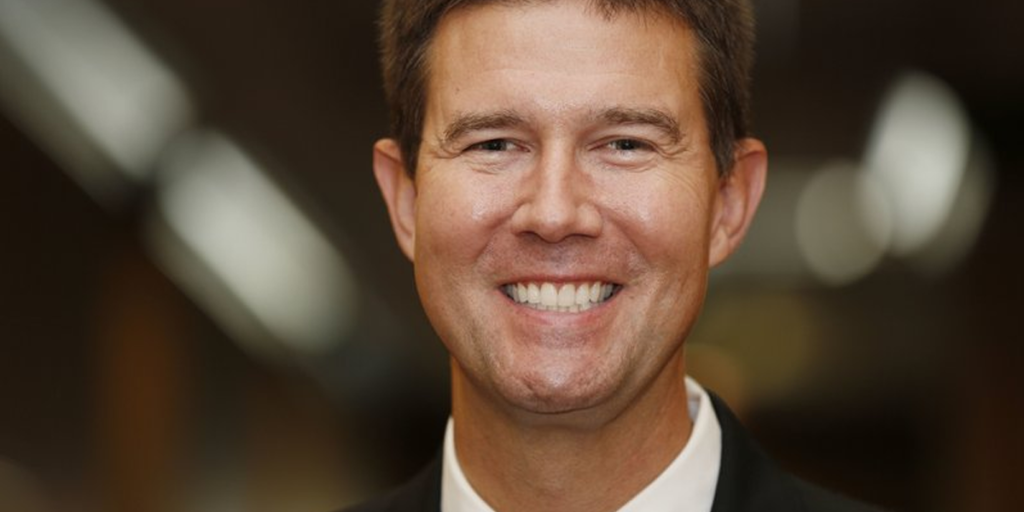
Secretary of State John Merrill announced yesterday that Alabama had participated in a program called Tabletop the Vote earlier in the month. It is a program run by the Cybersecurity and Infrastructure Security Agency (CISA), the National Association of Secretaries of State (NASS), and the National Association of State Election Directors (NASSED). It was created to help prepare election officials and state agencies for any cyber or physical incident that could occur during an election. An annual exercise, the session provides the opportunity for election leaders to stress test protocols and practice communication strategies during an election. Officials learn how to plan, prepare, and respond to emergency situations by working through modules that help identify strengths and weaknesses within the election process. Marty Redden, Secretary for the Office of Information Technology, stated, “The value of these exercises cannot be overstated. It allows us to refine and test our processes with both state and federal partners in a controlled environment. These exercises allow all participants to openly communicate ideas and risks, while improving our readiness prior to a real election.” “Alabama was excited to participate in such a proactive and engaging assembly that helps our state to continue to conduct the best elections possible. These learning experiences contribute to our plans to be able to execute the most safe and secure elections in the nation,” commented Secretary of State John Merrill.
Jerry Carl joins Terri Sewell in supporting Disaster Reforestation Act
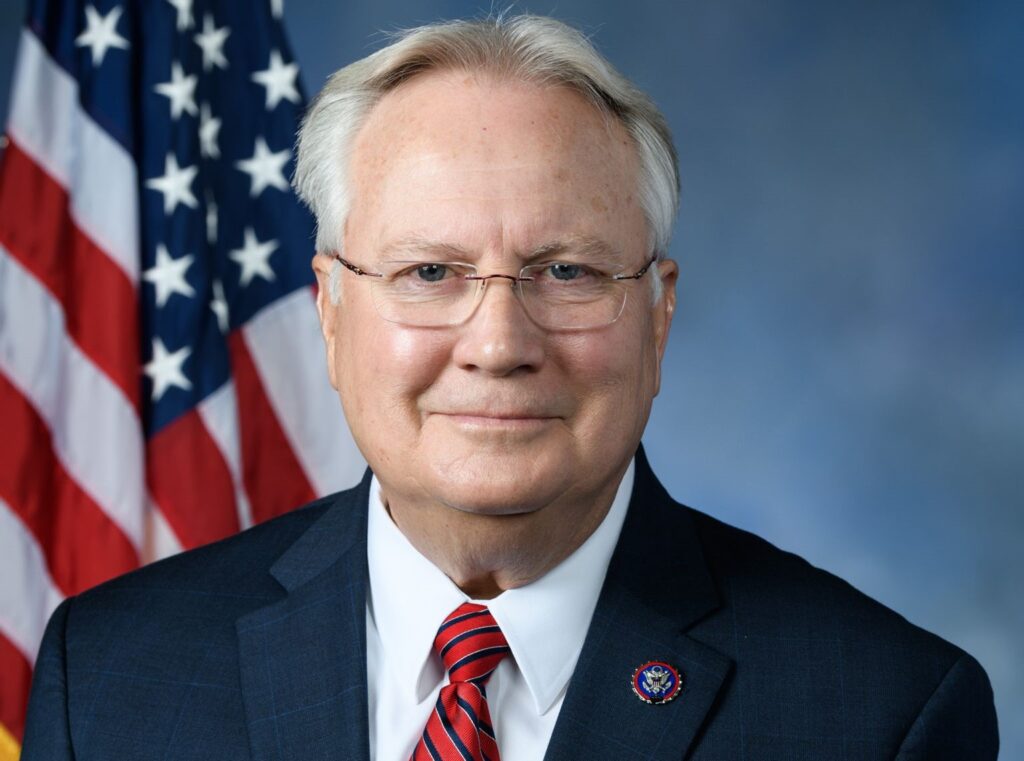
Congressman Jerry Carl announced his sponsorship of the Disaster Reforestation Act of 2021, which is bipartisan legislation to help timber growers recover from timber loss caused by natural disasters. Introduced by Terri Sewell and Buddy Carter in June, the bill would let private forest owners deduct the value of destroyed timber on their taxes after a natural disaster such as hurricanes and tornadoes while making it easier for timber owners to recover and reforest after a natural disaster. Carl stated, “South Alabama is home to more than 500,000 acres of privately-owned forests, which support 2,000 jobs in the district, so it is critical we amend the tax code to help Alabama’s private forest owners recover and reforest after natural disasters. Working forests create good-paying, sustainable jobs, which are necessary for a stable lumber market and create a natural solution to protect our environment. I urge my colleagues on both sides of the aisle to support this important legislation.” Sewell posted on Twitter, “Our beautiful Alabama forests keep our economy, environment, and people healthy. We must ensure that our tax code helps forest landowners recover after devastating natural disasters.”
Kevin McCarthy proposes 5 Republicans to sit on Jan. 6 panel
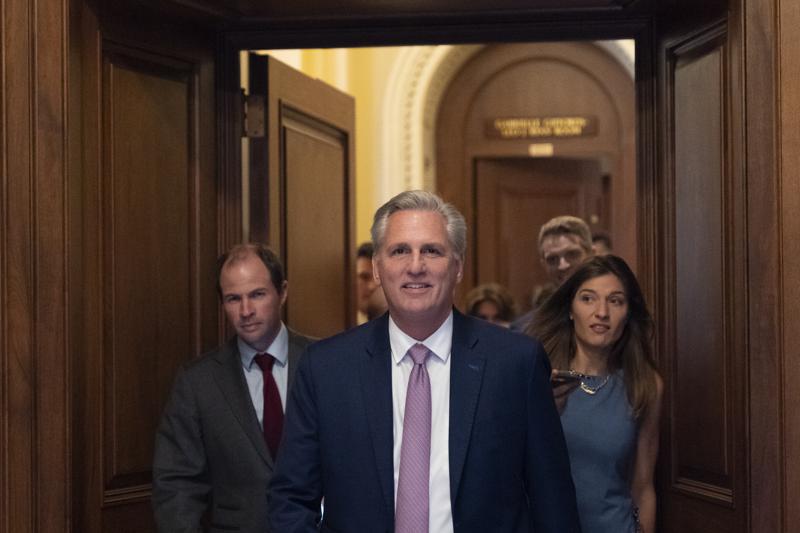
House Republican leader Kevin McCarthy has picked five Republicans to sit on the new select committee to investigate the Jan. 6 insurrection at the Capitol, signaling that Republicans will participate in the investigation that they have staunchly opposed. McCarthy said Monday that he had selected Indiana Rep. Jim Banks, who recently visited former President Donald Trump on trips to the U.S.-Mexico border and Trump’s New Jersey golf club, to be the top Republican on the panel. The Republican leader also tapped Ohio Rep. Jim Jordan, Illinois Rep. Rodney Davis, North Dakota Rep. Kelly Armstrong, and Texas Rep. Troy Nehls to serve on the committee. House Speaker Nancy Pelosi must approve the names before they are final, per committee rules. An aide to Pelosi said she had received notification from McCarthy, but it is unclear when or if she will approve the GOP members. The aide was granted anonymity to discuss the Republican picks ahead of an official announcement. The five Republican men selected by McCarthy have all backed Trump, whose supporters laid siege to the Capitol building on Jan. 6 and interrupted the certification of President Joe Biden’s victory. Banks, Jordan, and Nehls all voted to overturn Biden’s win that day, even after the rioting. Davis and Armstrong were among the minority of Republicans who voted to certify Biden’s win. McCarthy’s picks come after all, but two Republicans opposed the creation of the 13-person select committee in a House vote last month, with most in the GOP arguing that the majority-Democratic panel would conduct a partisan probe. House Democrats originally attempted to create an evenly split, independent commission to investigate the insurrection, but that effort fell short when it was blocked by Senate Republicans. House Republicans have largely remained loyal to Trump despite the violent insurrection of his supporters that sent many of them running for their lives. Banks made clear in a statement Monday evening that he would take a politically combative approach to his leadership on the panel, sharply criticizing the Democrats who had set it up. “Make no mistake, Nancy Pelosi created this committee solely to malign conservatives and to justify the Left’s authoritarian agenda,” Banks said. Jordan, one of Trump’s staunchest defenders through his two impeachments and the top Republican on the House Judiciary Committee, said after the House vote to form the panel that he believed the investigation is “impeachment three” against the former president. Trump was impeached by the House and acquitted by the Senate both times. The members selected by McCarthy had mixed reactions to the insurrection as it happened on Jan. 6. While Jordan led the effort to overturn election results, others tweeted to the rioters to end the violence or condemned it. “Thank you to the Capitol police and all law enforcement,” Armstrong tweeted shortly after the House was evacuated that afternoon. “Rioting is not protesting. This needs to stop. Now.” Around the same time, Davis tweeted: “This is a sad day for our country. The lawlessness has got to stop. Protestors must leave the Capitol so Congress can resume the process of confirming the Electoral College vote.” Nehls, a former sheriff, was one of several members who helped barricade the House doors as rioters tried to beat them down. He tweeted an Associated Press photo of himself holding the door alongside Capitol Police — face to face with rioters who had broken the glass in the entryway. “I was proud to stand shoulder to shoulder with Capitol police barricading entrance to our sacred House chamber while trying to calm the situation talking to protestors,” Nehls tweeted. “What I’m witnessing is a disgrace. We’re better than this. Violence is NEVER the answer. Law and order!” A week later, all five members voted against the impeachment of Trump, who had told his supporters gathered in Washington on Jan. 6 to “fight like hell” to overturn his election defeat. The Democratic chair of the select committee, Mississippi Rep. Bennie Thompson, said Monday evening that he hadn’t seen the GOP names but referred the matter to Pelosi. “It’s up to her,” he said. Pelosi named eight members of the committee earlier this month — seven Democrats and Republican Rep. Liz Cheney of Wyoming, who has strongly criticized Trump and has been the most outspoken member of her caucus against the insurrection. Cheney, who was demoted from GOP leadership in May over her comments, was one of the two Republicans who voted in favor of forming the committee, along with Illinois Rep. Adam Kinzinger. As McCarthy stayed quiet for weeks on Republican participation on the panel, Thompson has said that the committee will have a quorum to conduct business whether GOP members are present or not. The new members will be put to the test at the panel’s first hearing next week, with at least four rank-and-file police officers who battled rioters that day testifying about their experiences. Dozens of police officers were injured as the crowd pushed past them and broke into the Capitol building. Seven people died during and after the rioting, including a woman who was shot by police as she tried to break into the House chamber and three other Trump supporters who suffered medical emergencies. Two police officers died by suicide in the days that followed, and a third officer, Capitol Police Officer Brian Sicknick, collapsed and later died after engaging with the protesters. A medical examiner determined he died of natural causes. Republished with the permission of the Associated Press.
Canada to let vaccinated U.S. citizens enter country on August 9

Canada announced Monday it will begin letting fully vaccinated U.S. citizens into Canada on Aug. 9, and those from the rest of the world on Sept. 7. Officials said the 14-day quarantine requirement will be waived as of Aug. 9 for eligible travelers who are currently residing in the United States and have received a full course of a COVID-19 vaccine approved for use in Canada. Public Safety Minister Bill Blair, who said he spoke with U.S. Homeland Security Secretary Alejandro Mayorkas on Friday, said the U.S. has not yet indicated any plan to change current restrictions at the land border. Canadians are able to fly into the United States with a negative COVID-19 test. Asked in Washington if the U.S. would reciprocate, White House press secretary Jen Psaki said, “We are continuing to review our travel restrictions. Any decisions about resuming travel will be guided by our public health and medical experts. … I wouldn’t look at it through a reciprocal intention.” U.S. Democratic Congressman Brian Higgins, whose district includes Buffalo and Niagara Falls, said the U.S. has “neglected to give reopening the northern border the serious attention it deserves, and there is no excuse.” Canadian officials also announced that children who aren’t vaccinated but are traveling with vaccinated parents won’t have to quarantine but will have to avoid group activities, including schools and daycare centers. Transport Minister Omar Alghabra also said a ban on direct flights from India will be extended to Aug. 21 because of the delta variant. “The situation in India is still very serious,” he said. Prime Minister Justin Trudeau said last week that Canada could start allowing fully vaccinated Americans into the country as of mid-August for nonessential travel and should be in a position to welcome fully vaccinated travelers from all countries by early September. Canada leads G20 countries in vaccination rates, with approximately 80% of eligible Canadians vaccinated with their first dose and over 50% of those eligible fully vaccinated. “This weekend, we even passed the U.S. in terms of fully vaccinated people,” Trudeau said. “Thanks to the rising vaccination rates and declining COVID-19 cases, we are able to move forward with adjusted border measures.” Reopening to the U.S first is a “recognition of our unique bond, especially between border communities,” Trudeau said. In the early days of the pandemic, the U.S. and Canadian governments closed the more than 5,500-mile (8,800-kilometer) border to nonessential traffic. With increasing vaccination rates and dropping infection rates, some were annoyed the two governments hadn’t laid out plans to fully reopen the border. Canada began easing its restrictions earlier this month, allowing fully vaccinated Canadians or permanent legal residents to return to Canada without quarantining. But among the requirements are a negative test for the virus before returning and another once they get back. Pressure has been mounting on Canada to continue to ease the restrictions at the border, which have been in effect since March 2020. Providing exemptions for travel into Canada amid the pandemic is politically sensitive, and Trudeau is expected to call a federal election next month. Canadian officials have said they would like 75% of eligible Canadian residents to be fully vaccinated before loosening border restrictions for tourists and business travelers. The Canadian government expects to have enough vaccines delivered for 80% of eligible Canadians to be fully vaccinated by the end of July. The U.S. only allowed for exports of vaccines into Canada in early May. Commercial traffic has gone back and forth normally between the two countries since the start of the pandemic. The U.S. Travel Association estimates that each month the border is closed costs $1.5 billion. Canadian officials say Canada had about 22 million foreign visitors in 2019 — about 15 million of them from the United States. Republished with the permission of the Associated Press.
Capitol rioter who breached Senate gets 8 months for felony
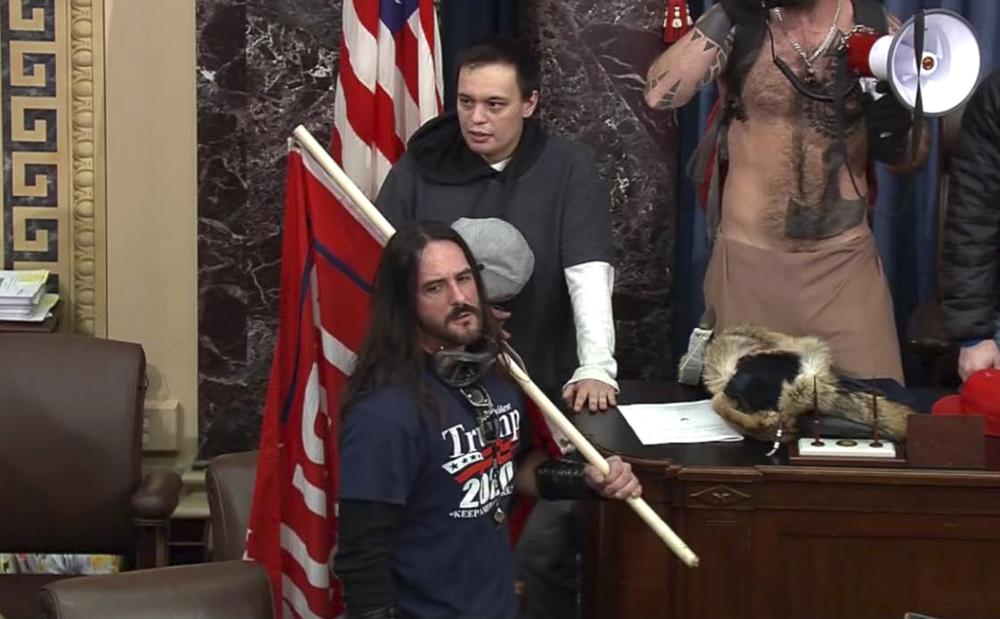
A Florida man who breached the U.S. Senate chamber carrying a Trump campaign flag was sentenced Monday to eight months behind bars, the first punishment handed down for a felony charge in the Jan. 6 Capitol riot and one that could help determine the severity of other sentences in hundreds of pending cases. In pronouncing the sentence on Paul Allard Hodgkins, U.S. District Judge Randolph Moss said the 38-year-old had played a role, if not as significant as others, in one of the worst episodes in American history. Thousands of rioters loyal to then-President Donald Trump stormed the Capitol and disrupted the certification of Joe Biden’s election win, in a stunning display of public violence. “That was not, by any stretch of the imagination, a protest,” Moss said. “It was … an assault on democracy.” He added: “It left a stain that will remain on us … on the country for years to come.” Moss acknowledged Hodgkins’ sentence could set a benchmark for future cases. And deciding an appropriate punishment was made more challenging because the case is unique and the court couldn’t look to previous sentencings as a guide. More than 500 people have been charged so far for their participation in the attack, and many like Hodgkins were accused of serious crimes but were not indicted, as some others were, for roles in larger conspiracies. They will have to decide whether to plead guilty or go to trial. Moss interrupted Hodgkins’ attorney, Patrick Leduc, to ask if granting the defense request to spare Hodgkins from prison could encourage others disgruntled by the results of a future election to besiege the Capitol. “If we allow people to storm the United States Capitol, what are we doing to preserve our democracy?” Moss asked. But the judge said Hodgkins deserved a lesser sentence than the 18 months prosecutors had requested, in part because he didn’t assault anyone, didn’t damage government property, and wasn’t among the lead attackers. Hodgkins apologized to the court and said he felt ashamed. Speaking calmly from a prepared text, he described being caught up in the euphoria as he walked down Washington’s most famous avenue, then followed a crowd of hundreds into the Capitol. “If I had any idea that the protest … would escalate (the way) it did … I would never have ventured farther than the sidewalk of Pennsylvania Avenue,” he told the judge. He added: “This was a foolish decision on my part.” He pleaded guilty last month to obstructing an official proceeding by participating in an attack that forced lawmakers to run and hide in fear. Five people died, including a police officer and rioter shot by police. Two other police officers who faced Jan. 6 rioters died by suicide days later. In requesting an 18-month prison sentence during the hearing in Washington, Assistant U.S. Attorney Mona Sedky likened the attack to “domestic terrorism.” Leduc, Hodgkins’ lawyer, said the government’s description of the Jan. 6 events was hyperbole. “I think it is gaslighting the country,” he said. What happened, he added, was “a protest that became a riot.” Moss interrupted Leduc again, noting that some of the Trump supporters seemed to be out to track down lawmakers, including House Speaker Nancy Pelosi. “There were people who were storming through the halls of the Capitol saying, ‘Where’s Nancy?’” the judge told the attorney. “That is more than a simple riot.” Sedky said that while Hodgkins didn’t engage in violence himself, he walked among many who did — in what she called “the ransacking of the People’s House.” And as he walked by smashed police barriers, he could see the smoke of tear gas and the chaos ahead of him. “What does he do?” she asked the court. “He walks toward it. He doesn’t walk away.” Hodgkins, she added, was in the midst of a mob that forced lawmakers to seek shelter and some congressional staffers to hide in fear, locked in offices, as hundreds swept through the building. Those in fear for their lives that day will she said, “bear emotional scars for many years — if not forever.” Under the June plea deal, Hodgkins agreed to plead guilty to the one count and pay $2,000 in restitution to the Treasury Department. In exchange, prosecutors agreed to drop less serious charges, including entering a restricted building and disorderly conduct. They also said they would ask for a reduced sentence for acceptance of responsibility and for saving the government from a costly trial. In earlier filings, Leduc described his client as an otherwise law-abiding American who, despite living in a poorer part of his hometown of Tampa, regularly volunteered at a food bank. He noted that Hodgkins is an Eagle Scout. His actions on Jan. 6 “is the story of a man who for just one hour on one day lost his bearings … who made a fateful decision to follow the crowd,” the attorney said. But Judge Moss said Monday that he didn’t accept that there was no forethought by Hodgkins or that he had no ill intentions. He brought rope and protective goggles with him to Washington, the judge said, and that demonstrated he came “prepared to defend his position and engage in whatever needed to be done.” Video footage shows Hodgkins wearing a Trump 2020 T-shirt, the flag flung over his shoulder and eye goggles around his neck, inside the Senate. He took a selfie with a self-described shaman in a horned helmet and other rioters on the dais behind him. Separately on Monday, Enrique Tarrio, the leader of the Proud Boys who was arrested in Washington two days before the insurrection, pleaded guilty to burning a Black Lives Matter banner that was torn down from a historic Black church in December. He also pleaded guilty to attempted possession of a large-capacity ammunition feeding device after police found two high-capacity firearm magazines when he was arrested. Republished with the permission of the Associated Press.
Judge refuses to dismiss charges against Alabama sheriff
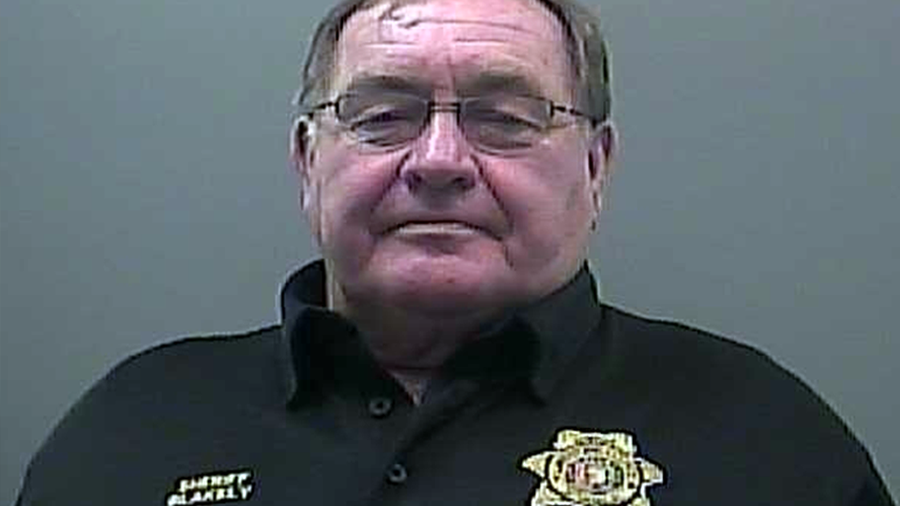
Testimony began in the corruption trial of a longtime Alabama sheriff Monday after a judge refused a defense request to throw out four charges alleging he stole thousands of dollars from his own campaign committee. Judge Pamela Baschab denied a request filed by Limestone County Sheriff Mike Blakely, and prosecutors immediately began calling witnesses who testified about the flow of money toward Blakely, who was first elected in 1983. News outlets reported Joyce Varnell, executive director of the Athens-Limestone Association of Realtors, testified that Blakely requested that a campaign donation that originated with a state realty fund be made out directly to him rather than his campaign account, called “Friends of Mike Blakely,” after the 2014 election. Clay Helms, the elections director for the secretary of state’s office, said all campaign contributions should go to accounts separate from the candidate’s personal finances. Candidates can’t put campaign money into a personal account unless it is reimbursement for a personal loan to the campaign, he said. Indicted on 13 counts in 2019, Blakely was accused by prosecutors during opening statements Friday of using money from his campaign and public accounts to cover personal expenses, and of pressuring employees for money. The first four counts of the indictment accuse Blakely, 70, of taking money from his campaign account. Blakely was the candidate and principal of the account, the defense argued, so he already had an interest in the money and can’t be convicted of stealing from the fund. The judge sided with prosecutors, who argued Blakely’s position could result in a bank teller who stole being acquitted of theft if the worker owned any stock in the bank. The state also said Blakely waited too long to seek dismissal of the charges and denied claims that state campaign laws in effect bar the theft charges. Aside from theft, Blakely is charged with using his office for personal gain and soliciting money from an employee. Blakely, who has continued working as sheriff, pleaded not guilty to all the charges and faces automatic removal from office if convicted of a felony. Republished with the permission of the Associated Press.