
Alabama Public Health announces TikTok contest to encourage vaccinations
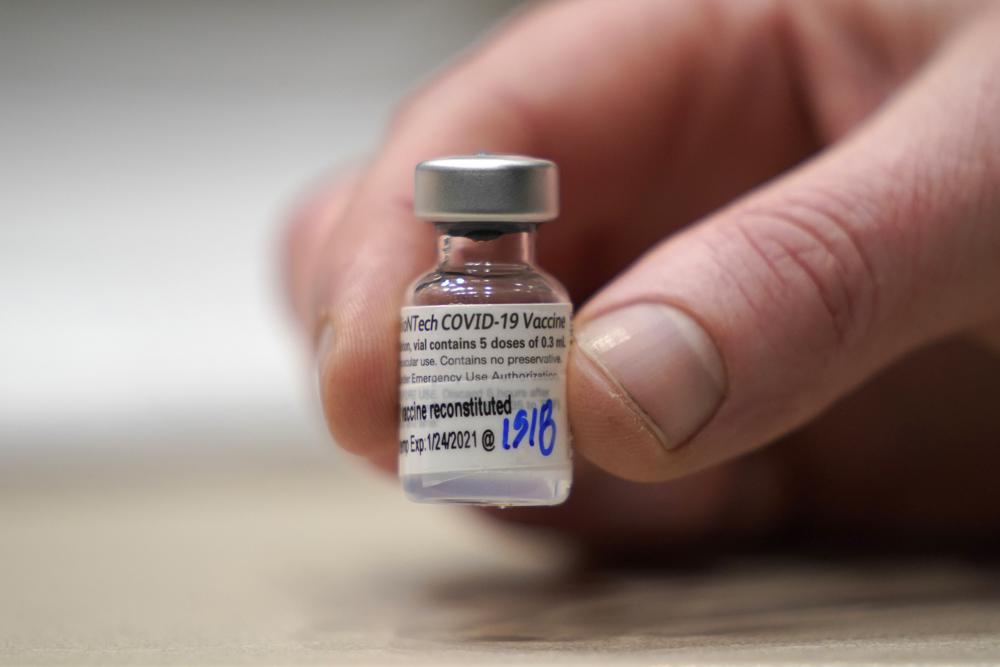
Alabama Public Health is starting to use some creative ways to encourage more Alabamians to get vaccinated. With a low vaccination rate across the state, only 30% of residents are fully vaccinated, leaders have had to find new ways to encourage vaccination. President Joe Biden recently called on younger Americans to get vaccinated and even has the star power to help. Singer Olivia Rodrigo recently met with Biden and Anthony Fauci to discuss ways to help the lagging vaccination rate in young people. According to their website, the Alabama Department of Public Health (ADPH) is sponsoring a TikTok contest for people between the ages of 13 and 29 to encourage vaccination against COVID-19 before the beginning of the school year. Contestants must submit a TikTok video showing themselves getting vaccinated and should include a message explaining, “This is why I got vaccinated.” ADHP will select four winners, and each will receive a $250 Visa gift card. The Pfizer vaccine was made available for children under 18 in May. Since then only 37 percent of residents age 12 to 17 have gotten at least one dose and only 38 percent of 18 to 29-year-olds have received at least one dose reported Politico. According to the Centers for Disease Control and Prevention, 56.2% of Americans have gotten at least one dose of the vaccine. The delta variant is much more contagious and most people who have complications from coronavirus are unvaccinated. COVID-19 cases have nearly tripled in the U.S. over two weeks.
Infrastructure bill fails first vote; Senate to try again

Senate Republicans rejected an effort Wednesday to begin debate on the big infrastructure deal that a bipartisan group of senators brokered with President Joe Biden, but pressure was mounting as supporters insisted they just needed more time before another vote, possibly next week. Senate Majority Leader Chuck Schumer, D-N.Y., had scheduled the procedural vote to nudge along negotiations that have dragged for weeks. But Republicans mounted a filibuster, saying the bipartisan group still had a few unresolved issues and needed to review the final details. They sought a delay until Monday. “We have made significant progress and are close to a final agreement,” the bipartisan group of senators, 11 Republicans and 11 Democrats said in a joint statement after the vote. The senators said they were optimistic they could finish up “in the coming days.” The nearly $1 trillion measure over five years includes about $579 billion in new spending on roads, broadband, and other public works projects — a first phase of Biden’s infrastructure agenda, to be followed by a much broader $3.5 trillion measure from Democrats next month. Biden’s top priority is at a critical juncture, posing a test of his ability to forge bipartisan cooperation in Washington and make investments the White House views as crucial to the nation’s ability to pull out of the COVID-19 crisis and spur economic growth. The president traveled to Ohio later Wednesday to promote his economic policies and was calling his infrastructure agenda a “blue-collar blueprint for building an American economy back.” He has said that Americans overwhelmingly support his plan. In a CNN town hall, Biden also talked up the benefits of the bipartisan framework, saying, “It’s a good thing, and I think we’re going to get it done.” He also made passing reference to the dangerously outdated Brent Spence Bridge across the Ohio River, saying they’ll “fix that damn bridge of yours.” At another point, Biden was asked by a union electrician if it was possible to bring Congress together to pass an infrastructure bill that would help the region replace the bridge. “The answer is, absolutely, positively, yes,” the president said. The party-line vote blocked the bill from advancing, 51-49, and fell far short of the 60 votes required under Senate rules. Schumer switched his vote to “no” at the end, a procedural step that would allow him to move to quickly reconsider. The bipartisan group has labored for days with Biden aides to strike a deal, which would be a first phase of the president’s eventual $4 trillion-plus package of domestic outlays — not just for roads and bridges, but foundations of everyday life, including child care, family tax breaks, education and an expansion of Medicare for seniors. The next steps are uncertain, but the bipartisan group insists it is close to a deal and expects to finish soon. “We’re voting no today because we’re not ready, but we’re saying we do want to take up this bill as soon as we are,” said Sen. Rob Portman, R-Ohio, a leader of the effort. “I think that’ll be Monday.” At least 11 Republicans signed on to a letter to Schumer saying they would vote yes to proceed on Monday if certain details about the package are ready. Republican Sen. Todd Young of Indiana was among the Republicans who signed the letter and said he was “cautiously optimistic” they can reach a bipartisan deal. Restless Democrats, who are facing a crowded calendar while trying to deliver on Biden’s priorities, nevertheless said they are willing to wait if a deal is within reach. “I’m willing to give it another chance next week,” said Sen. Richard Blumenthal, D-Conn. “But we need to fish or cut bait.” The senators in the bipartisan group were joined for a private lunch ahead of the vote by the two leaders of the House’s Problem Solvers Caucus, Rep. Josh Gottheimer, D-N.J., and Rep. Brian Fitzpatrick, R-Pa., a bipartisan group generally supportive of the effort. Schumer said senators are in the fourth week of negotiations after reaching an agreement on a broad framework for infrastructure spending with the White House. He said Wednesday’s vote was no different from other times when the Senate sought to get the ball rolling on debate and “not a deadline to have every final detail worked out.” But Senate Republican Leader Mitch McConnell of Kentucky encouraged Republicans to vote against it, called the vote a “stunt” that would fail, but he emphasized senators were “still negotiating in good faith across the aisle.” “Around here, we typically write the bills before we vote on them,” he said. Biden has been in touch with both Democrats and Republicans for several days, and White House press secretary Jen Psaki traveling with the president Wednesday on Air Force One said the administration was “encouraged.” While Biden proposes paying for his proposals with a tax hike on corporations and wealthy Americans who earn more than $400,000 a year, the bipartisan group has been working almost around the clock to figure out a compromise to pay for its package, having dashed ideas for boosting the federal gas tax or strengthening the IRS to go after tax scofflaws. Instead, senators in the bipartisan group are considering rolling back a Trump-era rule on pharmaceutical rebates that could bring in $170 billion, some of which could be used for infrastructure. They are also targeting unspent COVID-19 relief aid to health care providers and extending multiyear, modest reductions in a wide array of federal benefit programs, according to two people familiar with the talks who described the details on the condition of anonymity. Senators are also still haggling over public transit funds. Typically, spending from the federal Highway Trust Fund has followed the formula of 80% for highways and 20% for transit. Some Republicans are concerned that the ratio would change to 82%-18% under the bipartisan bill, said Sen. Mitt Romney, R-Utah. “Big numbers are involved,” Romney said. But Sen. Sherrod Brown, D-Ohio, said: “There’s not a lot of sentiment for public transit on their side. They
U.S. coronavirus cases nearly triple in 2 weeks
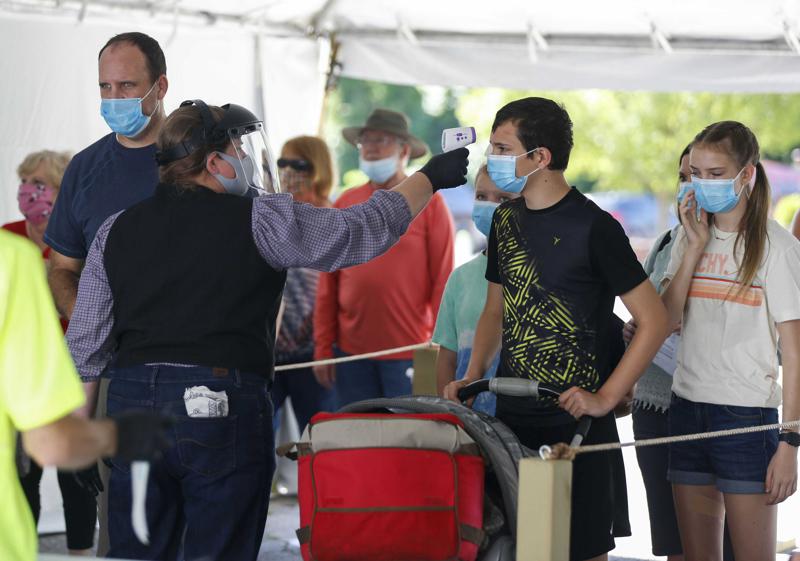
COVID-19 cases nearly tripled in the U.S. over two weeks amid an onslaught of vaccine misinformation that is straining hospitals, exhausting doctors, and pushing clergy into the fray. “Our staff, they are frustrated,” said Chad Neilsen, director of infection prevention at UF Health Jacksonville, a Florida hospital that is canceling elective surgeries and procedures after the number of mostly unvaccinated COVID-19 inpatients at its two campuses jumped to 134, up from a low of 16 in mid-May. “They are tired. They are thinking this is déjà vu all over again, and there is some anger because we know that this is a largely preventable situation, and people are not taking advantage of the vaccine.” Across the U.S., the seven-day rolling average for daily new cases rose over the past two weeks to more than 37,000 on Tuesday, up from less than 13,700 on July 6, according to data from Johns Hopkins University. Health officials blame the delta variant and slowing vaccination rates. Just 56.2% of Americans have gotten at least one dose of the vaccine, according to the Centers for Disease Control and Prevention. In Louisiana, health officials reported 5,388 new COVID-19 cases Wednesday — the third-highest daily count since the beginning of the pandemic in early 2020. Hospitalizations for the disease rose to 844 statewide, up more than 600 since mid-June. New Orleans leaders urged people to resume wearing masks indoors. Utah reported having 295 people hospitalized due to the virus, the highest number since February. The state has averaged about 622 confirmed cases per day over the last week, about triple the infection rate at its lowest point in early June. Health data shows the surge is almost entirely connected to unvaccinated people. “It is like seeing the car wreck before it happens,” said Dr. James Williams, a clinical associate professor of emergency medicine at Texas Tech, who has recently started treating more COVID-19 patients. “None of us want to go through this again.” He said the patients are younger — many in their 20s, 30s, and 40s — and overwhelmingly unvaccinated. As lead pastor of one of Missouri’s largest churches, Jeremy Johnson has heard the reasons congregants don’t want the COVID-19 vaccine. He wants them to know it’s not only OK to get vaccinated; it’s what the Bible urges. “I think there is a big influence of fear,” said Johnson, whose Springfield-based church also has a campus in Nixa and another about to open in Republic. “A fear of trusting something apart from scripture, a fear of trusting something apart from a political party they’re more comfortable following. A fear of trusting in science. We hear that: ‘I trust in God, not science.’ But the truth is science and God are not something you have to choose between.” Now many churches in southwestern Missouri, like Johnson’s Assembly of God-affiliated North Point Church, are hosting vaccination clinics. Meanwhile, about 200 church leaders have signed a statement urging Christians to get vaccinated, and on Wednesday, announced a follow-up public service campaign. Opposition to vaccination is especially strong among white evangelical Protestants, who make up more than one-third of Missouri’s residents, according to a 2019 report by the Pew Research Center. “We found that the faith community is very influential, very trusted, and to me, that is one of the answers as to how you get your vaccination rates up,” said Ken McClure, mayor of Springfield. The two hospitals in his city are teeming with patients, reaching record and near-record pandemic highs. Steve Edwards, who is the CEO of CoxHealth in Springfield, tweeted that the hospital has brought in 175 traveling nurses and has 46 more scheduled to arrive by Monday. “Grateful for the help,” wrote Edwards, who previously tweeted that anyone spreading misinformation about the vaccine should “shut up.” Jacob Burmood, a 40-year-old Kansas City, Missouri, artist, said his mother has been promoting vaccine conspiracy theories even though her husband — Burmood’s stepfather — is hospitalized on a ventilator in Springfield. “It is really, really sad, and it is really frustrating,” he said. Burmood recalled how his mother had recently fallen ill and “was trying to tell me that vaccinated people got her sick, and it wasn’t even COVID. I just shut her down. I said, ‘Mom, I can’t talk to you about conspiracy theories right now.’ … You need to go to a hospital. You are going to die.” His mother, who is in her 70s, has since recovered. In New York City, workers in city-run hospitals and health clinics will be required to get vaccinated or get tested weekly as officials battle a rise in COVID-19 cases, Mayor Bill de Blasio said Wednesday. De Blasio’s order will not apply to teachers, police officers, and other city employees, but it’s part of the city’s intense focus on vaccinations amid an increase in delta variant infections. The number of vaccine doses being given out daily in the city has dropped to less than 18,000, down from a peak of more than 100,000 in early April. About 65% of all adults are fully vaccinated, compared with about 60% of public hospital system staffers, said system leader Dr. Mitchell Katz. Meanwhile, caseloads have been rising in the city for weeks, and health officials say the variant makes up about 7 in 10 cases they sequence. “We have got to deal with it aggressively. And in the end, there is also a thing called personal responsibility,” de Blasio said, urging inoculated people to raise the issue with unvaccinated relatives and “get up in their face.” Back in Louisiana, New Orleans officials issued the new guidance on indoor masks, hoping to avoid the kind of virus-related shutdowns that devastated the city’s tourism economy in 2020. Mayor LaToya Cantrell stopped short of requiring masks. She said the advisory “puts the responsibility on individuals themselves.” The announcement came as the city’s seven-day average of new cases rose to 117, the highest level since early February. It had fallen as low as eight in mid-June. Republished
College coaches, administrators urging players to vaccinate
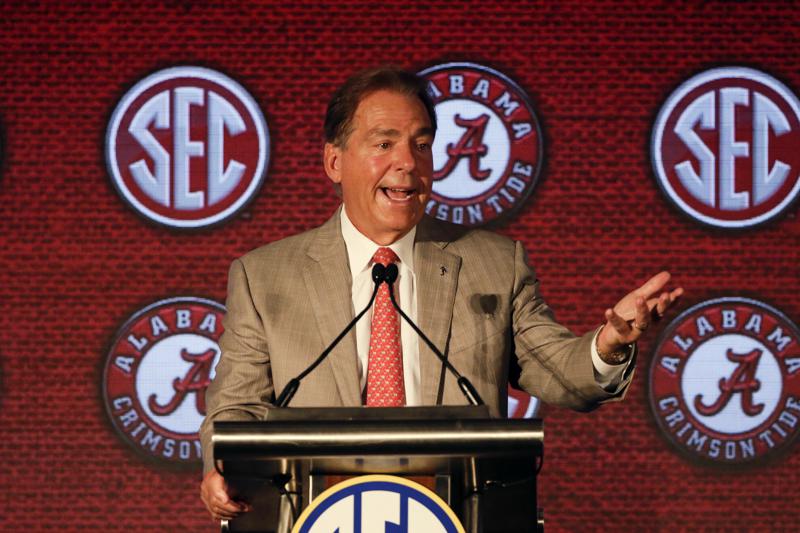
Over the summer, Crimson Tide coach Nick Saban urged his fellow Alabama residents to get vaccinated against the coronavirus in a public service announcement. The thinking was that one of the most popular people in Alabama might help since the state has one of the lowest percentages of vaccinated people in the nation. The video shows cheerleaders, the Big Al mascot, and scenes from Bryant-Denny Stadium with the unmistakable message: Protection against COVID-19 can help everyone get back to normal. It is also a point of emphasis for the defending national champion Crimson Tide and every other team hoping to minimize the risk of impacts from COVID-19 this season after last year’s disrupted effort that saw dozens of games postponed or canceled. It’s a priority and, in some cases, a challenge. Universities are struggling with whether they can legally require students to be vaccinated before returning to campuses, though Notre Dame, Michigan, UCLA, Washington, and others have taken that step. Many others, certainly across the South, have not, leaving coaches like Saban to emphasize that vaccination decisions are a personal choice but one that can impact the team. In the Southeastern Conference, Commissioner Greg Sankey said this week that six of the 14 football teams have at least 80% of their roster vaccinated — a number that ”needs to grow and grow rapidly.” The six teams include Alabama since Saban indicated “pretty close to 90%” of his players, are fully vaccinated, nearly triple the rate for the state’s overall population. Not every coach or program divulged their numbers at their respective leagues’ media days. The ones that did varied fairly widely. Oklahoma State coach Mike Gundy said his team was about 55% vaccinated as of six weeks ago. “I don’t know where we’re at now,” Gundy said last week. “But as an individual, they have to make a decision if that’s something they want to do. We all know the pros and cons of it.” The cons, besides personal health, include missing at least 10 days of practice and games in quarantine. And the chore of regular testing. Players who don’t get vaccinated likely face multiple COVID-19 tests weekly, just like last season. “I think that conflict of sticking something up your nose three times a week, all the headaches of wearing a mask, I think it wears people out,” Pitt coach Pat Narduzzi said. “I don’t want anything to do with it.” Coaches like Oklahoma’s Lincoln Riley and Saban can point to other sports to emphasize the potential impact of not getting vaccinated. Saban, who missed the game against rival Auburn last year after a positive COVID-19 test, points to the New York Yankees having six players recently sidelined by the coronavirus and North Carolina State having to drop out of the College World Series. “So every player has a personal decision to make to evaluate the risk of COVID relative to vaccine, and then they have a competitive decision to make on how it impacts their ability to play in games because with the vaccine you probably have a better chance,” Saban said. “Without it, you have a bigger chance that something could happen that may keep you from being on the field, which doesn’t enhance your personal development. Then how does it affect the team if you bring it to the team?” Riley said his team saw “a big uptick” in vaccinations after PGA Tour star Jon Rahm had to withdraw from The Memorial with a six-shot lead because of a positive COVID-19 test. “One day, a guy’s about to make a million and a half (dollars) and cruise to a six-shot victory,” Riley said. “And then all of a sudden, he’s out of there, and he’s vaccinated the next week.” He said, “a significant amount” of his team is vaccinated. “But, you know, the reality of the matter is we’re football coaches, and we’re football players,” Riley said. “And if you don’t get vaccinated, you’re going to be held to … a different standard, and you’re going to have the opportunity to lose games and not be available.” Georgia coach Kirby Smart had each of his vaccinated assistants talk to the team about their reasons for getting the shots. Smart said his team is “over 85%” vaccinated. “What it’s really about is being able to save our season, being able to keep our players safe,” he said. “We want to keep our coaches and staff safe. We want to keep our family members safe, and that comes through vaccinations.” Miami coach Manny Diaz didn’t mince words on the importance of players getting vaccinated. He said the Hurricanes, who open Sept. 4 against Alabama, will be above 85% vaccinated once some players get their second shot. “Whatever opinions we have are fine and dandy, but if you want to have a football team with as least disruption as possible, here’s a way to do it,” Diaz said. Atlantic Coast Conference Commissioner Jim Phillips said the league’s athletic directors discussed potential scenarios when a team might not be able to play a game. Sankey was clear that forfeits — not postponements, like last year — were on the table in the SEC this season: “That means your team needs to be healthy to compete, and if not, that game won’t be rescheduled.” Miami safety Bubba Bolden doesn’t like vaccines or taking medicine but made an exception this time. Bolden did say he understands why some teammates “are very against it.” “I was kind of against it,” he said. “And then I see some of my family members get it. And then, obviously, I didn’t want to miss a game due to COVID. I didn’t want to get any of my teammates sick. … So I got unselfish and decided to get it.” Republished with the permission of the Associated Press.
Katie Britt: Ready to fight for the American Dream
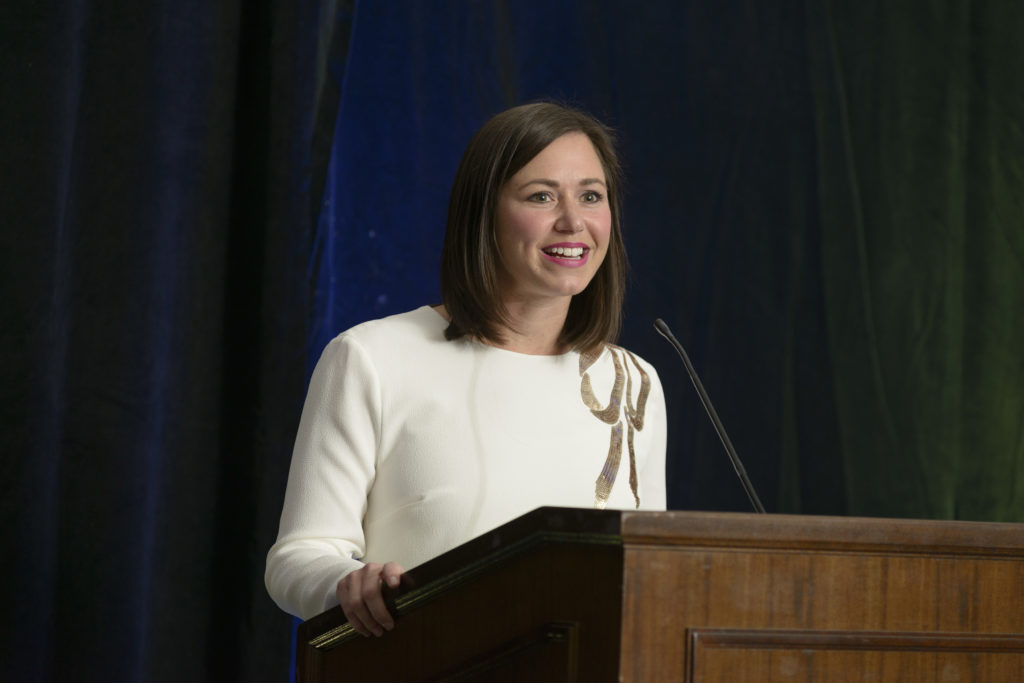
The American Dream is fueled by the aspiration that all Americans should have the opportunity to build a better life for themselves through work ethic, grit, and the content of their character. This opportunity should not be defined by gender, race, religion, political belief – or zip code. Unfortunately, that Dream is being shackled for many Alabamians right now. The past 16 months have further highlighted the damaging digital divide that is holding families back in communities all across our great state. While this divide has been underscored during the pandemic, we must remember that this is not a new or temporary problem. And, while the gap is most pronounced in much of rural Alabama, the issue affects many urban and suburban communities, as well. Alabama ranks 47th in broadband connectivity, according to U.S. Census Bureau data. The simple reality is that expanding affordable high-speed broadband internet access to all Alabamians is absolutely critical. Today, only 44% of Alabamians have access to what’s categorized as “affordable” broadband – and not all of that is truly high-speed. Additionally, more than 1 in 5 Alabamians lack broadband of any speed. This challenge is no different than the expansion of farm-to-market roads or rural electricity last century. The consequences are serious and widespread across education, health care, agriculture, small business, industry, and overall quality of life. Like in areas throughout my native Wiregrass, moms in communities across our state have to drive their children to the local McDonald’s just so they can do their homework. In rural areas already facing a severe shortage of hospitals and primary care options, telemedicine alternatives are limited by the lack of internet access. Modern farmers using high-tech equipment and practicing precision agriculture need broadband to stay competitive and operational. Small businesses on Main Street need the connectivity to process credit and debit card transactions – and much more. Industry recruitment and expansion, and the jobs that come with it, do not happen in areas where internet is not available. And, of course, much of modern life happens on the web. The state legislature and the Ivey Administration have made significant strides in recent years to implement solutions to bridge Alabama’s digital divide, from the Alabama Broadband Accessibility Act to the Connect Alabama Act. Meanwhile, reports indicate that it’s going to take a long-term, intentional investment of between $4-6 billion to get to where we need to be as a state when it comes to our broadband access. The federal government must play a leading role in meeting this vital need. I will work tirelessly to grow good-paying jobs so that hardworking Alabamians can thrive in safe, strong communities – and broadband expansion is integral in this equation. Alabama’s ability to compete in the 21st-century global economy is very much at stake; If we want to have a 21st-century workforce and have 21st-century jobs, we must have 21st-century infrastructure. I firmly believe that – in addition to roads, bridges, waterways, and airports – any federal infrastructure package must fund broadband significantly, responsibly, and strategically – not the partisan wish list and Green New Deal pet projects that are being pushed by Democrats in D.C. As Alabama’s next U.S. Senator, I will fight tirelessly to ensure opportunity is not defined by zip code and that all Alabamians have their shot at the American Dream. That is at the heart of our Alabama First movement. Working together, we will turn this dream into reality. Katie Britt is a Republican candidate to serve as the next U.S. Senator for Alabama. An Enterprise native, Katie resides in Montgomery with her husband, Wesley, and their two children, Bennett and Ridgeway.
