
Biden Administration names Nivory Gordon as state USDA director
The Biden Administration announced that Nivory Gordon Jr. has been chosen as the U.S. Department of Agriculture’s State Director for Alabama. He is the first Black person to hold that position. According to an Al.com report, Gordon has served for more than 34 years at the USDA in Rural Development in Alabama. The Alabama A&M University graduate started his career as a Co-Op student and has held several positions at USDA Rural Development, including Assistant County Supervisor, Construction Analyst, Rural Development Specialist, Area Specialist, and Area Director. During his time, Gordon has overseen several projects, including a new City Hall in Camden and a water delivery system. According to the White House announcement, the USDA’s Farm Service Agency implements agricultural policy, administers credit and loan programs, and manages conservation, commodity, disaster, and farm marketing programs in each U.S. State. Its mission is to “equitably serve all farmers, ranchers, and agricultural partners through the delivery of effective, efficient agricultural programs for all Americans.” State Executive Directors ensure the needs of local constituents are met and that USDA resources are distributed equitably and fairly. State Directors lead offices that offer grants, loans, and loan guarantees to help create jobs and support economic development and essential services. Gordon is a native of Wilcox County, Alabama, and currently resides there and operates a family farm in Furman, Alabama.
Kenneth Paschal announces run for full term in State House

State Rep. Kenneth Paschal announced on Tuesday that he is seeking to serve a full term in the Alabama House of Representatives for House District 73, Yellowhammer News reported. Paschal is currently serving the remainder of Matt Fridy’s term. Fridy was elected to the Alabama Court of Civil Appeals in 2020. He became the first black Republican elected to the legislature since Reconstruction. Paschal stated, “I want to again thank the voters of Shelby County for the trust they placed in me during the three special elections. I’ve only represented District 73 for the past three months, but I’ve met so many great people, and it has only reinforced my commitment to public service.” “Today, I’m officially announcing that I will be running for a full term in 2022. As I’ve said all along, I’m running for God and country. That hasn’t changed,” he continued. “We need strong conservatives in Montgomery who will stand up for what we believe.” Paschal, a U.S. Army Veteran, has served on the Constitution, Campaigns, and Elections Committee and the Military and Veterans’ Affairs Committee. Alabama Republican Party chairman John Wahl recently appointed him to serve as the state GOP minority outreach coordinator. House District 73 includes portions of Alabaster, Calera, Chelsea, Helena, Montevallo, Pelham, and unincorporated Brantleyville. The primary election is set to take place on May 24, 2022.
Justin Bogie: State government takes more revenue from citizens than ever before
In 2021, Alabama’s state government took more money from taxpayers than ever before. The big question is, what will state government leadership do with it? It should be used to provide tax relief to citizens and businesses, not to continue to grow government. According to end of fiscal year, 2021 data from open.alabama.gov, the Education Trust Fund, and General Fund budgets took in a whopping $11.2 billion in revenue last year. That’s nearly $1.2 billion (11.6%) more than the state collected in the fiscal year 2020. Don’t forget, this is on top of nearly $4 billion that has and will continue to flow directly to state government because of a series of federal stimulus bills designed to help states recover from the COVID-19 pandemic. The state’s Legislative Services Agency recently estimated that almost $47 billion total has been given to the state from the federal government over the past two years. That includes money such as direct payments to individuals, payments to county and local governments, the Paycheck Protection Program for businesses, and expanded unemployment benefits, among others. While it is good that Alabama’s economy has seen a swift recovery from the pandemic, especially compared to states with more restrictive environments, much of that growth is coming directly out of your wallet. Individual income tax receipts rose by $631.6 million last year, an increase of 15 percent. Sales tax receipts rose by nearly 15 percent, or $372 million. The state’s recently implemented online sales tax had another big year, adding $72 million more in revenue, almost 40 percent growth. And it wasn’t just individuals bearing increased tax burdens. According to open.alabama.gov, corporate income tax receipts to the Education Trust Fund increased by 72.6 percent in 2021, more than $355 million in new revenue. While the numbers are important, don’t get lost in them. The point is that while the state is taking in record amounts of revenue, you, the citizen, as well as businesses that are the life-blood of the economy, are in turn paying more than ever before. 2021 is not an anomaly. Since the end of the Great Recession, Alabama’s economy has generally seen steady growth. Since fiscal year 2019 state government has enacted record-high budgets and seen more revenue each year. But what have lawmakers done for citizens and the business owners of Alabama? Instead of looking for ways to return their money to them, government has looked for new ways to tax and spend even more of your money. In 2019 the Legislature and Governor Kay Ivey enacted a gas tax that is projected to bring in over $300 million in new revenue this year. Lawmakers also allowed for the tax to be raised by an additional $.01 every two years without ever having to take another vote on the issue. The 2021 Regular Legislative Session was dominated by two other issues that are in no small part about bringing in more revenue. The Legislature was successful in legalizing medicinal marijuana, which could bring in tens of millions of dollars in sales tax revenue in the future. While combined gambling and lottery legislation failed again, its potential to bring hundreds of millions of dollars in annual revenue to the state means that it will likely come before lawmakers again. When asked recently about the latest revenue windfall, Senate education budget committee chairman Arthur Orr, R-Decatur, identified contributing to the education budget’s stabilization fund, teacher pay raises, bonuses for retired educators, and tax cuts for retirees and low-income families as priorities. While tax cuts should be the top priority, why not find a way to provide tax relief that will benefit almost all Alabamians, such as eliminating the sales tax on groceries? Alabama’s corporate income tax rate is higher than many neighboring states and is highly susceptible to changes in the federal tax code. Why not lower the rate and change the deduction structure so that Alabama’s business environment is more competitive with other southern states? Pay raises and bonuses are the default that lawmakers always seem to go to when there is extra money. This mentality is why state government continues to grow. When the state collects more revenue than projected, that means that it took more from your pocket than it needed. That money should be given back to you, not used to expand state government. Justin Bogie is the Senior Director of Fiscal Policy for the Alabama Policy Institute.
Prison staffing levels will be issue on DOJ lawsuit

A federal judge said prison staffing levels can remain an issue in the U.S. Department of Justice’s lawsuit against Alabama but said federal officials must provide more details behind some of their allegations. U.S. District Judge David Proctor, in a mixed ruling for the state Friday, agreed with state lawyers that the Justice Department’s allegations of unsafe and unsanitary conditions were overly broad. But the judge refused Alabama’s request to dismiss staffing issues from the litigation. The U.S. Department of Justice last year sued Alabama, saying state prisons violate the ban on cruel and unusual punishment because of high levels of inmate-on-inmate violence, excessive use of force by correctional staff, and unsafe and unsanitary conditions. The Friday ruling came after lawyers for Alabama sought to dismiss the claims related to “unsafe and unsanitary conditions and correctional staffing.” Alabama had sought to dismiss the staffing issue because the state faces a separate court order in another lawsuit to increase the number of guards working in state prisons. U.S. District Judge Myron Thompson, in an ongoing lawsuit over inmate mental health care, ordered Alabama to increase prison staffing. “These correctional staffing concerns duplicate issues that the Braggs Court (mental health case) already addressed and will soon fully and finally address in its final remedial order,” lawyers for the state wrote in a court filing. Proctor wrote the mental health case does not have a “preclusive effect.” He said the Justice Department can continue to allege that understaffing is a “contributing factor” to the problems in state prisons. However, the judge ruled the Justice Department’s earlier filing was an overly broad “shotgun pleading” and asked federal officials to provide additional details within 45 days. He directed the Justice Department to separate allegations by facility, such as asserting which facilities “fail to provide safe and sanitary conditions,” such as having defective locks or inadequate camera surveillance. He said the Justice Department must file the amended complaint within 45 days. The state is embarking on a massive prison construction project. Alabama Gov. Kay Ivey and lawmakers recently approved a plan to build two new 4,000-bed prisons and a new women’s prison and renovate other facilities. Six current facilities would close. The $1.3 billion plan will use $400 million of state funds from the federal COVID-19 relief bill called the American Rescue Plan. The Justice Department noted in an earlier report that dilapidated facilities were a contributing factor to the unconstitutional conditions but wrote “new facilities alone will not resolve” the matter because of problems in culture, management deficiencies, corruption, violence, and other problems. Republished with the permission of the Associated Press.
Rudy Giuliani associates face trial in campaign finance scheme

Lev Parnas once pitched himself in TV interviews and through an unorthodox publicity campaign by his lawyer as someone who could expose corruption in the Trump Administration over its dealings in Ukraine. Less than two years later and with less fanfare, the 49-year-old is going on trial in a federal case that makes him out to be more of an ordinary grifter than a whistleblower who would bring down former President Donald Trump and Rudy Giuliani. Jury selection is scheduled to begin Tuesday in a trial in which Parnas, a Soviet-born Florida businessman, and a co-defendant, Ukraine-born investor Andrey Kukushkin, are accused of making illegal campaign contributions to U.S. politicians in order to further their business interests. Parnas and another Soviet-born Florida businessman who has already pleaded guilty in the case, Igor Fruman, initially caught the attention of journalists and investigators after making big donations through a corporate entity to Republican political committees, including a $325,000 donation in 2018 to America First Action, a super PAC supporting Trump. The pair then became middlemen in Giuliani’s effort to discredit then-candidate Joe Biden. They connected Giuliani with Ukrainian officials as the former New York City mayor tried to get that country to open an investigation into the future president’s son, Hunter. Ukrainian tycoons and officials, meanwhile, sought Giuliani’s help connecting with the Trump administration. Federal prosecutors in New York City, however, have made it clear that anyone looking for the trial to produce new, damaging information about Trump or Giuliani will be disappointed. They told U.S. District Judge Paul Oetken last week that while jurors will likely hear about how Parnas and Fruman tried to tout their influence as international fixers by sharing photos of themselves with Trump and Giuliani, the Republican ex-president and his former personal lawyer “will come up very peripherally” at the trial. Prosecutors have also quietly dropped one of the most intriguing allegations in the original indictment: That Parnas and Fruman donated money to American politicians as part of an effort by Ukrainian figures to oust the U.S. ambassador to Ukraine, Marie L. Yovanovitch, who later became a central figure in impeachment proceedings against Trump. When the charges were announced in 2019, then-U.S. Attorney Geoffrey S. Berman highlighted the Yovanovitch allegations, saying the defendants “sought political influence not only to advance their own financial interests but to advance the political interests of at least one foreign official – a Ukrainian government official who sought the dismissal of the U.S. ambassador to Ukraine.” Prosecutors later wrote to the judge that the allegation was dropped from a revised indictment in an effort to “streamline” the case but offered no further explanation. Giuliani has said he didn’t know about any illegal campaign contributions and is not charged in the case, although his work in Ukraine remains the subject of an ongoing criminal investigation. Federal agents searched Giuliani’s New York City home and office last April, carting away computers and phones as part of an inquiry into whether some of the work he did required him to register as a foreign agent. Giuliani has said his only client was Trump. With the Ukraine allegations gone, the trial is expected to focus on charges that Parnas exceeded limits on personal campaign contributions by disguising the origin of the money. U.S. Rep. Pete Sessions, a Texas Republican, Florida Gov. Ron DeSantis, and political committees aimed at supporting Republicans running for Congress were among those that got donations. Part of the case alleges that Parnas and Kukushkin were straw donors for Andrey Muraviev, a wealthy Russian investor in the burgeoning legal marijuana market in the United States. The indictment alleges that Muraviev put up $1 million for donations to be made to politicians in several states, including Nevada, where the group was hoping to enter the legal marijuana business. Prosecutors haven’t alleged that the politicians who got the money were aware it came from prohibited sources. Muraviev hasn’t been charged. The defense hopes to portray Parnas as an investor who was trying to develop legitimate marijuana and other business ventures, including an energy company, Global Energy Producers, that would be involved in exporting natural gas to Europe. He and Fruman were in part seeking connections “that could best further their nascent energy business interests,” defense attorney Joseph Bondy wrote in a court filing. He said the $1 million from Muraviev went to Fruman — not to Parnas — and was a personal loan, made in the wake of a waning Nevada cannabis venture. Kukushkin’s attorney, Gerald Lefcourt, argued in a recent court filing that his client, a San Francisco-based entrepreneur with longstanding ties to legal marijuana businesses in California, was just trying to start another such legitimate venture and was “duped” by Parnas and Fruman. He accused them of simply stealing Muraviev’s $1 million “to pay their debts, fund their own separate business, promote their own personal interests, support their lifestyle and sustain themselves until they could find another victim,” Lefcourt wrote. “Even the politicians who fell over themselves to be associated with Messrs. Parnas and Fruman and provided them with unfettered access were duped.” Another defendant in the case, David Correia, pleaded guilty to charges of making false statements to the Federal Election Commission and wire fraud conspiracy. The conspiracy count was related to an allegation that he defrauded investors in an insurance company that had paid Giuliani a $500,000 consulting fee. Unlike Fruman, who remained out of the spotlight and recently pleaded guilty to soliciting illegal campaign contributions, Parnas sought a starring role in Trump’s first impeachment by providing his personal records to congressional investigators. With Parnas under indictment in 2020, Bondy began tweeting photos of his client with Giuliani and Republican lawmakers with the hashtag #LetLevSpeak. The attorney also provided congressional investigators with a recording of Parnas speaking with Trump about Yovanovitch, the U.S. ambassador. In a portion of the tape, first obtained by ABC News, a voice that appears to be Parnas can be heard saying, “She’s basically walking around telling everybody: ‘Wait, he’s gonna get impeached. Just wait.’” A
Merck asks U.S. FDA to authorize promising anti-COVID pill

Drugmaker Merck asked U.S. regulators Monday to authorize its pill for treating COVID-19 in what would add an entirely new and easy-to-use weapon to the world’s arsenal against the pandemic. If cleared by the Food and Drug Administration — a decision that could come in a matter of weeks — it would be the first pill shown to treat the illness. All other FDA-backed treatments against COVID-19 require an IV or injection. An antiviral pill that people could take at home to reduce their symptoms and speed recovery could prove groundbreaking, easing the crushing caseload on U.S. hospitals and helping to curb outbreaks in poorer countries with weak health care systems. It would also bolster the two-pronged approach to the pandemic: treatment, by way of medication, and prevention, primarily through vaccinations. The FDA will scrutinize company data on the safety and effectiveness of the drug, molnupiravir, before rendering a decision. Merck and its partner Ridgeback Biotherapeutic said they specifically asked the agency to grant emergency use for adults with mild-to-moderate COVID-19 who are at risk for severe disease or hospitalization. That is roughly the way COVID-19 infusion drugs are used. “The value here is that it’s a pill so you don’t have to deal with the infusion centers and all the factors around that,” said Dr. Nicholas Kartsonis, a senior vice president with Merck’s infectious disease unit. “I think it’s a very powerful tool to add to the toolbox.” The company reported earlier this month that the pill cut hospitalizations and deaths by half among patients with early symptoms of COVID-19. The results were so strong that independent medical experts monitoring the trial recommended stopping it early. Side effects were similar between patients who got the drug and those in a testing group who received a dummy pill. But Merck has not publicly detailed the types of problems reported, which will be a key part of the FDA’s review. Top U.S. health officials continue to push vaccinations as the best way to protect against COVID-19. “It’s much, much better to prevent yourself from getting infected than to have to treat an infection,” Dr. Anthony Fauci said while discussing Merck’s drug last week. Still, some 68 million eligible Americans remain unvaccinated, underscoring the need for effective drugs to control future waves of infection. The prospect of a COVID-19 pill comes amid other encouraging signs: New cases per day in the U.S. have dropped below 100,000 on average for the first time in over two months, and deaths are running at about 1,700 a day, down from more than 2,000 three weeks ago. Also, the average number of vaccinations dispensed per day has climbed past 1 million, an increase of more than 50% over the past two weeks, driven by the introduction of booster shots and workplace vaccine requirements. Still, health authorities are bracing for another possible surge as cold weather drives more people indoors. Since the beginning of the pandemic, health experts have stressed the need for a convenient pill. The goal is for something similar to Tamiflu, the 20-year-old flu medication that shortens the illness by a day or two and blunts the severity of symptoms like fever, cough, and stuffy nose. Three FDA-authorized antibody drugs have proved highly effective at reducing COVID-19 deaths, but they are expensive, hard to produce, and require specialty equipment and health professionals to deliver. Assuming FDA authorization, the U.S. government has agreed to buy enough of the pills to treat 1.7 million people, at a price of roughly $700 for each course of treatment. That’s less than half the price of the antibody drugs purchased by the U.S. government — over $2,000 per infusion — but still more expensive than many antiviral pills for other conditions. Merck’s Kartsonis said in an interview that the $700 figure does not represent the final price for the medication. “We set that price before we had any data, so that’s just one contract,” Kartsonis said. “Obviously we’re going to be responsible about this and make this drug as accessible to as many people around the world as we can.” Kenilworth, New Jersey-based Merck has said it is in purchase talks with governments around the world and will use a sliding price scale based on each country’s economic means. Also, the company has signed licensing deals with several Indian generic drugmakers to produce low-cost versions of the drug for lower-income countries. Several other companies, including Pfizer and Roche, are studying similar drugs and are expected to report results in the coming weeks and months. AstraZeneca is also seeking FDA authorization for a long-acting antibody drug intended to provide months of protection for patients who have immune-system disorders and do not adequately respond to vaccination. Some experts predict various COVID-19 therapies eventually will be prescribed in combination to better protect against the worst effects of the virus. Republished with the permission of the Associated Press.
Hydropower decline adds strain to power grids in drought
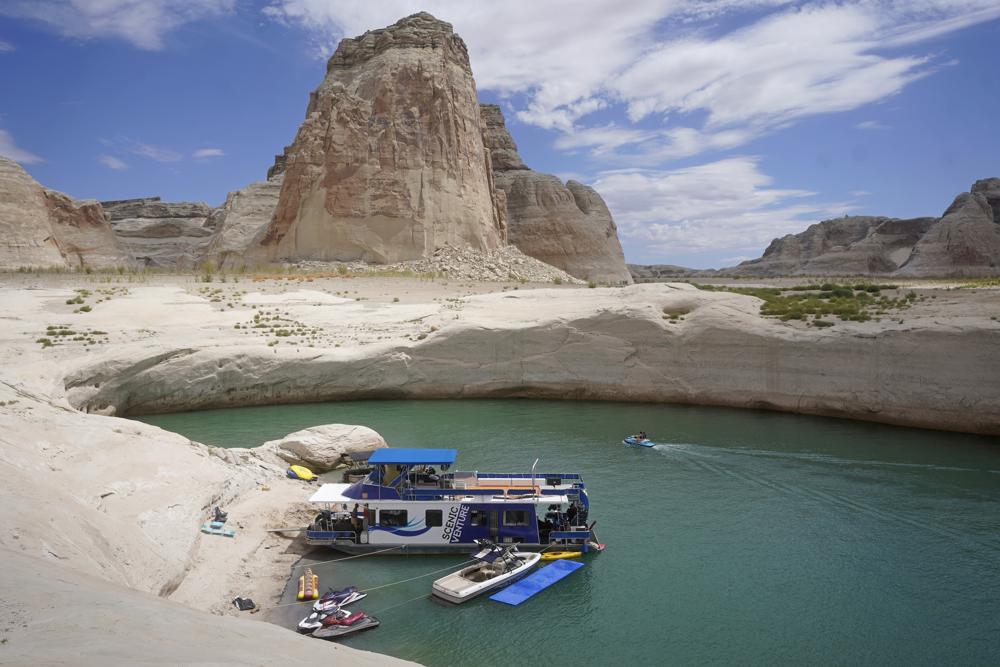
After water levels at a California dam fell to historic lows this summer, the main hydropower plant it feeds was shut down. At the Hoover Dam in Nevada — one of the country’s biggest hydropower generators — production is down by 25%. If the extreme drought persists, federal officials say a dam in Arizona could stop producing electricity in coming years. Severe drought across the West drained reservoirs this year, slashing hydropower production and further stressing the region’s power grids. And as extreme weather becomes more common with climate change, grid operators are adapting to swings in hydropower generation. “The challenge is finding the right resource, or a mix of resources, that can provide the same energy and power outputs as hydro,” said Lindsay Buckley, a spokesperson for the California Energy Commission. U.S. hydropower generation is expected to decline 14% this year compared with 2020, according to a recent federal forecast. The projected drops are concentrated in Western states that rely more heavily on hydropower, with California’s production expected to fall by nearly half. The reductions complicate grid operations since hydropower is a relatively flexible renewable energy source that can be easily turned up or down, experts say, such as in the evenings when the sun goes down, and solar energy generation drops. “Hydro is a big part of the plan for making the whole system work together,” said Severin Borenstein, a renewable energy expert at the University of California, Berkeley and board member of the California Independent System Operator which manages the state’s electric grid. Borenstein noted that hydropower is important as the state works to build out its electricity storage options, including by installing batteries that can dispatch energy when it is needed. Ben Kujala of the Northwest Power and Conservation Council, which handles power planning for the Columbia River basin, also noted that grid operators have adapted how they deploy hydropower in recent years to ensure that it complements solar and wind energy. Power grids linking Western regions also offer some relief. While California can face multi-year stretches of dry weather, the Pacific Northwest usually gets enough precipitation in the winter to recover and produce hydropower to export. But this year, the Northwest was also hit by extreme heat and less precipitation, according to Crystal Raymond, a climate change researcher at the University of Washington. While energy planners account for drought years, Raymond said climate change over the long term may further reduce the amounts of melting snow in mountains that fill reservoirs in the spring. In August, California officials shut down the Edward Hyatt hydropower plant for the first time in its 60-year history after water levels at Lake Oroville sank to historic lows. The plant can produce enough power for up to 750,000 homes but typically operates at lower levels. At Lake Powell on the Arizona-Utah border, federal officials recently said there is a 34% chance that the Glen Canyon Dam won’t be able to produce power at some point in 2023, up from a 3% chance for next year if extreme drought persists. Declines in hydropower production in California this summer coincided with heatwaves, forcing the state to buy extra power. To prevent outages in late September, state officials said they were deploying temporary emergency generators. “The drought did compound the difficulty of meeting demand,” said Jordan Kern, an energy and water systems expert at North Carolina State University. In some Northwestern states, hydropower production has reverted closer to normal levels after dipping just below their 10-year ranges earlier this year. California’s hydropower levels remained at the bottom of the state’s 10-year range through June. Federal forecasts says much of the West is likely to continue to see drought conditions through the end of the year. Declines in hydropower production mean production bumps for other energy sources. Natural gas power is expected to rise 7% in California and 6% in the Northwest this year over last, according to federal forecasts. Coal generation is forecast to rise 12% in the Northwest. The California Air Resources Board says the state has been able to continue reducing the electricity sector’s greenhouse gas emissions despite swings in hydropower generation in recent years. Republished with the permission of the Associated Press.
