
Kay Ivey cuts ribbon at new FirstNet Infrastructure at Redstone Arsenal
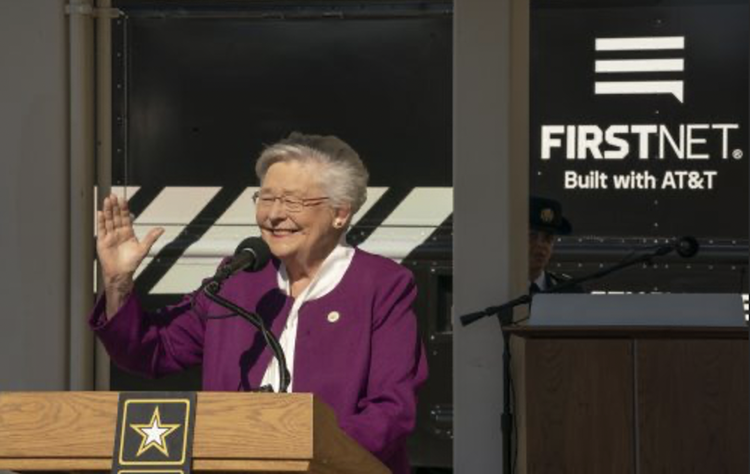
Emergency responders at Redstone Arsenal are getting a communications boost, Gov. Kay Ivey said. In a news release, the governor said first responders and security personnel at the military site near Huntsville will see improved wireless communications via FirstNet network expansions being completed by AT&T. Ivey was joined at an event announcing the expansions by Deputy Commanding General U.S. Army Materiel Command Lieutenant General Donnie Walker, Vice-Chair of the First Responder Network Authority Board of Directors Chief Richard Carrizzo, and Wayne Hutchens, president of AT&T Alabama. “The collaboration of the U.S. Army and FirstNet will provide U.S. Army public safety personnel – firefighters, law enforcement and security – at 72 Army installations including Redstone Arsenal with increased capabilities to communicate as effectively and efficiently as possible, to best protect themselves and those they serve,” Ivey said in the release. “We are honored to have the U.S. Army Materiel Command headquartered in Alabama and proud to celebrate the FirstNet build at Redstone Arsenal.” According to Military.com, Redstone Arsenal originally was designed to make conventional ammunition and toxic chemicals during World War II and later was designated as the home of Army missiles in 1948. FirstNet, according to the release, provides cell sites that enhance voice and mobile broadband coverage for the Army base. Ivey entered the state into the FirstNet network in 2017 to allow the state’s first responders and emergency personnel more capability to communicate effectively and efficiently. “Without communication, agencies cannot achieve the interoperability needed to bring vital resources to bear, especially when lives are at stake and time is of the essence,” Lt. Gen. Donnie Walker said in the release. “FirstNet gives us this capability. Security and safety of everyone who lives and works on this installation is job one. FirstNet is absolutely essential in that priority and pivotal in our efforts to improve the resilience of our installations. It is, in a word, a game changer.” By Brent Addleman | The Center Square Republished with the permission of The Center Square.
Court rejects Donald Trump’s efforts to keep records from January 6 panel
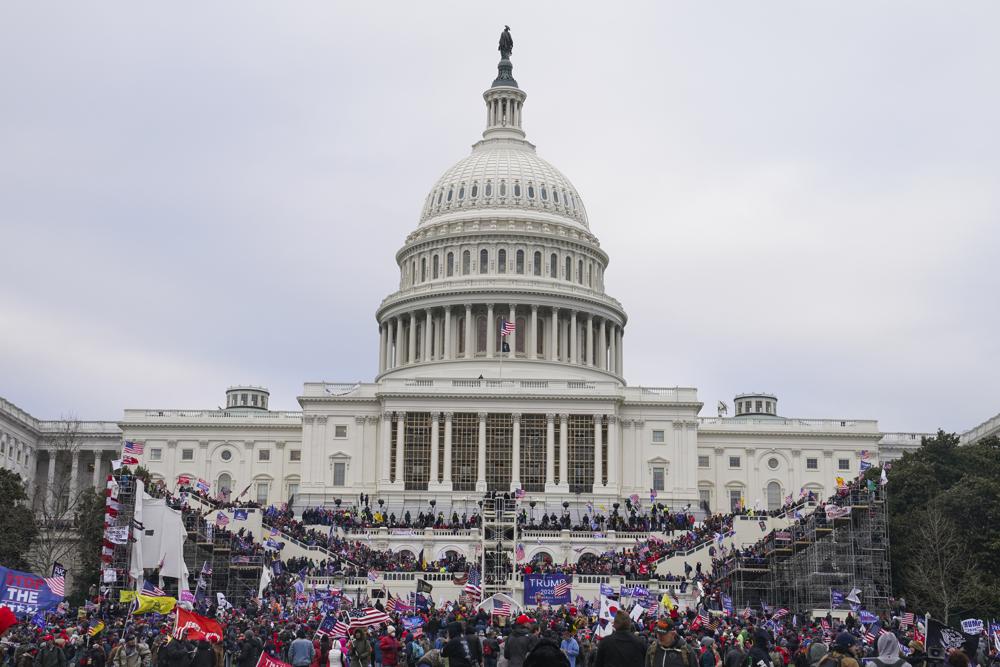
A federal appeals court ruled Thursday against an effort by former President Donald Trump to shield documents from the House committee investigating the January 6 insurrection at the Capitol. In a 68-page ruling, the three-judge panel tossed aside Trump’s various arguments for blocking through executive privilege records that the committee regards as vital to its investigation into the run-up to the deadly riot that was aimed at overturning the results of the 2020 presidential election. Judge Patricia Millett, writing for the court, said Congress had a “uniquely vital interest” in studying the events of January 6, and that President Joe Biden had made a “carefully reasoned” determination that the documents were in the public interest and that executive privilege should therefore not be invoked. Trump also failed to show any harm that would occur from the release of the sought-after records, Millett wrote. “On the record before us, former President Trump has provided no basis for this court to override President Biden’s judgment and the agreement and accommodations worked out between the Political Branches over these documents,” the opinion states. It adds, “Both Branches agree that there is a unique legislative need for these documents and that they are directly relevant to the Committee’s inquiry into an attack on the Legislative Branch and its constitutional role in the peaceful transfer of power. The appeals court ruled that the injunction that has prevented the National Archives from turning over the documents will expire in two weeks, or when the Supreme Court rules on an expected appeal from Trump, whichever is later. Lawyers for Trump can also ask the entire appeals court to review the case. Seven of the 11 appellate judges on the court were appointed by Democratic presidents, four by Republican presidents. The panel’s leaders, Reps. Bennie Thompson, D-Miss., and Liz Cheney, R.-Wyo., hailed the ruling, saying it “respects the Select Committee’s interest in obtaining White House records and the President’s judgment in allowing those records to be produced. Our work moves ahead swiftly. We will get to the truth.” But Trump’s spokeswoman said the matter was far from settled. “Regardless of today’s decision by the appeals court, this case was always destined for the Supreme Court,” Liz Harrington said. “President Trump’s duty to defend the Constitution and the Office of the Presidency continues, and he will keep fighting for every American and every future Administration.” In its ruling, the court said the executive privilege being asserted by Trump is not a personal privilege but instead one that he “stewards” for the “benefit of the Republic.” “The interests the privilege protects are those of the Presidency itself, not former President Trump individually. And the President has determined that immediate disclosure will promote, not injure, the national interest, and that delay here is itself injurious,” the opinion states. Biden had the committee defer its requests for some of the early documents that might have posed privilege claims, and officials expect more documents in subsequent tranches will be subject to the same outcome. The court praised Biden’s “calibrated judgment” in working with Congress and the Archives to weigh privilege concerns, saying it “bears no resemblance to the ‘broad and limitless waiver’ of executive privilege former President Trump decries.” White House spokesman Mike Gwin said, “As President Biden determined, the constitutional protections of executive privilege should not be used to shield information that reflects a clear and apparent effort to subvert the Constitution itself.” Trump sued the House January 6 committee and the National Archives to stop the White House from allowing the release of documents related to the insurrection. Biden had waived Trump’s executive privilege claims as the current officeholder. At issue, the court said, is not that Trump “has no say in the matter” but rather his failure to show that withholding the documents should supersede Biden’s “considered and weighty judgment” that Congress is entitled to the records. The National Archives has said that the records Trump wants to block include presidential diaries, visitor logs, speech drafts, handwritten notes “concerning the events of January 6” from the files of former chief of staff Mark Meadows, and “a draft Executive Order on the topic of election integrity.” Arguing for the committee, U.S. House lawyer Douglas Letter argued that the determination of a current president should outweigh predecessors in almost all circumstances and noted that both Biden and Congress were in agreement that the January 6 records should be turned over. All three of the appeals court judges who heard the arguments were nominated by Democrats. Millett and Judge Robert Wilkins were nominated by former President Barack Obama. Judge Ketanji Brown Jackson is a Biden appointee seen as a contender for a Supreme Court seat should one open during the current administration. Republican presidents nominated six of the nine Supreme Court justices, including three chosen by Trump. Republished with the permission of the Associated Press.
Academy of Honor recognizes accomplished Alabamians
The nation’s defense secretary and a pioneering social justice activist are among new members inducted Thursday into the Alabama Academy of Honor. The Academy honors 100 living Alabamians for their accomplishments and service to the state and nation. The ceremony included honorees for 2020 because that year’s ceremony was postponed because of the COVID-19 pandemic. The 2020 honorees are: Equal Justice Initiative founder Bryan Stevenson, former U.S. Congressman Jo Bonner, retired Maj. Gen. J. Gary Cooper, a decorated Vietnam veteran and the first Black officer in the Marine Corps to lead an infantry company into combat. The 2021 honorees are U.S. Secretary of Defense Lloyd Austin, Huntsville attorney Julian Butler, retired judge John England Jr., former Lockheed Martin CEO Marillyn Hewson, Grammy-award-winning recording artist Lionel Richie, and UAB’s Senior Vice President of Medicine Dr. Selwyn Vickers. Republished with the permission of the Associated Press.
