
U.S. regulators lift in-person restrictions on abortion pill
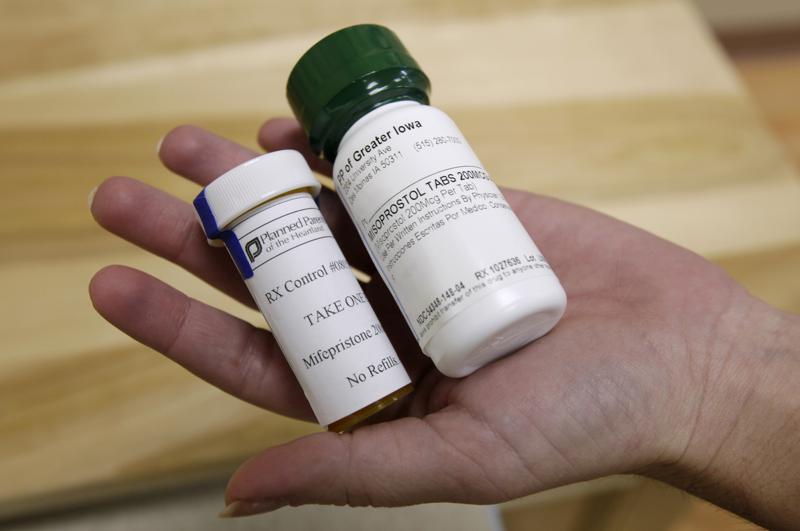
The Food and Drug Administration on Thursday permanently removed a major obstacle for women seeking abortion pills, eliminating a long-standing requirement that they pick up the medication in person. Millions of American women will now be able to get a prescription via an online consultation and receive the pills through the mail. FDA officials said a scientific review supported broadening access, including no longer limiting dispensing to a small number of specialty clinics and doctor’s offices. But prescribers will still need to undergo certification and training. Additionally, the agency said dispensing pharmacies will have to be certified. The decision is the latest shift in the polarized legal battle over medication abortion, which has only intensified amid the disruptions of the COVID-19 pandemic. It is certain to spur legal challenges and more restrictions in Republican-led states. Earlier this year, the FDA stopped enforcing the in-person requirement because of the pandemic. Under Thursday’s decision, the agency permanently dropped the 20-year-old rule, which has long been opposed by medical societies, including the American Medical Association, which say the restriction offers no clear benefit to patients. The FDA’s latest scientific review stems from a 2017 lawsuit led by the American Civil Liberties Union, which argued that the agency’s restrictions block or delay medical care, especially for people in low-income and rural communities. The ACLU hailed the elimination of the strictest requirements but said regulators should have gone further and allowed prescribing by any physician and broader pharmacy dispensing. Abortion opponents said the FDA decision would result in more drug-related side effects and complications for women. Physicians who prescribe the drug mifepristone, will have to certify that they can provide emergency care to deal with potential adverse effects, including excessive bleeding, FDA officials said Thursday. The change still means many more doctors will be able to write prescriptions, and American women will be able to fill their orders at far more pharmacies, including via online and mail-order services. The effect will vary by state. More than a dozen Republican-led states have passed measures that limit access to the pills, including outlawing delivery by mail. Increased use of mail-order abortion pills could pose a dilemma for the anti-abortion movement, given that its leaders generally say they don’t favor criminalizing the actions of women seeking abortions and because mail deliveries can be an elusive target for prosecutors. The latest policy shift comes as advocates on both sides of the abortion debate wait to see whether the conservative Supreme Court will weaken or even overturn the Roe v. Wade decision that guarantees the right to abortion nationwide. Roe’s demise would likely prompt at least 20 Republican-governed states to impose sweeping bans, while perhaps 15 states governed by Democrats would reaffirm support for abortion access. More complicated would be politically divided states, where fights over abortion laws could be ferocious. Medication abortion has been available in the United States since 2000 when the FDA first approved mifepristone to terminate pregnancies up to 10 weeks. Taken with a hormone blocker called misoprostol, it constitutes the so-called abortion pill. About 40% of all abortions in the U.S. are now done through medication — rather than surgery — and that option has become more pivotal during the COVID-19 pandemic. At the time of approval, the FDA imposed limits on how the drug could be distributed, including barring it from regular pharmacies and requiring that all doctors providing the drug undergo special certification. Women were also required to sign a form indicating they understood the medication’s risks. The FDA said Thursday there have been 26 deaths associated with the drug since 2000, though not all of those can be directly attributed to the medication due to underlying health conditions and other factors. Common drug side effects include cramping, bleeding, nausea, headache, and diarrhea. In some cases excess bleeding needs to be stopped with a surgical procedure. Near the beginning of the outbreak, the FDA waived in-person requirements for virtually all medications but left them in place for mifepristone. That triggered a lawsuit from the American College of Obstetricians and Gynecologists, which successfully overturned the restriction in federal court. The Trump administration then appealed the ruling to the Supreme Court, which reinstated the requirement in January. The point became moot — at least temporarily — in April when the FDA said it would not enforce the dispensing limits during the current public health emergency. “The FDA’s decision will come as a tremendous relief for countless abortion and miscarriage patients,” said Georgeanne Usova, a lawyer with the ACLU. “However, it is disappointing that the FDA fell short of repealing all of its medically unnecessary restrictions on mifepristone, and these remaining obstacles should also be lifted.” Jeanne Mancini, president of the March for Life Education and Defense Fund, said the decision “will lead to more lives lost to abortion, and will increase the number of mothers who suffer physical and psychological harm from chemical abortions.” Republished with the permission of the Associated Press.
Paul DeMarco: Alabama Association of School Boards makes right decision to leave national organization

A recent announcement in Alabama is a good sign for education in Alabama. The Alabama Association of School Boards did not renew their membership with their federal partner recently after the national group termed some parents “domestic terrorists” and asked President Joe Biden to get involved in local school boards. The furor across the Nation brought criticism and even hearings before Congress. Alabama is one of seventeen state associations that have left the national association and one of the reasons is that parents in our state have become vocal and more active to protect their kids. The state group also had long-standing concerns with the National School Board Association and their commitment to local control of school board decisions, which is particularly important to parents in Alabama. Families in Alabama are looking to take back school systems from liberals in academia who are trying to push their agendas on vulnerable students. We have seen parents becoming more active in their local systems recently and expect that to continue into 2022. Leaving the national organization will give the Alabama association credibility when they advocate for school board request before state representatives and senators. Alabama’s School Board Association rightly left the national board and reflects the will of parents and local school boards in the state. While K-12 schools in our state are seeing more involvement by parents to ensure schools are focused on education, what the state now needs is parents and state leaders to look at Alabama universities and colleges. A number of our state institutions of higher learning and their faculty appear to be more focused on progressive issues and not academics. Alabama leaders are seeing this and hearing from their constituents. Thus, you will see lawmakers in the upcoming legislative session address some of these issues going on in higher education. The real question is this a blip on the radar or is this part of a bigger trend in the state to reign in those who want to put ideology above educating state students. Time will tell. Paul DeMarco is a former member of the Alabama House of Representatives.
First case of Omicron variant found in Alabama

The Alabama Department of Public Health (ADPH) has reported its first case of the omicron COVID variant in Alabama. The patient is an Alabama resident who lives in the West Central Public Health District. According to the ADHP report, the individual developed mild symptoms in early December and sought COVID-19 testing. The individual had no travel history outside of Alabama. The first U.S. case was identified on December 1 in California. Research indicates omicron could be more transmissible than the current delta variant that remains the dominant strain in the U.S. State Health Officer Dr. Scott Harris stated, “We know that this virus is highly infectious and moves quickly throughout the world. Alabamians know what to do to keep each other safe now — get the vaccine, get tested, wear a mask indoors, and get a booster. Together, we can fight this virus and help keep our residents safe.” Omicron is classified by the CDC as a Variant of Concern. Scientists are still working to determine how it may compare with the predominant Delta variant in terms of transmissibility and severity. Additionally, scientists are still studying how much existing vaccines and therapies protect against the Omicron variant. According to ADPH, Omicron makes up 3% of all sequenced Covid-19 cases in the U.S., up from less than 0.1% in early December. As of December 10, there was one hospitalization and no deaths among the initial 43 omicron COVID cases in the U.S. There are now more than 189 cases of the variant. “We still have more to learn about Omicron, but the most important thing we can do right now is to use the tools we have available to make it as hard as possible for this virus to spread,” he commented. “In addition to vaccination and boosters, we can slow the spread of this variant and all COVID-19 variants by using the tried-and-true prevention methods of wearing masks, staying home when sick, and getting tested when appropriate.” ADPH also recommends that people should get vaccinated, and if eligible, get a booster. ADPH also recommends: Wear well-fitting masks in indoor public settings and crowded outdoor settings. Stay at least 6 feet from other people, especially if you are at higher risk of getting very sick. Get tested if you have symptoms, have been exposed to someone with COVID-19, have traveled or have been in a setting where you may have been exposed. Stay home if you are sick. Wash hands frequently. Stay away from crowds. Improve ventilation in your home and workplace. Take extra care to avoid exposure to the virus if you have underlying risk factors or live with someone who does.
$2T bill stalled, Senate Dems seem ready to move on for now
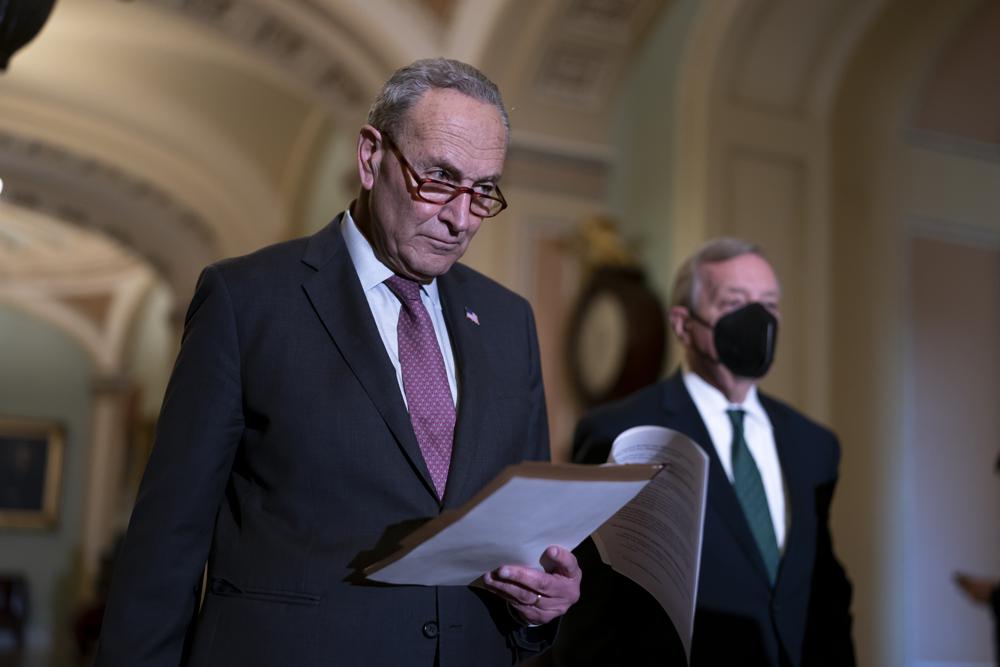
Democrats’ vast social and environment package was stuck in the Senate on Thursday as leaders’ hopes for an accord with holdout Sen. Joe Manchin and approval of their flagship domestic measure in the year’s waning days seemed all but dead. After a closed-door lunch among Senate Democrats, Sen. Ben Cardin, D-Md., told reporters that a statement by President Joe Biden was expected shortly giving an update on “his conversations with Sen. Manchin and others.” Talks on the 10-year, roughly $2 trillion bill between Biden and Manchin, who wants to cut and reshape the measure, are said to have yielded little progress. Majority Leader Chuck Schumer, D-N.Y., had set Senate passage before Christmas as his goal, but disputes with Manchin and other Democrats remain. It has become clear that the party is seeking explicit intervention from Biden in hopes he will cut a deal with Manchin, D-W.Va., or urge lawmakers to delay action until January. Biden “wants to get this done as soon as possible,” White House spokesperson Karine Jean-Pierre told reporters. She added, “But we understand it’s going to take time, and we’re going to continue to do the work.” Schumer barely mentioned the legislation as the day’s business began. Instead, he described Democrats’ efforts to break a logjam on voting rights legislation and a pile of nominations the Senate will consider “as we continue working to bring the Senate to a position where we can move forward” on the social and environment bill. Using his sway in a 50-50 Senate where Democrats need unanimity to prevail, Manchin has continued his drive to force his party to cut the bill’s cost and eliminate programs he opposes. All Republicans oppose the package, arguing the measure carrying many of Biden’s paramount domestic priorities is too expensive and would worsen inflation. “The best Christmas gift Washington could give working families would be putting this bad bill on ice,” said Senate Minority Leader Mitch McConnell, R-Ky. The rocky status of the Biden-Manchin talks was described Wednesday by a person who spoke only on condition of anonymity. The person said Manchin was pushing to eliminate the bill’s renewal of expanded benefits under the child tax credit, a keystone of Democratic efforts to reduce child poverty. Manchin told reporters Wednesday that assertions he wants to strip the child tax credit improvements were “a lot of bad rumors.” Asked if he backed eliminating one of the bill’s child tax credit improvements — monthly checks sent to millions of families — he said, “I’m not negotiating with any of you.” Adding further doubt about quick Senate action this year, Biden suggested that Democrats should instead prioritize voting rights legislation, a primary party goal that Republicans have long stymied. Democrats face an uphill fight on the voting measure, but focusing on it would let them wage a battle that energizes the party’s voters while lawmakers work behind the scenes on the social and environment bill. Asked whether Congress should quickly consider the voting legislation and delay the $2 trillion bill to next year, Biden told reporters, “If we can get the congressional voting rights done, we should do it.” He added, “There’s nothing domestically more important than voting rights.” Biden spoke Wednesday as he toured tornado damage in Dawson Springs, Kentucky. Letting the social and environment legislation slip into next year, when congressional elections will be held, would be ominous for the bill’s ultimate prospects. With Democrats having blown past previous self-imposed deadlines on the push, another delay would fuel Republican accusations that they are incompetently running a government they control. Democrats are bracing for November elections when the GOP has a real chance of winning control of the House and Senate. Word of Manchin’s stance prompted a backlash from colleagues, whom he’s frustrated for months with constant demands to cut the bill’s size and scope. The measure also has money for health care, universal prekindergarten, and climate change programs largely paid for with tax boosts on big corporations and the rich. The second-ranking Democrat, Sen. Richard Durbin of Illinois, said “the level of emotion” among Democrats over the child tax credit “is very high,” and said he was “stunned” when he heard about Manchin’s demands. Manchin has wanted the overall bill’s 10-year price tag to fall below $2 trillion. He also wants all its programs to last the full decade. The current bill would extend the enhanced child tax credit for just one year, a device to contain the bill’s cost. Renewing the improved benefits for ten years would increase its current one-year cost of around $100 billion to over $1 trillion, and doing that while cutting the overall bill’s size would wreak havoc on Democrats’ other priorities in the bill. The Treasury Department says the expanded tax credit has helped the families of 61 million children. Another impediment to Democrats is a time-consuming review by the Senate parliamentarian, Elizabeth MacDonough, about whether many of the bill’s provisions violate the chamber’s rules and should be dropped. Her written opinions on that, including on provisions letting many migrants remain temporarily in the U.S., may not be ready until the weekend or later. Manchin’s other demands have included removing a new requirement for paid family leave. Disputes among other lawmakers include how to increase federal tax deductions for state and local taxes. The House approved its version of the legislation in November. Republished with the permission of the Associated Press.
Judge clears 1955 court record of civil rights pioneer, Claudette Colvin
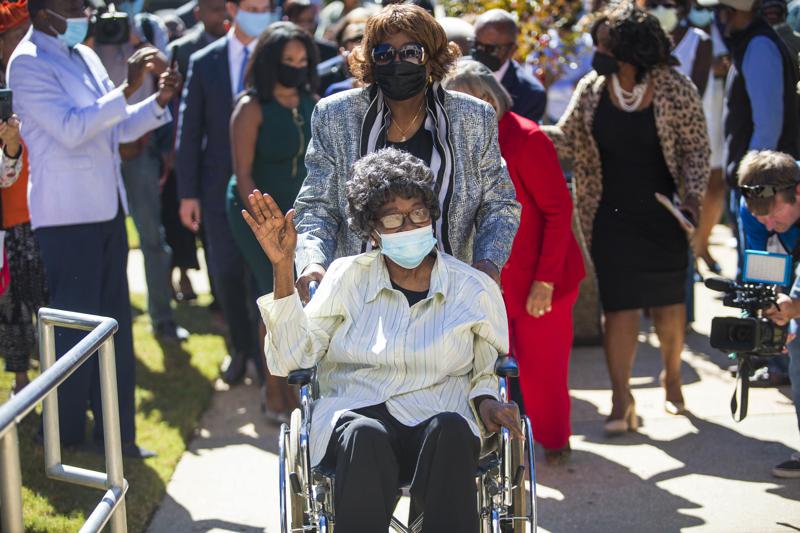
A judge has approved a request to wipe clean the court record of a Black woman who was arrested for refusing to move to the back of a segregated Alabama bus in 1955, months before Rosa Parks gained international fame for doing the same. A judge granted the request by Claudette Colvin, now 82, in a brief court order made public Thursday by a family representative. Parks, a 42-year-old seamstress and activist with the NAACP, gained worldwide notice after refusing to give up her bus seat to a white man on Dec. 1, 1955. Her treatment led to the yearlong Montgomery Bus Boycott, which propelled the Rev. Martin Luther King Jr. into the national limelight and often is considered the start of the modern civil rights movement. A 15-year-old high school student at the time, Colvin refused to shift seats on a segregated Montgomery bus even before Parks. A bus driver called police on March 2, 1955, to complain that two Black girls were sitting near two white girls in violation of segregation laws. One of the Black girls moved toward the rear when asked, a police report said, but Colvin refused and was arrested. The case was sent to juvenile court because of Colvin’s age, and records show a judge found her delinquent and placed her on probation “as a ward of the state pending good behavior.” Colvin never got official word that she had completed probation through the ensuing decades, and relatives said they assumed police would arrest her for any reason they could. At the time she asked a court in October to expunge her record, Colvin said she did not want to be considered a “juvenile delinquent” anymore. “I am an old woman now. Having my records expunged will mean something to my grandchildren and great-grandchildren. And it will mean something for other Black children,” Colvin said at the time in a sworn statement. Now that Juvenile Court Judge Calvin L. Williams has approved the request, Colvin said in a statement that she wants “us to move forward and be better.” “When I think about why I’m seeking to have my name cleared by the state, it is because I believe if that happened it would show the generation growing up now that progress is possible, and things do get better. It will inspire them to make the world better,” she said. Colvin never had any other arrests or legal scrapes, and she became a named plaintiff in the landmark lawsuit that outlawed racial segregation on Montgomery’s buses. Republished with the permission of the Associated Press.
CDC panel recommends Pfizer, Moderna COVID shots over J&J’s

Most Americans should be given the Pfizer or Moderna vaccines instead of the Johnson & Johnson shot that can cause rare but serious blood clots, U.S. health advisers recommended Thursday. The strange clotting problem has caused nine confirmed deaths after J&J vaccinations — while the Pfizer and Moderna vaccines don’t come with that risk and also appear more effective, advisers to the Centers for Disease Control and Prevention said. It’s an unusual move, and the CDC’s director, Dr. Rochelle Walensky, must decide whether to accept the panel’s advice. Until now, the U.S. has treated all three COVID-19 vaccines available to Americans as an equal choice since large studies found they all offered strong protection and early supplies were limited. J&J’s vaccine initially was welcomed as a single-dose option that could be especially important for hard-to-reach groups like homeless people who might not get the needed second dose of the Pfizer or Moderna options. But the CDC’s advisers said Thursday that it was time to recognize a lot has changed since vaccines began rolling out a year ago. More than 200 million Americans are considered fully vaccinated, including about 16 million who got the J&J shot. New data from unprecedented safety tracking of all those vaccinations persuaded the panel that while the blood clots linked to J&J’s vaccine remain very rare, they’re still occurring and not just in younger women as originally thought. In a unanimous vote, the advisers decided the safer Pfizer and Moderna vaccines are preferred. But they said the shot made by J&J’s Janssen division still should be available if someone really wants it — or has a severe allergy to the other options. “I would not recommend the Janssen vaccine to my family members,” but some patients may — and should be able to — choose that shot, said CDC adviser Dr. Beth Bell of the University of Washington. The clotting problems first came up last spring, with the J&J shot in the U.S. and with a similar vaccine made by AstraZeneca that is used in other countries. Eventually, U.S. regulators decided the benefits of J&J’s one-and-done vaccine outweighed what was considered a very rare risk — as long as recipients were warned. European regulators likewise continued to recommend AstraZeneca’s two-dose vaccine although, because early reports were mostly in younger women, some countries issued age restrictions. COVID-19 causes deadly blood clots, too. But the vaccine-linked kind is different, believed to form because of a rogue immune reaction to the J&J and AstraZeneca vaccines because of how they’re made. It forms in unusual places, such as veins that drain blood from the brain, and in patients who also develop abnormally low levels of the platelets that form clots. Symptoms of the unusual clots, dubbed “thrombosis with thrombocytopenia syndrome,” include severe headaches a week or two after the J&J vaccination — not right away — as well as abdominal pain and nausea. While it’s still very rare, the Food and Drug Administration told health care providers this week that more cases have occurred after J&J vaccinations since the spring. They occur most in women ages 30 to 49 — about once for every 100,000 doses administered, the FDA said. Overall, the government has confirmed 54 clot cases— 37 in women and 17 in men, and nine deaths that included two men, the CDC’s Dr. Isaac See said Thursday. He said two additional deaths are suspected. The CDC decides how vaccines should be used in the U.S., and its advisers called the continuing deaths troubling. In comparing the pros and cons of all the vaccines, the panelists agreed that side effects from the Pfizer and Moderna vaccines weren’t as serious — and that supplies now are plentiful. Nor is J&J still considered a one-and-done vaccine, several advisers noted. The single-dose option didn’t prove quite as protective as two doses of the Pfizer and Moderna vaccines. Plus, with extra-contagious virus mutants now spreading, booster doses now are recommended. Several countries, including Canada, already have policies that give preference to the Pfizer and Moderna vaccines. But J&J told the committee its vaccine still offers strong protection and is a critical option, especially in parts of the world without plentiful vaccine supplies or for people who don’t want a two-dose shot. While blood clots are rare, “unfortunately cases of COVID-19 are not,” J&J’s Dr. Penny Heaton said. The U.S. is fortunate in its vaccine availability, and Thursday’s action shouldn’t discourage use of J&J’s vaccine in places around the world where it’s needed, said CDC adviser Dr. Matthew Daley of Kaiser Permanente Colorado. The FDA also warned this week that another dose of the J&J vaccine shouldn’t be given to anyone who developed a clot following either a J&J or AstraZeneca shot. The committee also heard some of the first data on reported side effects of Pfizer vaccinations in younger children. Early last month, the CDC recommended a two-dose series for that age group, and more than 7 million doses have been given so far. But few problems have been reported. Of the 80 reported cases of serious side effects, about 10 involved a form of inflammation that has been seen in male teens and young adults. Republished with the permission of the Associated Press.
