
Jim Zeigler: Growing up on an Alabama Christmas tree farm

Many think that Christmas trees cannot grow in Alabama, that it takes the mountains of Tennessee and North Carolina. Well, here is my story of growing up on one of Alabama’s early Christmas tree farms – The Zeigler Christmas Tree Farm outside of Sylacauga, Alabama. My father, Bloise Zeigler, had grown up on an 80-acre farm in the Russell Chapel area near Fayetteville, Alabama. About 1951, Bloise Zeigler bought for our growing family a 20+ acre farm in the Oak Grove Community adjacent to Sylacauga. You can’t make a living and support a family of six on 20 acres, so Bloise Zeigler worked full-time at Coosa River Newsprint, later Kimberly-Clark, now Bowater, what’s left of it, near Childersburg, Alabama. As Dad worked full-time, he also worked part-time on his small farm for additional income. Sometimes a few cattle, chickens, or hogs. Always wife Bernice Zeigler’s garden, including a cornfield and strawberry patch — my Mom with a green thumb. After retiring from the newsprint plant, Bloise Zeigler had a desire to utilize the family farm more. He turned to his unofficial adviser on all things agricultural. Dr. John Woodruff is married to my older sister, Ina (to those in Sylacauga, “Ina Gayle.”) John Woodruff is an agricultural genius. Award-winning. The two minds got together and came up with it. Alabama’s soil and climate were perfect for growing Pinus Virginiana. Virginia Pines. Christmas trees. Bloise and Bernice Zeigler started the area’s first “choose-and-cut” Christmas tree farm. It took just three years for Virginia Pine seedlings to become usable Christmas trees. A nickel seedling could become what was in 1976 a $15.00 to $30.00 Christmas tree (They can cost more now). Eastern Red Cedars and Leland Cypress trees were added to the gourmet selection of Christmas trees. Plan the work and work the plan. By 1979, we were attracting families across east and central Alabama. The families would make an outing of it. Bring the children and grandchildren. Get your saw from Bloise Zeigler. Rummage through the fields until you find a tree you like. Cut it. Take it up to the Zeigler barn, where you could shake the dead needles out using a “shaker” invented by nephew Mickey Zeigler. And wrap it in a netting using a gizmo invented by Mickey Zeigler, mechanical genius. In 1996, a tree from the Zeigler Christmas Tree Farm was selected as the official Christmas Tree of Alabama. It adorned the inside of the Governor’s Mansion. That was the first time that something Zeigler-grown stayed in the Governor’s Mansion. For 30 years, families from Birmingham to Auburn, from Gadsden to Clanton, came to the Zeigler Christmas Tree Farm. It became a tradition. It was also a tradition for Bloise Zeigler to witness to the families about salvation through Jesus Christ, the true meaning of Christmas. Nowadays, all that remains of The Zeigler Christmas Farm is that witness and the pleasant remembrances of thousands of families. Do you know anybody over age 40 near the Sylacauga area? Ask them about the old Zeigler Christmas Tree Farm. And ask them about Bloise and Bernice Zeigler. You will be amazed at the Christmas stories they tell you. Old fashioned Alabama Christmas stories. Jim Zeigler has been State Auditor of Alabama since 2015.
J. Pepper Bryars: Alabama’s problem with violent suspects killing people while out on bail

Americans have recently begun waking up to the disastrous consequences of bail reform efforts that are being led by progressive district attorneys across the nation. The case of Darrel E. Brooks in Wisconsin is just the latest, if not most tragic, example. He ran over his girlfriend with a car in early November, but despite the seriousness of the charge and his long wrap sheet, Brooks was let out on a mere $1,000 bail. Two weeks later, he drove through the Christmas parade in Waukesha, seriously injuring dozens of people and killing six, including four grandmothers and an 8-year-old boy. While the enormity of the Waukesha tragedy is unusual, the process that contributed to it isn’t. Courts often let suspects charged with violent crimes out with little to no bail while their cases work through the slow gears of the criminal justice system, sometimes releasing known predators like Brooks to prey upon our communities for months, maybe even years before they face justice. But are things like this happening in Alabama? A quick search of the internet just turned up the following: Mobile: Christin Brionna Edwards was charged with four counts of attempted murder last month while being out on bail on a 2019 murder charge. The district attorney said the process is a “revolving door.” Montgomery: Jeremie Rashad Wright was charged with murder last month while he was already out on bail after being charged with another murder committed in 2018. Tuscaloosa: Deramus Devalle Harris was charged with murder last month while out on $75,000 bail from another murder charge in 2020. Birmingham: Anthony Needham shot his girlfriend in the head in 2018 and was charged with murder. He was let out of jail two days later on $100,000 bail, and several months later he shot and killed a man during a robbery. Huntsville: Charles Price Preston was charged with murder last year after having already been arrested 17 times for various other crimes, including assault, rape, and robbery. And the list goes on and on and on and on … So, yes, it is happening here in Alabama. And often. Some may recall the kidnapping and murder of 19-year-old Aniah Blanchard of Homewood in October 2019. Her alleged killer, 29-year old Ibraheem Yazeed of Montgomery, was well-known to police. He was out on bail after being charged earlier in the year with robbery, kidnapping, and attempted murder. Yazeed and three others allegedly robbed and beat two men in a Montgomery hotel, including a 77-year-old man who was left near death. Yazeed was also accused in 2012 with attempting to kill two police officers with his car, and he was arrested in 2017 for aggravated battery on another police officer. Prosecutors say Yazeed — still walking free after all of that — kidnapped Blanchard from an Auburn gas station, shot her in the head, and dumped her body in a wooded area of Macon County. Prosecutors and victim advocates say that current Alabama law prevented the courts from holding Yazeed without bail for his earlier charges because none of them were capital crimes or met others standards and that Aniah’s killing was a wake-up call. The governor signed a bill named “Aniah’s Law” earlier this year that would change that, adding murder, kidnapping, rape, assault, and other violent crimes to the list of charges that could lead to a defendant being denied bail. Voters will decide if Aniah’s Law becomes part of the state’s constitution in November 2022. Aside from Aniah’s Law, prosecutors are seeking to increase the maximum amount of bail for murder, which is currently set by the State Supreme Court along the following lines: Capital felony: $50,000-no bail allowed Murder: $15,000-$150,000 Drug manufacturing and trafficking: $5,000-$1.5 million. So, as you can see, someone charged with dealing drugs can be held for 15-times the amount of bail than someone charged with killing another human being. A rules committee of the Alabama State Supreme Court recently approved a motion from Montgomery County District Attorney Daryl Bailey to increase bail for murder to $1.5 million, after having already increased the maximum from $75,000 to $150,000 in 2014. We mustn’t simply give the state a blank check, however. It’s a safe bet that the government will abuse whatever additional power the people grant, without vigilant oversight. As Benjamin Franklin warned, “Those who would give up essential liberty, to purchase a little temporary safety, deserve neither liberty nor safety.” We deserve both. Aniah and all of the other victims deserved both. And with the enactment of Aniah’s Law, the increase of bail for murder, and the strength and will to ensure the state doesn’t abuse its authority, we just might be able to have it. (J. Pepper Bryars is a conservative opinion writer from Mobile who lives in Hunstville. Readers can find him at https://jpepper.substack.com).
Chris Talgo: Joy to the world, Build Back Better’s demise has come
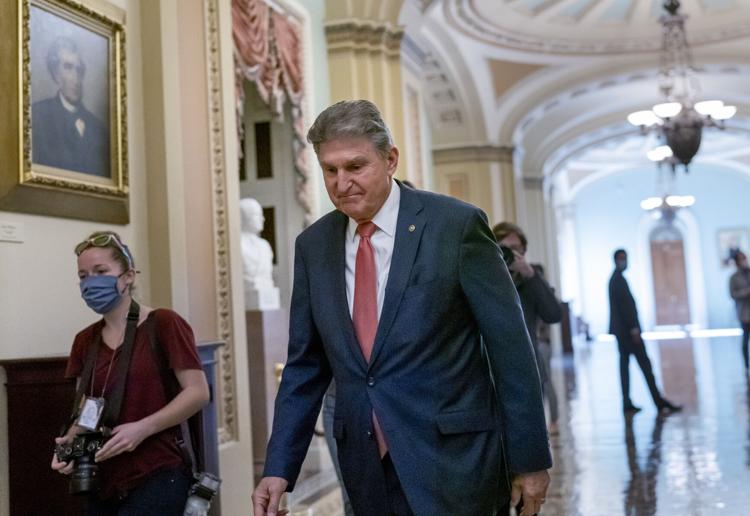
On December 19, just days before millions of Americans gather for Christmas festivities, Sen. Joe Manchin (D-WV) delivered a much-needed early present to the nation when he let it be known that he would not vote in favor of President Joe Biden’s Build Back Better bill. While on “Fox News Sunday,” Manchin succinctly stated, “I cannot vote to continue with this piece of legislation.” When pressed if there is any room for future negotiations, Manchin dug in his heels, saying, “I’ve done everything humanly possible … This is a no. I have tried everything I know to do.” Although the possibility exists that portions of Biden’s Build Back Better (BBB) bill could be resurrected in 2022, based on Manchin’s comments, it seems it is a fait accompli that the current version of BBB is dead and buried, forever. For most Americans, this is welcome news. Several recent polls show BBB is unpopular with the public. For instance, according to a December 9 poll conducted by NPR/Marist, only 41 percent of Americans support BBB. Unsurprisingly, only 42 percent of those polled said BBB “will help people like themselves,” while just 35 percent said BBB “will help lower inflation.” Apparently, and thankfully, the American people have a better understanding of basic economics than most members of the U.S. Congress, particularly those in the Democratic Party. Without a doubt, BBB would have supercharged the rampant inflation that is already wreaking havoc throughout the U.S. economy. As of this writing, the inflation rate, as measured by the consumer price index, has reached a 39-year high of 6.8 percent, with no sign of abating anytime soon. Even worse, the producer price index, which measures final demand for goods and services and functions as a gauge of future inflationary pressure, just hit an all-time high of 9.8 percent. In other words, the rapidly rising rate of inflation is unlikely to trend downward anytime soon. For all Americans, inflation has become a persistent problem. Per a report from the Penn Wharton Budget Model, “inflation in 2021 will require the average U.S. household to spend around $3,500 more in 2021 to achieve the same level of consumption of goods and services as in recent previous years (2019 or 2020). Moreover, we estimate that lower-income households spend more of their budget on goods and services that have been more impacted by inflation. Lower-income households will have to spend about 7 percent more while higher-income households will have to spend about 6 percent more.” However, despite the alarming signs that inflation is picking up steam and causing significant pain and suffering for American families, the Democratic Party could not care less. Immediately after Manchin put a stake through the heart of BBB, prominent Democrats and much of the mainstream media were in a tizzy. Rep. Ilhan Omar (D-MN) went into full-on attack mode, saying, “We all knew that Senator Manchin couldn’t be trusted, the excuses that he just made, I think, are complete bulls***.” Rep. Ayanna Pressley (D-MA) chimed in with this quip, “The Senate must return to session immediately and bring this historic and transformational bill to a vote so Senator Manchin – and every Republican who has opposed it from the very beginning—can demonstrate, on the record, the contempt they have for their constituents and for everyone who calls America home.” What Omar, Pressley, and too many other radical leftists fail to understand is that Manchin is representing his constituents, the people of West Virginia, who overwhelmingly oppose BBB. According to a recent poll, 53 percent of West Virginians strongly oppose BBB, and 59 percent of independent voters in West Virginia strongly oppose BBB. What’s more, 64 of West Virginians strongly agree that BBB will make inflation worse while 66 percent strongly agree that “Congress should slow down and reconsider the Build Back Better Act in light of inflation concerns.” Fortunately, for now, at least, Joe Manchin has dealt a devastating blow to President Biden’s Build Back Better bill. It remains to be seen whether or not Manchin caves and votes for BBB-lite. Yet, regardless of what happens in the future, we should celebrate the early Christmas miracle that is the demise of Build Back Better. Chris Talgo (ctalgo@heartland.org) is senior editor at The Heartland Institute.
Will Sellers: The failure of the pilgrims’ first Christmas

The Pilgrims’ first Christmas in the new world was remarkable, but not for the reasons you’d think. On December 25, 1621, exactly 400 years ago, William Bradford, the governor of the Plymouth Colony, prohibited the celebration of Christmas. But he wasn’t a Scrooge or a Grinch; he was simply following his religious conviction. He believed that Sunday was the only day for celebration and time off from work. While the Pilgrims’ first Thanksgiving was like the one we celebrate today, their first Christmas bore no resemblance to our current observance of this secular and religious holiday. On that first Christmas Day in Plymouth, some colonists objected to working, claiming that their conscience required them to observe the day referred to as Nativity. Thinking that the appeal to conscience was an attempt to use the day for devotion and personal reflection, those conscientious objectors were excused from participating in the work detail. However, when Governor Bradford saw they were using the day for merriment and games, he confiscated their “toys” and explained that it was not permitted for some colonists to work while others engaged in frivolous activities. The celebration of Christmas was off to an inauspicious start in the New World. Succumbing to this early American leadership, some 20 years later, the English Parliament would also ban the celebration of Christmas. This belief that Christmas Day was not to be celebrated was the synthesis of two trends. First, the Puritans could find no support for the celebrations of Holy Days in Scripture. They found nothing in the New Testament authorizing any day for religious observance other than Sunday. The Catholic tradition, which was affirmed by the Anglican church, permitted the celebration of over 90 holidays or feast days commemorating any number of Saints’ Days or other historical religious events. Combine this with the strict observance of Sunday, and in a work year, more than a third of the calendar was devoted to something other than work. Thus, the second trend eliminating Christmas celebration was the need for manual labor to sustain the colony. So religious beliefs and economic necessity combined to limit time off from work to only one day a week. Taking the Old Testament admonition strictly, the Pilgrims believed in a six-day work week. Only Sunday was reserved as the day for worship and rest from work. As the colony was first constituted, everything was held in communal form without specific rights to private property. Work was a necessity, so everyone had to farm the community farmland and participate in the survival of the colony. The excitement to be in a new land and the freedom to practice their religious faith sustained the enthusiasm for participation in this communal structure. But soon, production died down as colonists came to realize there was no incentive to work harder to produce more as the benefit for initiative did not exist. Having everything in common had drastic results. Food became scarce, and rationing was required. Notwithstanding sermons to the contrary, a sense of agrarian slothfulness pervaded the colony since there was no difference in the distribution of the crops between the hard workers and the slackers. As this situation began a downward spiral, more work was required, but yields remained dismal. Christmas then was not de-listed for strictly religious reasons but reflected the imposed work ethic that of necessity limited time off and required the colonists to labor. Celebration was a luxury that was inconsistent with subsistence farming for a community that truly lived from hand to mouth. In as much as the Puritans based their decision to limit holidays on their Biblical interpretation, they failed to fully appreciate one of the bedrock doctrines of their faith: total depravity — the corruption of human nature by original sin and its practical application to the economics of their community. Had they fully understood the ramification of this doctrine, they would never have established an economy based on a communal structure that limited private property. Believing that human nature is flawed and selfish, the colony leadership should have known that any system based on voluntary goodness was bound to fail. William Bradford would learn this the hard way as the production from crops lessened, and the colony came close to starvation. It was only then that the political economy was changed to allow private property. This critical change created a system in which the selfishness of original sin was harnessed so people could experience the direct correlation between hard work and abundance. Instead of having a common storehouse, people were allowed to produce what they could, consume what they needed and then barter and trade with others. In fact, the initial stages of development of the Plymouth Colony are in and of itself a lesson in microeconomics. Once this new system was adopted, the colony began to thrive and prosper while the government of the colony became less focused on forcing people to work, measuring the fruits of the common labor, and restricting activities. Rather, the colonial government became a manager of individual rights, encouraging industry and promoting a free trading system. Not that they did any of this perfectly, but whether they knew it or not, they had moved from a command economy to a free market system. Regardless of the label, the practical effect was that a system of private ownership worked and allowed the colony to sustain itself. The acknowledgment and celebration of Christmas would take a bit longer to be recognized. Puritan, if not evangelical, theology would develop to accept the various celebrations listed in the Old Testament as a basis to celebrate holidays other than Sunday. Unlike Thanksgiving, we cannot find inspiration for the Pilgrims’ first Christmas, but we can profit by their example and appreciate that the celebration of holidays, like Christmas, is a luxury inspired by freedom and produced courtesy of free-market capitalism. Will Sellers is a 1985 graduate of Hillsdale College and an Associate Justice on the Supreme Court of Alabama. He is best
Alabama to get limited supply of new COVID-19 treatment

With COVID-19 hospitalizations and cases on the rise in Alabama, the state will have a limited number of doses of a new drug that can be used to treat the illness, health officials said Thursday. The state’s initial supply of 780 courses of the Pfizer oral drug Paxlovid, which the Food and Drug Administration approved for emergency use as the omicron variant spreads rapidly, will be distributed through pharmacies, the Department of Public Health said in a statement. Dr. Scott Harris, the state health officer, said the drug will be available to people who aren’t hospitalized with the illness but isn’t a substitute for vaccinations, “which remain the best way for most people to protect themselves against severe illness and death due to COVID-19.” “I continue to urge all Alabamians to be vaccinated and receive a booster dose when eligible,” Harris said. Paxlovid, which will be available by prescription by the first week of January, was authorized for the treatment of mild-to-moderate COVID-19 symptoms in adults and children. Other states will also receive limited supplies before production and distribution increases, officials said. Less than half of the state’s population is fully vaccinated, and relatively few people are following health recommendations to wear masks in public places and maintain a safe distance from others. In Hoover earlier this week, unmasked holiday shoppers far outnumbered people with covered faces at the state’s largest shopping mall, the Riverchase Galleria. More than 16,380 people have died of COVID-19 in the state, giving Alabama the nation’s second-highest death rate from the illness caused by the coronavirus, according to researchers from Johns Hopkins University. Over the last two weeks, the rolling average number of daily new cases has increased by 348, or 64.1%, but the state ranks last in the nation for new cases per capita, according to Johns Hopkins. Hospitalizations for COVID-19 have jumped more than 70% statewide in a month to more than 430 on Wednesday, but that is still far below levels from early fall when officials said the state’s health care system was in danger of being overwhelmed by the illness. Republished with the permission of the Associated Press.
William Haupt III: Christmas Eve 1776 changed the world forever
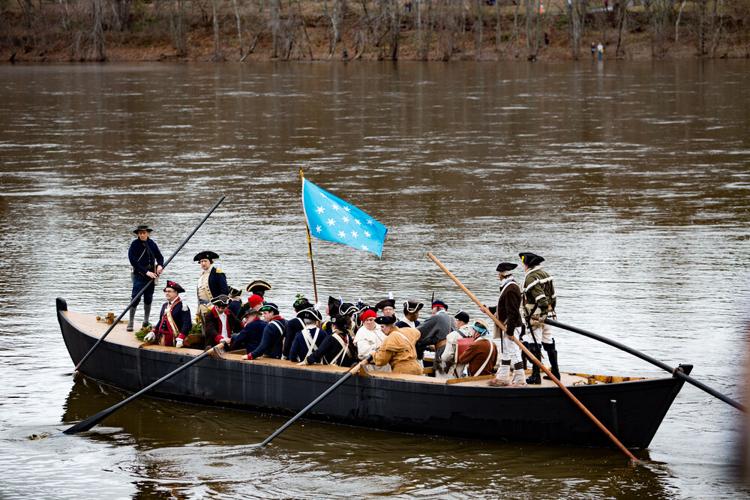
“We must remember, mankind allows that all those who conduct themselves as worthy members of the community, are equally entitled to the protections of civil government.” – George Washington The greatest Christmas gift the world received was the night of our savior’s birth. And its greatest gift to world freedom came on Christmas Eve, 1776, on the banks of the Delaware River – America. The birthing of America was not easy. Only a third of the colonists supported a Revolution. It pitted neighbors against neighbors. These patriots were not only rebelling against the British. They were fighting other colonists who were loyal to British King George, parliament, and the English church. Often overlooked are the “fence-sitters” who were content living free from monarchical dominance. They enjoyed colonial religious and economic freedoms and tolerated the British as a necessary evil. The patriots needed to earn the support from these neutralists in order to win the Revolution. The patriots humiliated the Loyalists in public and subjected them to violence, intimidation, ridicule, and harassment. They vandalized their property and burned down their businesses. Even families were divided. Ben Franklin’s son William, governor of New Jersey, was loyal to the king. “He that would live in peace and at ease must not speak all he knows or judge all he sees.” – Ben Franklin Colonists who did not join the patriots united with the British as obedient subjects. Others thought they could profit from selling arms and war supplies to the British without true allegiance to anyone. Patriots had been building support for the Revolution since the end of the French and Indian War in 1763. In severe debt, the British enacted the 1765 abusive Stamp and the 1767 Townshend Acts. Following the patriots 1773 Tea Party in Boston Harbor, they passed The Coercive Acts in 1774. And that was the final insult the patriots needed to win the war of propaganda against the British! Gifted orators like Patrick Henry and Enlightenment thinkers John Locke and Thomas Paine kept the momentum for revolution growing with colonial statesmen, politicians, and with uneasy patriots. “If there must be trouble, let it be in my day, so that my children may have peace.” – Thomas Paine No man in the colonies was more persuasive with the commoners and the peasants in promoting the Revolutionary War than Enlightenment thinker and gifted English writer Thomas Paine. He had led reform movements in Europe and Paine inspired farmers, workers, and commoners to revolt. Paine went from towns, hamlets, and villages distributing copies of his 90-page booklet, “Common Sense.” Paine preached the rewards and the substantiality of independence to patriots who never dreamed it was an option. “The mind once enlightened cannot again become dark.” – Thomas Paine On April 18, 1775, the British marched from Boston to Concord, Massachusetts, to seize stockpiled colonial weapons. Paul Revere rode through the streets of Boston rallying the patriots: “The British are coming, the British are coming!” The next day, when the patriots and the Redcoats clashed at Lexington and Concord, it was “the shot heard round the world.” This signified the beginning of the Revolution and, most importantly, it marked the birthing of America as the guardian of global liberty. When the minutemen fired the first shots of the Revolution, the Redcoats were well prepared. They had superior weapons, ammo, uniforms, and abundant food and medical supplies. They were ready to defend their turf. They were prepared to fight a marathon battle to stop the colonial insurrection. On the other hand, the colonies had a volunteer army with no central government and little money. They sent troops to the Continental Army but kept many behind to protect themselves. Many of the colonies were more concerned for self-survival, while the British were determined to win the war. Late in 1776, the Revolutionary War looked like it was a lost cause. The patriots lacked uniforms, food, ammunition, and weapons and some were even shoeless. There was tremendous suffering from cold and starvation. A series of defeats had depleted morale, and many had already deserted. In the bitter cold on Christmas Eve 1776, dogged by pelting sleet and snow, George Washington knelt in prayer at McKonkey’s Ferry asking the Lord for the right words to inspire his troops to keep going. They needed to cross the Delaware River to Philadelphia for a surprise attack on the British. Historian James Cheetham wrote, “As Washington mounted his horse that night he pulled a draft of Thomas Paine’s ‘American Crisis’ from his saddlebag. As he began reading it, he knew that it was the answer to his prayers. When he returned to camp he ordered it read to his troops immediately.” “The summer soldier and the sunshine patriot will, in this crisis, shrink from the service of their country; but he that stands by it now, deserves the love and thanks of man and woman. Tyranny, like hell, is not easily conquered; yet we have this consolation with us, that the harder the conflict, the more glorious the triumph. What we obtain too cheap, we esteem too lightly: it is dearness only that gives a thing its value. Heaven knows how to put a proper price upon its goods; and it would be strange indeed if so celestial an article as freedom should not be highly rated.” – Thomas Paine The next morning, Christmas Day 1776, Washington’s army crossed the icy Delaware and won two crucial battles. He defeated the British at Trenton and a week later he executed a daring night raid to capture Princeton on January 3. This gave control of New Jersey to America and turned around the morale and unified the colonial army. Washington’s insightful reading of “The American Crisis” on Christmas Eve 1776 turned a humbling defeat into a glorious victory for the American patriots! Shortly after the war, John Adams remarked: “Without the pen of Paine, the sword of Washington would have been wielded in vain.” Washington’s men basked in its victory
